Can you use AI to translate your writing? Yes, and it's far better than it was a few years ago. But accuracy still varies a lot depending on the language, the topic and the kind of text. And in school, translating your work with AI can count as misconduct if you don't follow your course rules.
The research shows both the progress and the limits. A 2024 evaluation by machine translation researchers found that large language models now lead the field, but titled its report "The LLM Era Is Here but MT Is Not Solved Yet". A 2021 medical study found one free online translator kept the meaning of discharge instructions 94% of the time in Spanish, but only 55% in Armenian.
This guide covers what AI translation is good at, where it fails, what universities say and how to check a translation before you rely on it.
Can you use AI to translate your writing?
Yes, AI tools can translate writing quickly and often well, especially between widely used languages like English and Spanish. Accuracy drops for less widely used languages, specialist topics and informal speech, and fluent output can still contain serious errors. For school work, check your course rules first, since many universities require you to acknowledge machine translation. For anything important, have a fluent speaker check the result.
How good is AI translation now?
Much better than it was, and still not perfect. Every year, researchers run the Conference on Machine Translation (WMT) evaluation, in which systems translate the same test texts and professional annotators judge the results.
The 2024 report, led by Tom Kocmi with 21 co-authors, compared participating systems with 8 large language models and 4 online translation services across 11 language pairs. A large language model was the best system overall, and most participants built their systems on language models.
The title of the report was a warning, though: "The LLM Era Is Here but MT Is Not Solved Yet". The authors note that translations can contain serious flaws even when they seem fluent. They found speech transcripts the hardest domain, and noted that current evaluation methods struggle to tell machine output from human translation, which makes quality harder to measure.
Why does accuracy vary by language?
Because systems learn from examples, and some languages have far more translated text available than others. You can see the effect in a 2021 study by Breena Taira and colleagues, published in the Journal of General Internal Medicine.
The researchers put 20 common emergency department discharge instructions through a free online translation tool into 7 languages. Bilingual volunteers then judged whether each translation kept the intended meaning.
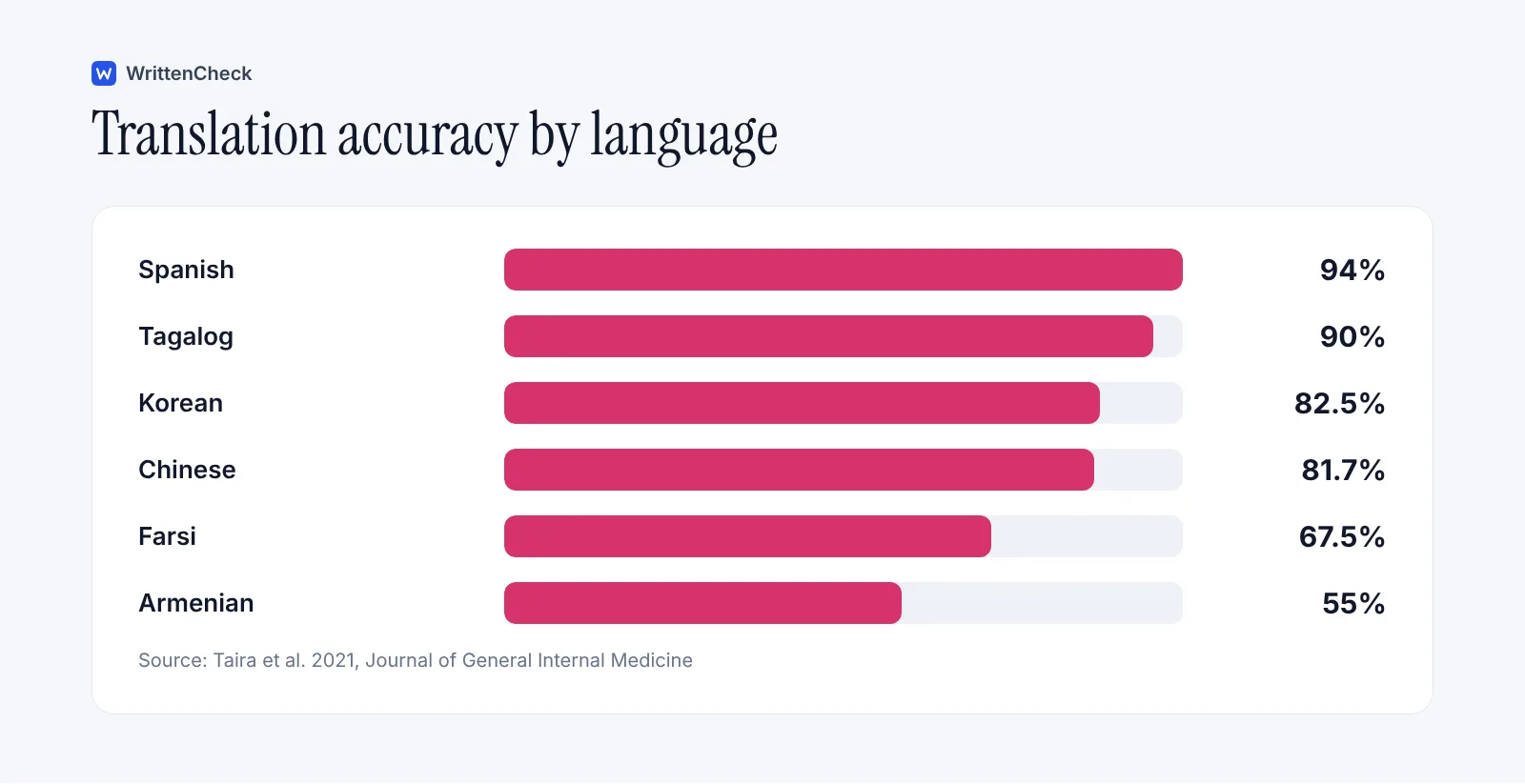
Language | Translations that kept the meaning |
|---|---|
Spanish | 94% |
Tagalog | 90% |
Korean | 82.5% |
Chinese | 81.7% |
Vietnamese | 77.5% |
Farsi | 67.5% |
Armenian | 55% |
All 7 languages | 82.5% |
The tool has improved since then, and newer AI models may do better. But the pattern, high accuracy in widely used languages and lower accuracy in others, is a good reason to be careful with any language that has less data behind it.
What kinds of text are hardest to translate?
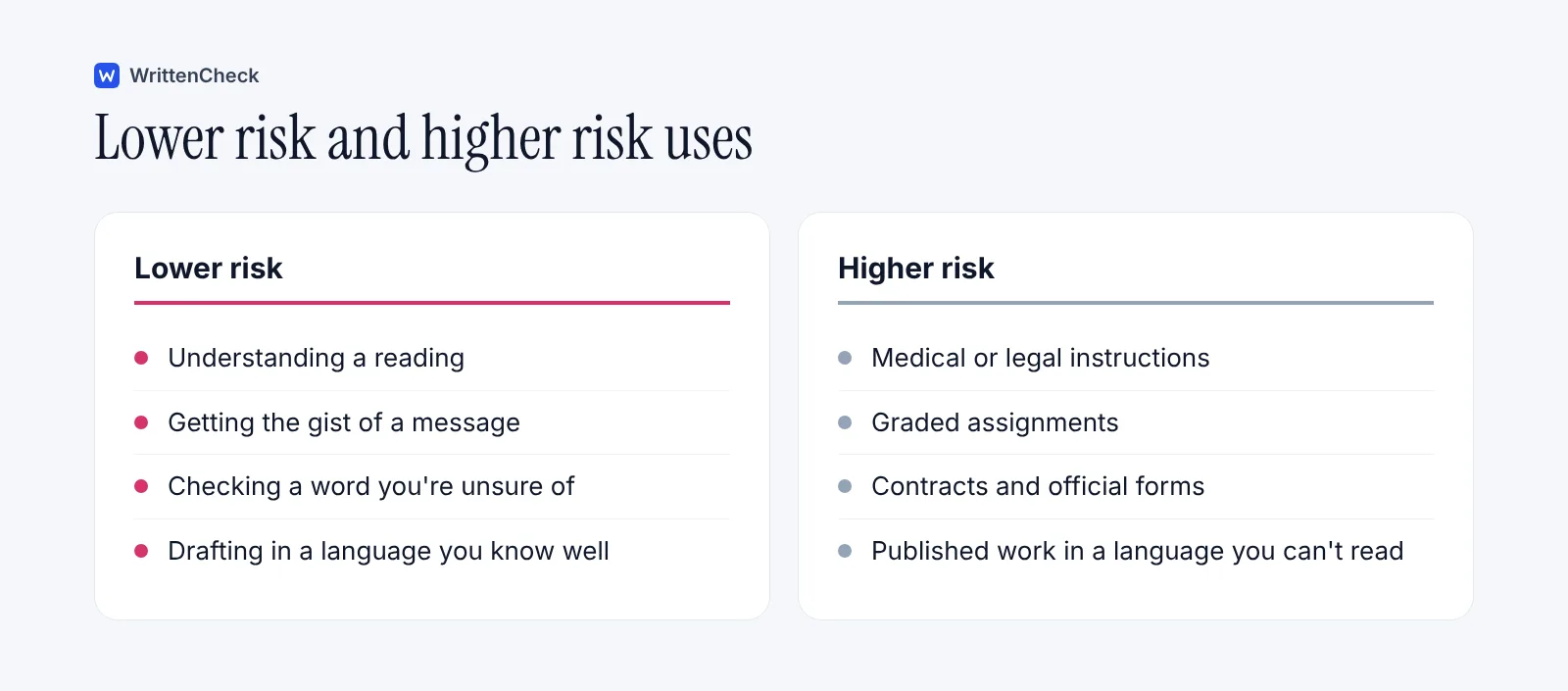
Text where small changes in meaning matter, or where meaning depends on context. Watch out for:
Medical, legal and safety text, where a small error can cause harm.
Idioms, humour and wordplay, which rarely translate word for word.
Names, numbers and units, which can be changed or mistranslated.
Informal or spoken language, which WMT 2024 found especially hard.
Specialist terms, which may have a precise meaning in one field and a different one elsewhere.
Is it OK to translate an assignment with AI?
Often only with permission and acknowledgement. Rules differ by university, by course and by assessment.
The University of Queensland's library says you must acknowledge any machine translation used in an assessment, and that failing to do so can be treated as academic misconduct. It notes that machine translation isn't allowed in in-person assessments, and suggests stating how much you used it, for example for specific sections or for checking your own translation.
The University of Melbourne's guidance for students says acceptable use of translation and editing tools varies by discipline, subject and assessment. It warns that these tools can change the meaning of your work, blur whether the ideas and expression are truly yours, and undermine language skills that may be what the assessment is testing. It says students must acknowledge AI use and strongly recommends acknowledging translation tools too.
So check your assignment guidelines, ask your teacher or coordinator if you're unsure, and acknowledge the tool when you use it. Our review of university AI policies shows how much rules vary from one university to another.
How do you acknowledge machine translation?
Say which tool you used, what for and how much. The University of Queensland suggests stating the extent of use, for example whether you translated specific sections or used the tool to check your own translation. It says the note can go on an assignment coversheet, in your methodology section, or in the text or reference list, depending on your course.
Here's an example acknowledgement:
I wrote this essay in English. I used an AI translation tool to understand two sources that were only available in Spanish, and I checked the passages I quote against the original text. No part of my own writing was machine translated.
If your course gives a template, use that. Keep a copy of your original drafts and the sources you translated. If anyone asks how you used the tool, you'll be able to show them exactly. Our guide on how to cite AI covers formal citation styles for AI tools.
How do you check an AI translation?
Use more than one check for anything that matters.
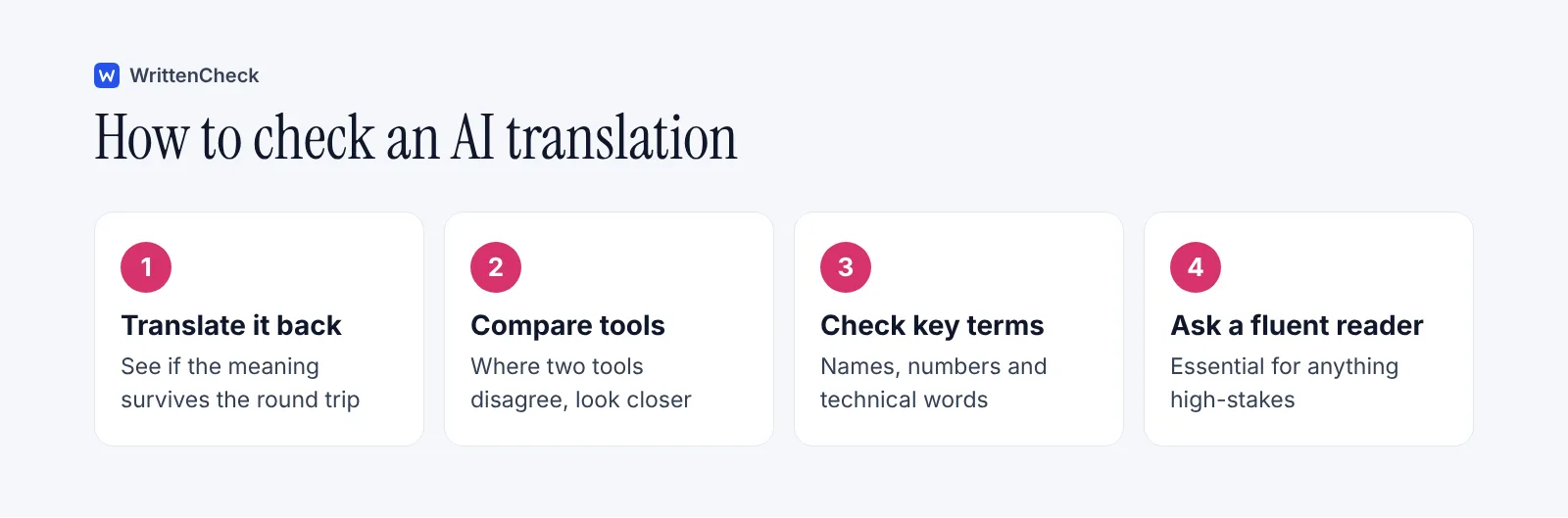
Translate it back. Put the translation back into the original language. If the meaning changes, something went wrong.
Compare two tools. Where they agree, you can be more confident. Where they differ, look closely.
Check key terms. Names, dates, numbers, units and technical words are where errors often hide.
Ask a fluent speaker. For medical, legal, official or published text, this is the only reliable check.
It also helps to read the translation slowly and ask whether each sentence says exactly what you meant, not just something close.
Back-translation has limits. A translation can survive the round trip and still sound unnatural, or be wrong in a way that happens to reverse cleanly. Treat it as a quick warning sign, not proof.
How can AI help if you write in a second language?
AI can help you understand readings, check vocabulary and get feedback on your English drafts. Many students find that more useful, and safer, than translating whole assignments.
A good approach is to write in the language of the assignment yourself, even if it's slower, then ask AI to point out unclear sentences or grammar mistakes. You keep your own ideas and build your skills. Our guide to AI writing tools for non-native English speakers goes into this in detail.
Here's an example prompt that keeps you in control:
Here's a paragraph I wrote in English. My first language is Urdu. Point out any sentences that sound unnatural to a native speaker, and explain why in simple words. Don't rewrite the whole paragraph.
When you've finished, our word counter can check your length, and you can paste the final text into our free AI detector to see which sentences read most like AI. Heavily machine-translated or AI-polished passages are often the ones worth a second look.
Frequently asked questions
How accurate is AI translation?
It depends on the language and the text. In a 2021 study of medical instructions, a free online translator kept the meaning 94% of the time in Spanish but only 55% in Armenian. Large language models now lead international evaluations, but the 2024 report still warned that fluent translations can contain serious flaws.
Is it plagiarism to translate someone else's work with AI?
Translating someone else's work and presenting it as your own is still plagiarism, even if the words are now in a different language. Translated ideas and text need to be credited to the original author. Check your university's rules, and cite the original source as you would for any quotation or paraphrase.
Can I write my essay in my first language and translate it?
Only if your course allows it. Some universities treat undisclosed machine translation in assessments as misconduct, and the University of Queensland says it isn't allowed in in-person assessments. Many courses assess your writing in the target language itself. Ask your teacher first, and acknowledge the tool if it's permitted.
What's the best way to check a translation?
Combine checks. Translate it back into the original language, compare the output of two tools, and double-check names, numbers and technical terms. For anything important, such as medical, legal or published text, ask a fluent speaker or professional translator to review it. No automated check is fully reliable.
Are AI chatbots better than translation apps?
In the 2024 international evaluation, a large language model was the best system overall, ahead of dedicated online translation services in most language pairs. But the best tool still varies by language pair and type of text. For important work, compare more than one tool and have a fluent speaker check the result.
Should I use AI translation for medical or legal documents?
Not on its own. Errors in these documents can cause real harm, and studies have found accuracy drops in some languages. Use a qualified interpreter or professional translator for medical, legal and official documents. AI translation can help you understand the gist, but shouldn't be the final version.
Sources
Findings of the WMT24 General Machine Translation Shared Task: The LLM Era Is Here but MT Is Not Solved Yet, Kocmi et al., Proceedings of WMT 2024, ACL Anthology
A Pragmatic Assessment of Google Translate for Emergency Department Instructions, Taira, Kreger, Orue and Diamond, Journal of General Internal Medicine, 2021
Machine translation, University of Queensland Library, accessed November 2026
Advice for students regarding translation and editing tools, University of Melbourne, accessed November 2026
Findings of the WMT24 General Machine Translation Shared Task (full paper), ACL Anthology, 2024


Comments