If you quoted or paraphrased an AI chatbot in your essay, you need to cite it. Knowing how to cite AI in APA, MLA or Chicago style takes about two minutes once you've seen the formats, and all three style guides now publish official guidance.
The rules changed recently. APA updated its generative AI guidance in September 2025, and MLA published an updated and revised version of its guidance in August 2025. Older examples you find online may follow the earlier versions.
This guide shows the current formats with examples, how in-text citations work, where your prompts go, and a disclosure statement you can adapt. It also covers when an AI tool shouldn't be your source at all.
How to cite AI in APA
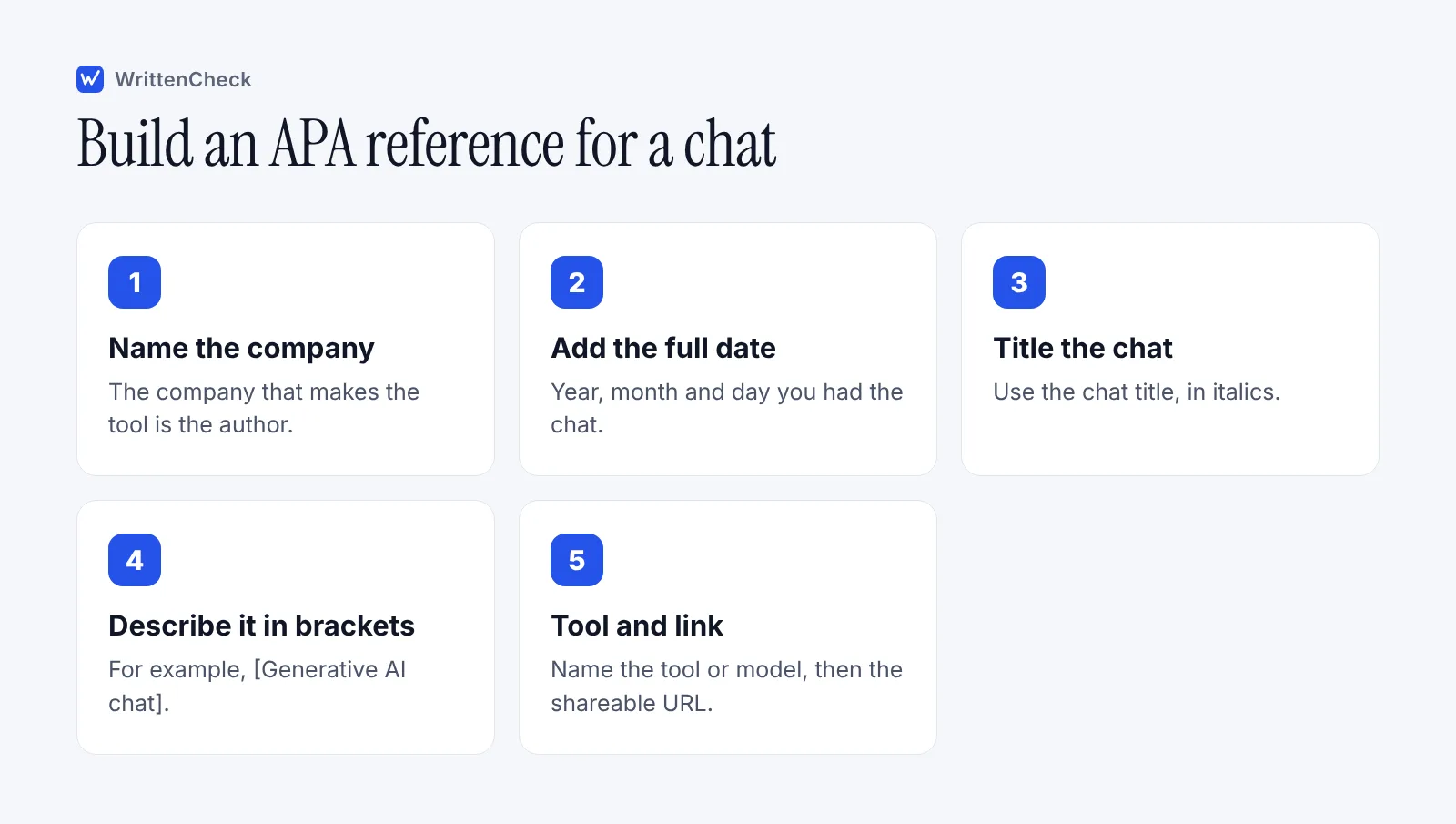
To cite AI in APA, name the company that makes the tool as the author, then give the date of the chat, the chat title in italics, a description in square brackets, the tool or model name and the shareable URL. In the text, cite the company and year, such as (OpenAI, 2025). If you're citing the tool in general, use the year only and the tool URL.
APA explains its guidance in a series of APA Style blog posts dated September 9, 2025, starting with "Citing generative AI in APA Style: Part 1, Reference formats." The formats below follow that update as reproduced in university library guides from the University of Southern California, the University of Wisconsin-Madison and the University of British Columbia. The official APA Style blog has the final word, so check it if your instructor is strict about details.
APA format for a specific chat
The template, as given in the University of Wisconsin-Madison library guide:
AI Company Name. (year, month day). Title of chat in italics [Description, such as Generative AI chat]. Tool Name/Model. URL
Here's an example built from that template:
OpenAI. (2026, March 3). Causes of the 1929 stock market crash [Generative AI chat]. ChatGPT. https://chatgpt.com/share/your-chat-link
In-text citations follow the usual author and date pattern:
Parenthetical: (OpenAI, 2026)
Narrative: OpenAI (2026)
APA format for the tool in general
When you're referring to the tool itself, use the general format. The USC library guide gives this example:
OpenAI. (2025). ChatGPT [Large language model]. https://chatgpt.com/
The UBC library guide says the general format fits uses like editing or organizing your writing, translation, and creating code, tables or figures, which you'd also disclose in an author note or methods section.
What if your chat can't be shared?
Some AI tools, including many school or workplace versions, don't create a shareable link. Library guides differ here. The UW-Madison guide says APA "does not make direct recommendations" for this case and suggests appending your prompts and outputs or asking your instructor. The UBC guide suggests citing the tool generally. Ask your instructor which they prefer.
APA also says AI output isn't a "personal communication," according to the UBC guide, because no person wrote it. So don't use that format.
How to cite AI in MLA
In MLA, don't list the AI tool as an author. Start with a description of what was generated, usually the prompt, as the title of the source. Then give the tool name in italics as the container, the model or version, the company, the date and a shareable link.
The MLA Style Center published "How do I cite generative AI in MLA style? (Updated and Revised)" on August 13, 2025. Its works-cited example for a paraphrase reads:
"Describe the theme of nature in Jane Austen's Mansfield Park" prompt. ChatGPT, model GPT-4o, OpenAI, 23 Sept. 2024, chatgpt.com/share/66f1b0a0-d704-8000-be9a-85f53c850607.
In the text, MLA uses a shortened form of the title:
In Mansfield Park, physical locations like Mansfield Park and Sotherton reflect the morality and choices of the people who live in them ("Describe the theme").
Here's how MLA explains each core element:
MLA element | What to put there |
|---|---|
Author | Leave it out. MLA says "We do not recommend treating the AI tool as an author." |
Title of source | A description of what was generated, often the prompt |
Title of container | The AI tool, in italics |
Version | The specific model or version, as precisely as you can |
Publisher | The company that made the tool |
Date | When the content was generated |
Location | A stable, shareable URL if there is one, or the tool's general URL |
For long prompts, you can shorten the description. The MLA guidance allows this when the full prompt would be unwieldy.
How to cite AI in Chicago style
Chicago credits AI mostly in notes. A footnote names the tool, the company, the date and a URL. In author-date style you can cite it in parentheses. A bibliography entry is only needed if there's a publicly available link.
The Chicago Manual of Style Online answers this in its Q&A section. For a formal note, it gives this example:
Text generated by ChatGPT, OpenAI, January 10, 2026, URL.
If you haven't included the prompt in your text, put it in the note:
ChatGPT, response to "Explain how to make pizza dough from common household ingredients," OpenAI, January 10, 2026, URL.
Chicago also says that if you edited the AI text, you should say so, for example "edited for style and content." Small changes like smart quotes or font adjustments can be made silently.
For informal writing, Chicago says naming the tool in your sentence can be enough. Its example: "The following recipe for pizza dough was generated by ChatGPT."
The Illinois State University library guide to Chicago author-date style adds that you shouldn't include AI in the bibliography "unless you have a publicly available url (doesn't require account log in)." It shows a parenthetical citation like this:
This pizza dough recipe can be created from common household ingredients. (ChatGPT, March 7, 2023).
APA, MLA and Chicago side by side
APA | MLA | Chicago | |
|---|---|---|---|
Who is the "author" | The company | No author. The prompt or description comes first | The tool, in notes |
In-text form | (Company, year) | ("Shortened prompt") | Footnote, or (Tool, date) in author-date |
Reference list entry | Yes | Yes, in works cited | Only with a publicly available link |
Link | Shareable chat URL | Shareable URL, or tool URL | URL in the note |
Latest official update | September 2025 | August 2025 | See the CMOS Online Q&A |
Where do your prompts and the full AI response go?
Put short prompts in your text or in the citation itself. Put long prompts and full responses in an appendix, unless your instructor wants them somewhere else.
The UW-Madison guide summarizes APA advice that researchers should document their prompts and may include them "in an appendix or supplemental material." The MLA prompt-as-title format already puts the prompt in your works cited. Chicago puts it in the note.
Here's a simple way to build an appendix:
Label it. "Appendix A: AI prompts and responses."
List each prompt in order, with the date and the tool or model.
Paste the full response, or the part you used, under each prompt.
Add the shareable link if one exists.
Refer to it in your text. For example: "The full exchange is in Appendix A."
Keep a copy of every chat you might cite. Shared links can stop working, and some tools delete history.
How do you write an AI acknowledgement statement?
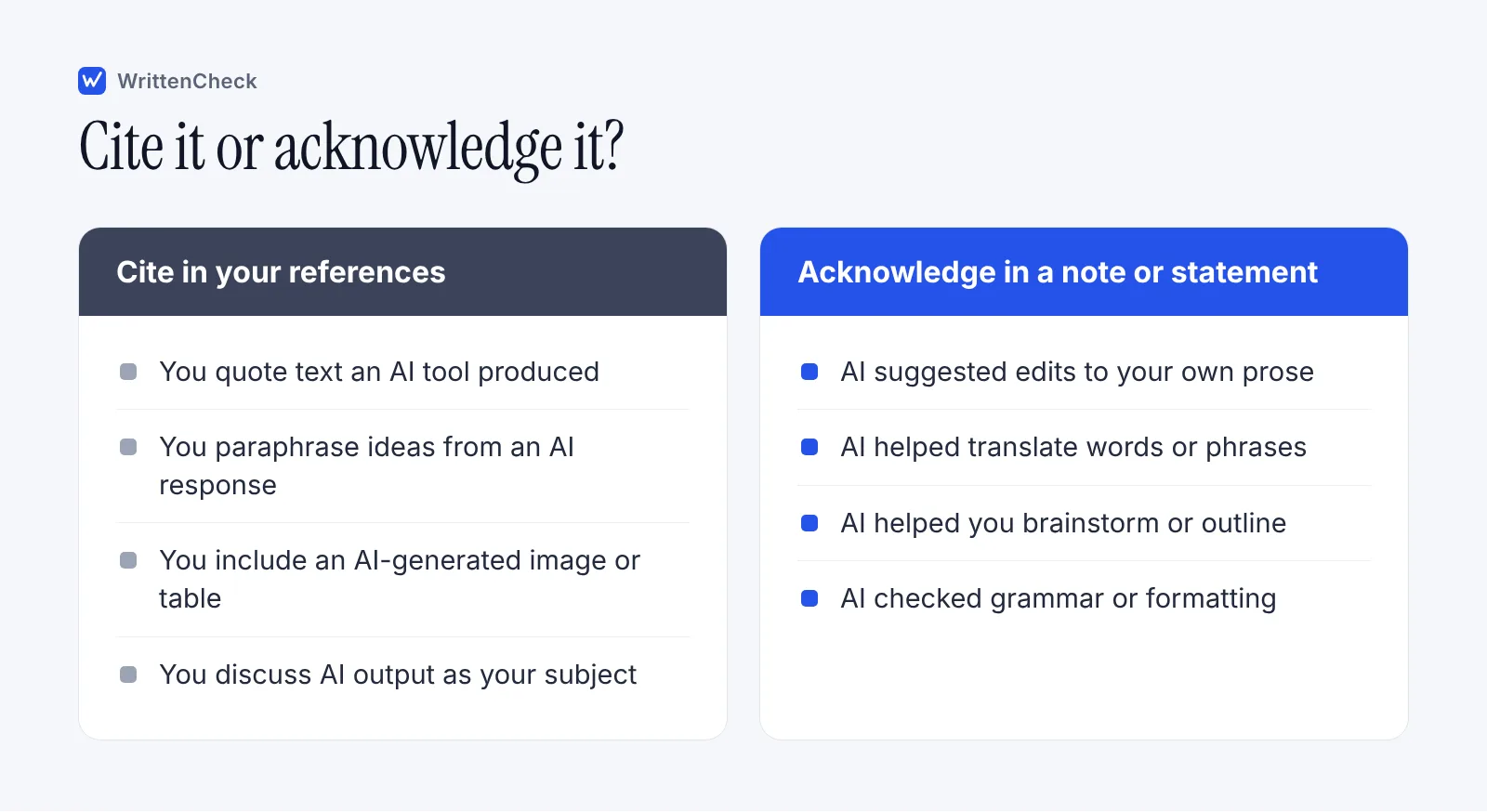
An AI acknowledgement statement is a short note that says which tool you used, what you used it for and how you checked the result. It covers help that doesn't need a full citation, like brainstorming or editing.
MLA calls this acknowledging "substantive uses of AI" and suggests putting the statement in your text, a note, or alongside linked or appended chat transcripts. Its guidance says a statement should explain where and how AI touched your work, and which prompts you used.
Here's a template you can adapt:
AI acknowledgement: I used [tool and model] on [date] to [task, for example "brainstorm possible research questions" or "suggest edits to the clarity of my second section"]. I [what you did with the output, for example "chose and developed one question myself" or "accepted some suggestions and rejected others"]. All analysis, arguments and final wording are my own. I checked [facts, sources or claims] against [your sources]. My prompts are in Appendix A.
And a filled-in example:
AI acknowledgement: I used an AI chatbot on 3 March 2026 to suggest five possible angles for this essay. I chose the third angle and wrote the essay myself. I didn't use any AI-generated text in the final version.
If your instructor has their own disclosure format, use that instead. Our guide on whether using AI is plagiarism explains why disclosure matters so much.
When should you not cite AI as a source?
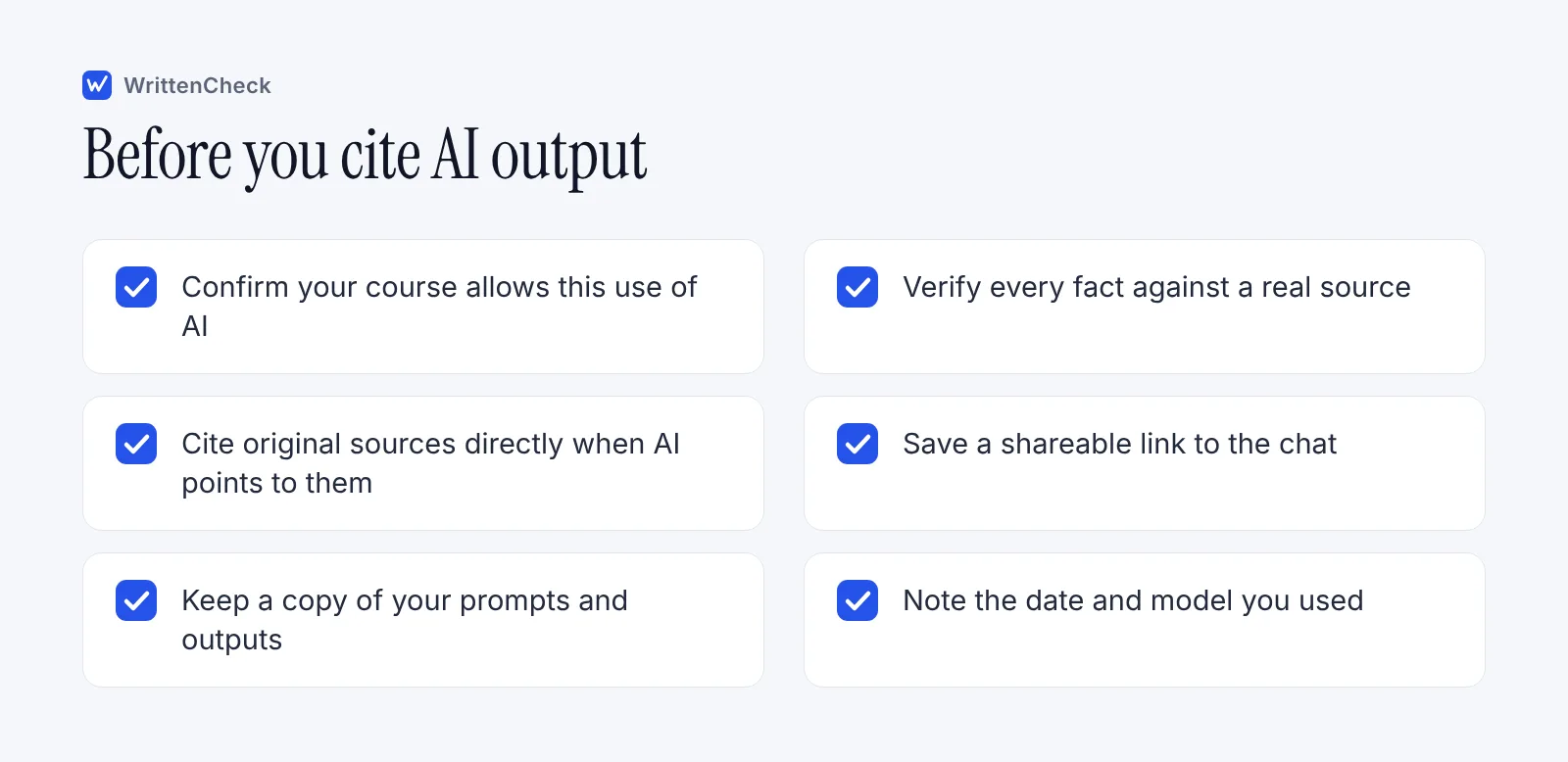
Don't cite AI as your source for facts, statistics, quotes or research findings. Find the original source, read it, and cite that.
AI tools can invent sources. MLA warns that they "can also hallucinate, or make up, sources or incorrectly summarize the content," and tells you to directly consult and cite the sources an AI tool links to, instead of the AI response.
Cases where an AI citation is the wrong move:
A fact or number. "The Great Depression began in 1929 (OpenAI, 2026)" is weak. Cite a history book or a primary source.
A study the AI summarized. Find the paper and cite it. If you can't find it, it may not exist.
When your course bans AI. A citation doesn't make banned use allowed.
As a co-author. The Committee on Publication Ethics (COPE) says "AI tools cannot be listed as an author of a paper." MLA also advises against treating the tool as an author.
AI citations make sense when the AI output itself is what you're discussing or using. That might be an essay analyzing chatbot answers, a quoted AI-written passage, or a generated image in your project.
Clear citations also help if anyone ever questions your work. Our guide on how teachers check for AI shows why a visible process matters. Before you submit, you can paste your draft into our free AI detector to see which sentences read most like AI. Treat the result as an estimate, and make sure any AI help is cited or acknowledged the way your course asks.
Frequently asked questions
Do I have to cite AI if I only used it for brainstorming?
Usually you acknowledge it instead of citing it. MLA separates content you quote or paraphrase, which needs a citation, from functional uses, which need an acknowledgement in a note or your text. If an AI tool helped you brainstorm and you wrote everything yourself, a short acknowledgement statement is normally enough. Your instructor's rules come first, so check the syllabus.
What date do I use in an AI citation?
Use the date you had the chat or generated the content. APA uses year, month and day for a specific chat, and only the year when you cite the tool in general. MLA gives the date in day, month, year form, such as 23 Sept. 2024. Chicago notes use the month, day and year.
How do I title an AI chat in APA?
Use the chat title, in italics, followed by a description in square brackets, such as [Generative AI chat]. Pick a title that describes the topic of the conversation, so readers can tell what it covered. Keep it short and specific, and add the shareable link at the end of the reference.
Can I cite an AI tool as an author?
Not in MLA, which says it doesn't recommend treating the AI tool as an author. In APA, the company that makes the tool takes the author position. In publishing, COPE says AI tools can't be listed as authors because they can't take responsibility for the work. You, the writer, stay responsible for everything you submit.
Should I include my prompt in the citation?
In MLA, yes, the prompt or a description of it usually becomes the title of the source. In Chicago, include the prompt in the note if it isn't already in your text. In APA, the chat title and a shareable link carry the context, and long prompts and responses can go in an appendix.
What's the difference between citing AI and disclosing AI use?
A citation credits specific content you quoted or paraphrased, with an entry in your reference list. A disclosure, or acknowledgement statement, describes how you used AI in your process, such as brainstorming, editing or translating. Many assignments need both: citations for the AI text you used, and a statement explaining your overall use.
Sources
How do I cite generative AI in MLA style? (Updated and Revised), MLA Style Center, August 13, 2025
Beyond Citation: Describing AI Use in Your Work, MLA Style Center, August 13, 2025
Citing content developed or generated by artificial intelligence (Q&A), The Chicago Manual of Style Online, accessed October 2026
Generative AI: Citing, University of Wisconsin-Madison Libraries, accessed October 2026
APA Style 7th Edition: Generative AI, University of Southern California Libraries, accessed October 2026
Generative AI: APA Citation Style Guide, University of British Columbia Library, accessed October 2026
Generative AI: Chicago Style (author-date), Milner Library, Illinois State University, accessed October 2026
Authorship and AI tools, Committee on Publication Ethics (COPE), February 13, 2023


Comments