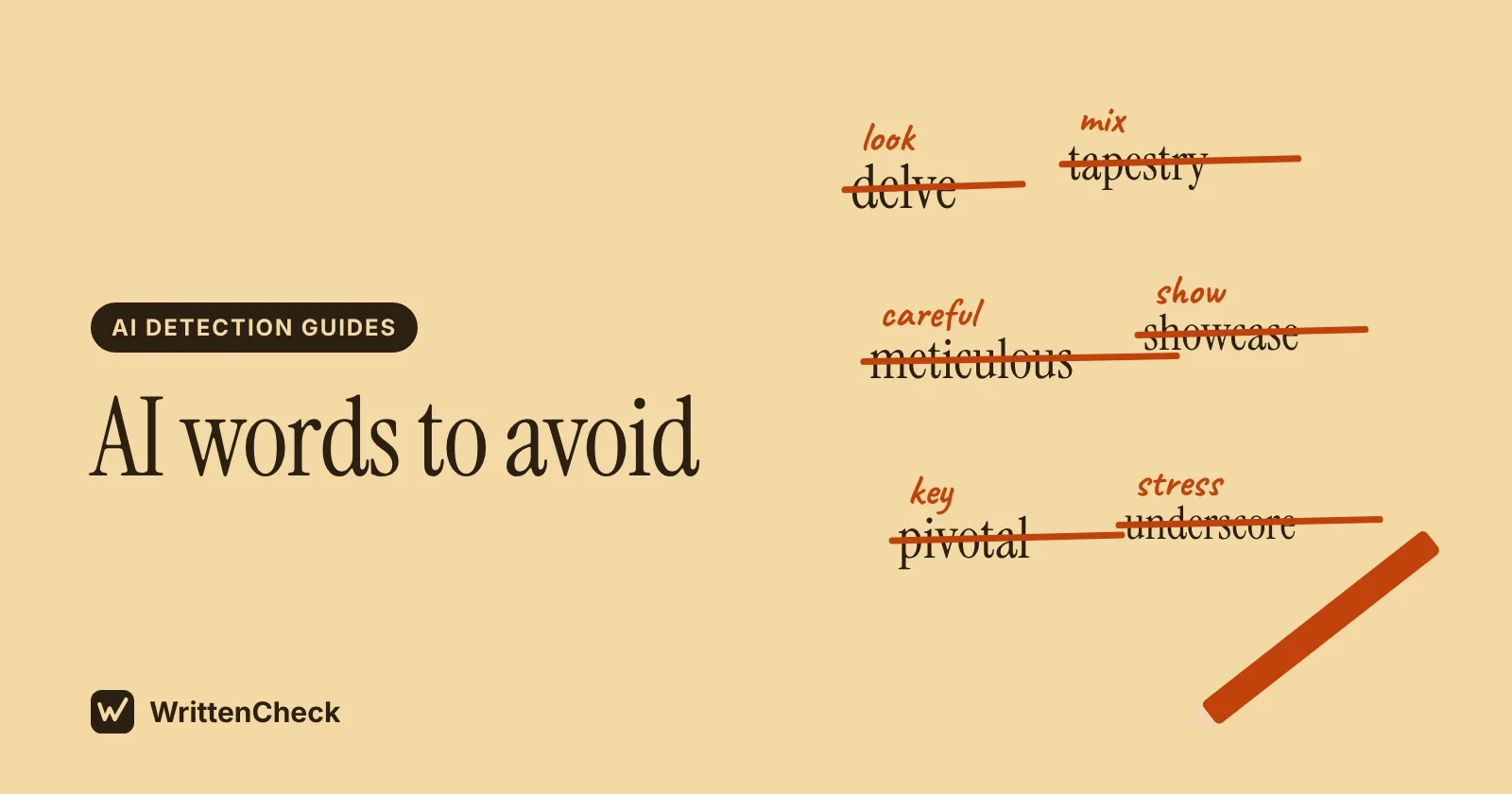
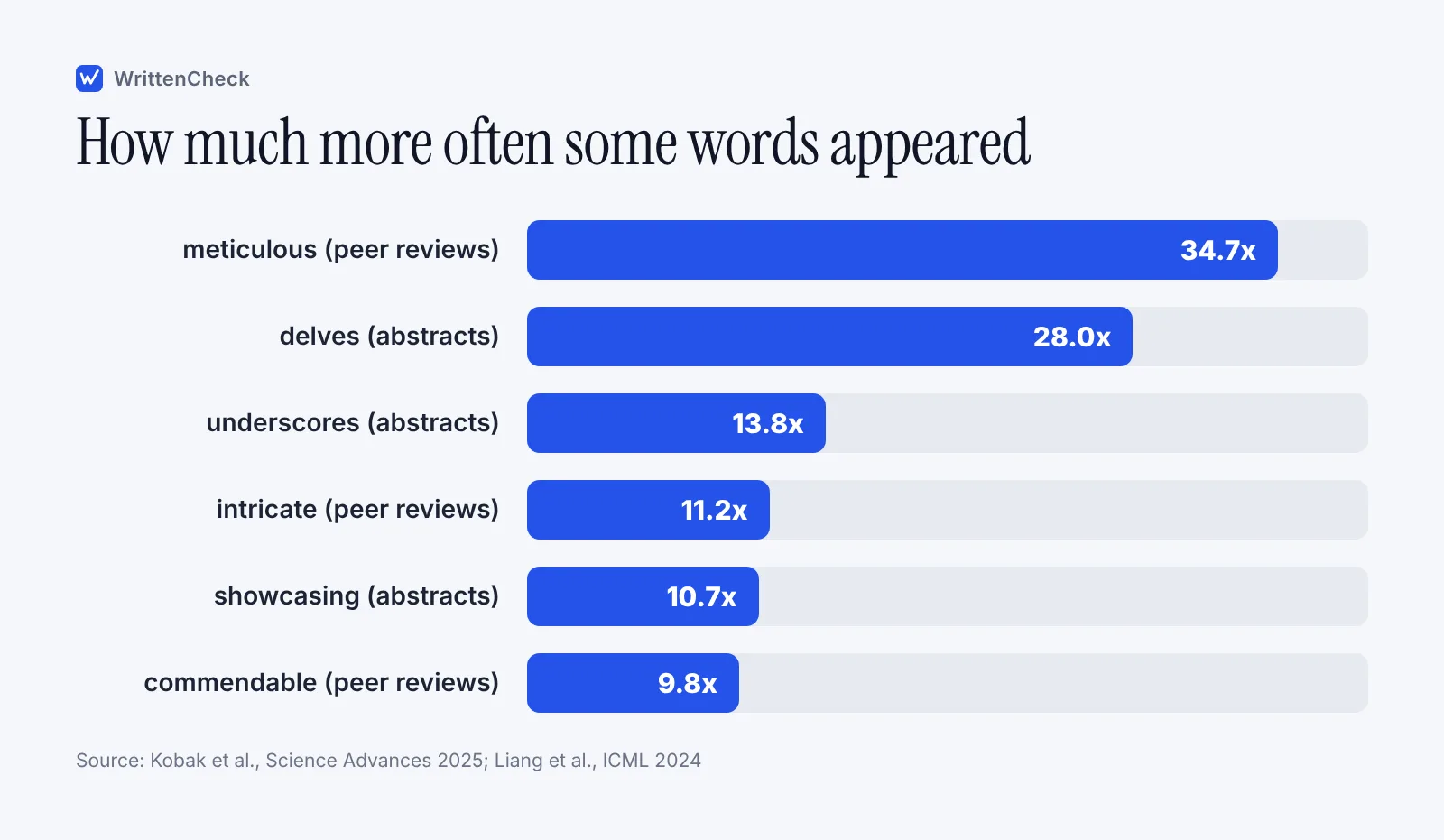
In 2024, the word "delves" showed up in biomedical abstracts 28 times more often than its past trend predicted. Nothing happened in medicine to explain it. What happened was AI chatbots, and a lot of researchers using them to polish their writing.
That jump is why lists of AI words to avoid exist. Some words became so tied to machine-written text that readers now flinch when they see them. This post covers what the research found, gives you a table of plainer swaps, and explains the structural habits that give text away more than any single word.
One thing up front. Using "delve" doesn't prove anyone used AI. People wrote it long before chatbots, and plenty still do. The point of this list is clearer writing.
What are AI words to avoid?
AI words to avoid are words and phrases that AI chatbots use far more often than people do, so they now make readers suspicious. Research has measured some of them, including delves, underscores, showcasing, meticulous, intricate and commendable. Others are stock phrases like "plays a significant role" or "in the ever-changing world of." Swapping them for plainer words, and fixing the sentence habits around them, makes writing clearer.
Where did the list of AI words come from?
From researchers counting words in huge collections of text before and after AI chatbots became popular. The changes were large enough to measure across millions of documents.
The best-known study is by Dmitry Kobak, Rita González-Márquez, Emőke-Ágnes Horvát and Jan Lause, published in Science Advances in July 2025. They tracked vocabulary in more than 15 million PubMed abstracts from 2010 to 2024. In 2024 they found 454 "excess words," meaning words used far more than the trend predicted. During the peak of the Covid pandemic in 2021 there were 190.
The kind of word mattered too. Covid's excess words were content words like "respiratory" and "remdesivir." The 2024 excess words were almost all style words. Of the 379 excess style words in 2024, 66% were verbs and 14% were adjectives. The authors estimated that at least 13.5% of 2024 biomedical abstracts were processed with AI chatbots.
A 2024 study by Weixin Liang and colleagues at Stanford found the same thing in peer reviews for major AI conferences. Words like "meticulous" appeared 34.7 times more often after chatbots arrived, "intricate" 11.2 times and "commendable" 9.8 times.
In 2025, a PNAS study led by Alex Reinhart at Carnegie Mellon compared human writing with text from instruction-tuned models. In one popular model's output, "camaraderie" and "tapestry" appeared roughly 150 times as often as in human text. "Palpable" and "intricate" were overused across models too.
Which words and phrases sound most like AI?
The table below lists common ones with plainer swaps. The first group was measured in the studies above. The second group is stock phrasing that editors cut from any draft, AI or not, because it's vague.
AI-sounding word or phrase | Plainer alternative |
|---|---|
delve into | look at, explore, dig into |
underscore | show, stress |
showcase | show, display |
meticulous | careful, thorough |
intricate | complex, detailed |
commendable | good, strong (or say what's good) |
crucial | key, needed, important |
pivotal | key, deciding |
palpable | obvious, clear (or show the feeling) |
tapestry | mix, range |
camaraderie | friendship, team spirit |
testament to | proof of, shows |
realm | area, field |
landscape | field, market, situation |
leverage | use |
foster | build, encourage |
robust | strong, reliable |
seamless | smooth, easy |
navigate (a challenge) | handle, deal with |
plays a significant role in | affects, shapes, matters for |
in today's fast-paced world | (cut it) |
it's important to note that | (cut it, then state the point) |
a wide range of | many, several (or give the number) |
ever-evolving | changing |
in conclusion | (cut it, or just conclude) |
Two cautions about any list like this. Models get updated, so a list built on last year's output may not match next year's. And the swap only helps if the plain word fits. "Meticulous" is a fine word for a surgeon.
The 2025 study by Jenna Russell, Marzena Karpinska and Mohit Iyyer gives a sense of how readers use these words. People who often use AI writing tools were asked to explain how they judged articles. Vocabulary was their most cited clue, and they named words like "testament," "crucial" and "significantly." But they also weighed structure, originality and how quotes sounded, which leads to the next point.
Why do AI chatbots use these words so much?
Nobody knows for sure. The leading idea is that the extra training step, where human raters score answers, rewards a certain polished register. That hasn't been proven.
In a paper at COLING 2025, Tom Juzek and Zina Ward tested where words like "delve" come from. They found no evidence that model architecture, training choices or the training data caused it. Their model tests were consistent with human feedback training playing a role, but their study of human raters was inconclusive. They also pointed out that a lack of transparency about how models are built makes this hard to study.
So treat confident claims about the cause with care. The pattern is clear. The reason is still open.
What sentence patterns are signs of AI writing?
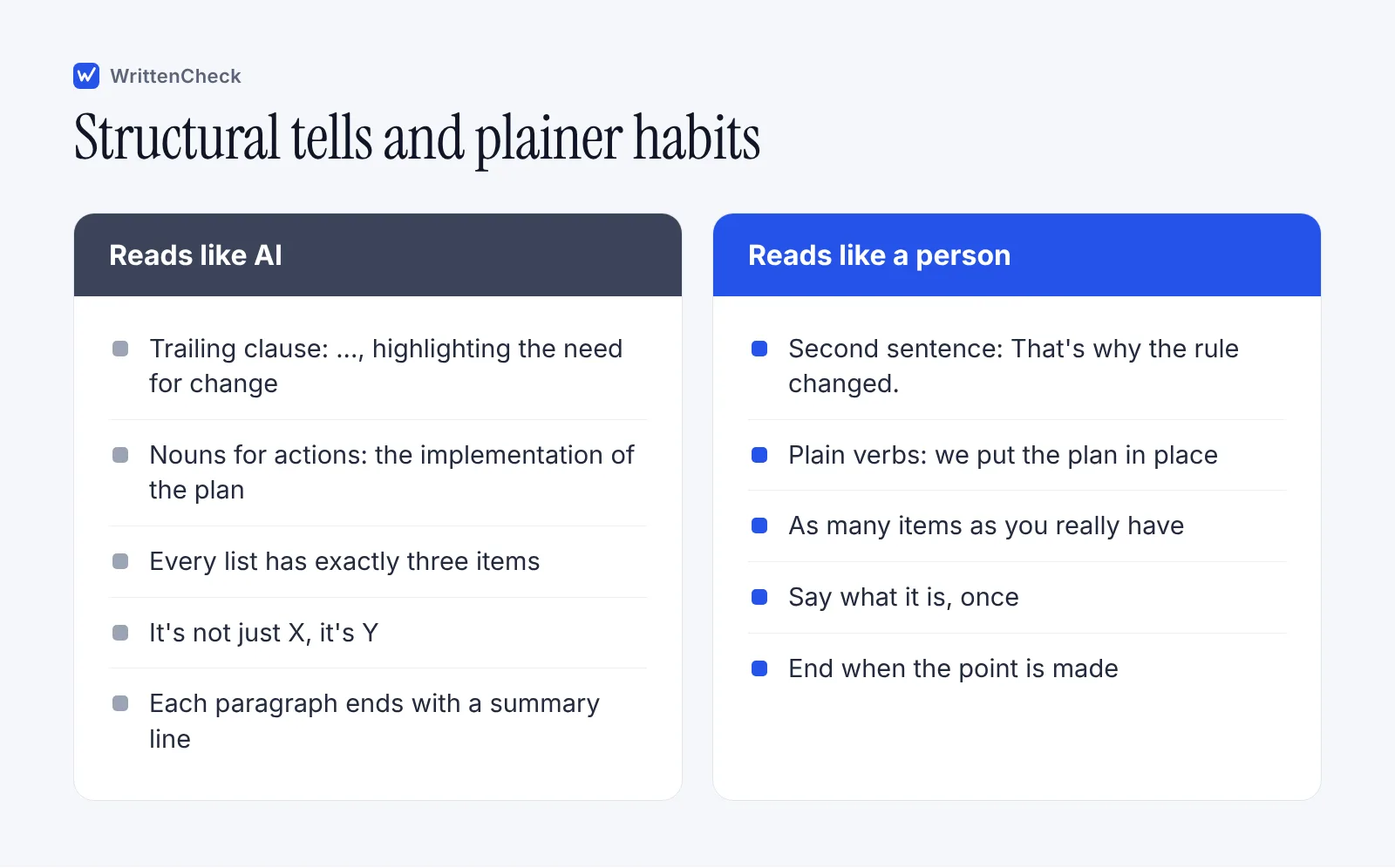
Structure gives text away more than vocabulary does. Habits like trailing "-ing" clauses, heavy use of nouns for actions and very even paragraphs show up across whole documents.
The Reinhart study measured two of these. Instruction-tuned models used present participial clauses at 2 to 5 times the human rate. That's the "..., highlighting the need for reform" shape tacked onto the end of a sentence. They used nominalizations, nouns made from verbs like "implementation" or "utilization," at 1.5 to 2 times the human rate.
Other patterns are easy to recognize once you've seen them a few times:
The three-part list. "Clear, concise and compelling." Every list, every time.
The contrast frame. "It's not just a tool, it's a partner."
The announcement opener. "In the world of education, assessment matters." The first clause says nothing.
The summary closer. Each paragraph ends by restating itself.
The hedge pile. "This can potentially help to some extent."
Here's a short example we wrote to show how these stack up.
Before: In today's fast-paced world, remote work plays a pivotal role in shaping modern careers, offering flexibility, autonomy and balance. It's not just a trend, it's a fundamental shift, underscoring the need for robust policies.
After: Remote work changed how a lot of people plan their careers. Some moved cities. Others took jobs they couldn't have reached by commute. Companies now need rules for things like core hours and home-office costs.
The second version has no flagged words, but that isn't what makes it better. It has specific detail and sentences that do one job each.
Does using AI words prove a text is AI-generated?
No. A word count can show a trend across millions of abstracts. It can't tell you whether one person used AI on one essay.
The Kobak team's estimates are population-level. They describe how much a whole body of writing shifted. They say nothing about any individual author. Plenty of human writers use "underscore" and "intricate" because those words were common in academic English long before 2023.
There's a fairness problem too. In a 2023 study in Patterns, Liang and colleagues found that AI detectors flagged 61.3% of essays by non-native English writers as AI-generated. Formal, textbook vocabulary is what many second-language writers were taught. If a reader treats "moreover" as a confession, those writers pay the price.
For a fuller method that puts word choice in its place, see how to tell if something is written by AI. It starts with facts and citations, which are far stronger clues.
How do you write naturally instead?
Write the way you'd explain the idea to a smart friend, then edit for specifics. Most stock phrases disappear once each sentence has a real job.
George Orwell's 1946 essay "Politics and the English Language" still works as an editing guide. Two of his rules fit here. Never use a long word where a short one will do. If it's possible to cut a word out, always cut it out.
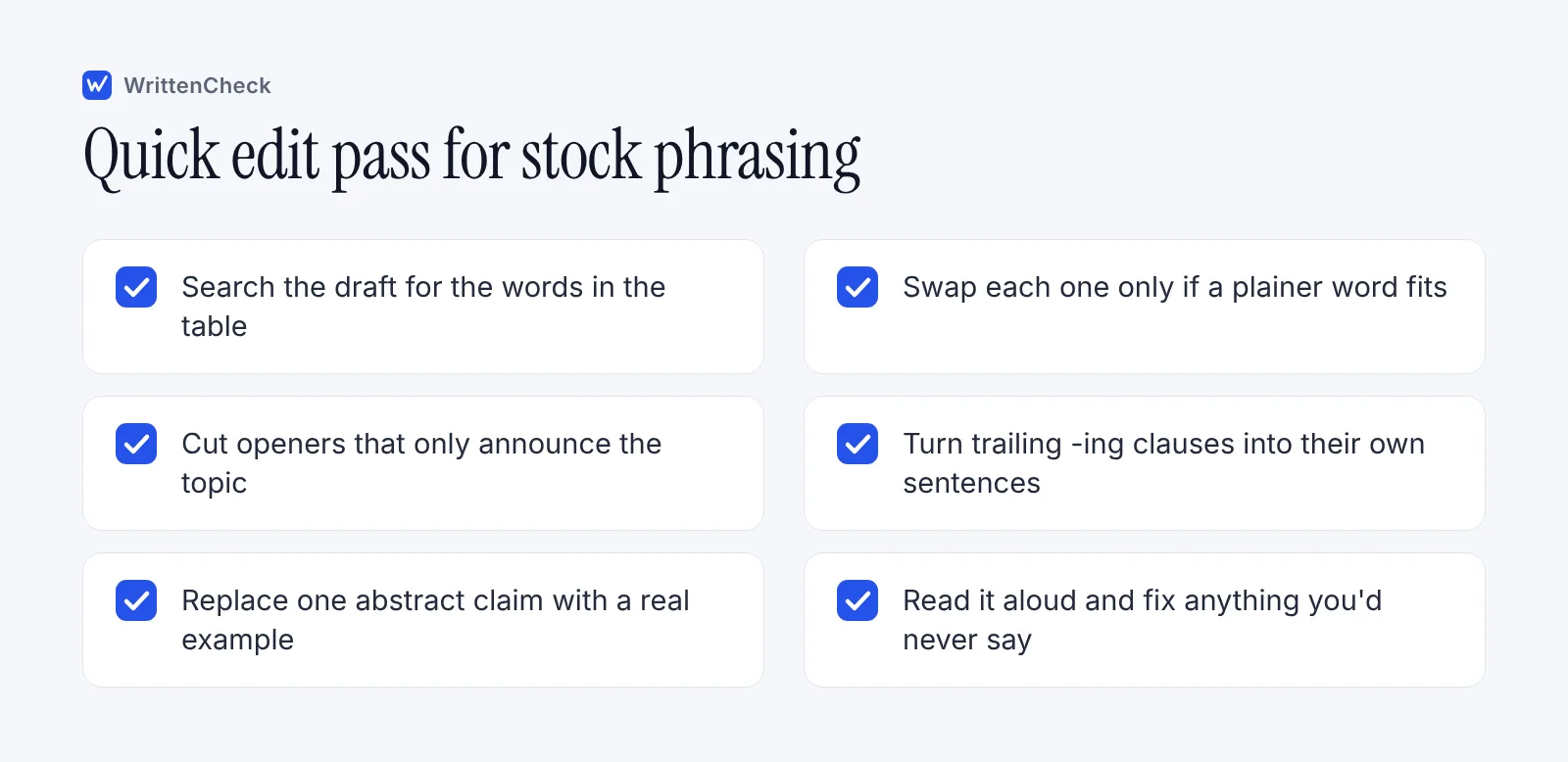
Here's an editing routine you can run on any draft:
Search for the words in the table. Use Find in Google Docs or Microsoft Word. Don't panic about one or two.
Ask what each one means here. If "pivotal" means "the vote that decided it," write that.
Cut announcement openers. Start with the claim itself.
Break up trailing clauses. Turn ", highlighting the need for X" into a new sentence that says who needs what.
Turn nouns back into verbs. "The implementation of the policy" becomes "when the school started the policy."
Count your lists. If every one has three items, change some to two or four, matching what you actually have.
Add one concrete detail per paragraph. A name, a number, a place, an example.
Read it aloud. Anything you'd never say to a person is a candidate to rewrite.
Swapping words is never the goal by itself. A draft with every flagged word removed can still be vague and padded. A draft that uses "intricate" once, where it fits, can be excellent.
How can you check your own draft?
Run the edit pass above first, then get a second opinion. A friend's honest read is useful. So is a tool that shows which sentences sound most generic.
You can paste your draft into our free AI detector to see which sentences read most like AI, with a score for each sentence. It checks 80 to 3,000 words at a time in 16 languages, and we don't keep your text. Treat the result as a pointer to sentences worth rereading. If you want to know what the tool is measuring, read how AI detectors work.
Then pick the three highlighted sentences that bother you most and rewrite them with a specific detail each.
Frequently asked questions
What words does AI use the most?
Research on scientific abstracts and peer reviews found big increases in words like delves, underscores, showcasing, meticulous, intricate and commendable after AI chatbots became popular. A 2025 PNAS study also found words like camaraderie, tapestry and palpable heavily overused in model output. The exact list shifts as models change, so watch for vague, inflated wording in general. Memorizing one list won't keep up.
Is "delve" really an AI word?
It became one by reputation. In 2024, "delves" appeared in biomedical abstracts about 28 times more often than the past trend predicted, which researchers linked to AI-assisted writing. It's still an ordinary English word that people used long before chatbots. Using it once in your own writing is fine, though "look at" or "explore" is often clearer.
Are AI buzzwords enough to prove someone used AI?
No. Word-frequency studies describe trends across millions of documents. They say nothing about a single author. Many human writers, especially those who learned formal academic English, use these words naturally. Studies have also found that AI detectors flag non-native English writers more often. Treat vocabulary as a weak hint at most, and look for stronger evidence such as fabricated sources or missing drafts.
Why does AI overuse certain words?
The cause isn't settled. A COLING 2025 paper by Juzek and Ward found no evidence that model architecture, training choices or training data were responsible. Their results were consistent with human feedback training playing a role, but not conclusive. What researchers agree on is the pattern itself, which shows up clearly in large collections of text.
What are signs of AI writing besides word choice?
Sentence structure is a bigger clue. Instruction-tuned models use trailing "-ing" clauses at 2 to 5 times the human rate and more nouns made from verbs. Other common habits include three-item lists everywhere, "not just X, it's Y" contrasts, openers that only announce the topic, and paragraphs that end by restating themselves. A lack of specific detail is often the clearest sign.
Should I remove every word on the list from my writing?
No. Use the list as a prompt to reread. If a word fits the meaning and your reader understands it, keep it. Remove words that inflate a simple idea or stand in for a detail you haven't given. Clearer writing is the goal, and that matters more than avoiding any particular word.
Sources
Delving into LLM-assisted writing in biomedical publications through excess vocabulary, Kobak, González-Márquez, Horvát and Lause, Science Advances, July 2025
Monitoring AI-Modified Content at Scale: A Case Study on the Impact of ChatGPT on AI Conference Peer Reviews, Liang et al., ICML 2024, 2024
Do LLMs write like humans? Variation in grammatical and rhetorical styles, Reinhart et al., PNAS, February 2025
Is it human, or is it AI?, Carnegie Mellon University, February 2025
Why Does ChatGPT "Delve" So Much? Exploring the Sources of Lexical Overrepresentation in Large Language Models, Juzek and Ward, COLING 2025, December 2024
People who frequently use ChatGPT for writing tasks are accurate and robust detectors of AI-generated text, Russell, Karpinska and Iyyer, ACL 2025, 2025
GPT detectors are biased against non-native English writers, Liang et al., Patterns, July 2023
Politics and the English Language, George Orwell, The Orwell Foundation, 1946


Comments