Emily Dickinson filled her poems with dashes. Her early publishers swapped many of them for semicolons and periods. More than a century later, the same mark has a new problem. People now see an em dash in an email and assume a chatbot wrote it.
That's the em dash AI claim in one line. It isn't baseless. Preprint data shows em dashes rising sharply in scientific writing since AI chatbots arrived. But as a test for a single piece of writing, the em dash is one of the weakest signals there is.
This post covers what the mark is, how style guides say to use it, what the research on em dash AI patterns does and doesn't show, and how to use it well if you like it.
Does an em dash mean AI wrote it?
No. An em dash doesn't mean AI wrote a text. Writers have used the mark for centuries, and Microsoft Word turns two hyphens into one automatically. Some AI models use em dashes heavily and others barely use them. Data does show em dashes rising in scientific writing since AI chatbots arrived, but that's a trend across thousands of papers. It tells you nothing certain about one email or essay.
What is an em dash?
An em dash is the longest common dash in English punctuation. Merriam-Webster notes it's about the length of a capital M, which is where the name comes from.
It's easy to confuse with two shorter marks:
Mark | What it looks like | Main job | Example |
|---|---|---|---|
Hyphen | short (-) | Joins words | a well-known author |
En dash | medium, about the width of N | Ranges in formal typesetting | pages 10 to 20, set with an en dash |
Em dash | long, about the width of M | Sets off an aside or break | She said yes—then left. |
Chicago style sets em dashes with no space on either side. Merriam-Webster points out that most newspapers and many magazines add a space on each side instead. Merriam-Webster itself uses the closed style, as do the examples below. Both are correct. Pick one and stay consistent.
How do you use an em dash correctly?
Use it to set off extra information or to mark a sudden break. In a 2024 refresher, the editors of The Chicago Manual of Style describe em dashes as marks that set something off from the surrounding text, much like parentheses.
Here are the main uses, with examples:
To set off an aside in the middle of a sentence. Use a pair.
The new library—the one with the rooftop garden—opens in May.
To add an explanation or example at the end. Merriam-Webster says an em dash can stand in for a colon here.
She had one goal for the summer—finish the novel.
To mark a sudden break or change of direction.
I was going to call you—wait, is that my phone?
To show speech that stops short in dialogue.
"If you open that door, I'll—"
Purdue OWL, the writing lab at Purdue University, notes that a dash carries more emphatic force than a comma. That's why a dash feels louder. Merriam-Webster adds a point worth knowing. The em dash is sometimes seen as a less formal colon or parenthesis, but it appears in all kinds of writing, including the most formal. Choosing it over another mark is mostly a matter of taste.
To type one, the Chicago editors give these shortcuts:
Mac: Option + Shift + Hyphen.
Windows, in Microsoft Word: Ctrl + the minus key on the number pad.
AutoCorrect in Microsoft Word: type two hyphens between words and Word converts them to a dash as you keep typing.
That last point matters for the AI debate. Plenty of people never chose an em dash on purpose. Their word processor gave them one.
Where did the em dash AI idea come from?
From readers noticing that AI chatbots use the mark a lot, and from data showing a jump in em dashes in published writing since late 2022. The pattern is real across large collections of text.
The clearest data comes from a pre-registered study posted to arXiv in June 2026 by Przemysław Czuma. He looked at 69,632 medRxiv preprints from 2020 to 2025 and checked how many had an em dash in the Discussion section. Before 30 November 2022, when a widely used AI chatbot was released to the public, 4.23% did. Afterward, 11.58% did. By 2025, the figure was 20.3%.
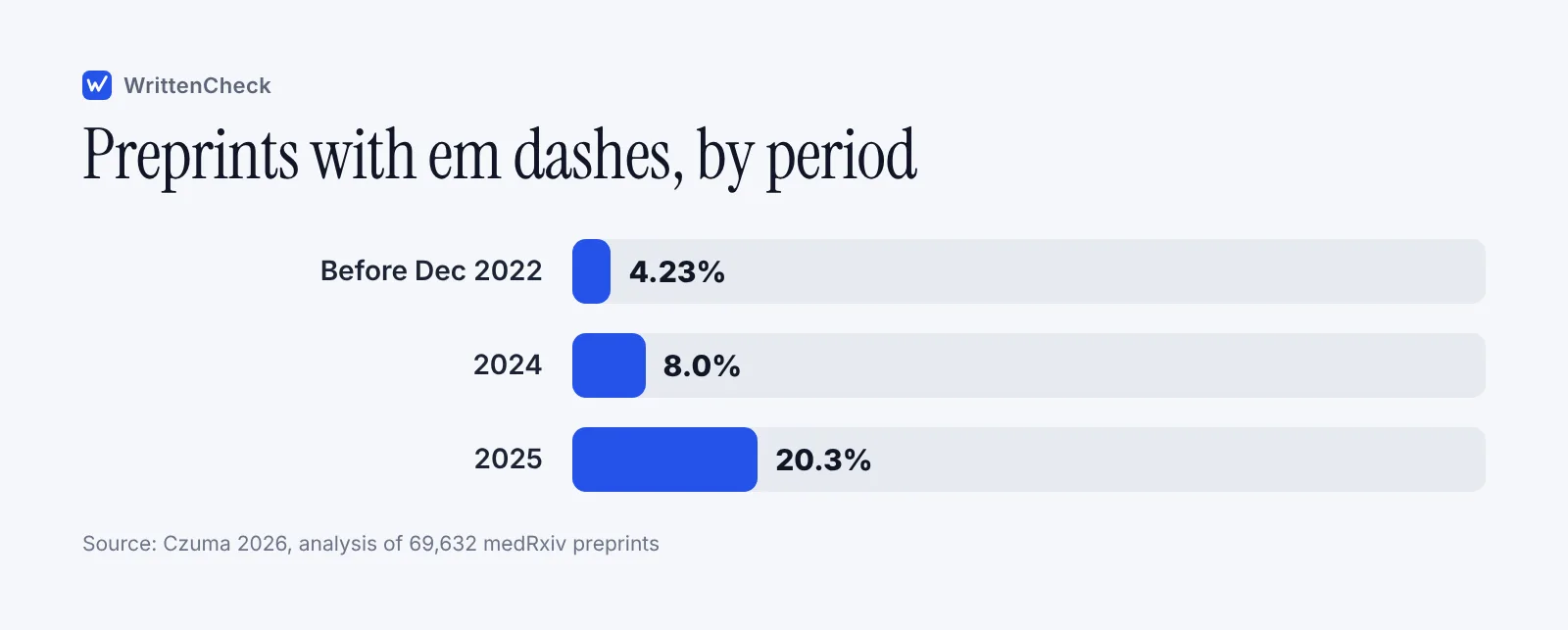
The study also found the rise didn't appear in boilerplate sections, which writers rarely polish. That fits the idea that something changed in how people drafted and edited prose.
Two caveats matter, and the author states both. This is a preprint, so it hasn't been through peer review yet. And the author writes that the design can't prove AI caused the change, only that the change is consistent with that explanation.
Why do AI writing tools use so many em dashes?
Nobody has a confirmed answer, and research on the question is new.
One idea comes from a March 2026 preprint by independent researcher E. M. Freeburg. It tested twelve models from five providers and found em dash rates ranging from zero to about nine per 1,000 words, depending on the model. The paper proposes that em dashes are formatting habits from training data leaking into plain prose. That's a hypothesis from a single, non-peer-reviewed paper. Treat it as interesting rather than settled.
The more useful finding for readers is the range. If some models produce no em dashes at all, then a text without them tells you nothing either. Language models also respond to instructions, so anyone can ask for no dashes.
Why is the em dash a weak sign of AI writing?
Because it fails in both directions. Lots of human writing has em dashes, and lots of AI text has none. A signal that common on both sides can't separate them.
Here's why it misleads:
Writers used it long before AI. Dickinson's manuscripts are full of dashes. The editors of The Chicago Manual of Style have written about how her editions rendered them as spaced hyphens, en dashes or em dashes.
Software inserts it. AutoCorrect in Microsoft Word turns double hyphens into dashes for anyone typing normally.
Model behavior varies. The Freeburg preprint found some models used none.
It's trivially removable. A single find-and-replace erases it. Anyone hiding AI use would do that first.
Population trends don't transfer to individuals. The Czuma data describes thousands of papers. It can't tell you who used AI in any one of them.
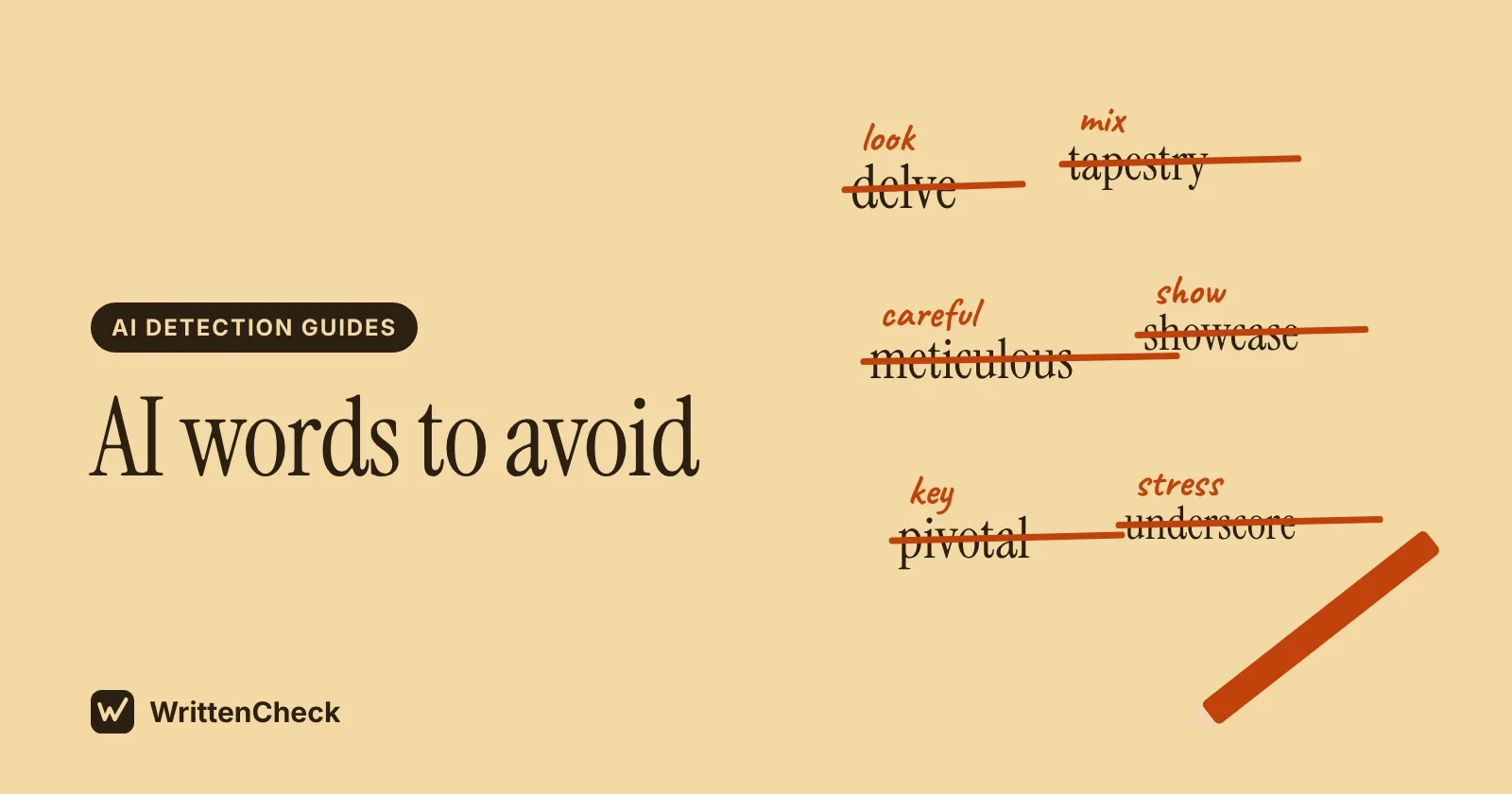
If you're trying to judge a text, look at stronger evidence first, like whether the facts and citations hold up. Our guide on how to tell if something is written by AI walks through that method. The em dash belongs with other weak style hints like the words in our post on AI words to avoid.
How do you use em dashes well?
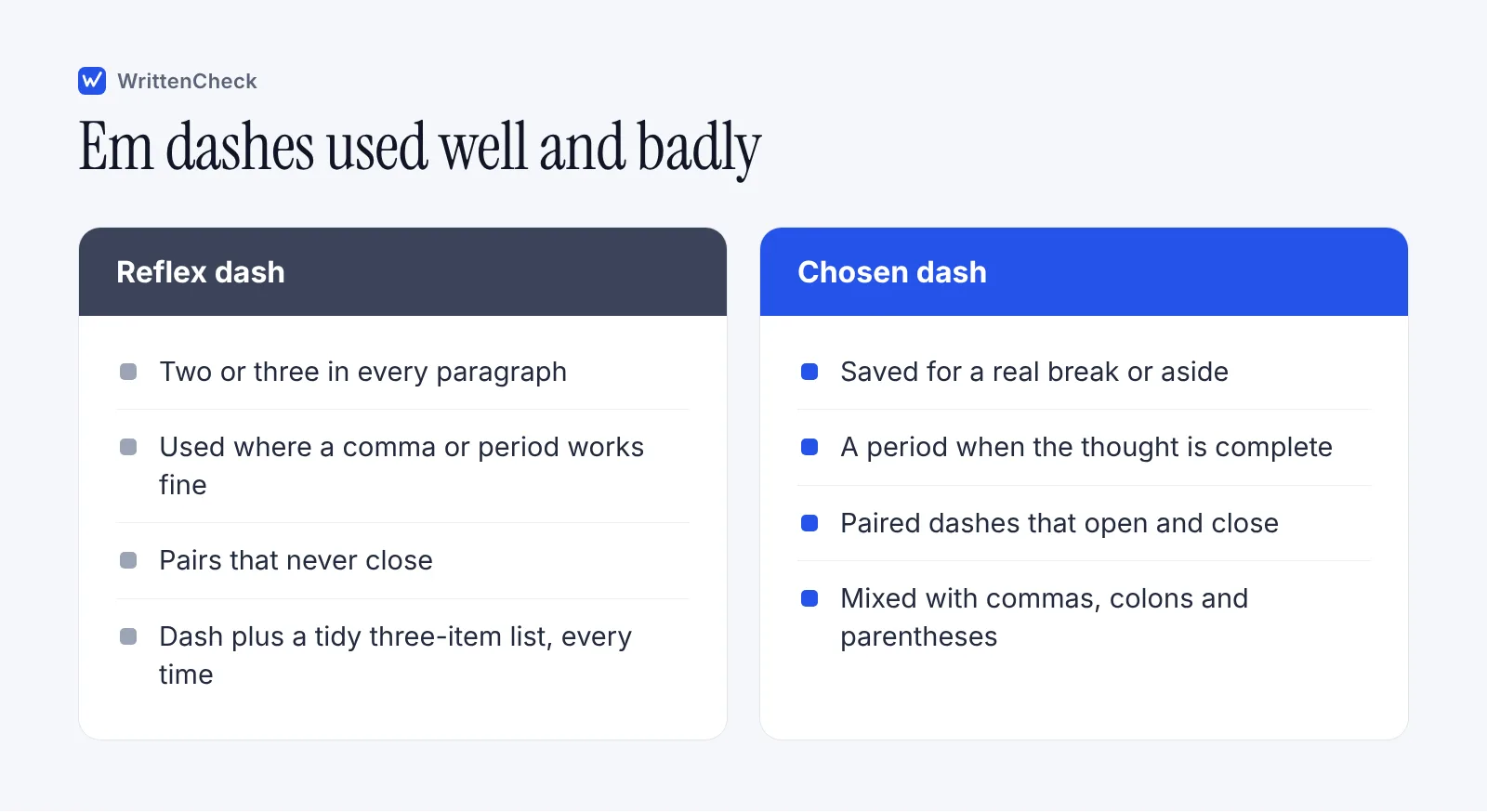
Use them on purpose. A dash should mark a real break, and it reads best when it's rare.
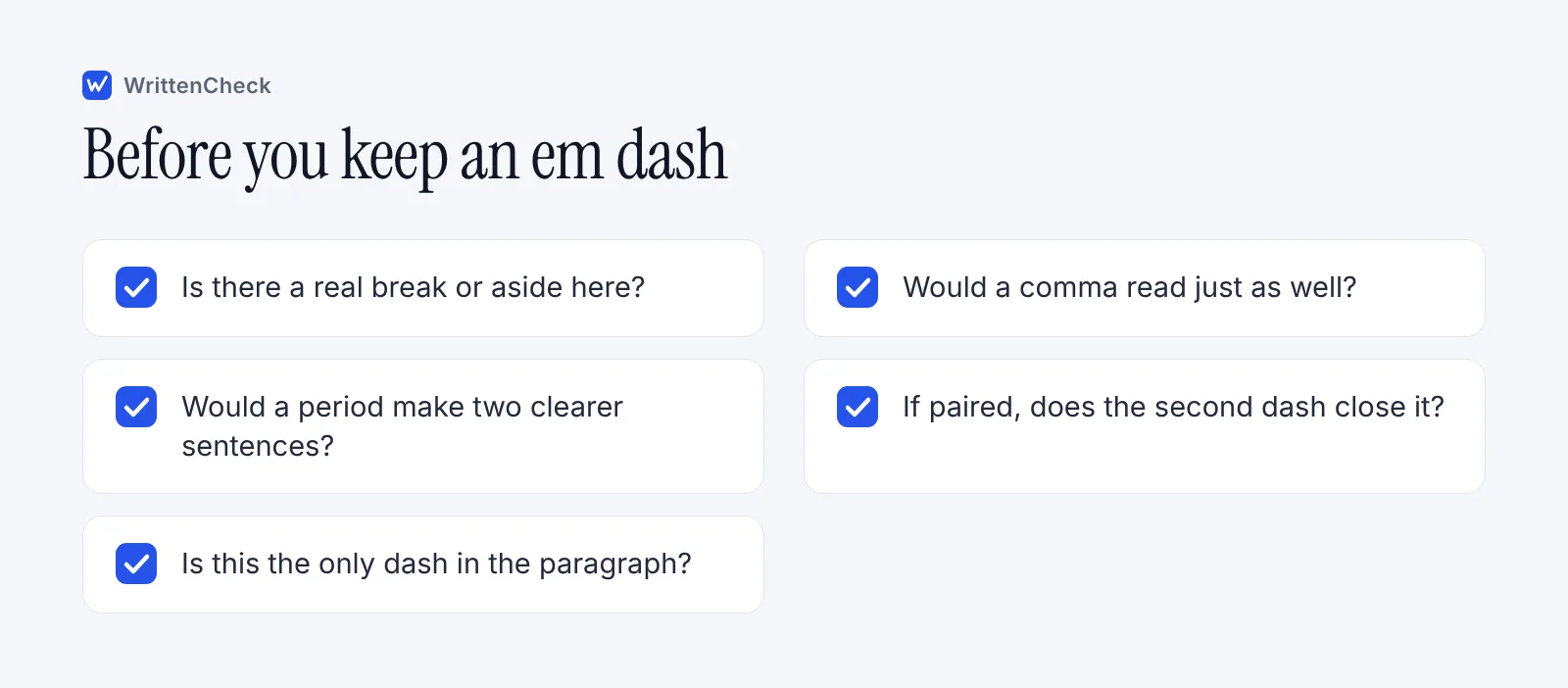
Here's an editing routine for dashes:
Search your draft for the dash. In Word or Google Docs, paste the character into Find.
Count them per paragraph. More than one in most paragraphs is a sign you're leaning on it.
Test each one against a comma. If a comma reads just as well, use the comma.
Test it against a period. Many dashes join two complete thoughts that would be clearer as two sentences.
Check every pair. An aside that opens with a dash needs a second dash to close it.
Keep the best ones. The dash that marks a real turn or a sharp aside earns its place.
Here's an example we wrote, before and after:
Before: Good feedback is specific—it names what worked—and it's timely—students get it while the work still matters to them—which is why it changes behavior.
After: Good feedback is specific. It names what worked. It's also timely—students get it while the work still matters to them.
The second version keeps one dash where there's a real aside. The rest became periods. It reads faster and sounds more like a person talking.
Should you stop using em dashes?
If you like them, keep them. The em dash AI theory is a weak reason to drop a standard mark that writers have used for centuries.
What helps is variety. Mix dashes with commas, colons, parentheses and plain periods. A draft with one or two well-placed dashes reads as a choice. A draft with a dash in every sentence reads as a habit, whoever wrote it.
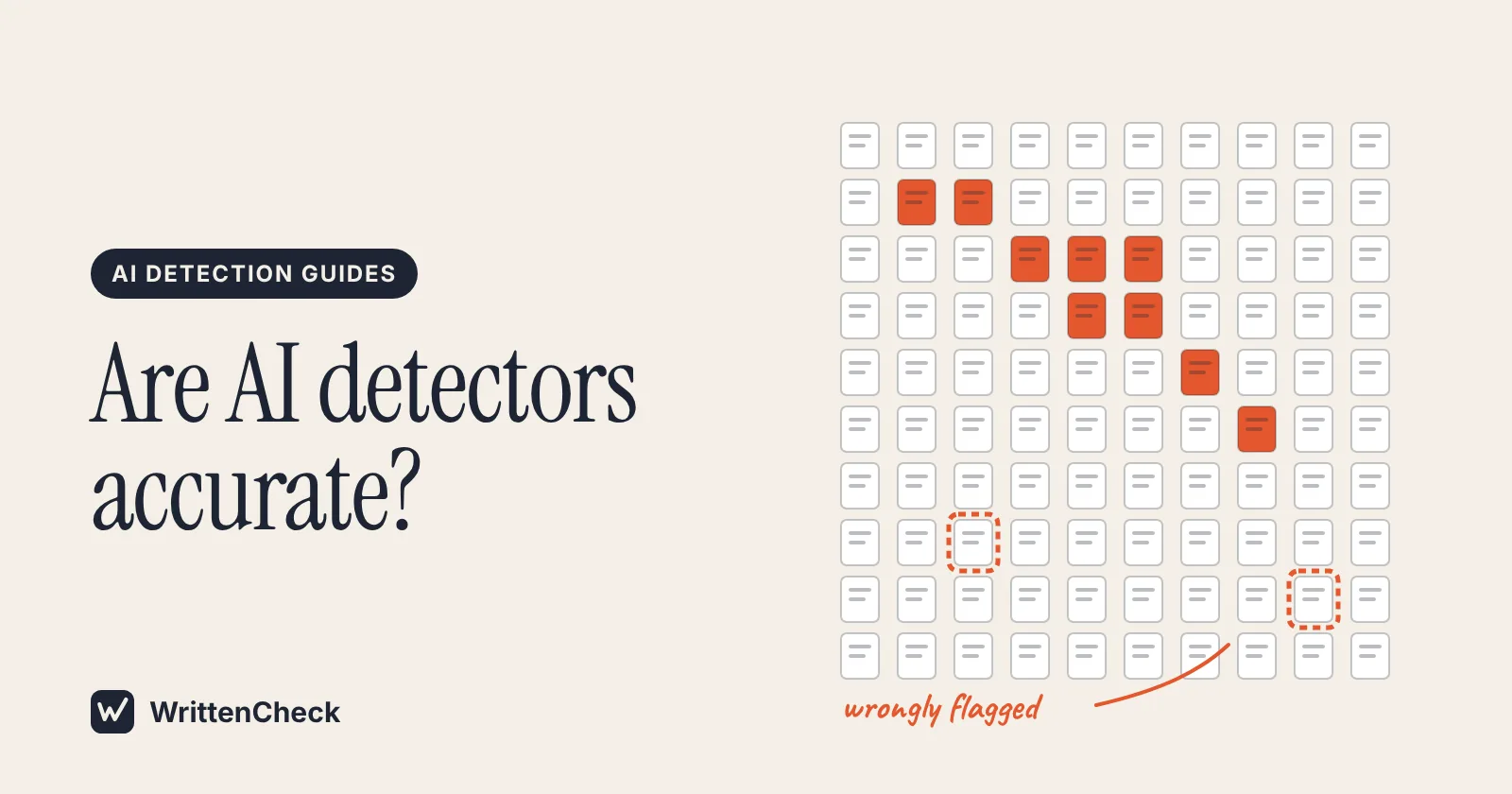
If you're worried how a draft comes across, you can paste it into our free AI detector. It gives a score for each sentence and highlights the ones that read most like AI, which tells you more than counting punctuation. Scores are estimates, and they're weaker on short texts. Our guide on whether AI detectors are accurate explains what affects them.
Start with your last long email or essay. Find every em dash, run the checklist above, and keep the ones that pass.
Frequently asked questions
Is using an em dash a sign of AI?
Not on its own. Em dashes are a standard punctuation mark that writers used long before AI chatbots, and Microsoft Word inserts them automatically when you type two hyphens. Some AI models use the mark heavily, while others use almost none. A text with many em dashes might get a second look, but it isn't evidence of AI use.
Why do people think em dashes mean AI?
Many readers noticed AI chatbots using em dashes often, and data supports a broad trend. A 2026 preprint found the share of medRxiv preprints with an em dash in the Discussion section rose from about 4% before late 2022 to about 20% in 2025. The study itself says it can't prove AI caused the rise.
How do I type an em dash?
On a Mac, press Option, Shift and Hyphen together. In Microsoft Word on Windows, press Ctrl and the minus key on the number pad, or type two hyphens between words and let AutoCorrect convert them. Chicago style uses no spaces around the dash, while many newspapers add spaces.
What's the difference between an em dash and an en dash?
An em dash is the longest dash, about the width of a capital M. It sets off asides or marks a break in a sentence. An en dash is shorter, about the width of a capital N, and in formal typesetting it mostly shows ranges, such as page or year spans. A hyphen is shortest and joins words, as in "well-known."
Should writers stop using em dashes because of AI?
No. The em dash is a correct, flexible mark that style guides still recommend for asides and sudden breaks. Avoid overusing it, the same advice editors gave before AI chatbots existed. Use one where there's a real break, and choose commas, periods or parentheses where they read better. Variety reads more naturally than any single mark.
Do AI detectors look for em dashes?
Detectors generally look at statistical patterns across whole sentences and passages, such as how predictable the wording is, rather than one character. Punctuation can be part of a passage's overall pattern, but a single mark doesn't decide a result. For a fair read, look at which sentences get flagged and why, and weigh that with other evidence about how the text was written.
Sources
How to Use Em Dashes, En Dashes, and Hyphens, Merriam-Webster, accessed October 2026
Hyphens and Dashes: A Refresher, CMOS Shop Talk, The Chicago Manual of Style, January 2024 (updated April 2025)
A Dash of Poetic License, Russell Harper, CMOS Shop Talk, October 2019
Punctuation Marks for Achieving Emphasis, Purdue OWL, Purdue University
Em-ergence of the em-dash: a population-level rise in em-dash frequency in medRxiv preprints at the dawn of the large-language-model era, Przemysław Czuma, arXiv preprint, June 2026
The Last Fingerprint: How Markdown Training Shapes LLM Prose, E. M. Freeburg, arXiv preprint, March 2026


Comments