There's no single tell that proves a person didn't write something. That's the honest starting point for anyone trying to work out how to tell if something is written by AI. What you can do is run a handful of checks, in the right order, and collect evidence instead of trusting a hunch.
This guide gives you that method. It works on an essay, a blog post, a product review or a cover letter. You'll see which checks are objective (facts, citations), which are softer (style, voice), and why your instinct is the least reliable tool you have.
If you want the technical side first, read how AI detectors work. This post is about what you, the reader, can check with your own eyes.
How to tell if something is written by AI
You can tell if something is written by AI by stacking evidence. Check whether the facts and citations hold up, since AI tools often invent sources. Then look for missing specifics, a flat or overly balanced voice, and repeated stock phrases and structures. Add context such as drafts or version history, and use a detector as one signal. No single clue is proof, so look for several pointing the same way.
Why can't you trust your gut feeling?
Because research keeps showing that people are bad at this and don't know it. Most readers perform close to chance, and they feel sure of themselves while doing it.
A few studies make the point:
In 2021, Elizabeth Clark and colleagues at the University of Washington found that untrained evaluators told GPT-3 text from human text at chance level. Training raised accuracy only to about 55%.
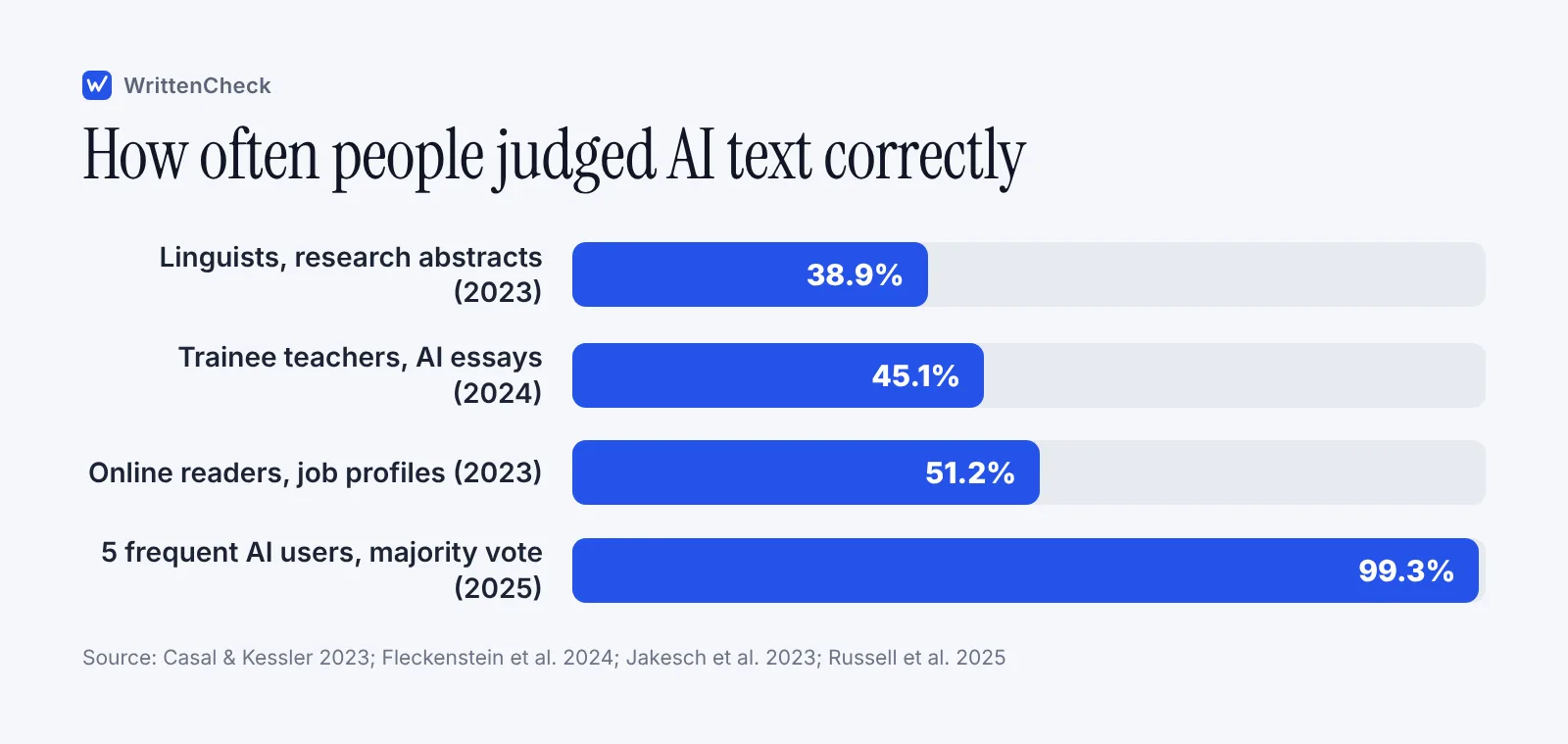
In 2023, Maurice Jakesch, Jeffrey Hancock and Mor Naaman ran six experiments with 4,600 participants in PNAS. People spotted AI-written self-descriptions (dating, hosting and job profiles) about 51 to 52% of the time.
In 2023, J. Elliott Casal and Matt Kessler asked 72 linguists and journal reviewers to sort research abstracts. They got it right 38.9% of the time.
In 2024, Johanna Fleckenstein and colleagues found that trainee teachers correctly identified only 45.1% of AI-written essays. Both trainee and experienced teachers were overconfident.
The Jakesch study also explains why people fail. Participants treated first-person pronouns, family topics and contractions as signs of a human. Those cues showed up just as often, or more often, in the AI text. Gut feeling runs on rules of thumb, and the rules are wrong.
There's one hopeful result. In 2025, Jenna Russell, Marzena Karpinska and Mohit Iyyer found that people who use AI writing tools a lot were far better judges. Voting together, five such readers classified 299 of 300 articles correctly. Readers who rarely used AI tools did no better than chance. So skill comes from exposure and a method. A feeling that "this sounds off" isn't enough.
Step 1: Do the facts check out?
Start here, because it's objective. Pick the two or three most specific claims in the text and check them.
AI writing tools produce fluent text, and fluency hides errors well. Look for:
Wrong details stated with confidence. A date, a statistic, a quote that sounds right but isn't.
Facts that are true but generic. "Exercise improves mental health" can be defended forever. It also tells you nothing about who wrote it.
Events after the tool's training data, or missing recent events. An essay about a fast-moving topic that ignores the last year of news is worth a second look.
A human can make every one of these mistakes. What you're looking for is a pattern of confident vagueness or confident error, especially next to polished prose.
Step 2: Do the citations exist?
Open every source. This is the single most useful check a reader can run, because fake references are common in AI output and easy to verify.
In a 2023 study in Scientific Reports, William Walters and Esther Isabelle Wilder asked two versions of a popular chatbot to write short literature reviews. For the older model, 55% of the 222 citations were fabricated. For the newer model, 18% of 414 were. Many of the real citations also had errors in authors, titles or dates.
Here's how to check a reference in under a minute:
Paste the exact title into a search engine or Google Scholar in quotes.
If it exists, check the author names and year against the text.
Open the source and find the claim the writer attributes to it.
If there's a DOI, paste it into doi.org and see where it goes.
Note any source that doesn't exist, or that exists but says something different.
A single citation error could be sloppiness. Two invented sources in one short essay is strong evidence that something generated the reference list.
What does AI writing look like at the sentence level?
It tends to be smooth, even and predictable. Specific words and sentence shapes show up far more often than they do in human writing.
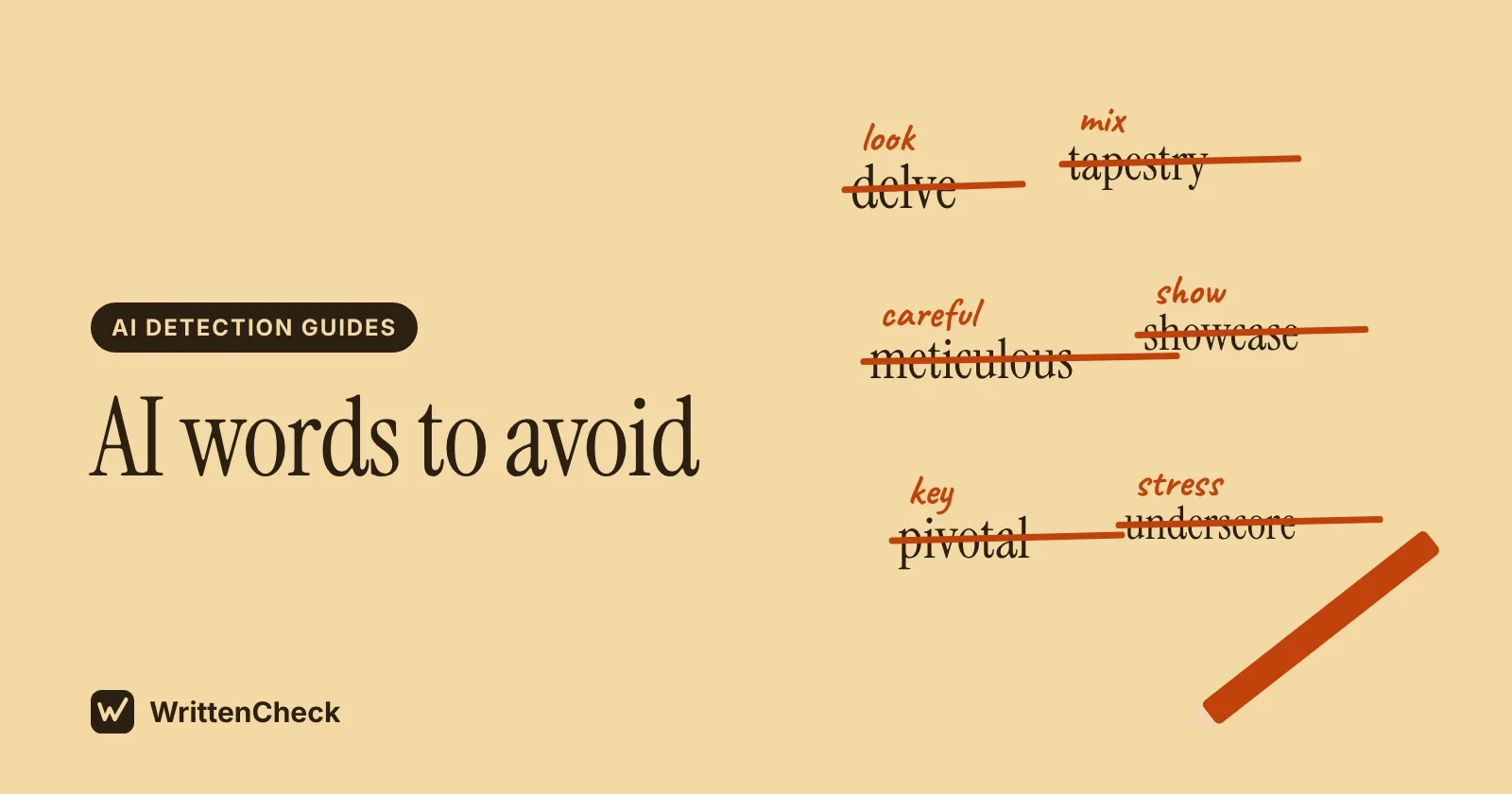
Researchers have measured some of this. In a 2025 Science Advances paper, Dmitry Kobak and colleagues tracked word use in more than 15 million biomedical abstracts. After AI chatbots arrived, "underscores" appeared about 14 times more often than expected in 2024 abstracts, and "showcasing" about 11 times. The surge was almost all style words, mostly verbs and adjectives. Also in 2025, a PNAS study led by Alex Reinhart at Carnegie Mellon found that instruction-tuned models used present participial clauses ("..., highlighting the need for...") at 2 to 5 times the human rate.
This table sorts common signals by how much weight they deserve.
Signal | What it looks like | How much weight |
|---|---|---|
Invented or mismatched citations | A paper that doesn't exist, or says something else | High, and you can verify it |
Confident factual errors | Wrong dates, made-up statistics | Medium to high |
No specifics at all | No names, numbers, places or personal detail | Medium |
Stock vocabulary in clusters | Underscore, showcase, intricate, palpable | Low to medium |
Tidy structure everywhere | Every paragraph has three points and a summary line | Low |
Trailing "-ing" clauses | "..., highlighting the importance of..." | Low |
Em dashes, formal tone, no typos | Polished punctuation and grammar | Very low |
Notice where formality and clean grammar sit. Careful human writers, second-language writers and anyone using a grammar checker produce polished text too. Treating polish as a red flag punishes the wrong people.
How does voice give AI text away?
AI text often sounds like nobody in particular. It's balanced, positive and general, and it rarely commits to a view or a memory.
Read the passage below. We wrote it as an example to show common patterns.
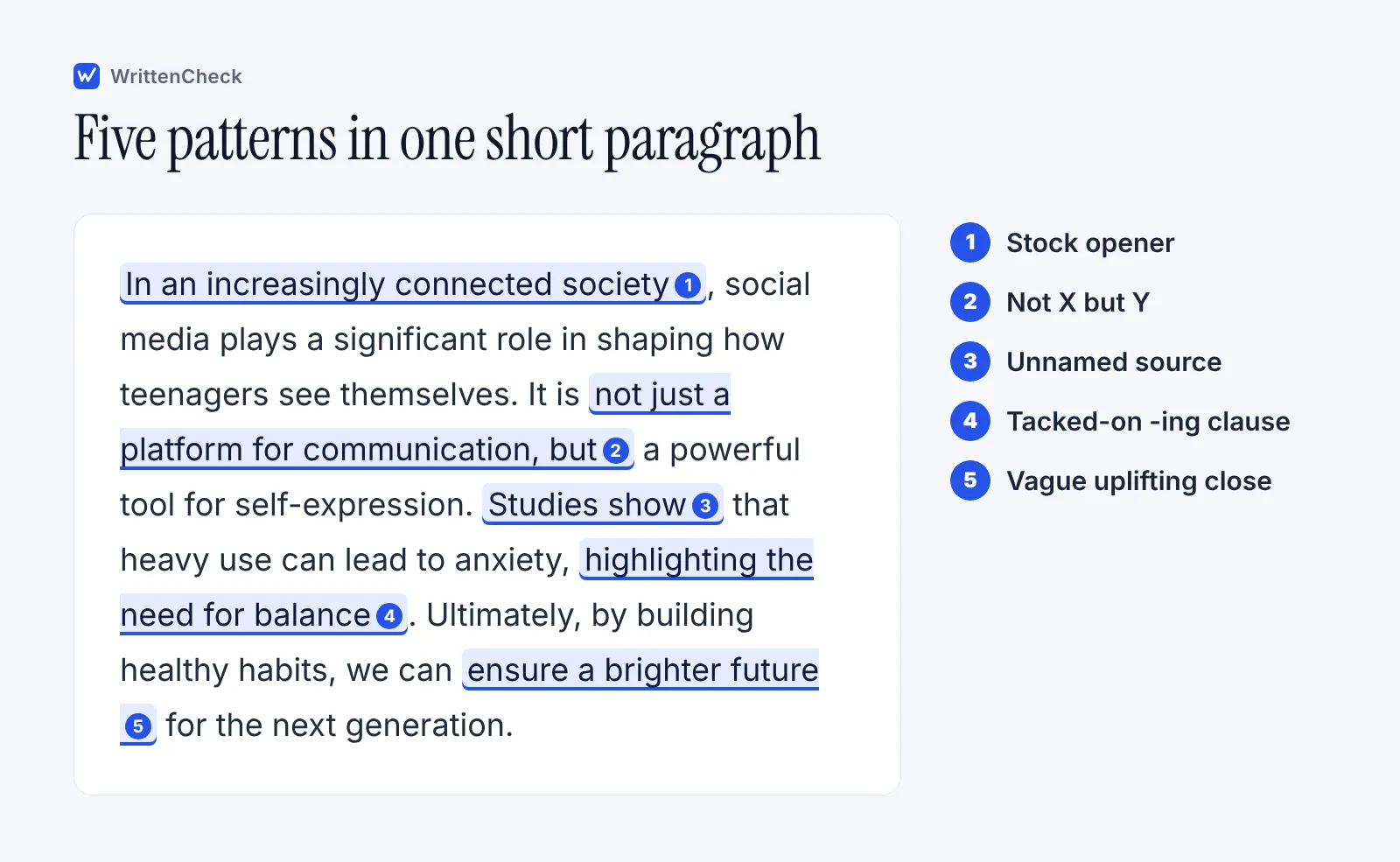
None of those phrases is damning alone. Plenty of teenagers write "studies show." What stands out is that the paragraph has five patterns in four sentences and not one specific detail. It names no study, no app, no age group and no personal experience.
Now compare a version we wrote in a human register:
My sister deleted Instagram in March after a week where she checked it 140 times a day (she counted). She says the first three days were awful and then she stopped reaching for her phone at red lights.
It's messier. It's also specific, a little funny, and clearly from somebody. When you read for voice, ask three questions:
Could only this writer have written it, or could anyone?
Does the text take a side, or does it weigh "both sides" and land nowhere?
Are there moments of surprise, humor or awkwardness that a person leaves in?
The Russell study found that expert readers relied on exactly this kind of clue. Beyond vocabulary, they flagged predictable sentence structure, a lack of originality and quotes in which every speaker sounded the same.
How to check if an essay is AI generated
For an essay or assignment, you usually have more than the text. Use it. Process evidence is far stronger than style.
Run the fact and citation checks above. Note anything you can't verify.
Compare with earlier work. A sudden jump in vocabulary, structure or topic knowledge is worth a question. It isn't a verdict.
Look at the drafting history. Google Docs and Microsoft Word both keep version history. Writing that grows over several sessions looks very different from one large paste.
Check the prompt match. AI text often answers a slightly more general question than the one the assignment asked.
Ask the writer about it. A five-minute chat about a source or an argument tells you more than any scan.
Teachers can find a fuller workflow in how to tell if a student used AI. Students who want to know what to expect can read how teachers check for AI.
When should you use an AI detector, and how do you read it?
Use a detector after your own checks, as one more piece of evidence. Read the sentence-level results as well as the headline number.
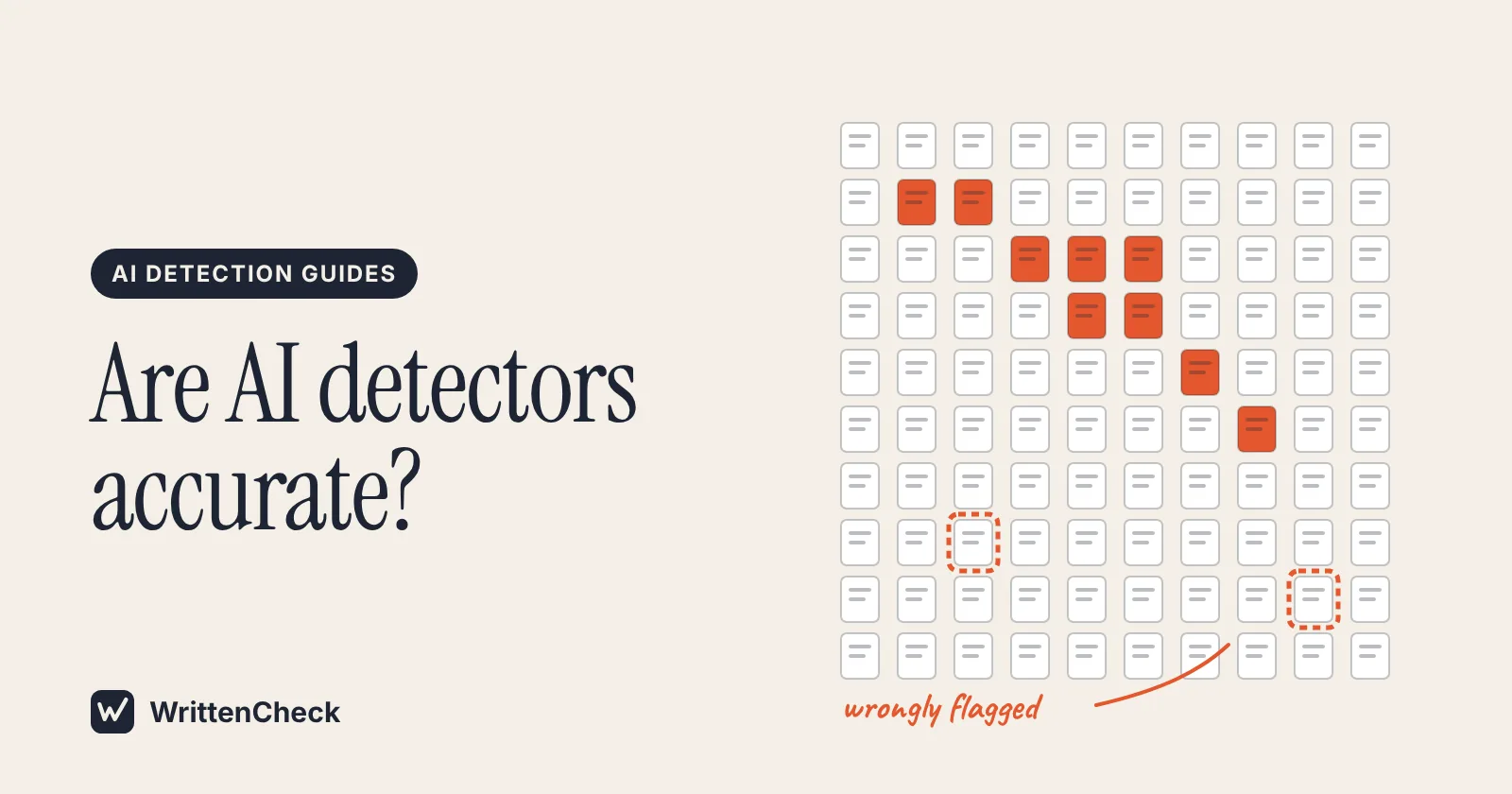
A detector is software that estimates how likely it is that a passage was produced by a language model, based on statistical patterns in the wording. It can't see who typed the words or whether someone used AI for one paragraph and wrote the rest. Our guide on whether AI detectors are accurate covers the limits in detail.
When you read a result:
Look at which sentences are flagged. Do they match the ones you already found generic? Or is the tool flagging a definition or a list of facts, which is hard for anyone to write in an original way?
Check the length. Short texts give weak estimates.
Think about who wrote it. Very formal writing, writing in a second language and AI drafts that a person edited heavily are all harder to judge.
Treat the score as an estimate. It is never proof of misconduct.
You can paste a draft into our free AI detector to see an overall score, a likely range, a confidence level and which sentences read most like AI. It checks 80 to 3,000 words at a time and works in 16 languages. You can also read how our detector works.
What should you do if you're still not sure?
Weigh what you have, then decide what's at stake. For a random blog post, "probably AI" is fine as a private judgment. For a grade, a job application or a published article, you need more.
Sort your evidence into two piles:
Strong evidence | Weak evidence |
|---|---|
A citation that doesn't exist | Uses "underscore" or "showcase" |
A quote nobody said | Polished grammar, no typos |
Writing history shows one large paste | Formal or neutral tone |
Writer can't explain their own argument | Detector score alone |
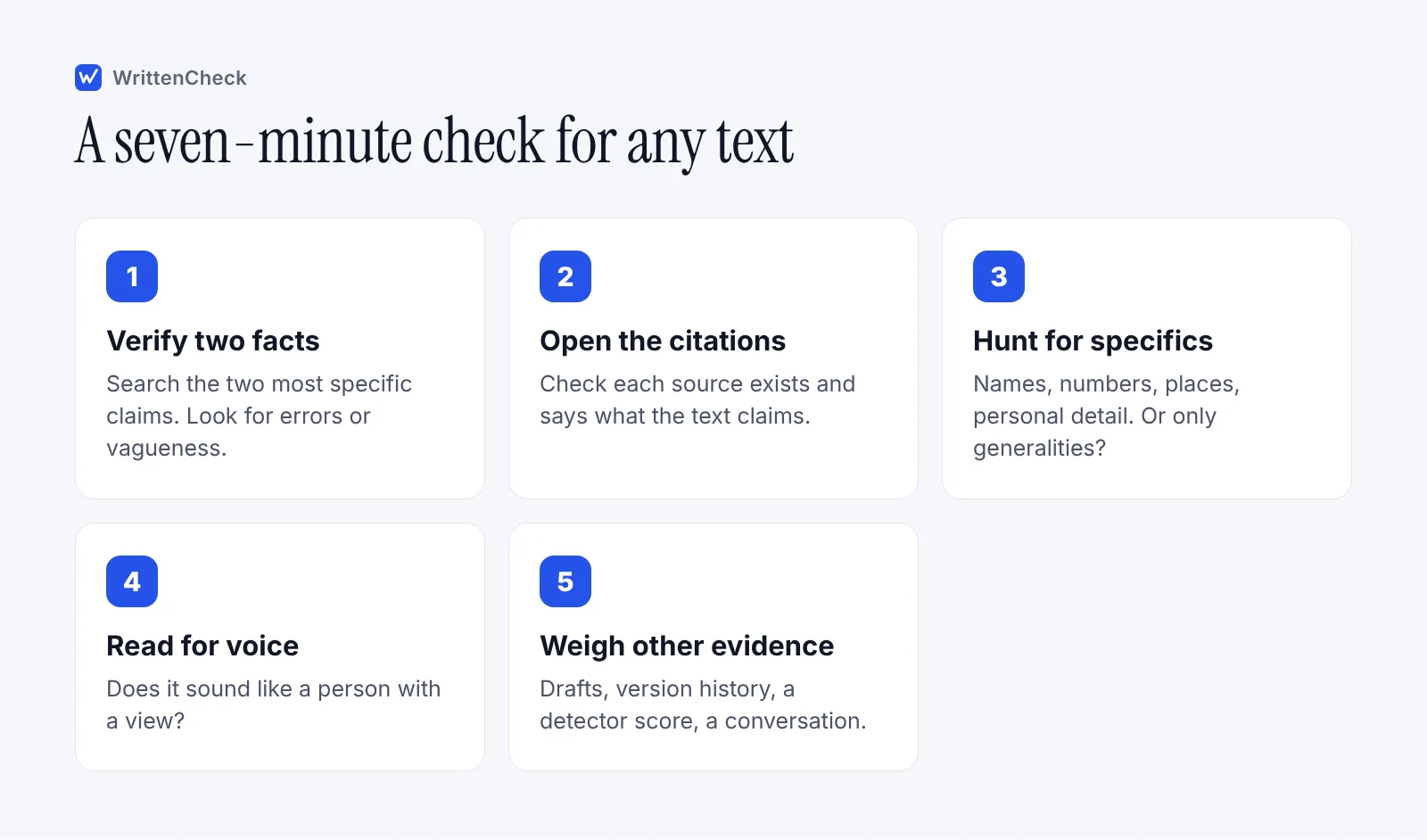
If everything sits in the weak pile, you don't have a case. If you have strong evidence, have a calm conversation and ask open questions. Your next step is simple. Pick one text you're unsure about today, run the five-step check above, and write down what you found before you decide anything.
Frequently asked questions
Can you tell if something is written by AI just by reading it?
Sometimes, but not reliably. Most studies find untrained readers perform close to chance, and they tend to be overconfident. People who use AI writing tools often do much better, because they've seen the patterns many times. Even then, reading alone gives you a judgment. It gives you no proof. Pair it with checks you can verify, such as testing whether the citations exist and whether the facts are correct.
What is the most reliable sign of AI writing?
Invented sources are the clearest sign a reader can check. AI chatbots have been shown to produce references that look real but don't exist, or that exist but say something else. Open each cited source and confirm it supports the claim. A human can make a citation mistake, but several fake references in one short piece is hard to explain any other way.
Does using words like "underscore" mean a text is AI-generated?
No. Words such as underscore, showcase and intricate rose sharply in academic writing after AI chatbots appeared, but people used them before and still do. One word proves nothing. A cluster of these words, combined with vague claims, no specifics and a very even structure, is a reason to look closer and run more objective checks.
How do I check if an essay is AI generated without a detector?
Check the facts and open every citation. Compare the essay with the writer's earlier work. Look at the version history in Google Docs or Microsoft Word to see how the text grew. See whether it answers the exact assignment question. Then talk to the writer about one argument or source. Process evidence like drafts and notes is far stronger than any style clue.
Are AI detectors more accurate than people?
It depends on the people and the text. Untrained readers often do worse than detectors, while experienced AI users can do very well. Detectors also have known weak spots, including short texts, heavily edited AI drafts, formal human writing and second-language writers. The safest approach is to treat a detector as one piece of evidence next to your own checks, never as the final word.
Can AI writing be completely undetectable?
A well-edited AI draft can be very hard to tell apart from human writing, by people or software. That's why process evidence matters. Drafts, notes, version history and a conversation about the work reveal how a text was made in ways the final words can't. For teachers, assignments that build in these steps make the question easier to answer.
Sources
All That's 'Human' Is Not Gold: Evaluating Human Evaluation of Generated Text, Clark et al., ACL-IJCNLP 2021, August 2021
Human heuristics for AI-generated language are flawed, Jakesch, Hancock and Naaman, PNAS, March 2023
Can linguists distinguish between ChatGPT/AI and human writing?, Casal and Kessler, Research Methods in Applied Linguistics, December 2023
Do teachers spot AI? Evaluating the detectability of AI-generated texts among student essays, Fleckenstein et al., Computers and Education: Artificial Intelligence, June 2024
People who frequently use ChatGPT for writing tasks are accurate and robust detectors of AI-generated text, Russell, Karpinska and Iyyer, ACL 2025, 2025
Fabrication and errors in the bibliographic citations generated by ChatGPT, Walters and Wilder, Scientific Reports, September 2023
Delving into LLM-assisted writing in biomedical publications through excess vocabulary, Kobak et al., Science Advances, July 2025
Do LLMs write like humans? Variation in grammatical and rhetorical styles, Reinhart et al., PNAS, February 2025
GPT detectors are biased against non-native English writers, Liang et al., Patterns, July 2023


Comments