Getting an email that says your work "may have been generated by AI" is a horrible feeling, especially when you wrote every word. If you've been falsely accused of using AI, the next few days matter. The good news is that most cases come down to evidence, and you probably have more of it than you think.
This guide gives you a calm plan. It covers what to do in the first 24 hours, what proof to gather, what to write to your teacher, and how appeals usually work. It also explains why honest writing gets flagged, so you can talk about it with confidence.
You're not the only one this has happened to. In a Center for Democracy and Technology survey reported by K-12 Dive in January 2025, 1 in 5 US high school students said they or someone they know had been accused of using AI to cheat without proof, or had been cleared after an accusation.
What should you do if you're falsely accused of using AI?
If you're falsely accused of using AI, stay calm and reply in writing. Ask what evidence the concern rests on and which policy applies. Then gather proof of your process, such as version history, drafts, notes, sources and browser history. Offer to meet, explain your work or write in person. If the outcome is still unfair, use your school's formal appeal process.
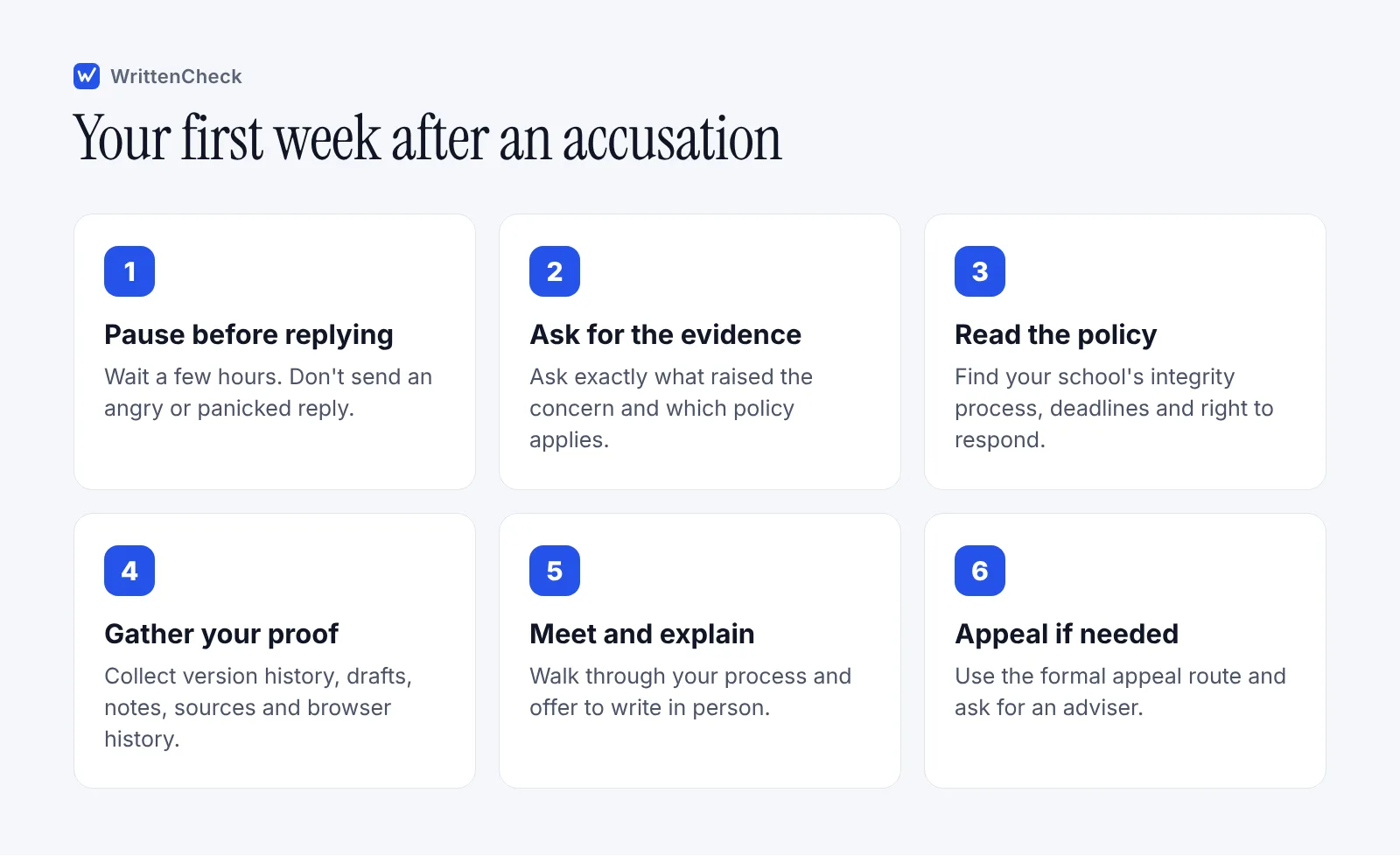
The order matters. Students who reply in anger, or who rush to "prove" innocence by running their essay through five detectors, often make the conversation harder. Slow, organized and polite works far better.
How should you reply in the first 24 hours?
Wait a few hours before you answer, then send a short, polite reply that asks questions. Don't admit to something you didn't do, and don't accuse your teacher of anything.
Things to avoid in that first reply:
Long emotional explanations. Save the detail for the meeting.
Screenshots of other detectors "proving" you're human. A second score doesn't settle much, and it can look defensive.
Rewriting or deleting anything in your document. Leave the history exactly as it is.
Things to ask for:
What specifically raised the concern. Was it a detector score, a change in style, a source, something else?
A copy of any report or highlighted passages.
The name of the policy or honor code section involved.
What happens next, and by when you need to respond.
An example email to your teacher
Here's an example you can adapt. Keep it short.
Subject: Question about my essay on [topic]
Hi [Teacher's name],
Thanks for letting me know about your concern with my essay. I wrote it myself, and I'd like to show you how I did it.
Could you tell me what raised the concern, and share any report or passages you looked at? Could you also point me to the policy that applies, so I understand the process?
I have my Google Docs version history, my outline and notes, and my source list. I'm happy to meet, walk you through my drafts, or answer questions about the essay in person.
Thank you, [Your name], [Class and period]
That email does three things. It states your position once. It asks for the evidence. And it offers proof and a conversation, which is what most teachers want.
What evidence proves you didn't use AI?
The strongest evidence shows your process over time. Nothing proves a negative perfectly, but a record of your work growing across days is very hard to argue with.
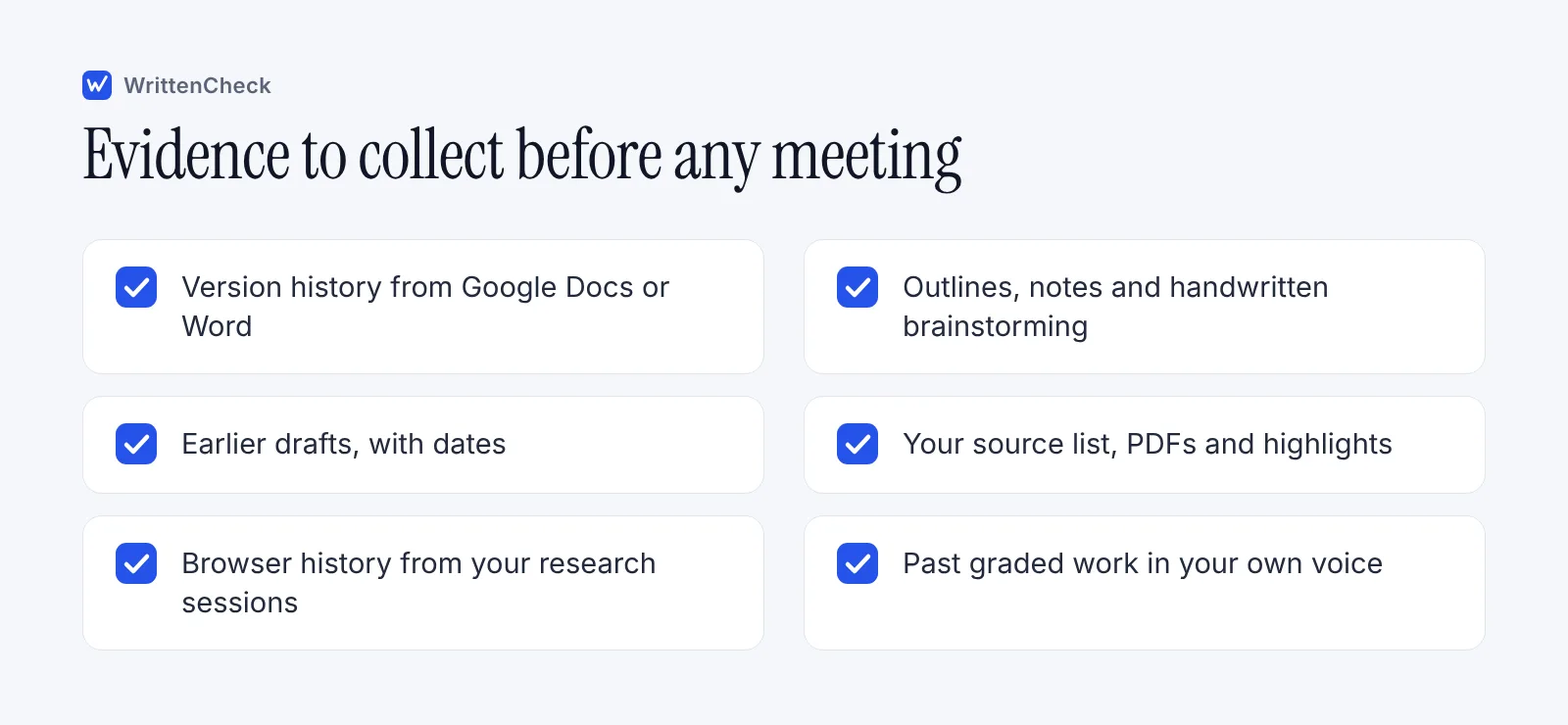
Evidence | What it shows | Where to find it |
|---|---|---|
Version history | Your text growing and changing over time | Google Docs: click Last edit at the top right. Word: files saved to OneDrive or SharePoint |
Drafts and outlines | How your ideas developed | Your files, email to yourself, cloud storage |
Notes and brainstorms | Thinking before writing | Notebooks, phone photos, notes apps |
Sources and highlights | That you did the reading | PDFs, library account, citation manager |
Browser history | When you researched and what you read | Your browser history for the dates you worked |
Past graded work | Your normal voice and habits | Your class portal or old files |
A few tips for each:
Version history. In Google Docs, according to the Google Docs Help page "Find what's changed in a file," you open the document on a computer and click Last edit at the top right. Your teacher needs edit access to see it, so offer to share it. Take screenshots of key sessions with timestamps as a backup.
If you wrote elsewhere first. Maybe you drafted on paper or in a notes app, then pasted it in. That's fine. Bring the paper or the note, and explain the paste.
Browser history. It shows the articles and library pages you opened while researching. Export or screenshot the relevant dates only. You don't need to share your whole history.
The University at Buffalo, in its guidance for instructors, lists "earlier drafts, time-stamped documents, etc." as the kind of material students may provide. Your school may use similar language, so check its policy.
Why does honest writing get flagged as AI?
AI detectors estimate how predictable your text is. Clear, simple or very formal writing can look predictable, so human work gets flagged sometimes. This is called a false positive.
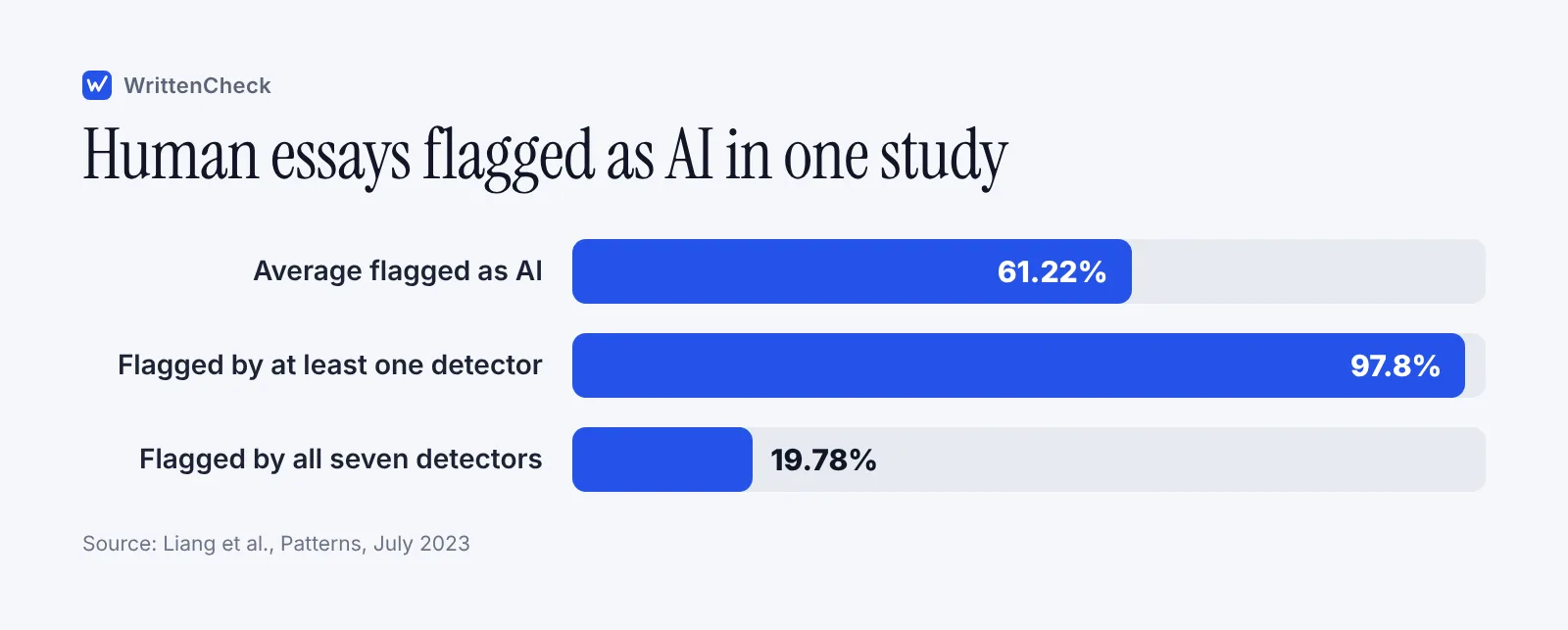
Researchers have measured this. In a 2023 study in the journal Patterns, Weixin Liang and colleagues at Stanford ran 91 human-written TOEFL essays, by non-native English speakers, through seven AI detectors. On average, the detectors labeled 61.22% of them as AI-generated. And 97.8% were flagged by at least one detector.
A separate 2023 study in the International Journal for Educational Integrity, led by Debora Weber-Wulff, tested 14 detection tools. The authors concluded that the tools "are neither accurate nor reliable." They also wrote that detector reports "cannot be used as the only basis for reporting students for cheating."
Writing that tends to get flagged more often:
Writing by people using English as a second language
Very formal, structured writing, like lab reports or legal summaries
Short texts, where there's little to measure
Writing that follows a strict template or rubric closely
Our explainers on how AI detectors work and whether AI detectors are accurate go deeper. If you mention this research in your meeting, keep it brief. Your own drafts will carry more weight than any study.
How do you explain your work in a meeting?
Bring your evidence, and be ready to talk about your ideas. If you wrote the essay, a short conversation usually shows it.
Before the meeting:
Reread your essay twice. Know your argument, your examples and why you chose them.
Review your sources. Be ready to say where each quote or number came from.
Put your evidence in order. A simple folder with version history screenshots, drafts and notes, sorted by date.
Write three sentences about your process. For example: "I started with an outline on Monday. I wrote the body over two evenings. I rewrote the conclusion after your feedback."
Offer to write in person. Suggest a short timed piece on a related prompt, or offer to rewrite one paragraph in front of the teacher.
Many schools expect this kind of conversation. Western Washington University, for example, tells instructors to start with a "non-accusatory conversation" and to hear the student's perspective before any formal step.
During the meeting, answer plainly. If you used a grammar tool or a tutor, say so. Small, honest details make the rest of your account more believable.
The University of Portsmouth, in guidance for its personal tutors, notes that students can bring "a friend or representative" to formal meetings, and points to students' union caseworkers for help. Many schools offer something similar. Ask.
How do appeals work if the decision goes against you?
Most schools and universities have a formal process with a right to respond and to appeal. The details live in your student handbook or academic integrity policy.
Look for these:
Deadlines. Appeals often have short windows. Note the date the decision was sent.
Grounds for appeal. Common ones are procedural errors, new evidence, or a decision that doesn't match the evidence.
Who can help. A students' union adviser, an academic adviser, a school counselor, or an ombuds office. Parents can often help at the K-12 level.
What to submit. A short written statement plus your evidence, organized by date.
Stick to facts in your appeal. Say what happened, what evidence you provided, and why the decision doesn't fit that evidence. If the only evidence against you was a detector score, say so, and cite your school's own guidance if it warns against relying on one.
How can you prevent a false accusation next time?
You can't control a detector, but you can make your process easy to see. A few habits cover almost every case.
Write in one document with version history, and name versions at key points.
Keep your outline, notes and source list in the same folder.
Read the AI policy for each class. If something isn't clear, ask before you start.
If your class allows some AI use, disclose it the way your teacher asks.
Hand in drafts when they're offered, even if they're optional.
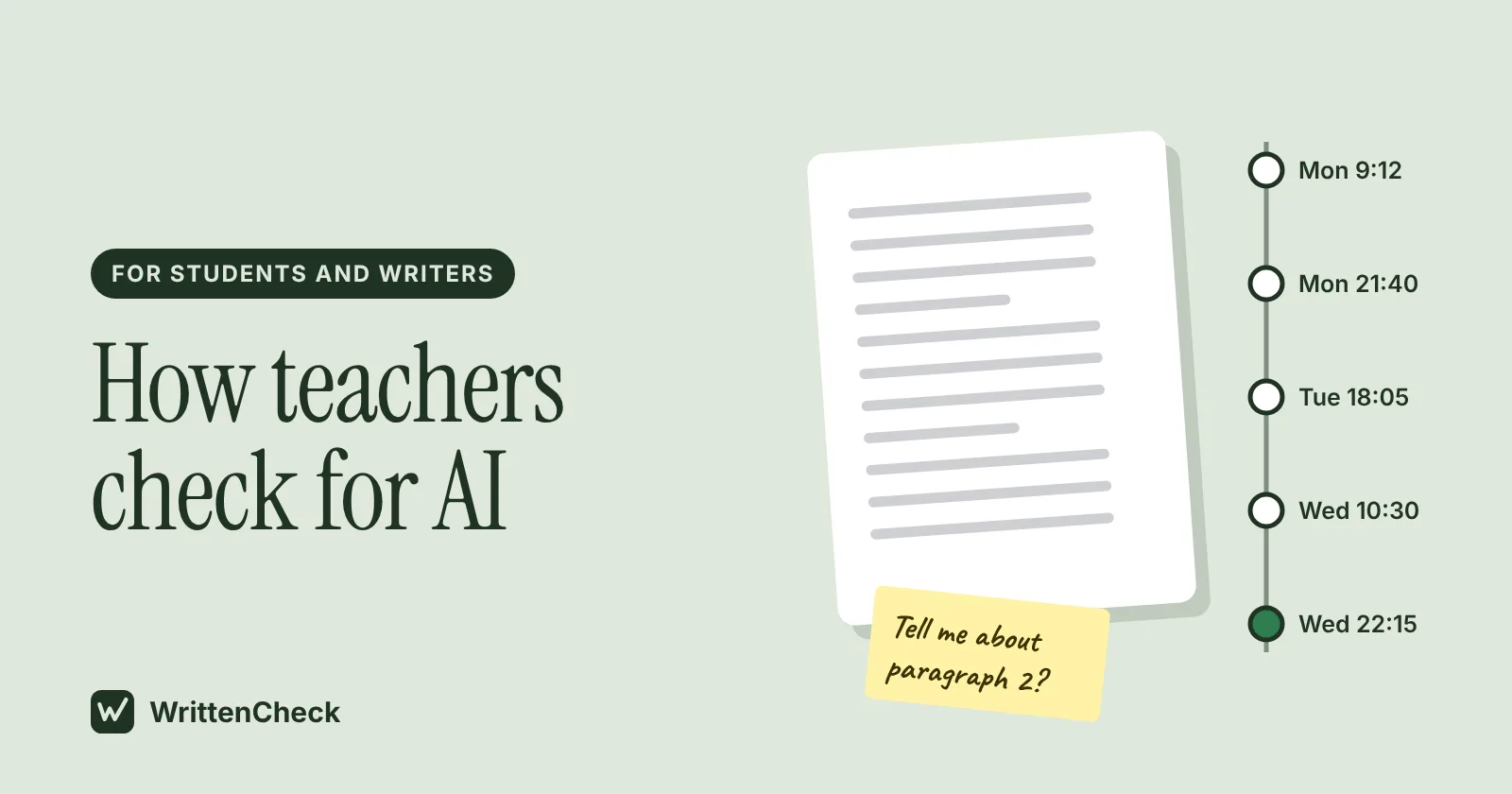
Our guide on how teachers check for AI shows what teachers look for, so you know which records matter most.
If you want to see how a piece reads before you submit, you can paste it into our free AI detector. It shows a score for each sentence and highlights the ones that read most like AI. It's an estimate, so use it to spot flat or generic passages worth rewriting in your own voice. Your drafts and notes remain your real protection.
Frequently asked questions
Can a teacher fail me based only on an AI detector score?
It depends on your school, but many policies say a score alone isn't enough. A 2023 study in the International Journal for Educational Integrity concluded that detector reports can't be the only basis for reporting students. If a detector is the only evidence, ask for the policy in writing and point out that you have drafts and version history showing your process.
How do I prove I didn't use AI if I have no version history?
Use whatever shows your process. Handwritten notes, outlines, earlier files, emails to yourself, your source list and browser history from your research days all help. Offer to explain your essay in detail or write a short piece in person on a related prompt. Your ability to discuss your own ideas is strong evidence on its own.
Should I run my essay through other AI detectors to defend myself?
It rarely helps much. Different detectors give different scores, and a low score from one tool doesn't cancel a high score from another. It can also make you look defensive. Spend that time organizing your drafts, notes and version history instead, since those show how you actually wrote the work.
Why was my writing flagged as AI when I wrote it myself?
Detectors look for predictable word choices and even sentence patterns. Clear, formal or simple writing can match those patterns. Research by Liang and colleagues in 2023 found that essays by non-native English writers were flagged far more often than essays by US eighth graders. Short texts and template-driven assignments are also harder to judge.
Can I ask for someone to come with me to the meeting?
Often, yes. Many universities let students bring a friend, adviser or students' union representative to formal integrity meetings. In K-12, a parent or guardian can usually attend. Check your school's policy, and ask ahead of time so the meeting isn't delayed.
What if I used AI for something my class allowed?
Say so clearly and show what you did. If the policy allowed AI for brainstorming or grammar checks, explain exactly how you used it and share any chat history or notes. Being upfront helps your credibility. If you're not sure whether a use was allowed, ask your teacher how they want it disclosed in future.
Sources
GPT detectors are biased against non-native English writers, Liang et al., Patterns, July 2023
Testing of detection tools for AI-generated text, Weber-Wulff et al., International Journal for Educational Integrity, December 25, 2023
Student, teacher AI use continued to climb in 2023-24 school year, K-12 Dive, January 15, 2025
Artificial Intelligence Guidance for instructors, University at Buffalo Office of Academic Integrity, 2025
Evaluating Student Work When AI is Suspected, Western Washington University, accessed October 2026
Supporting a tutee who is accused of academic misconduct, University of Portsmouth, accessed October 2026
Find what's changed in a file, Google Docs Editors Help, accessed October 2026
How to Use Version History in OneDrive and Microsoft 365, HP Tech Takes, July 31, 2026


Comments