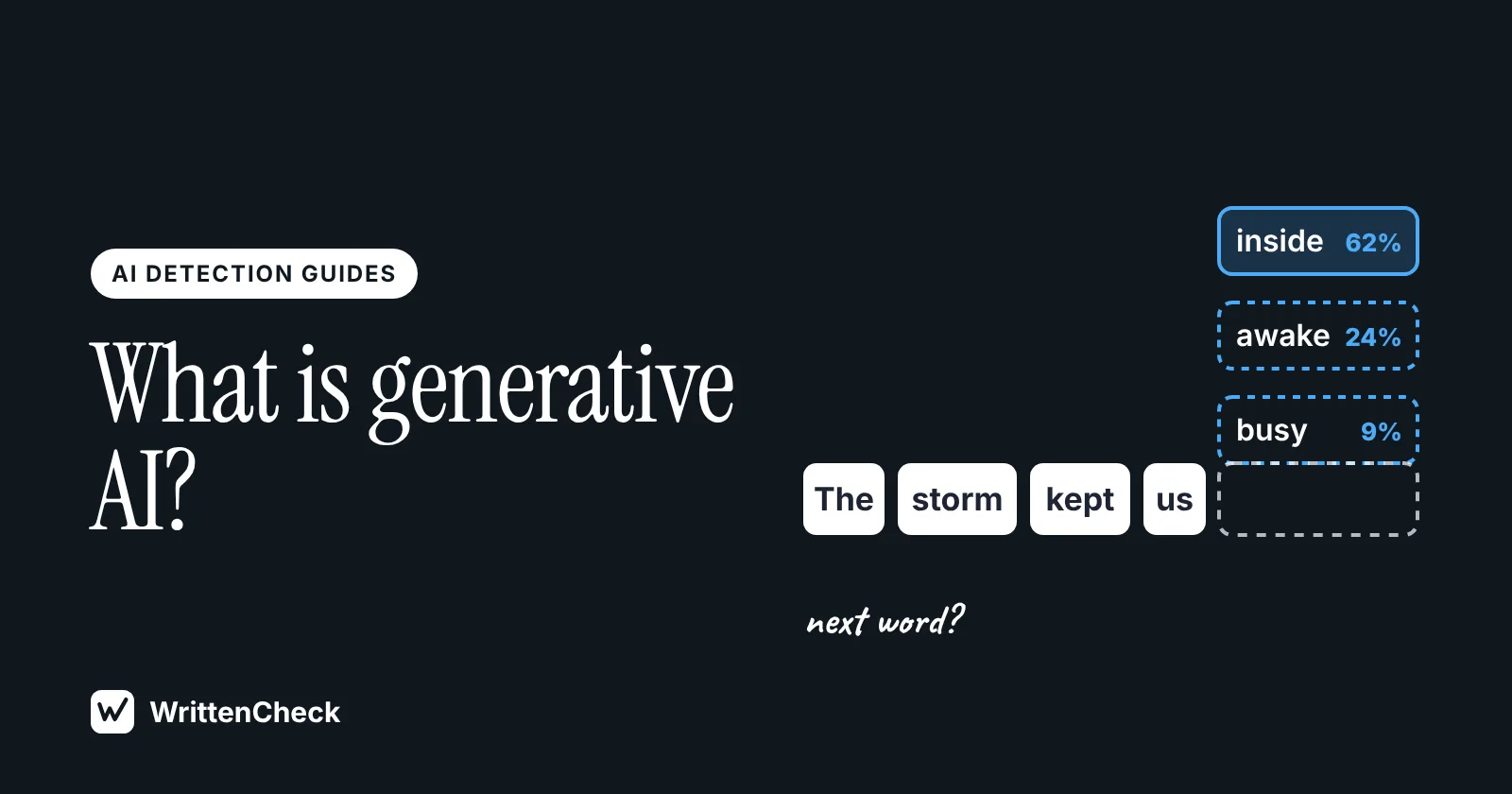
Generative AI is software that creates new content, such as text, images, audio, video or code, after learning patterns from huge amounts of existing examples. You type a request in everyday language and it produces something that didn't exist a second ago.
That's the short answer to "what is generative AI?" The longer answer matters if you teach, study or write, because how these tools work explains both why they're useful and why they get things wrong.
Below we cover the official definitions, how a large language model builds a reply word by word, generative AI examples by type, where it fails, and how to use it honestly.
What is generative AI?
Generative AI is a type of artificial intelligence that produces new content, such as text, images, music, video or code, in response to a prompt. It learns statistical patterns from very large training datasets, then uses those patterns to generate output that resembles what it learned. The US National Institute of Standards and Technology (NIST), using the wording of a 2023 US executive order, defines it as the class of AI models that "emulate the structure and characteristics of input data in order to generate derived synthetic content."
How official bodies define it
Three definitions are useful to know, because schools and employers often borrow them.
NIST (2024) describes generative AI as models that copy the structure of their input data to make new "synthetic content."
UNESCO (2023) describes it as technology that "automatically generates content in response to prompts written in natural-language conversational interfaces," and stresses that it produces new content rather than only finding existing content.
OECD (2023) defines an AI system more broadly as one that infers from its input how to generate outputs "such as predictions, content, recommendations, or decisions." Generative AI is the part of that family whose main output is content.
Generative AI versus other AI
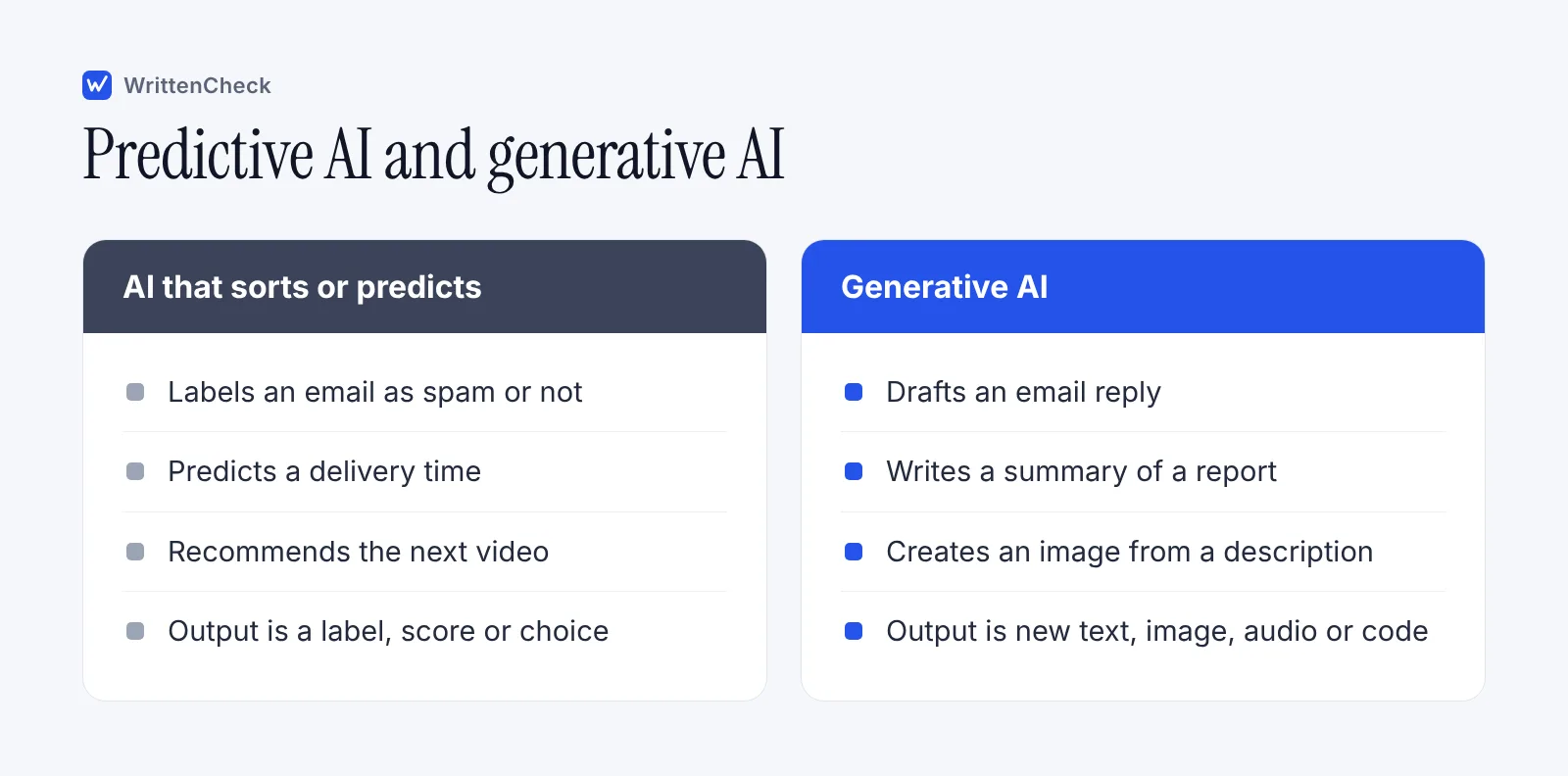
A lot of the AI people meet day to day sorts or predicts things. A spam filter labels email. A map app predicts arrival time. Generative AI produces something new. Both kinds learn from data, so the difference is in the output.
How does generative AI work?
Generative AI works in two stages. First, a model is trained on a huge collection of examples until it has learned patterns in them. Then, when you give it a prompt, it uses those patterns to produce new output, one small piece at a time.
Stage 1: training
For text models, training is mostly self-supervised. A widely used free online course on large language models explains that the model learns by "predicting the next word in a sentence having read the n previous words," and no human has to label the data. The text itself provides the answers. UNESCO's guidance notes the data comes from webpages, social media conversations and other online media.
After this pretraining, models are usually fine-tuned on smaller, more focused datasets so they follow instructions or suit a task. The same course points out that fine-tuning needs far less data than training from scratch, because the model already learned a lot in pretraining.
Stage 2: generation
When you send a prompt, the model doesn't look up an answer. It estimates which piece of text is most likely to come next, adds it, and repeats. UNESCO's guidance describes this as estimating "the probability of specific words or phrases" in context and using those probabilities to predict the next likely word.
Images, audio and video
Image tools often use a different method called diffusion. In a 2020 paper, Jonathan Ho, Ajay Jain and Pieter Abbeel showed how a model can make high-quality images by learning to reverse a process that adds noise. It starts from random noise and removes it step by step until an image appears.
What is a large language model?
A large language model, or LLM, is a generative AI model trained on very large amounts of text to predict the next token in a sequence. AI chatbots and writing assistants run on LLMs. "Large" refers to the scale of the training data and of the model itself.
If you've searched "what is an LLM," that's the whole idea. A 2021 Stanford report led by Rishi Bommasani called models like these foundation models, meaning they're "trained on broad data at scale" and can be adapted to many tasks. One base model can be tuned for chat, summaries, translation or code.
What is a token?
A token is the unit of text a model reads and writes. It can be a whole word, part of a word or a punctuation mark. That same course gives the example of "tokenization," which a common method splits into "token" and "ization." Frequent words stay whole and rare words get split into pieces.
What the Transformer changed
The best-known LLMs are built on the Transformer architecture. In 2017, Ashish Vaswani and seven co-authors published "Attention Is All You Need," which replaced older step-by-step designs with a mechanism called attention. Attention lets the model weigh every earlier word when choosing the next one. The paper reports that its large model trained in 3.5 days on eight GPUs, and the design was easy to run in parallel. That made it practical to train much bigger models.
How does an LLM write a sentence, step by step?
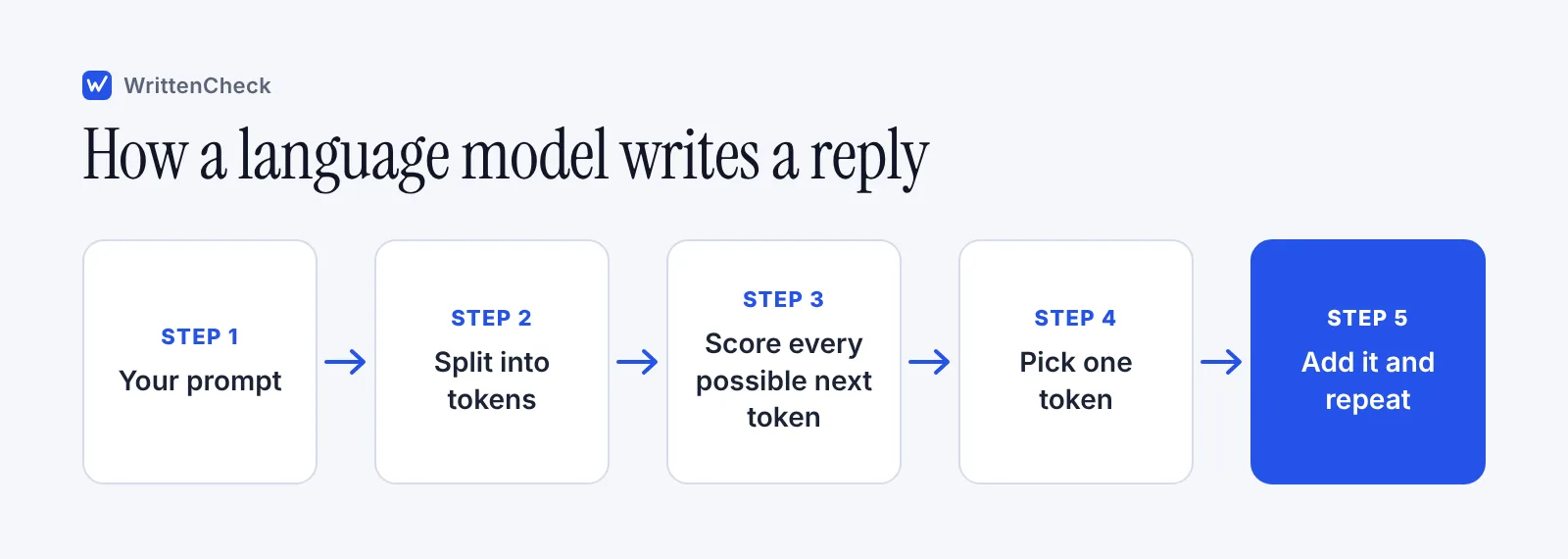
An LLM writes by running the same short loop again and again. Here's what happens when you ask it a question.
Your prompt is split into tokens. Each token becomes a number the model can work with.
The model reads all the tokens so far. Attention lets it link related words, even far apart.
It scores every possible next token. Each one gets a probability.
It picks one. Usually a likely one, with a little randomness so replies vary.
It adds that token and repeats. The loop runs until the reply is complete.
A worked example
Say you type "The school bus was late because of the." Here's how a model might spread its bets for the next word. These numbers are made up to illustrate the idea.
Next word | Illustrative probability |
|---|---|
snow | 30% |
traffic | 28% |
weather | 20% |
driver | 6% |
giraffe | under 0.1% |
The model will almost always pick one of the top few. That's why generative AI writing is fluent and on topic. It's also why it can sound flat. It tends toward the expected word, and AI detectors measure exactly that predictability.
What are some generative AI examples?
Generative AI examples fall into five main groups by what they produce. The same pattern-learning idea sits under all of them.
Type | What it makes | Example at school or work |
|---|---|---|
Text | Answers, drafts, summaries, translations | A student asks for a plain explanation of photosynthesis |
Images | Pictures and diagrams from a description | A teacher makes an illustration for a worksheet |
Audio | Speech, voices, music | A podcast intro read in a synthetic voice |
Video | Short clips from text or images | A short animation for a presentation |
Code | Programs, formulas, fixes | A spreadsheet formula explained and written |
Some tools combine these, so you can upload a photo of a graph and ask questions about it in text.
What can generative AI get wrong?
Generative AI can produce false information, repeat bias from its training data and copy the style of its sources too closely. Its fluency makes these problems easy to miss.
Hallucinations. Because it predicts likely words without checking facts, it can invent studies, quotes and sources. In a 2023 study in Scientific Reports, William Walters and Esther Isabelle Wilder found that 55% of references written by an older chatbot model, and 18% by a newer one, didn't exist. Our guide to AI hallucination shows how to check answers.
Outdated or missing knowledge. A model only knows what was in its training data. Recent events and niche topics are weak spots.
Bias. UNESCO warns that models inherit biases from their training data, and that much of that data reflects the values and norms of the Global North.
Privacy. UNESCO notes that using generative AI almost always means sharing your data with the company that runs it. Don't paste personal details about yourself or anyone else.
Age. UNESCO's 2023 guidance recommends a minimum age of 13 for using generative AI tools in class. It also notes that many commentators think 13 is too young and have called for 16.
How should students and teachers use generative AI?
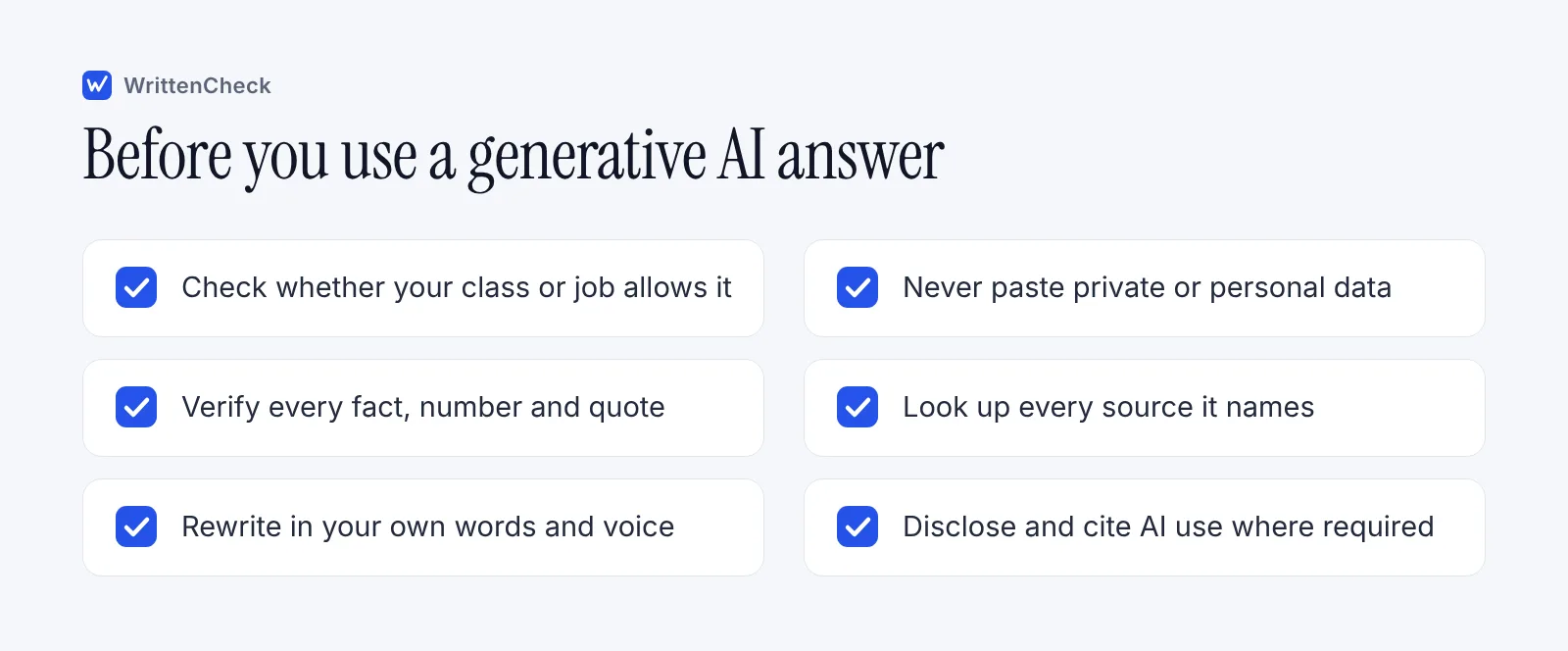
Use it where your rules allow, for tasks where you can check the result, and be open about it. These habits keep the learning yours.
Check the rules first. Policies differ by school, class and task.
Use it to think, then write yourself. Ask it to quiz you, explain a hard idea or find gaps in your outline.
Verify everything. Facts, numbers, quotes and sources all need checking.
Keep your voice. Drafts that lean on AI text tend to read as generic.
Disclose and cite. If you used it, say how. Some tools can add hidden watermarks to their output, yet honest disclosure stays your job.
If you want to see which sentences in a draft read most like AI writing, paste it into our free AI detector. It gives an overall score and a score for each sentence, and like every detector it gives an estimate.
Frequently asked questions
What is generative AI in simple terms?
Generative AI is software that makes new things, like text, pictures, sound or code, when you ask it in plain language. It learned by studying huge numbers of examples and spotting patterns. When you give it a prompt, it uses those patterns to produce something that fits. It doesn't understand or check facts the way a person does.
What is an LLM, and is it the same as generative AI?
An LLM, or large language model, is one kind of generative AI. It works only with text, or mainly with text, and writes by predicting the next token. Generative AI is the wider group, which also includes models that make images, audio and video. So every LLM is generative AI, but image tools based on diffusion are generative AI without being LLMs.
Does generative AI copy its training data?
Usually it produces new combinations of patterns it learned. Even so, those patterns come from other people's writing, often collected without permission, as UNESCO points out, and the tool can't tell you whose ideas it used. That's one reason to treat AI output carefully in academic work and to cite any source ideas properly. Our post on whether using AI is plagiarism covers how schools tend to see it.
Who invented generative AI?
No single person did. Generative models have a long research history. Two papers explain much of today's boom. The 2017 paper "Attention Is All You Need" by Vaswani and colleagues introduced the Transformer used by most text models. The 2020 paper by Ho, Jain and Abbeel showed how diffusion can create high-quality images.
Can generative AI think or understand?
It produces text by predicting likely tokens based on patterns, which can look like understanding. It has no built-in way to check whether its words are true. NIST has recorded concerns that words like "hallucination" make these systems sound more human than they are. A safer mental model is a very well-read autocomplete that needs checking.
Is it safe for students to use generative AI?
It can be, with limits. UNESCO recommends a minimum age of 13 for independent use in classrooms. Students should follow school rules, avoid sharing personal data, check every fact and source, and say when they've used it. Teachers can set tasks where students show their process, such as notes and drafts.
Sources
Artificial Intelligence Risk Management Framework: Generative Artificial Intelligence Profile (NIST AI 600-1), National Institute of Standards and Technology, July 2024
Guidance for generative AI in education and research, UNESCO (Miao and Holmes), 2023
What is AI? Can you make a clear distinction between AI and non-AI systems?, OECD.AI (Grobelnik, Perset and Russell), March 2024
Attention Is All You Need, Vaswani et al., arXiv, June 2017
How do Transformers work?, Hugging Face LLM Course, accessed October 2026
Tokenizers, Hugging Face LLM Course, accessed October 2026
Denoising Diffusion Probabilistic Models, Ho, Jain and Abbeel, arXiv, June 2020
On the Opportunities and Risks of Foundation Models, Bommasani et al., Stanford Center for Research on Foundation Models, August 2021
Fabrication and errors in the bibliographic citations generated by ChatGPT, Walters and Wilder, Scientific Reports, September 2023


Comments