Can AI detectors be wrong? Yes, and the mistakes aren't spread evenly. They fall harder on certain writers and certain kinds of writing. A student writing in their second language, an engineer writing a lab report, or anyone handing in a short answer is more likely to see a high score for work they wrote themselves.
Detectors also miss AI writing, especially once someone has edited it. Both errors matter. One can lead to a false accusation. The other can make a clean score look like proof of honesty when it isn't.
This guide covers both kinds of mistake, who gets flagged unfairly and why, and what to do if a detector gets it wrong about you or one of your students.
Can AI detectors be wrong?
Yes. AI detectors can be wrong in both directions. They can flag human writing as AI, which is a false positive, and miss AI writing, which is a false negative. Independent studies have found both. False positives are more likely for second-language writers, formal or formulaic writing and short texts. False negatives are more likely when AI text has been edited or paraphrased. A detector score is an estimate, not proof.
What's the difference between a false positive and a false negative?
A false positive is human writing that a detector labels as AI. A false negative is AI writing that a detector labels as human. Every detector trades one against the other.
Error | What happens | Who it hurts | Common causes |
|---|---|---|---|
False positive | Human text is flagged as AI | The honest writer, through stress, lost grades or a misconduct case | Second-language writing, formal genres, short texts, famous texts |
False negative | AI text passes as human | Classmates and teachers relying on fair grading | Human edits, paraphrasing tools, new AI models |
Detectors give a probability, and someone picks the point where "likely AI" starts. Set that point low and you catch more AI text but flag more humans. Set it high and you protect humans but miss more AI. In the RAID benchmark, presented at ACL 2024, researchers at the University of Pennsylvania found accuracy swings so much with this choice that they fixed every detector at a 5% false positive rate before comparing them. You can read more about this trade-off in our guide to whether AI detectors are accurate.
Who gets flagged unfairly, and why?
Writers whose work is naturally predictable get flagged most. Detectors measure how easy each word is for a language model to guess, so anything that makes writing more predictable raises the score. Our explainer on how AI detectors work covers the mechanics.
Second-language writers
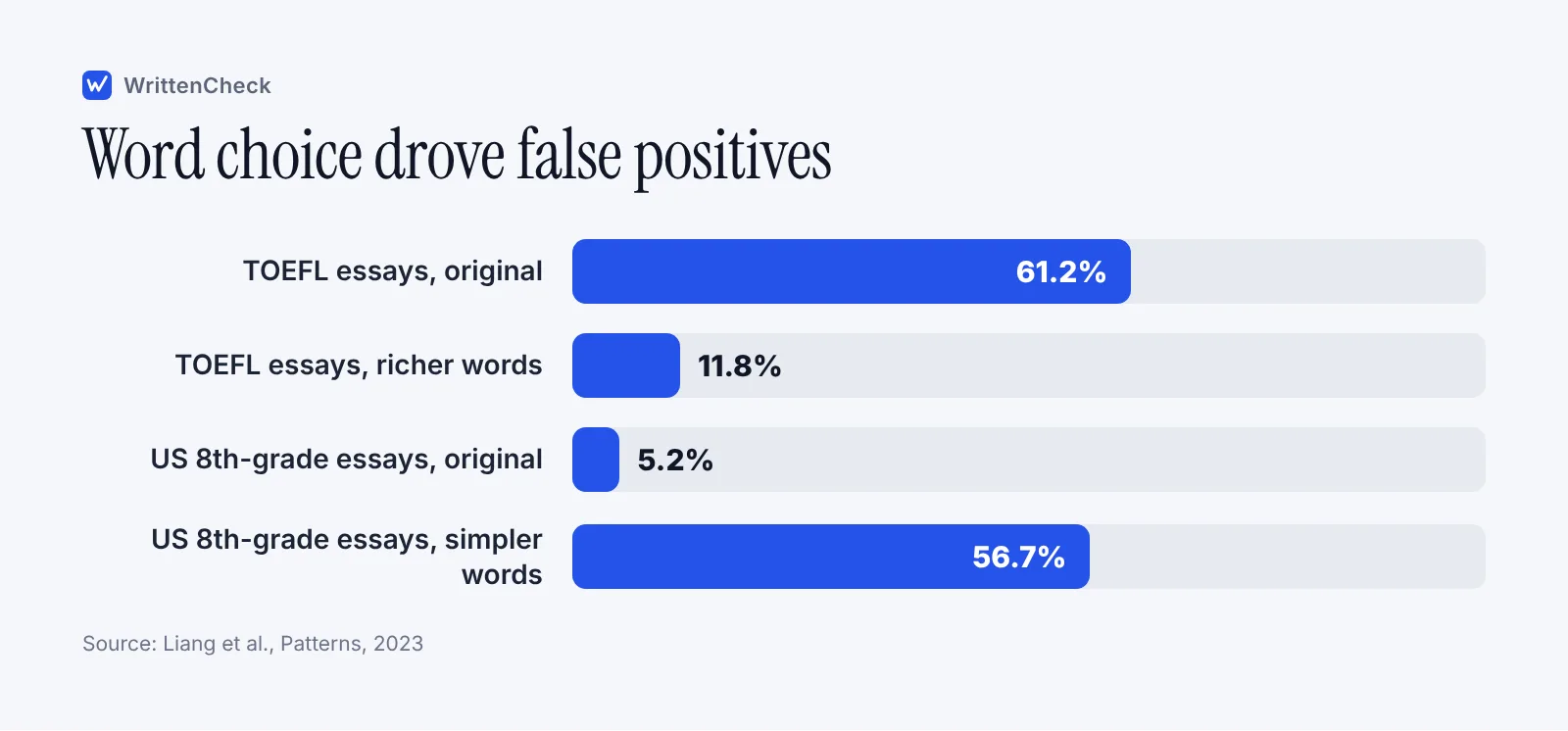
This is the best-documented bias. In 2023, Weixin Liang, James Zou and colleagues at Stanford ran 91 TOEFL essays, written by non-native English speakers, through seven AI detectors. On average, 61% were wrongly flagged as AI. Eighteen essays were flagged by all seven detectors, and 89 of the 91 were flagged by at least one. Essays by US eighth graders were classified almost perfectly.
The researchers then tested the cause. When they had the TOEFL essays' word choices made richer, false positives dropped to about 12%. When they made the US essays' word choices simpler, false positives jumped from about 5% to 57%. That points to vocabulary range as the trigger, more than who the writer was.
Formal and formulaic writing
Lab reports, legal memos, grant applications and five-paragraph essays follow conventions. That's the point of them. But conventions make writing predictable, and predictability is what a detector reads as AI. The Gonzaga University faculty guide on AI detectors notes that people writing formally for a grade tend to produce text with lower perplexity and burstiness, the same patterns AI text shows.
Here's an example of a human-written lab report paragraph that a detector might score high.
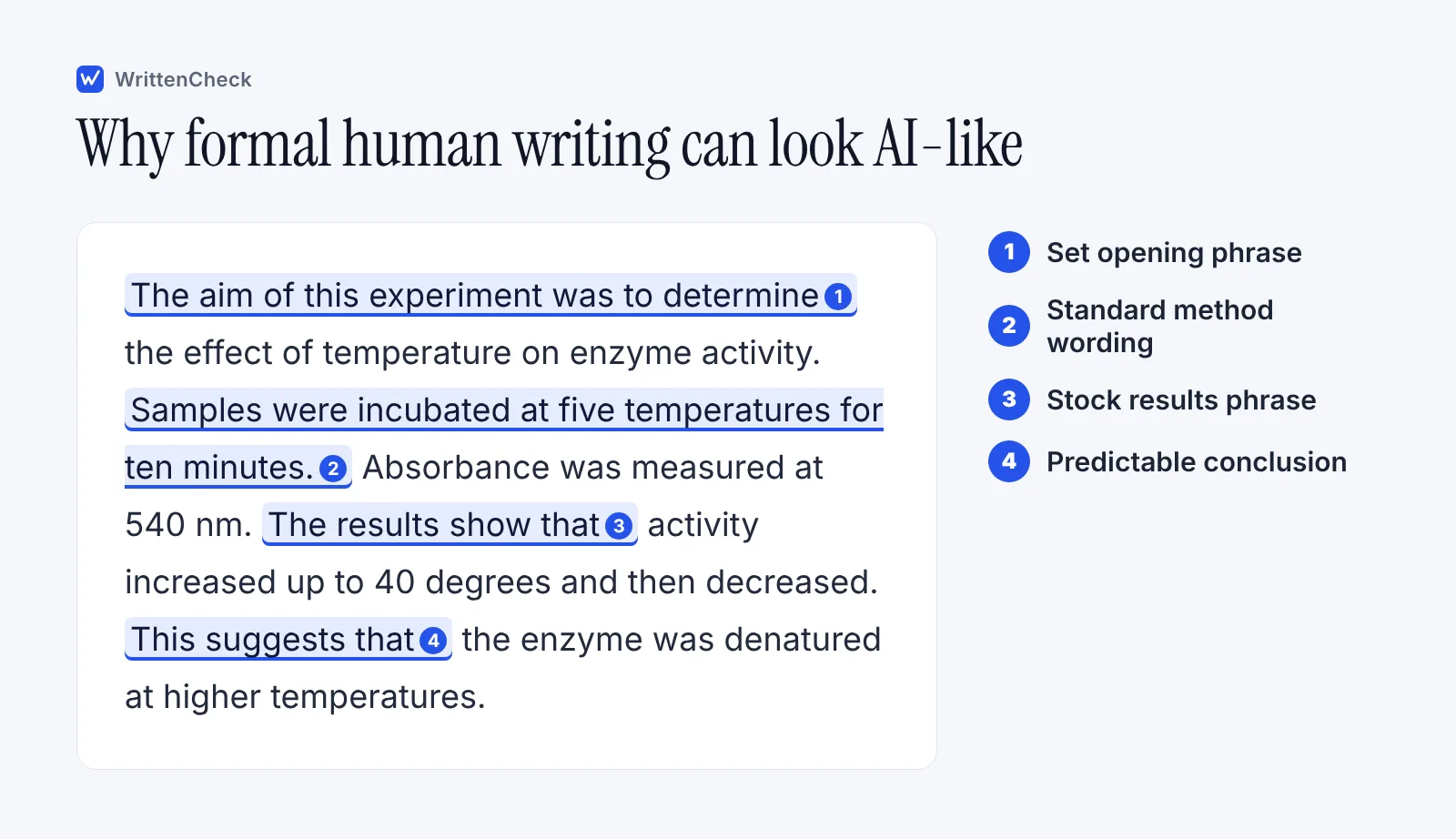
Nothing in that paragraph is wrong. It's what a science teacher asks for.
Short texts
A short text gives a detector very few clues. A 2025 review by Kathleen Fraser and colleagues at the National Research Council Canada, published in the Journal of Artificial Intelligence Research, reports that classifiers need roughly 120 to 200 words to reach their full potential. Discussion posts, short answers and abstracts often fall below that.
Text that passed through other tools
When people write in another language and use machine translation, the result can look less human to a detector. In a 2023 study in the International Journal for Educational Integrity, Debora Weber-Wulff and colleagues found that 14 detection tools classified human text correctly about 20 percentage points less often after it was machine-translated into English.
Famous texts
Some famous documents are among the most predictable texts in existence, because language models were trained on them many times over. The Gonzaga guide notes that detectors have flagged parts of the Bible and the US Constitution as AI-generated. It's a vivid reminder that a high score means "predictable," which is different from "machine-made."
Why do AI detectors miss AI writing?
They miss it mainly because people change it. In the same 2023 study of 14 tools, average detection fell from 74% on unedited AI text to 42% after people edited it by hand, and to 26% after a paraphrasing tool rewrote it.
How the text was generated matters too. The Stanford team found that asking an AI chatbot to rewrite its own college essays in more literary language cut the detection rate from 100% to 13%. The RAID benchmark found detectors were also fooled by AI models they hadn't seen in training. So a low score isn't a clean bill of health. It's another estimate.
What should you do if a detector flags your writing?
Stay calm and gather evidence of how you wrote it. A score is a claim about patterns in text, and your process is stronger evidence than that.
Ask to see the result. Find out which tool was used, what the score was and which sentences were highlighted.
Collect your drafts. Open the version history in Google Docs or Microsoft Word. It shows when you wrote each part and how it changed.
Gather your notes and sources. Outlines, research notes, browser history and earlier drafts all show your thinking over time.
Offer to talk through the work. Explain why you made certain arguments or chose certain words. People can usually discuss writing they did themselves in detail.
Mention anything that affects your style. Writing in a second language, a formal genre or a short word limit are all known reasons for false positives.
Read your school's policy. Guidance such as Jisc's in the UK says a detector score shouldn't be the only evidence. Ask for the full process to be followed.
Our guide on what to do if you're falsely accused of using AI goes through this in more detail, including what to say.
What should teachers do to avoid false accusations?
Use a score as a reason to look closer, never as a verdict. The University of Pittsburgh's teaching center decided in June 2023 not to endorse any AI detection tool, saying the software was "not yet reliable enough to be deployed without a substantial risk of false positives." Jisc, the UK's education technology body, said in 2025 that decisions "should never be based solely on AI detection, whether by a tool or a person."
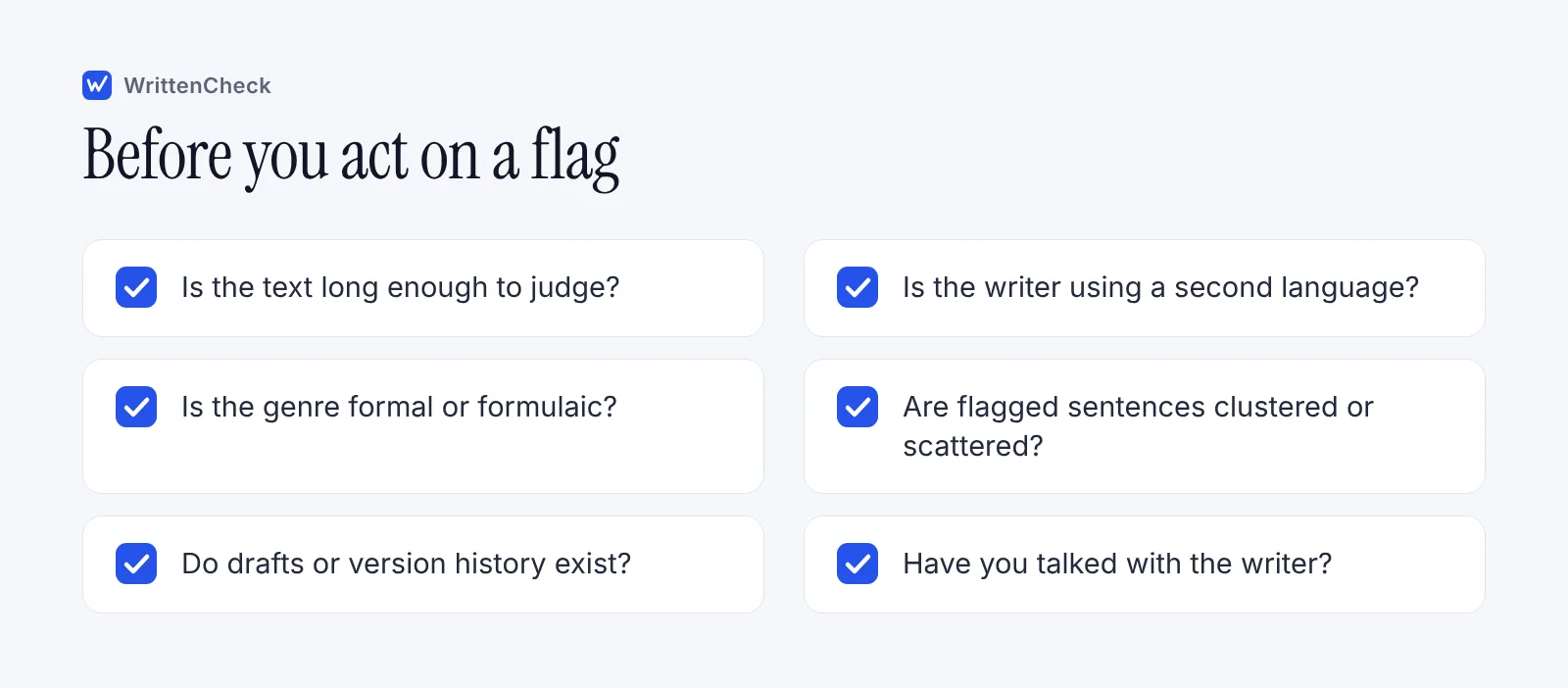
A few habits lower the risk of a wrongful accusation.
Know your class. If many students write in a second language, expect more false positives and weigh scores even less.
Compare with earlier work. A sudden change in voice is more telling than a single score.
Ask process questions. "How did you find this source?" or "What did your first draft argue?" are fair questions that honest students can answer.
Build in checkpoints. Outlines, drafts and short in-class writing make process visible without any detector.
Our guide on how to tell if a student used AI has more on these conversations.
How can you read a detector result more fairly?
Look past the headline number. If a tool shows a range, a confidence level and sentence-level scores, those tell you far more than one percentage.
WrittenCheck shows an overall score, a likely range, a confidence level and a score for each sentence, with the sentences that read most like AI highlighted. Known weak spots for any detector, ours included, are short texts, AI drafts edited by people, very formal human writing and second-language writing. If you're checking your own work before you submit it, paste it into our free AI detector and read the highlighted sentences. If they're your most generic lines, adding your own examples and reasoning will make the writing better anyway.
Frequently asked questions
How often do AI detectors give false positives?
It varies by tool, text and writer, so there's no single rate. In a 2023 test of 14 tools, human English text was classified correctly 96% of the time on average, but some tools did much worse. For TOEFL essays by non-native speakers, a Stanford study found seven detectors flagged 61% on average. The writer and genre matter as much as the tool.
Are AI detectors biased against non-native English speakers?
Research shows a real risk. Writers using a second language often choose simpler and more common words, which language models find easy to predict. Detectors read that predictability as a sign of AI. In the 2023 Stanford study, making the vocabulary richer cut false positives sharply. Making native writers' vocabulary simpler raised them.
Can a detector prove that someone used AI?
No. A detector estimates how closely a text's patterns match AI writing it has seen. It can't see who typed the words, what tools they used or what they intended. Universities and education bodies such as Jisc advise that a score should never be the only basis for a decision. Process evidence, like drafts and version history, is far stronger.
Why did a famous text get flagged as AI?
Famous texts appear many times in the data language models learn from, so a model finds them extremely easy to predict. Detectors read low surprise as a sign of AI, so parts of well-known documents can score high. It shows that detectors measure predictability, and predictable human writing can look the same as AI writing.
Does a low AI score prove a text is human?
No. Edited or paraphrased AI text often gets low scores. In a 2023 study of 14 tools, detection of AI text fell to 42% after hand edits and 26% after machine paraphrasing. A low score means the text doesn't strongly resemble the AI writing the detector learned from. It doesn't rule out AI use.
What should I say if I'm falsely accused of using AI?
Say you wrote the work yourself and offer evidence. Share your version history, drafts and notes, and offer to explain your choices in person. Mention known causes of false positives that apply to you, such as writing in a second language or a formal genre. Ask which tool was used and how your school's policy treats detector scores.
Sources
GPT detectors are biased against non-native English writers, Liang et al., Patterns, July 2023
Testing of detection tools for AI-generated text, Weber-Wulff et al., International Journal for Educational Integrity, December 2023
Detecting AI-Generated Text: Factors Influencing Detectability with Current Methods, Fraser, Dawkins and Kiritchenko, Journal of Artificial Intelligence Research, 2025
AI Detectors (A Guide to AI for Gonzaga Faculty), Gonzaga University Library, updated May 2026
RAID: A Shared Benchmark for Robust Evaluation of Machine-Generated Text Detectors, Dugan et al., ACL 2024, May 2024
Teaching Center doesn't endorse any generative AI detection tools, University Times, University of Pittsburgh, June 2023
AI Detection and assessment: an update for 2025, Jisc National Centre for AI, June 2025


Comments