People search for this hoping for a number, like 20% or 30%, below which an AI score is safe. There isn't one. No university guidance we've read sets a percentage that counts as acceptable, and the score a detector shows doesn't measure what most people think it does.
What percentage of AI is acceptable depends on two things. The first is the rule for your task. Some assignments allow no AI at all, others expect you to use it. The second is what the score actually means, which is usually how AI-like the text looks, not how much of it came from AI.
This guide explains both, then shows how to read low, middle and high scores, with practical steps for students, teachers and writers.
What percentage of AI is acceptable?
There's no universal percentage of AI that's acceptable. What counts is the rule for your specific assignment, publication or client, which might allow no AI, AI for planning only, or AI throughout. A detector score can't answer this, because it estimates how AI-like the text looks rather than how much AI you used. If AI use is allowed, disclose it as asked. If it isn't, any amount is too much.
What does an AI detection score actually mean?
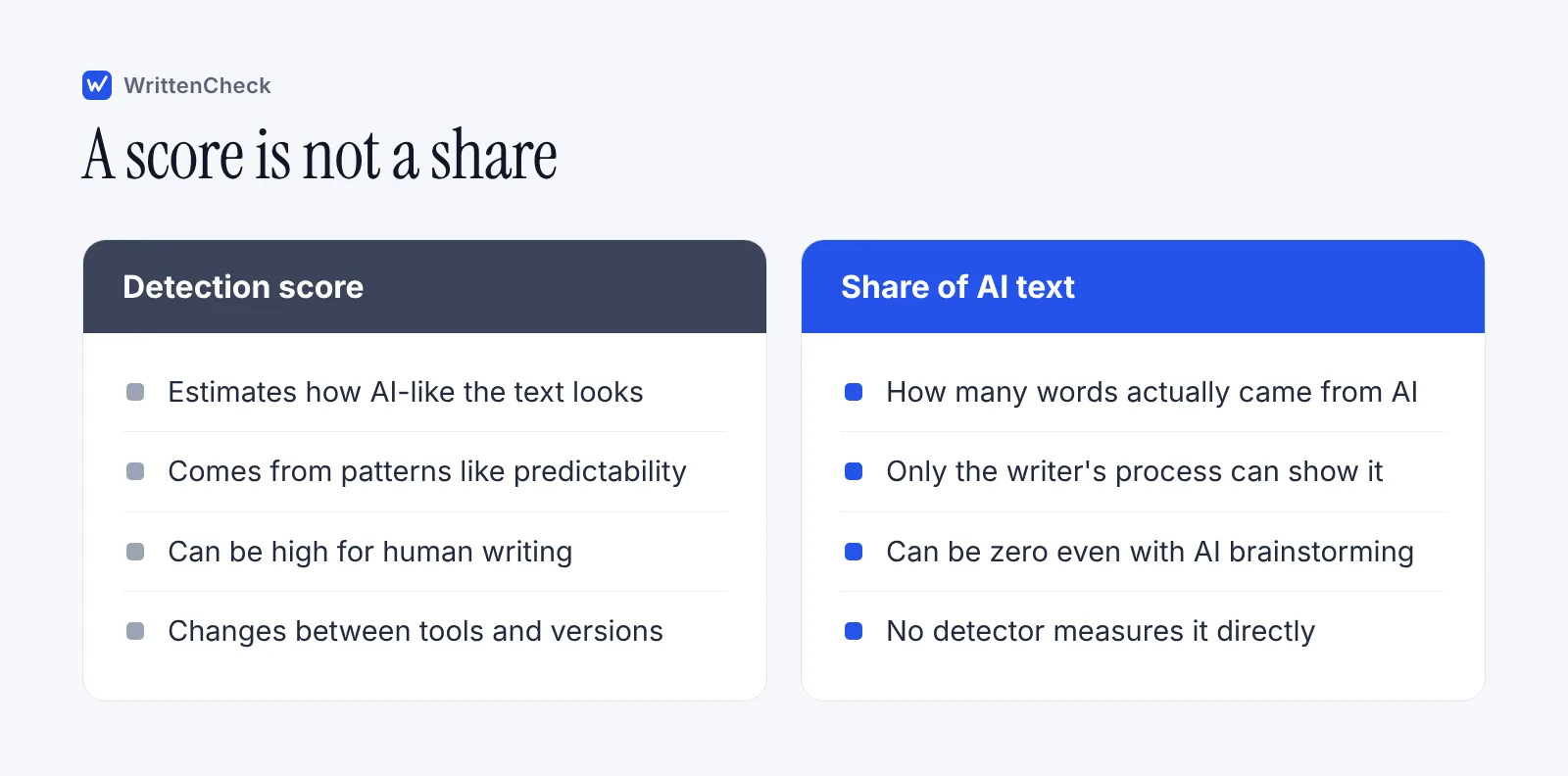
An AI detection score is a detector's estimate of how likely a text is to be AI-written, based on patterns like how predictable the words are. It isn't a measure of how many words came from an AI tool.
That's the most common misreading. Say a detector gives your essay 40%. Most people read that as "40% of my essay is AI." Usually it means something closer to "the detector sees a moderate chance this text is AI-written, based on how it reads." Some tools report the share of sentences they flag instead, which is a different number again. Check what your tool says it measures.
Here are two examples that show why the difference matters. Both are made up to illustrate the point.
Example 1. A student uses an AI chatbot to brainstorm topics, then writes all 1,000 words herself in a plain, formal style. The share of AI text is zero. A detector might still give a middling score, because formal writing is predictable.
Example 2. A student writes 800 words and pastes in 200 words from an AI tool. The share of AI text is 20%. The overall score could land almost anywhere. Sentence-level scores are more likely to point at the pasted paragraph.
If you want the background on why predictable writing scores high, our guide on how AI detectors work explains perplexity and sentence scoring in plain English.
Why is there no safe percentage?
There's no safe percentage because scores vary by tool, by text and by writer, and because human writing can score high. Detectors also change when they're retrained, so the same essay can get a different number next month.
The research on errors makes a fixed cut-off risky. In 2023, a Stanford team led by James Zou found that seven detectors wrongly flagged an average of 61% of TOEFL essays written by non-native English speakers. The same year, Debora Weber-Wulff and colleagues tested 14 tools and found none above 80% accuracy. A single number applied to every student would treat these writers unfairly. Our guide on whether AI detectors can be wrong covers who gets flagged and why.
What do schools and universities actually say about AI scores?
The guidance we reviewed says the same thing in different words. A score can start a conversation, and it can't settle a case. None of it sets a percentage threshold.
Source | Date | What it says about AI scores |
|---|---|---|
University of Kentucky, Office of the Provost | April 2023 | Scores "should be handled sensitively and with healthy skepticism," and accuracy is low |
University of Pittsburgh, Teaching Center | June 2023 | Didn't endorse any AI detection tool, citing a substantial risk of false positives |
Jisc National Centre for AI (UK) | June 2025 | Decisions "should never be based solely on AI detection, whether by a tool or a person" |
MIT Sloan Teaching & Learning Technologies | Updated 2026 | Advises clear AI policies and process statements over reliance on detectors |
The University of Kentucky guidance also warns that detectors "might not flag writing that has been human edited after initially being generated by AI." That cuts both ways. A low score doesn't prove a text is human, and a high one doesn't prove it isn't.
So what decides whether AI use is acceptable?
The rules for the task decide it. Many schools now describe allowed AI use in levels instead of percentages.
One widely used framework is the AI Assessment Scale, developed by Mike Perkins, Jasper Roe and Leon Furze. Its revised version, published in the Journal of University Teaching and Learning Practice in 2025, has five levels.
Level | Name | What AI use looks like |
|---|---|---|
1 | No AI | The task is done in a setting designed to exclude AI |
2 | AI Planning | AI may help with topic exploration, outlining and early research |
3 | AI Collaboration | AI may help with ideas, drafting, feedback and refinement |
4 | Full AI | AI use is expected as part of the task |
5 | AI Exploration | AI is used creatively to solve problems or produce new insights |
Under a level 1 task, any AI writing is a problem whatever the score says. Under a level 3 or 4 task, a high score might be completely expected, as long as you disclose your use the way the task asks. The authors argue that AI detectors are unreliable and shouldn't be used to police the scale.
If you're writing a policy, our guide to AI policies for schools has sample wording for each kind of rule.
How should you read low, middle and high scores?
Read every band as a prompt for what to check next. The bands below are general guidance. They aren't cut-offs, and they assume a text long enough to judge.
Score band | What it usually suggests | What to check next |
|---|---|---|
Low | The text doesn't strongly resemble AI writing | Nothing, unless other evidence says otherwise. Edited AI text can still score low. |
Middle | Mixed or uncertain signals | Look at the range, the confidence level and which sentences scored high |
High | The text reads a lot like AI writing | Check the writer's drafts and context before drawing any conclusion |
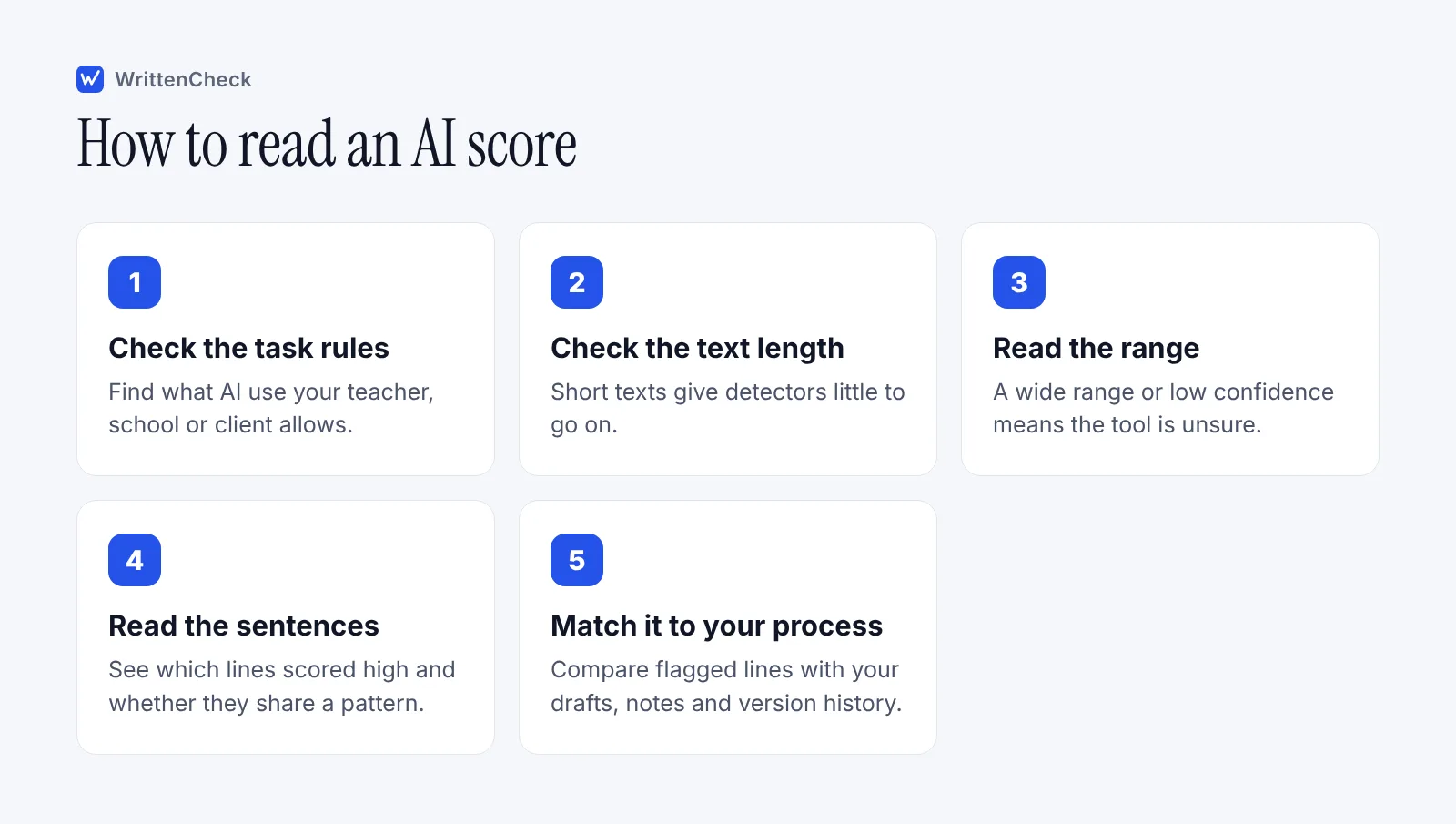
A few things make any band less meaningful. Very short texts give the detector little to work with. Formal genres such as lab reports and legal writing score higher. Writing in a second language can push scores up. And a wide likely range, or a low confidence level, means the detector itself isn't sure.
What should students do with their AI score?
Focus on the rules and your process. A target number won't help you.
Find the AI rules for the task. Check the syllabus, the assignment brief or ask your teacher. If it's unclear, ask before you start.
Disclose any allowed AI use. Say what tool you used and for what, in the format your teacher asks for. Our guide on how to cite AI shows APA and MLA formats.
Keep your process visible. Write in Google Docs or Microsoft Word with version history on, and save your notes and outlines.
Read flagged sentences as feedback. If your most generic sentences scored high, add your own examples and reasoning. That's better writing, whatever the score.
Don't chase a target percentage. Rewriting your own work just to lower a score wastes time and won't help if you're asked how you wrote it.
What should teachers and editors do with an AI score?
Set the rule in advance and use the score as one signal among several. If you say "anything over 20% is cheating," you'll punish some honest students and miss some edited AI text.
For teachers, that means stating the allowed level of AI use for each task, asking for process evidence like drafts or a short reflection, and talking to students before reaching any conclusion. For editors and clients working with freelance writers, it means agreeing in writing whether AI tools are allowed and what disclosure you expect. A contract clause does more than any score.
If you do want to see how a draft reads, paste it into our free AI detector. WrittenCheck shows an overall score, a likely range, a confidence level and a score for each sentence, so you can see exactly which lines read most like AI. It checks 80 to 3,000 words at a time, in 16 languages.
Frequently asked questions
Is a 20% AI score bad?
Not on its own. A 20% score is an estimate of how AI-like the text looks, and human writing can land there easily, especially if it's formal or short. What matters is whether your task allowed AI and whether your process supports your work. Check which sentences scored high and keep your drafts in case anyone asks.
Does a 0% AI score prove I didn't use AI?
No. Detectors miss AI writing, especially after it has been edited or paraphrased. In a 2023 study of 14 tools, detection of hand-edited AI text averaged 42%. A low score means the text doesn't strongly resemble the AI writing the tool learned from. Your drafts and notes are better proof of your process than any score.
Why do different AI detectors give different percentages?
Each detector is trained on different examples, uses a different model and sets its own threshold for what counts as AI. They also report different things. Some give a probability for the whole text, while others report the share of sentences they flag. So two tools can give very different numbers for the same essay without either being broken.
What AI percentage do universities allow?
The guidance we reviewed doesn't set one. Universities and education bodies such as Jisc and the University of Kentucky treat detector scores as something to handle with skepticism and human judgment. What's allowed is set by each course or assignment, often as a level of AI use, such as no AI, AI for planning or AI throughout, with disclosure.
Can my own writing get a high AI percentage?
Yes. Formal or formulaic writing, short texts, heavy use of common phrases and writing in a second language can all make human text look predictable to a detector. A Stanford study in 2023 found seven detectors wrongly flagged an average of 61% of TOEFL essays by non-native speakers. A high score is a reason to look closer. It proves nothing by itself.
Should I rewrite my work to get a lower AI score?
Only if the rewrite makes it better writing. Adding your own examples, clearer reasoning and varied sentences is good practice. Rewriting just to push a number down rarely helps, since scores vary between tools and versions. If AI use was allowed, disclosing it is the right move. If it wasn't, the fix is to do the work yourself.
Sources
Upholding academic integrity and ensuring fairness; AI detection, University of Kentucky Office of the Provost, April 2023
Teaching Center doesn't endorse any generative AI detection tools, University Times, University of Pittsburgh, June 2023
AI Detection and assessment: an update for 2025, Jisc National Centre for AI, June 2025
AI Detectors Don't Work. Here's What to Do Instead., MIT Sloan Teaching & Learning Technologies, updated September 2026
The AI Assessment Scale Revisited: A Framework for Educational Assessment, Perkins, Roe and Furze, Journal of University Teaching and Learning Practice, 2025
The AI Assessment Scale, Perkins, Roe and Furze, accessed October 2026
GPT detectors are biased against non-native English writers, Liang et al., Patterns, July 2023
Testing of detection tools for AI-generated text, Weber-Wulff et al., International Journal for Educational Integrity, December 2023

Comments