Is using AI plagiarism? Not automatically. Asking an AI chatbot to explain a hard concept is no more plagiarism than asking a tutor. But copying AI-written text into an essay and handing it in as yours usually breaks your school's rules, and some universities now call that plagiarism by name.
The confusion is understandable. Plagiarism has traditionally meant taking another person's words or ideas. An AI tool isn't a person, so students reasonably ask whether the old rule even applies.
Universities have answered that question, though not all in the same words. This guide shows how plagiarism is defined, how schools classify unauthorized AI use, which uses are usually fine, and what to do if you're not sure.
Is using AI plagiarism?
Using AI isn't plagiarism in itself. Submitting AI-generated text or ideas as your own work, without permission or acknowledgement, usually is treated as plagiarism or academic misconduct. The University of Oxford names unauthorized AI material in its plagiarism definition. Other schools file it under misconduct or unauthorized help. Either way, the penalty can be serious, so check your course policy.
The key word in nearly every policy is "own." If the work you hand in claims to be your own thinking and writing, and an AI tool produced part of it, that claim isn't true. That's the problem schools care about, whatever label they use.
How is plagiarism defined?
Plagiarism is passing off someone else's words, ideas or work as your own. Every major definition centers on missing credit.
Two definitions worth knowing:
Merriam-Webster defines plagiarize as "to steal and pass off (the ideas or words of another) as one's own," and to "use (another's production) without crediting the source."
The University of Oxford defines plagiarism as "presenting work or ideas from another source as your own" without full acknowledgement, with or without the author's consent.
Notice the difference. The dictionary talks about "another," which suggests a person. Oxford talks about "another source," which is broader. That small wording change is why some schools fold AI into plagiarism and others don't.
How do universities classify unauthorized AI use?
Most universities treat unauthorized AI use as a breach of academic integrity. They differ on the category it falls under. Here's how three well-known universities put it.
University | How it frames unauthorized AI use | Disclosure |
|---|---|---|
University of Oxford | Part of plagiarism. Its definition includes material "generated wholly or in part" by AI, unless use was authorized in advance | AI may be used in assessments only with prior authorization |
University of Cambridge | Academic misconduct, when unacknowledged AI content is used in a summative assessment "as though it is their own work" | Allowed if the assessment brief says so |
Stanford University | Treated "analogously to assistance from another person" unless the instructor says otherwise | Students should acknowledge AI use beyond incidental use, and disclose when in doubt |
Sources for this table are listed at the end. Wording comes from each university's own policy page.
Plagiarism or academic misconduct?
Academic misconduct is the umbrella term. It covers plagiarism, cheating on exams, fabricating data, unauthorized collaboration and more. So when a school calls AI misuse "misconduct" instead of "plagiarism," it's using a wider category. The consequences can be just as serious.
Stanford's guidance, issued by its Board on Conduct Affairs in February 2023, shows how this works. Treating AI like help from another person means the same rules apply as if a friend wrote your paragraph. Stanford also says that "using generative AI tools to substantially complete an assignment or exam" isn't permitted, unless the instructor's policy allows it.
Is using AI cheating?
It can be. If your instructor bans AI on an assignment and you use it anyway, most schools would call that cheating, even if you rewrote every sentence. If your instructor allows AI for certain tasks and you stay within those limits, it isn't. The rule comes from the course, which is why the same use can be fine in one class and a violation in the next.
When is it fine to use AI?
AI use is fine when your instructor or institution allows it and you stay within the limits they set. Many policies allow AI for learning tasks while banning it for producing the work you submit.
Cambridge, for example, says students can use AI tools appropriately for personal study, research and formative work, and encourages them to discuss that use with supervisors.
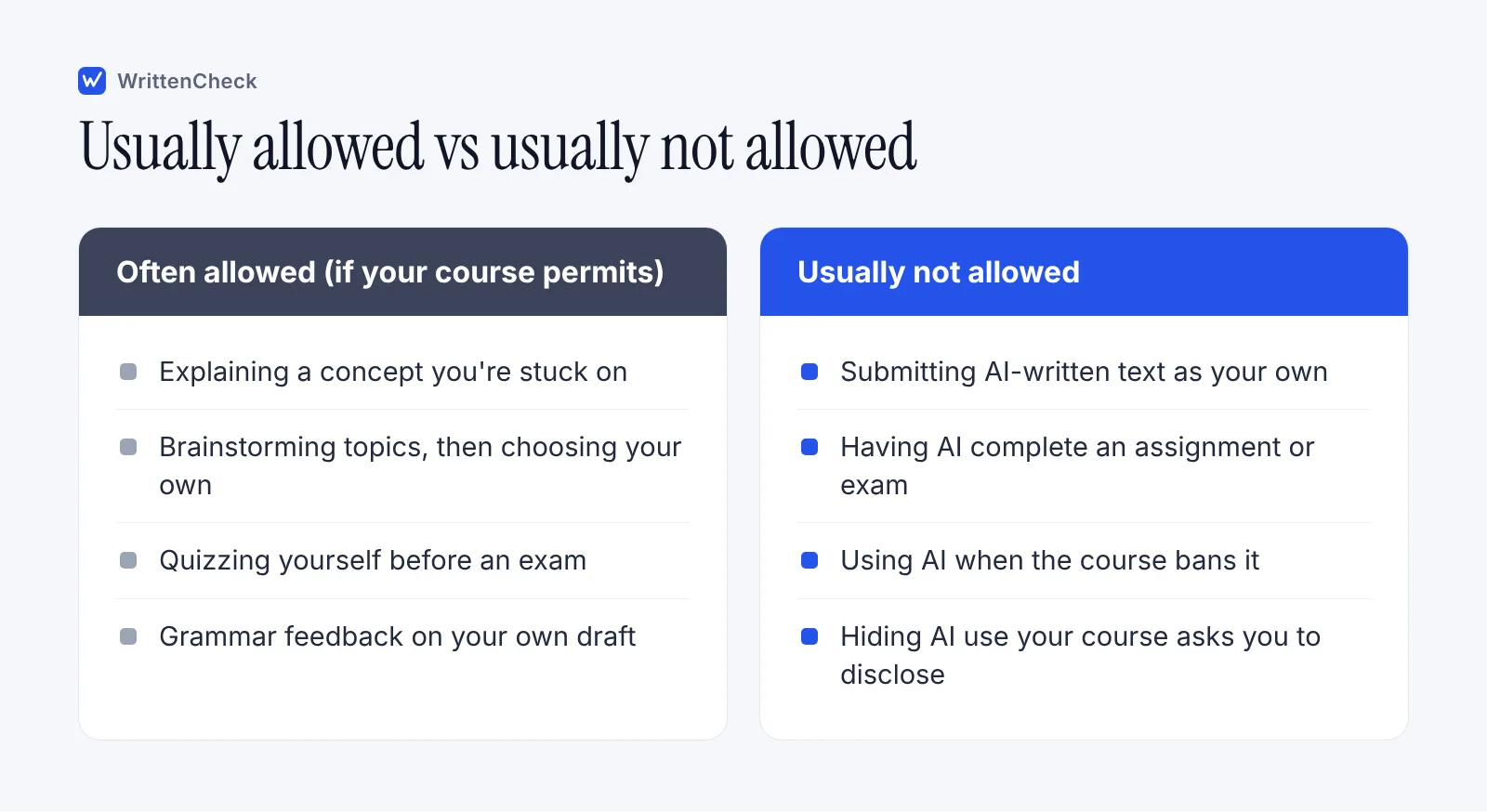
Here are some examples of where many courses draw the line. These are illustrations only, since your syllabus may differ.
Use | Often allowed? | Why |
|---|---|---|
Asking AI to explain photosynthesis in simpler words | Often yes | It's like a tutor. You still write your own answer |
Generating 10 essay topic ideas, then choosing and developing one yourself | Often yes, with disclosure | The thinking and writing stay yours |
Grammar suggestions on a draft you wrote | Often yes | Similar to a spell checker, though some courses limit it |
Asking AI to write your introduction, then editing it | Usually not, unless allowed | The core wording came from AI |
Pasting an assignment prompt and submitting the answer | No | Stanford calls this substantially completing the work |
Using AI on a take-home exam that bans it | No | It breaks the exam rules |
The pattern is simple. AI that helps you learn is often fine. AI that does the work you're graded on usually isn't.
Why do so many students get this wrong?
Ask a class "is using AI plagiarism?" and you'll hear several different answers. That's because AI use is now normal, and course rules vary. Students use these tools all the time, so the line between help and misuse can blur.
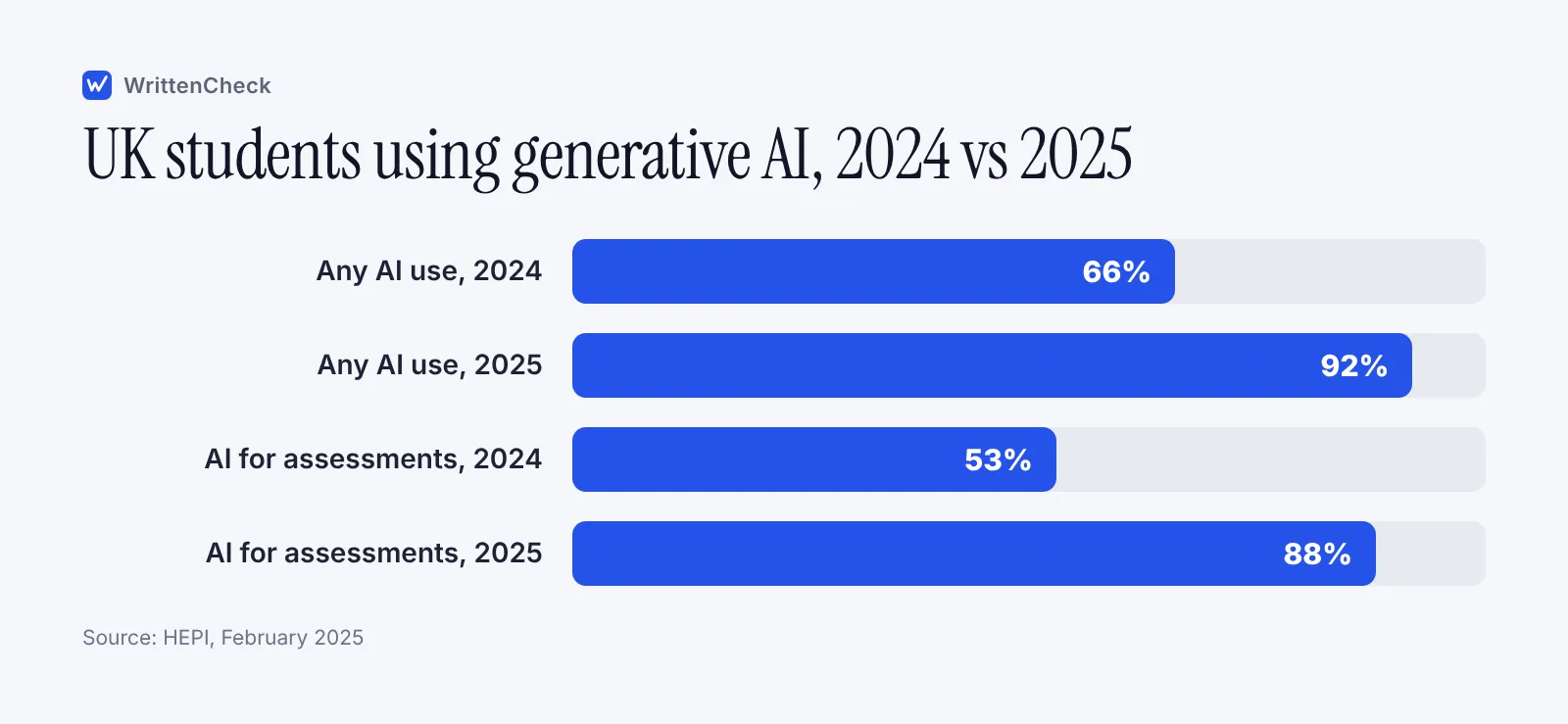
The Higher Education Policy Institute (HEPI), a UK think tank, surveyed 1,041 full-time undergraduates in December 2024. It found that 92% used AI in some form, up from 66% a year earlier. And 88% had used generative AI for assessments, up from 53%.
The same survey found that 80% of students said their university's AI policy was clear, and 53% worried about being accused of cheating. So most students know rules exist. The trouble is applying them assignment by assignment.
If you've ever been worried about an accusation, our guides on how teachers check for AI and what to do if you're falsely accused of using AI explain the process.
How should you disclose AI use?
Disclose AI use the way your instructor asks. If they don't specify, add a short note saying which tool you used, what for, and how you checked the output. Stanford tells students to "default to disclosing" when unsure.
Academic publishing has similar rules. The Committee on Publication Ethics (COPE), a body that sets ethics guidance for journals, says "AI tools cannot be listed as an author of a paper" and that authors must say how they used them. Authors stay responsible for everything in the paper, including parts an AI tool produced.
Here's an example of a short disclosure note for a class essay:
AI use statement: I used an AI chatbot to suggest possible essay topics and to explain the difference between two economic theories. I chose the topic, did the research and wrote all of the text myself. I checked every explanation against the course textbook.
Keep it honest and specific. A vague line like "AI was used" helps no one. If you used AI more heavily, say so.
What should you do if you're not sure AI is allowed?
Ask before you use it. One email can save you a misconduct case.
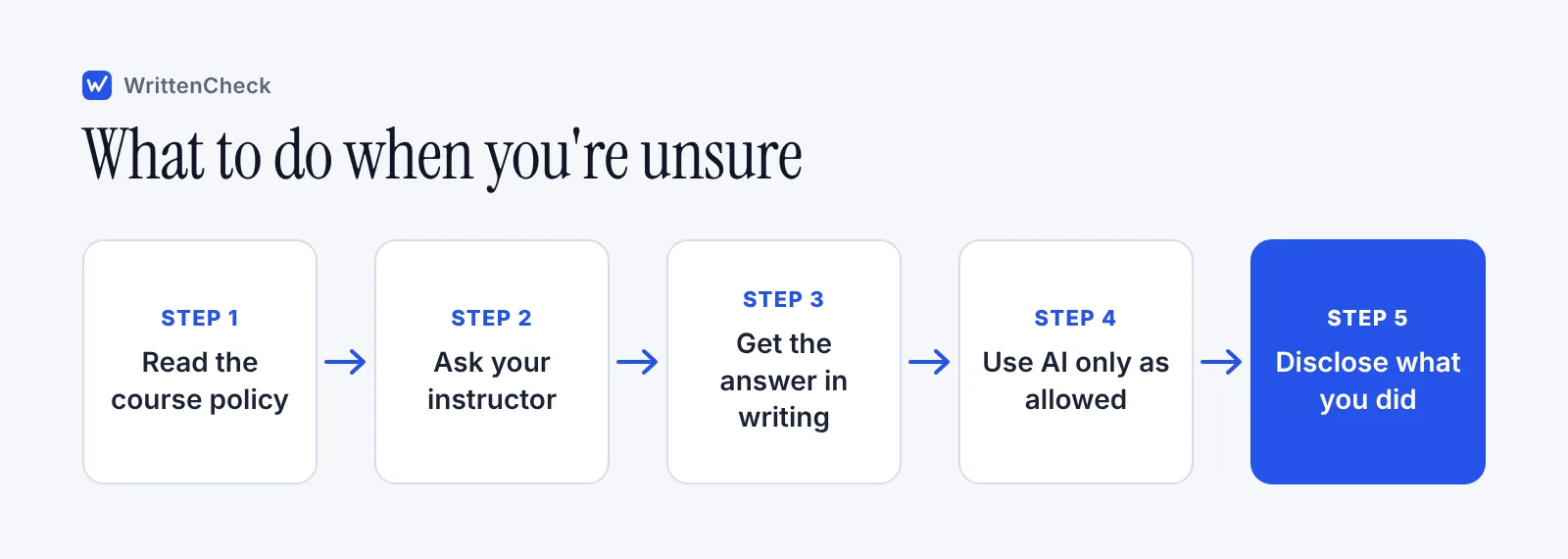
Follow these steps:
Read the syllabus and assignment sheet. Look for words like "generative AI," "AI tools" or "unauthorized assistance."
Check your school's general policy. It often sets the default when a course says nothing. At Stanford, for instance, the default is to treat AI like help from another person.
Ask your instructor in writing. Be specific. "Can I use an AI tool to check grammar on my final draft?" gets a clearer answer than "Can I use AI?"
Save the answer. An email reply protects you if questions come up later.
Use AI only as allowed, and disclose it. Keep notes on what you asked and how you used the output.
It also helps to write in a way that's clearly yours. Our list of AI words to avoid points out phrases that make writing sound generic, whoever wrote it.
If you want to check how a draft reads before you submit, you can paste it into our free AI detector. It gives a score for each sentence and highlights the ones that read most like AI. Scores are estimates, so use them as a prompt to revise in your own voice, and keep your notes and drafts as your record of the work.
Frequently asked questions
Is it plagiarism to use AI for brainstorming?
Usually not, if your course allows it and you disclose it. Brainstorming with AI is closer to talking ideas over with a classmate. The ideas you develop and the words you write are still yours. Some instructors still want a note saying you used AI for ideas, and a few ban it entirely, so check the course policy first.
Can AI-generated text be plagiarism if no person wrote it?
Many schools say yes, or treat it the same way. The University of Oxford includes material generated wholly or in part by AI in its plagiarism definition, unless use was authorized. Other universities call it academic misconduct or unauthorized assistance. The label differs, but submitting AI text as your own work breaks the rules in most places.
Is paraphrasing AI text still plagiarism?
It can be. Rewording AI output doesn't make the ideas or structure yours. If the course bans AI for that task, paraphrased AI text is still unauthorized use. If the course allows it, you'd normally still need to acknowledge where the content came from. The safest approach is to use AI only as permitted and disclose it clearly.
Do I need to cite AI if I only used it for grammar?
It depends on your instructor. Stanford guidance asks students to acknowledge AI use other than incidental use, and grammar suggestions may or may not count as incidental in a given course. If you're unsure, add a one-line note saying you used an AI tool for grammar checks. A short, honest note is much easier than explaining yourself later.
What happens if I'm caught using AI without permission?
Consequences depend on your school and how serious the case is. They can range from redoing the assignment or a failing grade to formal misconduct findings. Oxford warns that intentional or reckless plagiarism can lead to failing a degree or expulsion. Most schools follow a set process, with a chance for you to respond before any decision.
Is using AI cheating if my teacher never mentioned it?
Not necessarily, but don't assume it's fine. When a course says nothing, your school's general policy usually applies. At Stanford, for example, AI help is treated like help from another person by default. The quickest fix is to email your teacher and ask before you start.
Sources
Plagiarism, University of Oxford, accessed October 2026
Artificial Intelligence (AI), University of Cambridge Educational Quality and Policy Office, accessed October 2026
Generative AI Policy Guidance, Stanford University Office of Community Standards, February 16, 2023
Plagiarize, Merriam-Webster Dictionary, accessed October 2026
Authorship and AI tools, Committee on Publication Ethics (COPE), February 13, 2023
Student Generative AI Survey 2025, Higher Education Policy Institute, February 26, 2025


Comments