Paste a typical essay prompt into an AI chatbot and you'll get a passable answer in seconds. That's the honest starting point for AI resistant assignments. You can't make a task impossible to hand off, but you can design it so that handing it off is hard, and so that the real learning shows up in the work itself.
This guide covers the designs that teaching centers and researchers keep coming back to, with example prompts by subject you can adapt this week. It also covers the trade-offs, because some of the most secure formats create problems for students who need accommodations.
What are AI resistant assignments?
AI resistant assignments are tasks designed so that an AI chatbot can't complete them well on its own, and so that a student's own thinking is visible along the way. They usually combine in-class work, drafts and reflections, material only your class has seen, personal or local detail, and a short conversation about choices the student made. They make misuse harder and easier to spot, though no design makes it impossible.
Can you make an assignment AI-proof?
No, and good guidance says so plainly. Northern Illinois University's Center for Innovative Teaching and Learning wrote in 2024 that it wouldn't try to make assignments AI-proof "because that may not be possible," at least not for long.
Research backs this up. In a 2025 study in the British Journal of Educational Technology, Alexander Kofinas, Crystal Han-Huei Tsay and David Pike ran experiments at two UK universities. They found that markers in general couldn't distinguish assessments with AI input from those without, even though AI's presence changed how markers approached the marking. Authentic, real-world assessment design alone didn't solve the problem. The authors recommended a shift toward synchronous interpersonal assessments, meaning live, person-to-person formats.
So set a realistic goal. You want tasks where doing the work yourself is the easiest path, where the process leaves evidence, and where a quick conversation can confirm that the student understands what they handed in.
Which assignment designs make AI misuse harder?
The designs that work best make the process part of the grade. Here are the main options, what each one shows you, and what to watch for.
Design | What it makes visible | Time cost for you | Watch out for |
|---|---|---|---|
Process portfolio | How the work grew, stage by stage | Medium, but each stage is quick | Too many checkpoints can feel like busywork |
In-class drafting | Writing you know is the student's own | Low, uses class time | Students who need extra time or assistive tech |
Personal and local connections | Thinking tied to their own life or place | Low | Students who don't want to share personal details |
Oral defense or conference | Whether they understand their own work | Medium to high | Anxiety, speech differences, second-language speakers |
Annotated sources | What they actually read and why it mattered | Medium | Annotation can be faked if it's not checked |
Critiquing AI output | Judgment, fact-checking and revision skill | Low to medium | Needs a clear AI-use rule and disclosure |
Berkeley's Center for Teaching and Learning makes the equity point directly. Handwritten exams and timed oral presentations can disadvantage students who rely on assistive technologies or need extended time, so support structures need to stay in place alongside any AI restrictions. MIT Sloan's teaching team gives the same advice and recommends a mix of assessment types.
How do process portfolios work?
A process portfolio grades the stages of a project along with the final product. Each stage is small, and together they show how the student's thinking developed.
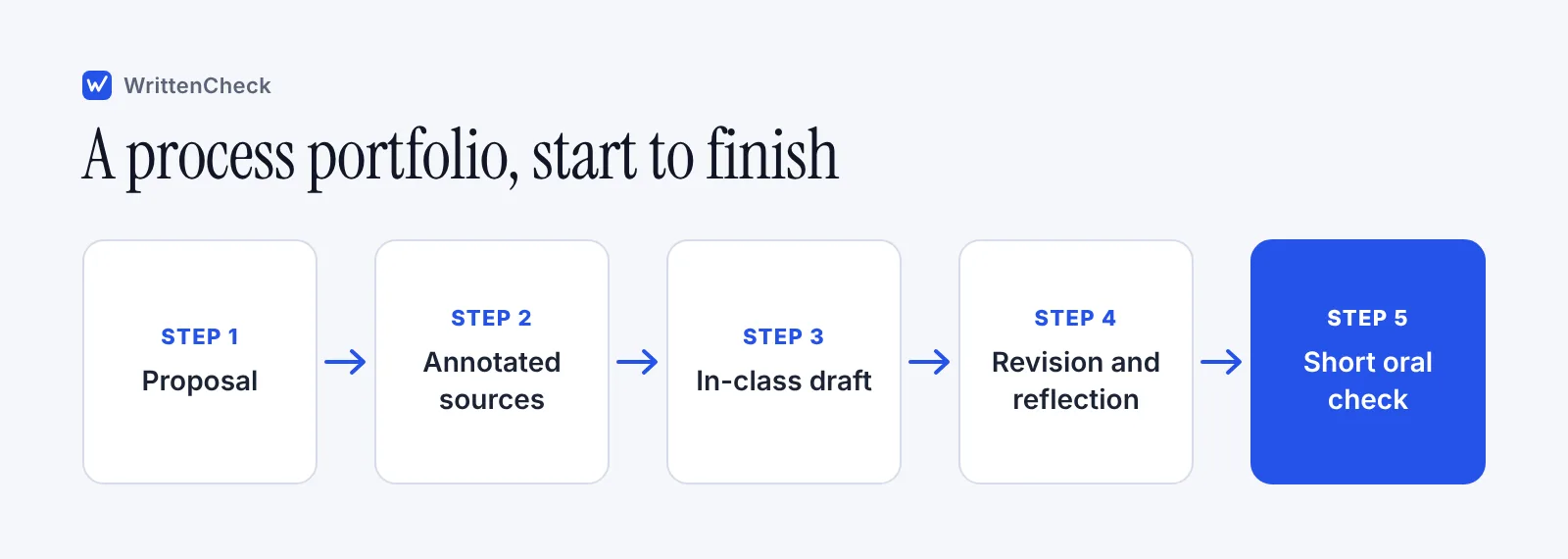
Cornell's Center for Teaching Innovation suggests asking students to identify the successes and challenges they experienced throughout a project, which turns the reflection into a record of real decisions. Berkeley's center recommends scaffolding through brainstorming, outlining, drafting, peer feedback and reflection, with in-class or AI-free drafts followed by revision.
A simple version for a four-week project:
Week 1, proposal. Half a page on the question, why it interests them and two places they'll start looking. Check it in class and give a quick comment.
Week 2, annotated sources. Three sources, each with two or three sentences on what it adds and one quote they plan to use.
Week 3, in-class draft. Forty minutes of drafting in the room, from their notes. Collect it.
Week 4, revision and reflection. The final version, plus a short note on the biggest change they made since the in-class draft and why.
Last day, short oral check. Three to five minutes per student on one choice they made. You can run these while the class works on something else.
The in-class draft is the anchor. Once you have it, you can compare the final version with work you saw being written.
What do AI resistant prompts look like by subject?
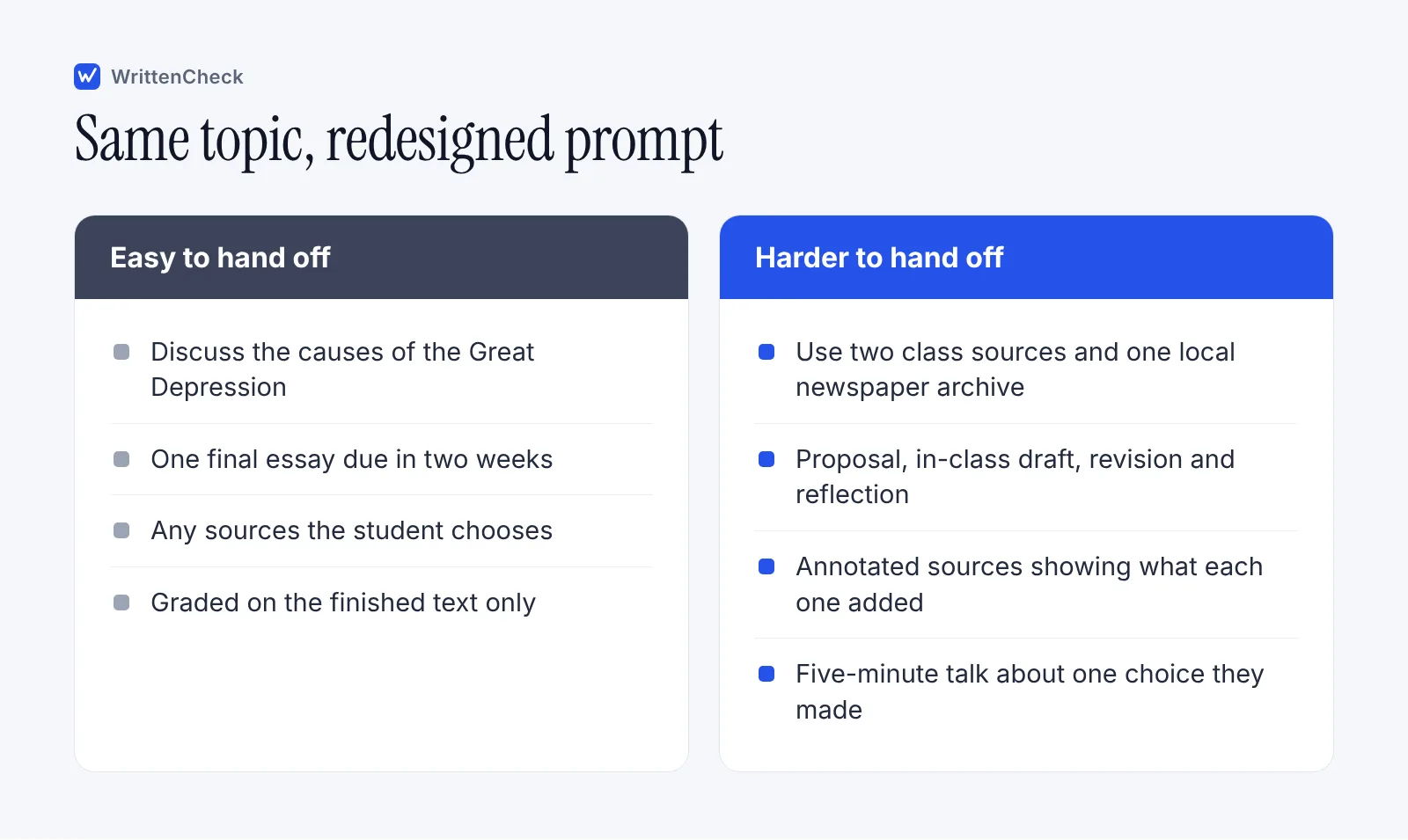
Good prompts tie the task to something only your class has, ask for a choice the student must defend, and build in a step that happens in the room. Here are example prompts you can adapt.
English
Choose one scene from the novel we read in class this month that changed how you saw a character. In class, write a page explaining what you thought before that scene and what changed. At home, revise it into a full essay using two quotes from your annotated copy. In your reflection, say which of your first-draft ideas you dropped and why.
History
Find a front page from our local newspaper archive published during the period we're studying. Compare how it covered one event with how our textbook describes it. Bring the page to class and be ready to explain in three minutes one thing the newspaper got wrong or left out.
Science
Using the data your group collected in last week's lab, write up your results. Explain one result that didn't match your prediction and two possible reasons. Include a photo of your raw data sheet. In a short conference, I'll ask you to walk me through one calculation.
Math
Pick one homework problem you got wrong this unit. Record a two-minute explanation of where your thinking went off track and how you'd solve it now. Then write a new problem of your own that would catch the same mistake, with a worked solution.
World languages
Interview a family member or neighbor about a tradition they remember, in any language you share. Write a short summary in the target language, then present it to a small group in class without notes, using the vocabulary from this unit.
Any subject, with AI encouraged
Ask an AI chatbot to answer this unit's review question. Fact-check its answer against your notes and our textbook. Mark every error or vague claim, rewrite the weak parts, and submit the original output, your marked-up version and a paragraph on what the AI got wrong and why you think that happened.
The last prompt fits the higher levels of the AI Assessment Scale, a framework published in 2024 by Mike Perkins, Leon Furze, Jasper Roe and Jason MacVaugh that helps teachers pick how much AI use each task allows. Our guide to writing an AI policy for schools explains how to label each assignment with a level and how students should disclose what they used. For citing AI output in the critique task, point students to our post on how to cite AI.
How do you run an oral defense without a huge time cost?
Keep it short, focused on one choice, and scheduled during class. A three-minute conversation tells you more than an hour of reading for clues.
Kofinas and colleagues recommended live, person-to-person assessment for exactly this reason. You don't need a formal viva. A few questions do the job:
"Why did you pick this source over the others?"
"What was the hardest paragraph to write, and what did you change?"
"If you had another week, what would you add?"
"Explain this sentence to me as if I'd missed that lesson."
Students who did the work tend to answer easily, even if they're nervous. Be careful not to treat nerves as evidence of anything. Offer a written alternative or a recorded answer for students with anxiety, speech differences or accommodations that make live talk harder.
The University of Sydney took this idea to a whole-university level. In November 2024 it announced a "two-lane" approach. Lane 1 is secure, supervised assessment without AI. Lane 2 is open assessment where students may use relevant tools and must acknowledge them. Classroom teachers can borrow the idea on a smaller scale, with one secure task per unit and open tasks around it.
What doesn't work?
Some popular tricks waste time or backfire. Avoid relying on these:
Hidden instructions in the prompt. Traps meant to trip up AI output treat every student as a suspect and can confuse the honest ones.
Banning AI with no redesign. A rule on its own doesn't change a task that's easy to hand off.
Relying on a detector to enforce the design. Scores are estimates. Our guide to using an AI detector for teachers explains why they should only prompt a closer look.
It also helps to keep the scale of the problem in view. Stanford researchers working with Challenge Success reported in 2023 that 60 to 70% of high school students admitted at least one cheating behavior in the previous month, about the same as before AI chatbots arrived. Redesign is about making learning visible for everyone. Catching a few cheaters is a side effect.
How do you redesign one assignment this week?
Pick one assignment you'll set soon and make two or three changes. You don't have to rebuild your whole course.
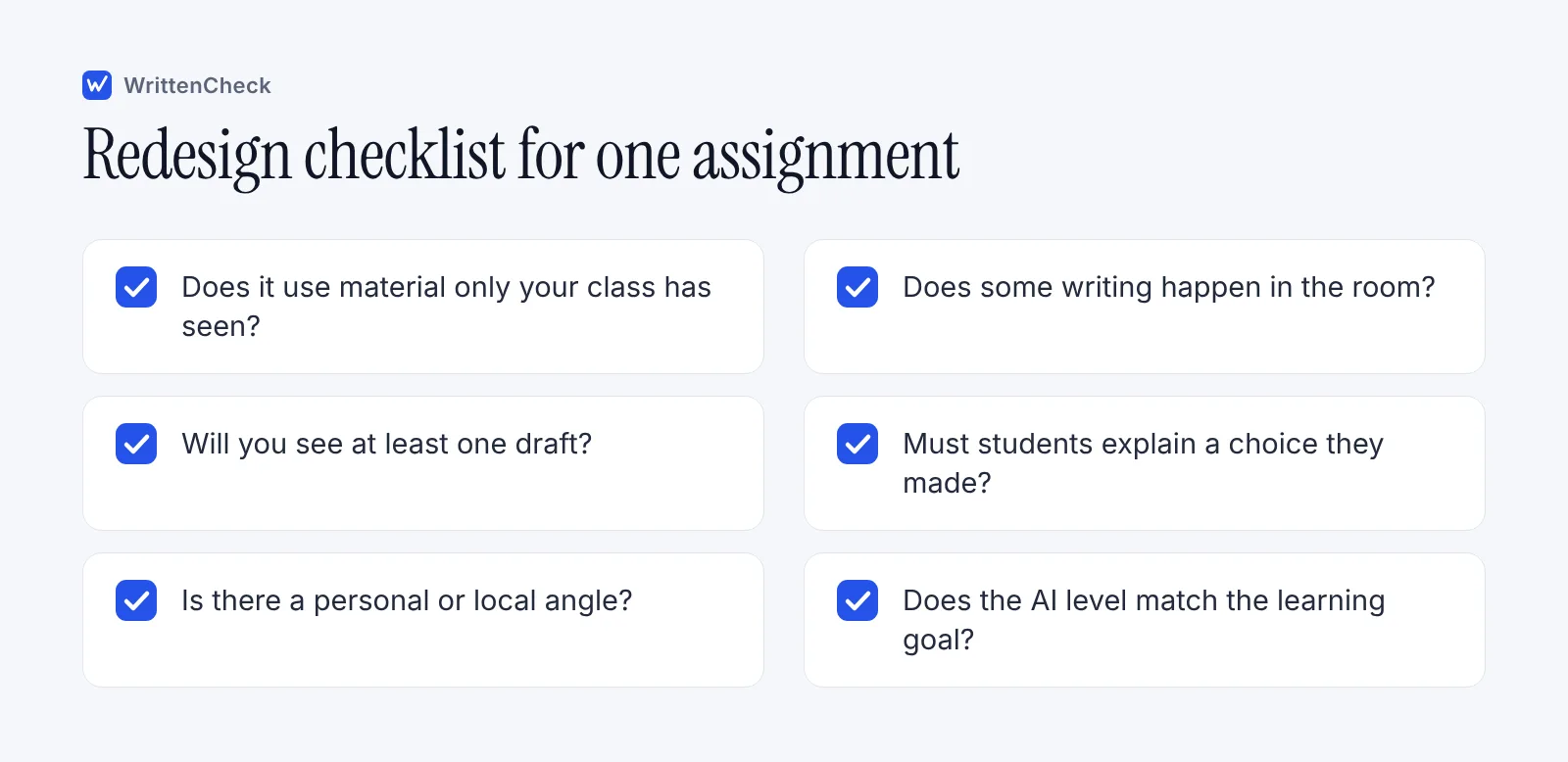
Paste your current prompt into an AI chatbot. Read what comes back. If it would earn a decent grade, the task needs work.
Name the learning goal. What should students be able to do at the end? Decide the AI level from that.
Add one in-class stage. A proposal, a timed draft or a planning session in the room.
Tie it to your class. A text, dataset, discussion or local source only your students have used.
Add one moment of explanation. A reflection on a choice or a three-minute conversation.
Update the rubric. Give real points to process, sources and reflection, so the final text isn't the only thing that counts.
If something still looks off after the redesign, our guide on how to tell if a student used AI covers fair next steps. You can also paste a sample answer into our free AI detector to see which sentences read most like AI, which is a quick way to see how generic a prompt's likely answers are.
Start with the assignment you'll set next, run step 1 tonight, and bring the in-class stage to your next lesson.
Frequently asked questions
What is an AI-proof assignment?
There's no such thing in practice. Teaching centers, including Northern Illinois University's, say that making assignments fully AI-proof may not be possible, and a 2025 UK study found markers generally couldn't tell which work had AI input. A better goal is an AI resistant assignment, one where the student's thinking is visible through drafts, reflections and short conversations, so misuse is harder and easier to notice.
What are good AI assignment ideas for high school?
Strong options include process portfolios graded in stages, essays drafted partly in class, projects tied to local sources such as a town newspaper archive, lab write-ups based on data the student collected, and short oral conferences on one choice the student made. Tasks that ask students to fact-check and improve an AI chatbot's answer also work well, as long as AI use is clearly allowed and disclosed.
Do in-class essays solve the AI problem?
They give you writing you know is the student's own, which is very useful as a baseline. But they limit research and revision, and timed handwriting can disadvantage students who need extra time or assistive technology. Most teaching centers recommend using in-class drafting as one stage in a larger process, followed by revision and reflection, rather than as the only form of assessment.
How long should an oral defense take?
Three to five minutes per student is usually enough. Ask about one specific choice, such as a source, a paragraph or a calculation, and let the student explain. Run conferences while the rest of the class works on something else. Offer a written or recorded alternative for students whose accommodations or anxiety make live conversation unfair as an assessment format.
Should assignments ever require AI use?
Yes, when using AI well is part of what you're teaching. A task that asks students to generate an AI answer, fact-check it, mark its errors and rewrite it builds judgment that matters in many jobs. Make the AI level clear on the task sheet, ask students to submit the original AI output and their prompts, and grade the quality of their critique and revisions.
Will these designs take more grading time?
Some will at first. Process stages add small pieces to read, but each one is quick, and they often cut time later because final drafts improve and you spend less time investigating doubtful work. Start with one redesigned assignment per term, grade early stages with brief comments or a checklist, and add more as you see what works.
Sources
Generative-AI-resistant assignments, Northern Illinois University Center for Innovative Teaching and Learning, February 2024
The impact of generative AI on academic integrity of authentic assessments within a higher education context, British Journal of Educational Technology (Kofinas, Tsay and Pike), March 2025
AI in Assignment Design, Cornell University Center for Teaching Innovation, accessed October 2026
Redesigning Assignments and Assessments, UC Berkeley Center for Teaching and Learning, accessed October 2026
AI Detectors Don't Work. Here's What to Do Instead., MIT Sloan Teaching and Learning Technologies, accessed October 2026
The Artificial Intelligence Assessment Scale (AIAS): A Framework for Ethical Integration of Generative AI in Educational Assessment, Journal of University Teaching and Learning Practice (Perkins, Furze, Roe and MacVaugh), April 2024
University of Sydney AI assessment policy, University of Sydney, November 2024
What do AI chatbots really mean for students and cheating?, Stanford Graduate School of Education, October 2023


Comments