An essay that sounds nothing like the student who handed it in is a real signal. It isn't proof. If you're trying to work out how to tell if a student used AI, the best evidence usually isn't in the essay alone. It's in the student's earlier writing, in their drafts, and in what they can tell you about the work when you sit down together.
This guide is for teachers who have a hunch and want a fair way to check it. It covers what to compare, where to find process evidence, what to actually say to the student, and how to write it all down so the outcome holds up if anyone asks later.
How can you tell if a student used AI?
Compare the work with the student's own earlier writing, then look at how it was made. Sudden shifts in voice and polish, sources that don't exist, and content that ignores what you taught are worth checking. Then ask for drafts or version history and talk with the student about their process. No single sign proves AI use, and neither does a detector score. A pattern of evidence plus the student's explanation is what you can act on.
Why isn't a gut feeling enough?
Because research shows teachers are much less accurate at spotting AI text than they think. Every reader has this blind spot, so the answer is to collect evidence before you decide.
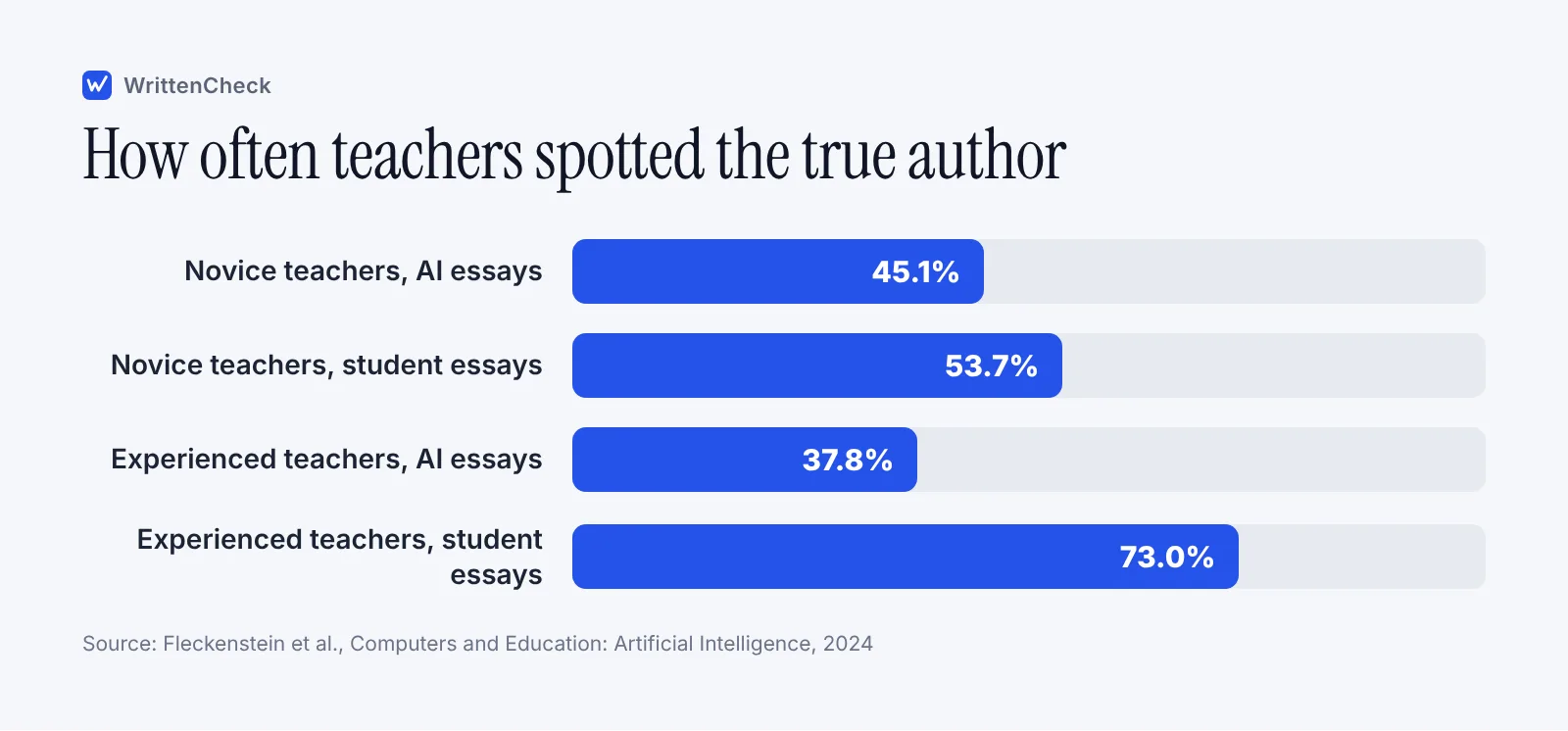
In a 2024 study in Computers and Education: Artificial Intelligence, Johanna Fleckenstein and colleagues asked 89 novice teachers and 200 experienced teachers to sort student essays from essays written by an AI chatbot. The novice teachers correctly identified 45.1% of the AI essays. The experienced teachers did better on student essays but correctly flagged only 37.8% of the AI ones. Both groups were overconfident in their calls.
A 2023 study by Tal Waltzer, Riley Cox and Gail Heyman found something similar with 69 high school teachers. They were right about 70% of the time, and their confidence didn't predict whether they were right. Subject expertise didn't help either. Well-written student essays were the hardest to classify, which means your strongest writers are the ones most likely to be wrongly suspected.
So treat your first reaction as a reason to look closer. Nothing more.
How to tell if a student used AI by comparing earlier writing
Look for changes against the same student's baseline. A sign means a lot more when it breaks from how this particular student usually writes.
Arizona State University's School of Life Sciences lists common signs in its guidance for instructors, including citations that don't exist, generic language with no personal insight, references to concepts the course never covered, and grammar that doesn't match a student's previous work. It also says plainly that none of these are proof of misconduct.
Here's how to check each one fairly.
Sign | What to compare it with | Innocent explanations to rule out |
|---|---|---|
Voice suddenly changes | Earlier essays, in-class writing, emails to you | Heavy revision, a tutor, a parent's edits, a grammar tool |
Vocabulary jumps a level | Words they use in class discussion | Wide reading, a thesaurus, a new interest in the topic |
Every paragraph is evenly polished | Their usual mix of strong and weak sections | Extra time and effort on this one task |
Sources that don't exist or don't say what's claimed | Look each one up yourself | Careless citing, copied reference lists |
Content that ignores your lessons | Your readings, your examples, class notes | Outside reading, a previous course |
No personal or local detail when the prompt asked for it | The prompt wording | An unclear prompt |
The citation check is the most concrete. A reference you can't find anywhere, or a real article quoted as saying something it doesn't say, is a specific problem you can show the student. A vague sense that the essay "sounds like AI" isn't.
Be careful with students writing in a second language. Their in-class writing and their take-home writing can differ a lot for ordinary reasons, like time to use a dictionary or a grammar checker.
Where do you find process evidence?
Look at how the work was built. Real writing leaves a trail of notes, false starts and revisions, and most of it is easy to find.
Check version history. In Google Docs, open File, then Version history, then See version history. Google notes that you need edit access to the file to browse earlier versions, so ask the student to share it with you as an editor. In Microsoft Word, version history only works for files saved in OneDrive or SharePoint. Select the file name at the top and choose Version history.
Read the pattern of edits. Gradual growth over several sessions looks very different from one session where the full essay appears at once. Keep in mind that some students write offline and paste in at the end, so a single big paste is a question to ask, not an answer.
Ask for planning materials. Outlines, notes, annotated readings, search history for sources, a photo of a brainstorm on paper.
Pull an in-class writing sample. Anything written in your room, under your eye, is your best baseline. If you don't have one yet, collect one early next term.
Check earlier drafts you've already seen. If you gave feedback on a draft, compare it with the final. Did the student act on your comments, or did the essay change completely?
How do you talk to a student about suspected AI use?
Meet privately, start by asking how they did the work, and listen before you name your concern. The University at Albany's teaching center recommends a confidential meeting and suggests asking students to describe how they worked on the assignment. ASU's guidance suggests opening with curiosity rather than accusation.
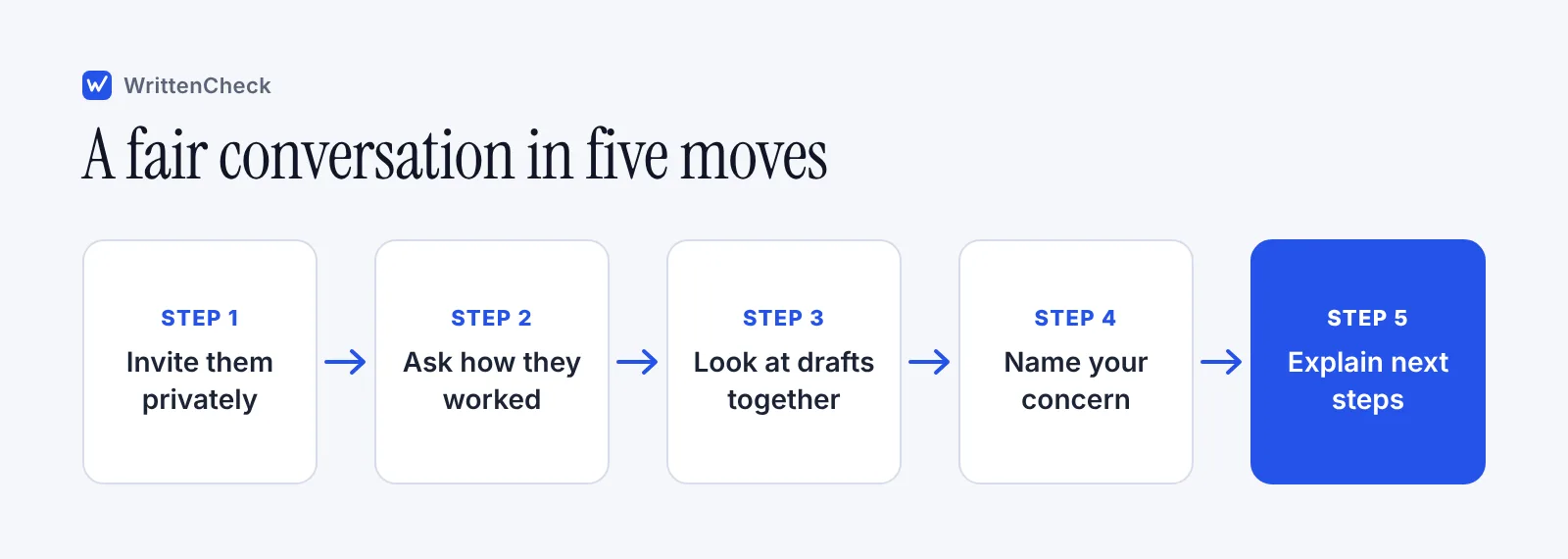
Here's an example script you can adapt. Keep your tone level and your questions specific to the assignment.
Opening: "Thanks for coming in. I want to talk about your essay on the causes of the 1929 crash. I'd like to understand how you put it together."
Process: "Walk me through how you got started. Which source did you find most useful, and what did it argue? In your third paragraph you use the term 'margin buying.' Can you explain what that means in your own words?"
Evidence: "Can you open your document's version history with me, or show me your notes?"
Your concern: "Some parts of this read quite differently from your earlier essays. For example, this paragraph and this source, which I couldn't find. Can you help me understand that?"
The rule: "In this class, AI tools are fine for brainstorming but not for writing the essay itself. Did you use any AI tool at any stage?"
Next steps: "Thanks for being straight with me. Here's what happens now."
A student who wrote the essay can usually talk about it. They remember the source that annoyed them, the paragraph they rewrote three times, the point they weren't sure about. That said, nervous students freeze. A shaky answer under pressure isn't a confession, so give them time and a second chance to show you their notes.
If the student says they used AI, ask how. "I asked it to fix my grammar" and "I pasted in the prompt and handed in what came back" are very different things, and your policy may treat them differently.
What should you not do?
Avoid anything that turns a suspicion into a verdict before you have evidence. The most common mistakes are easy to make on a busy day.
Don't confront a student in front of others. It hurts trust with the whole class, whatever the outcome.
Don't use a detector score as your only evidence. Even the best scores are estimates. More on this below.
Don't assume a sudden improvement is cheating. Students do have breakthrough essays, especially after feedback.
Don't go beyond your school's policy. Check what your school's academic integrity process requires before you set any penalty.
Don't assume it's everywhere. Stanford researchers working with Challenge Success reported that 60 to 70% of high school students admitted at least one cheating behavior in the previous month, and that the rate stayed about the same or dipped slightly in 2023 surveys after AI chatbots arrived.
Many teachers are handling this without much support. In a survey of 460 grade 6 to 12 teachers in late 2023, the Center for Democracy and Technology found 64% said students had faced consequences for suspected AI use, while only 28% had received guidance on how to respond when they suspect it.
How should you document a suspected case?
Write things down on the day, in plain factual language. Good notes protect the student, protect you and make any follow-up faster.
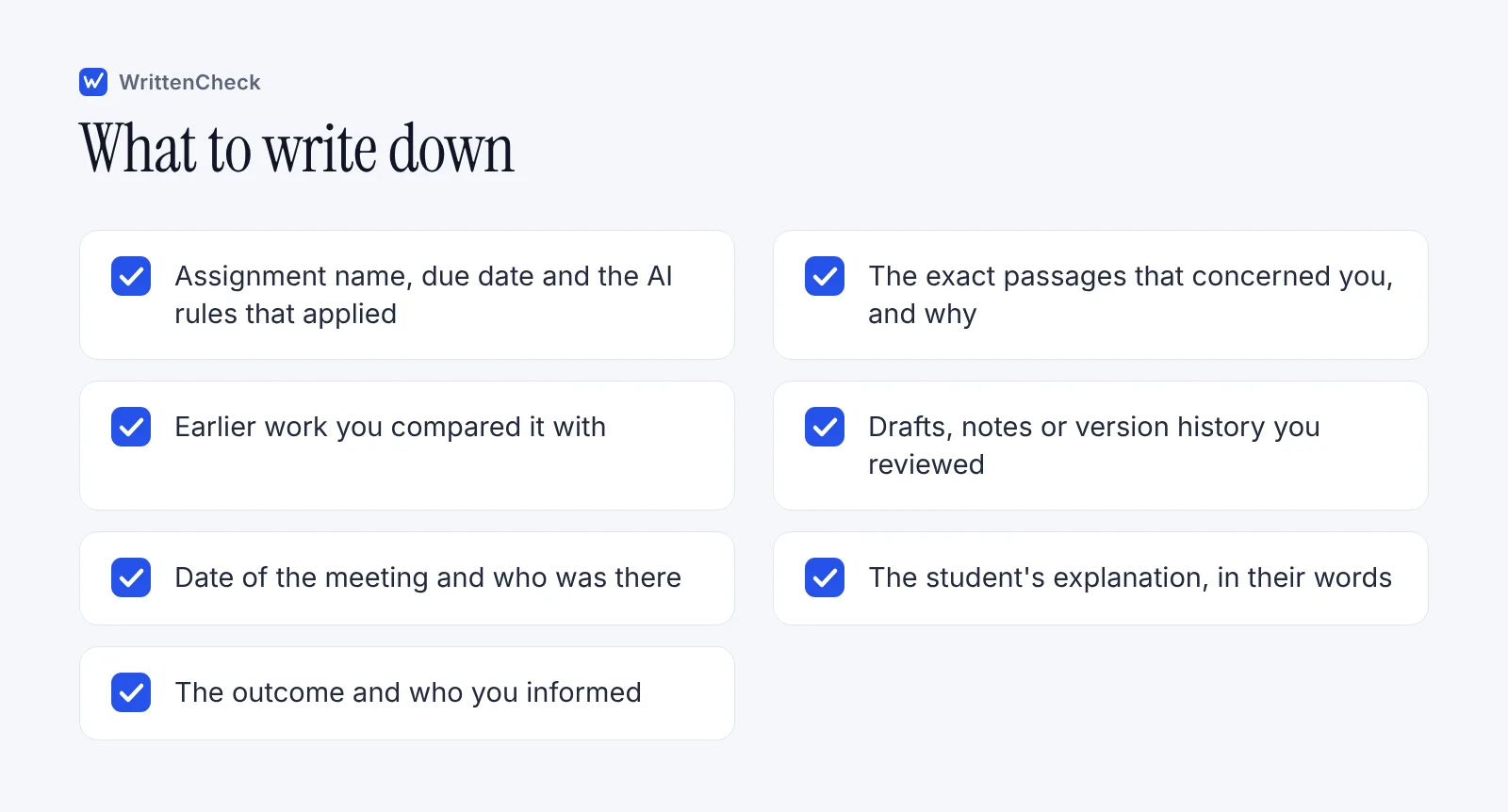
Stick to what you observed. For example, "The essay cites a 2021 article by Morales in the Journal of Economic History. I searched the journal's archive and could not find it" is useful. "The essay felt like AI" is not.
Keep copies of the version history screenshots, the earlier work you compared against and the policy text that applied. If the case goes to an integrity panel or a parent meeting, these are the documents people will ask for.
Should you also run the work through an AI detector?
You can, as one more piece of information, but never as the deciding piece. A detector gives you a probability estimate based on patterns in the text, and it can be wrong in both directions. Our guide to how AI detectors work explains why, and are AI detectors accurate covers the limits in detail.
Second-language writers deserve extra care here. In a 2023 study in Patterns, Weixin Liang and colleagues at Stanford found that seven detectors misclassified human-written TOEFL essays as AI-generated 61.3% of the time on average, while essays by US eighth graders were classified with near-perfect accuracy.
The Victorian Department of Education in Australia gives schools sensible advice. Its guidance says detection tools can give inaccurate or inconclusive results, and it tells schools to keep using established ways to authenticate work, including asking students to explain how they completed an assessment.
If you do use one, treat it as a pointer to the passages worth asking about. You can paste a draft into our free AI detector to see which sentences read most like AI, then take those sentences into the conversation as questions. Check your school's rules on sharing student work with any outside tool first.
What happens after the conversation?
Most cases end in one of three places. Your next move depends on which one you're in.
Your concern is resolved. The student shows drafts, explains their sources and talks fluently about the argument. Thank them, note the outcome and move on.
The student misunderstood the rules. They used AI in a way they thought was allowed. Albany's teaching center suggests having students rework the assignment so the learning still happens, rather than defaulting to a failing grade. Then make your policy clearer for everyone.
The misuse is clear. Follow your school's academic integrity process exactly, with your notes attached. Don't invent a separate penalty.
For a student's view of this process, our post on how teachers check for AI is worth sharing with your class. Students who know you look at drafts and talk to writers tend to keep their drafts.
Before your next writing assignment, collect a short in-class writing sample from every student and require drafts in a shared document. Do that once and the next time you have a hunch, the evidence will already be on your desk.
Frequently asked questions
Can teachers really tell if a student used AI?
Not reliably by reading alone. In a 2024 study, experienced teachers correctly identified only 37.8% of AI-written essays, and in a 2023 study high school teachers were right about 70% of the time, with confidence that didn't track accuracy. Teachers do much better when they compare work with a student's earlier writing, review drafts and version history, and talk with the student about how the work was made.
What is the strongest single sign of AI use in student work?
Sources that don't exist, or real sources quoted as saying things they don't say, are the most concrete sign because you can verify them yourself and show the student. Even then, careless citing has other causes. Treat a fake reference as a strong reason to ask questions, and pair it with process evidence like notes and drafts before you reach any conclusion.
What should I say first when I meet the student?
Open with questions about the work itself. Something like "I'd like to understand how you put this essay together" invites the student to explain without getting defensive. Ask about their sources, a specific paragraph and their notes. Only after you've heard their account should you describe what concerned you, using specific passages rather than a general impression.
Is version history proof that a student wrote their essay?
It's strong supporting evidence, though it can't settle the question on its own. Steady growth over several sessions suggests the student built the work themselves. A single large paste raises a question, since some students draft offline or in another app and paste at the end. Ask the student to explain the pattern, and look at it alongside notes, earlier drafts and their in-class writing.
Can I give a zero if a detector says the essay is AI?
You shouldn't base a penalty on a detector score alone. Scores are estimates, and research has found detectors misclassify some groups, such as second-language writers, far more often than others. Use any score only as a prompt to look closer, and follow your school's academic integrity process, which usually requires evidence and a chance for the student to respond.
How can I prevent this situation next term?
Set clear AI rules for each assignment, collect an in-class writing sample early, and make plans and drafts part of the grade. When process evidence is built into every assignment, you rarely need to ask one student for extra proof, and students know from the start that you look at how work is made as well as the final result.
Sources
Do teachers spot AI? Evaluating the detectability of AI-generated texts among student essays, Computers and Education: Artificial Intelligence (Fleckenstein et al.), June 2024
Testing the Ability of Teachers and Students to Differentiate between Essays Generated by ChatGPT and High School Students, Human Behavior and Emerging Technologies (Waltzer, Cox and Heyman), 2023
Recognizing and Responding to Suspected AI Use, Arizona State University School of Life Sciences, updated December 2025
Respond to suspicions of student cheating with AI, University at Albany, accessed October 2026
Up in the Air: Educators Juggling the Potential of Generative AI with Detection, Discipline, and Distrust, Center for Democracy and Technology, March 2024
What do AI chatbots really mean for students and cheating?, Stanford Graduate School of Education, October 2023
GPT detectors are biased against non-native English writers, Patterns (Liang et al.), July 2023
Generative Artificial Intelligence: Promoting academic integrity, Victorian Department of Education, updated June 2025
Find what's changed in a file, Google Docs Editors Help, accessed October 2026
View previous versions of Office files, Microsoft Support, accessed October 2026


Comments