Students are already using AI chatbots for homework, and most of them are guessing at the rules. A good AI policy for schools ends the guessing. It tells students what's allowed on each task, how to say what they used, and what happens if something goes wrong.
This guide walks through how to write one for a single classroom or a whole school. You'll get a simple set of use levels, example syllabus statements you can adapt, a disclosure template for students, and a plan for explaining it to students and parents.
What should an AI policy for schools include?
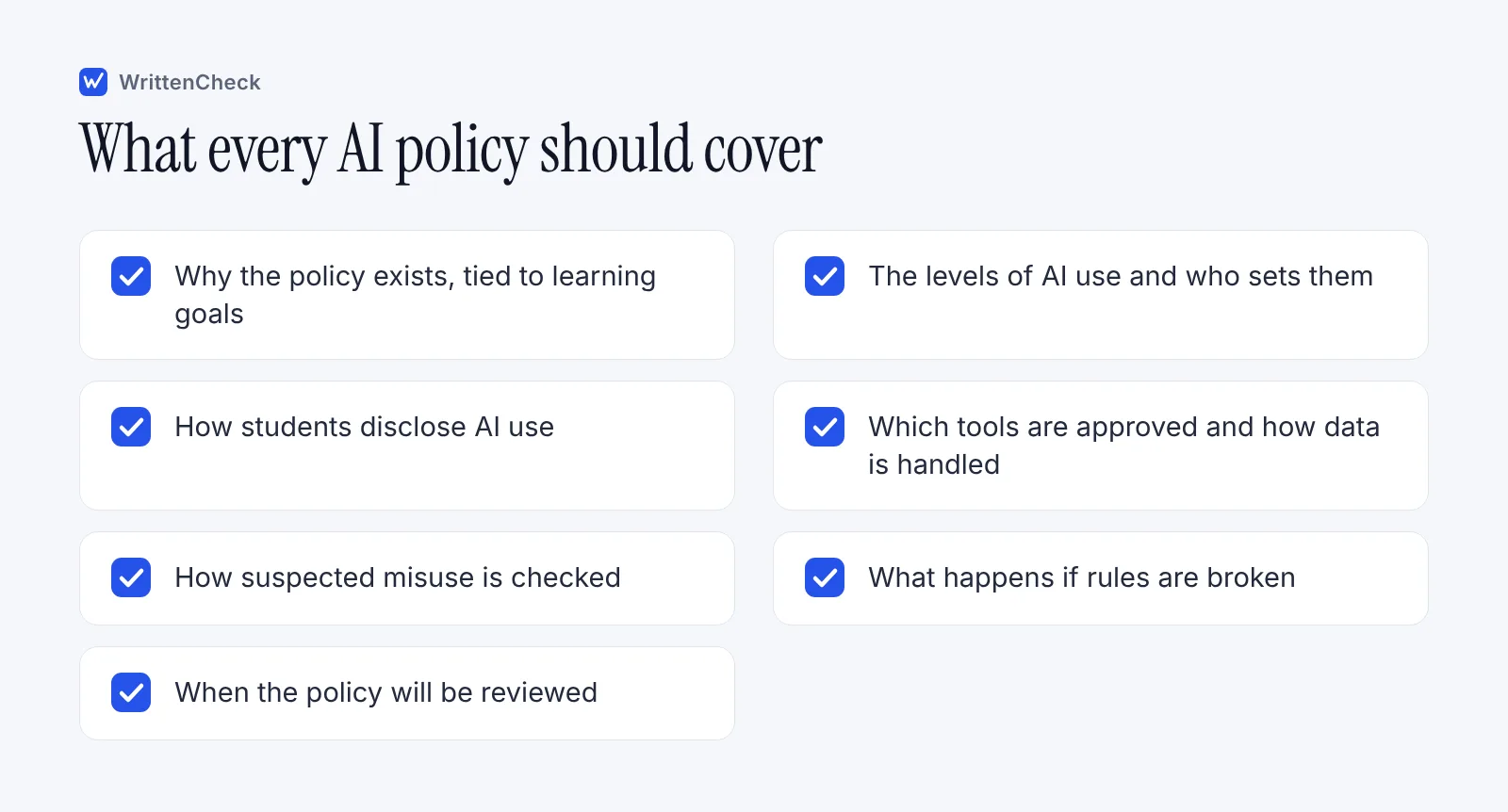
A school AI policy should state why it exists, define a few levels of AI use that teachers can assign to each task, explain how students disclose AI use, list approved tools and how student data is protected, and set out what happens when misuse is suspected. It should be short enough to read in five minutes, written in plain language for students and parents, and reviewed at least once a year.
Why does your school need an AI policy now?
Because without one, every teacher and every student is making up their own rules. That's unfair to students, who get different answers in different rooms, and it leaves teachers with nothing to point to when a problem comes up.
The gap has been wide. When UNESCO released its Guidance for generative AI in education and research in September 2023, it reported that fewer than 10% of more than 450 schools and universities in a global survey had institutional policies or formal guidance on generative AI. The guidance, written by Fengchun Miao and Wayne Holmes, called for data privacy protection, teacher training and an age limit of 13 for using AI tools in the classroom.
US schools have moved faster since then. By late 2023, 85% of teachers in a Center for Democracy and Technology survey said their school had a policy that either permitted or banned generative AI use. But a policy that exists isn't the same as a policy students understand. If your current one is a single paragraph saying "use AI responsibly," it needs work.
What levels of AI use can a policy allow?
Most good policies define a few levels and let teachers pick one for each assignment. That's more honest than a single school-wide rule, because the right amount of AI help depends on what the task is meant to teach.
The best-known framework is the AI Assessment Scale, published in 2024 by Mike Perkins, Leon Furze, Jasper Roe and Jason MacVaugh in the Journal of University Teaching and Learning Practice. A revised version, described by the University of Iowa's teaching center, runs from No AI through AI Planning, AI Collaboration and Full AI to AI Exploration. Carnegie Mellon's Eberly Center offers sample policies in three broad groups, from full prohibition to encouraged use with citation to use allowed only for set activities.
For most schools, three levels are enough to start:
Level | What students may do | Good fit for | Disclosure needed? |
|---|---|---|---|
No AI | Nothing. No AI tools at any stage | In-class writing, skills checks, exams, early drafts | No, there's nothing to disclose |
AI with disclosure | Use AI for named tasks only, such as brainstorming, feedback on a draft or checking grammar | Most homework, research projects, revision | Yes, a short note on what was used and how |
AI encouraged | Use AI freely as part of the task, then evaluate and improve its output | Lessons on AI literacy, critiquing AI writing, prompt design | Yes, plus the prompts or chat log |
The Victorian Department of Education in Australia uses a similar idea. Its guidance tells schools to prohibit, limit, modify, incorporate or require AI use depending on what the assessment is meant to measure.
What do example syllabus statements look like?
Here are three original statements you can copy and edit. Each one names the rule, gives the reason and says what to do if a student isn't sure.
No AI
AI use in this assignment: not allowed. For this essay, don't use any AI tool at any stage, including for ideas, outlines, translation or editing. This task is practice in building an argument on your own, and I need to see where your thinking is right now so I can help. Spell checkers built into your word processor are fine. If you're unsure whether a tool counts, ask me before you use it.
AI with disclosure
AI use in this assignment: allowed for planning and feedback, with disclosure. You may use an AI chatbot to brainstorm topics, suggest questions to research, or give feedback on a draft you wrote. You may not use it to write sentences or paragraphs that you hand in. Add a short disclosure note at the end saying which tool you used, what you asked it to do and what you changed as a result. You're responsible for checking every fact and source, because AI tools can make things up.
AI encouraged
AI use in this assignment: encouraged. This project is about working well with AI. Use any AI tool you like to generate a first draft, then critique it, fact-check it and rewrite it. Submit your prompts and the AI output alongside your final version, and highlight what you changed and why. You'll be graded on the quality of your judgment and your edits, so show your thinking.
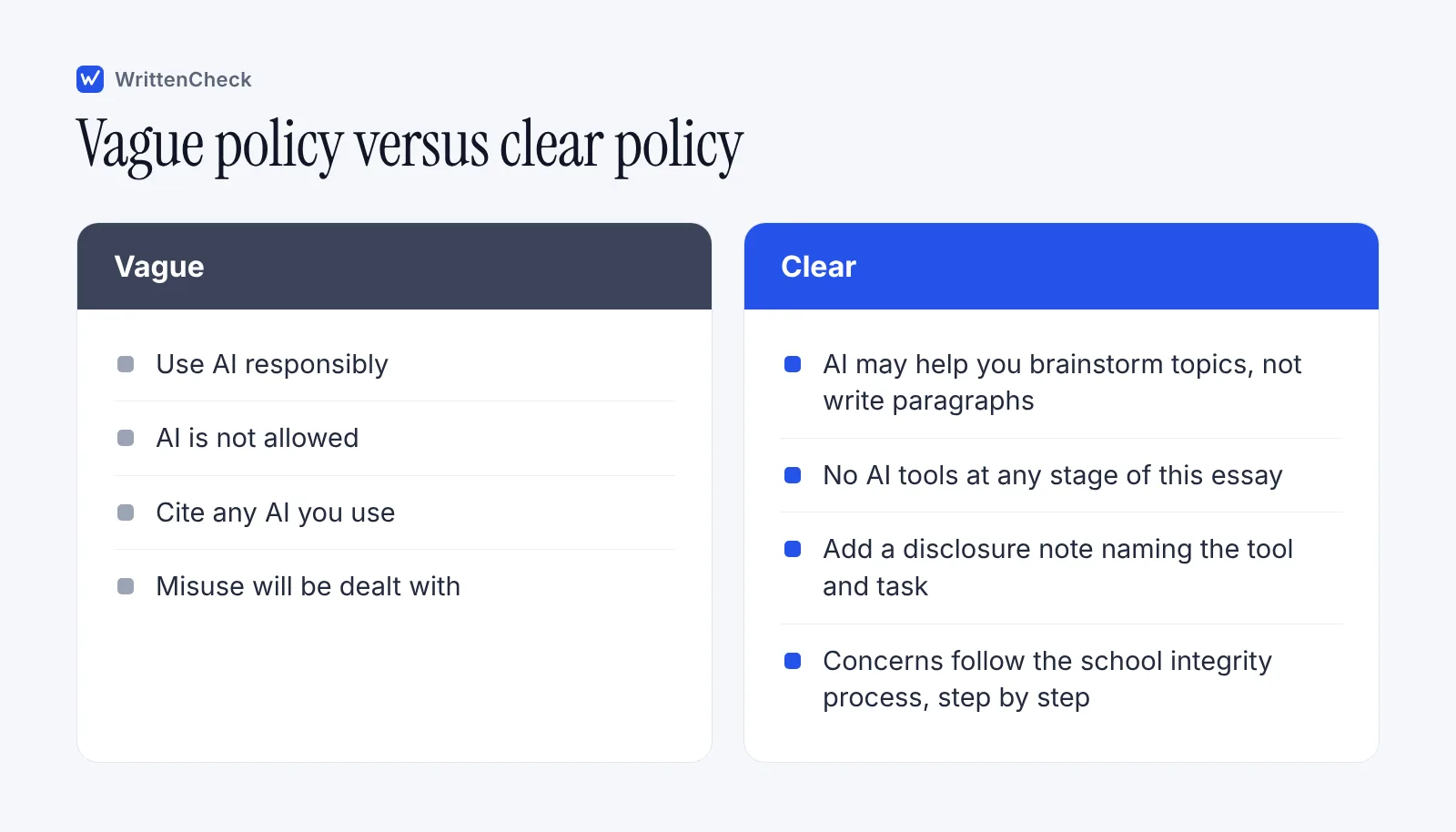
Carnegie Mellon's sample policies make two points worth keeping. Explain how the rule supports learning, and remind students that AI tools often give wrong information and that they're responsible for what they submit.
What should a student AI disclosure statement say?
A disclosure statement should name the tool, the task it helped with, and what the student did with the output. Keep it short so students actually write it.
Here's a template students can fill in:
AI disclosure Tool used: [name and version, if known] Date(s) used: [dates] What I used it for: [for example, brainstorming three possible topics, or feedback on paragraph 2] What I asked it: [paste or summarize the main prompts] What I kept, changed or rejected: [one or two sentences] I checked all facts and sources myself: [yes or no, with a note]
And here's an example of a filled-in version:
AI disclosure. I used an AI chatbot on 3 March to suggest five possible research questions about water use in our town. I chose the third one and reworded it. I didn't use AI for any of the writing. All sources are ones I found and read myself.
If your class follows a citation style, such as APA or MLA, show students how that style handles AI as well. The disclosure note covers the how and why, while a citation covers any AI text quoted directly. If a student is unsure where the line sits between using AI and copying, our post on whether using AI is plagiarism is a good one to share.
How do you write an AI policy for schools?
Start small, write in plain language and plan to revise. A two-page policy that people read beats a twenty-page one nobody opens.
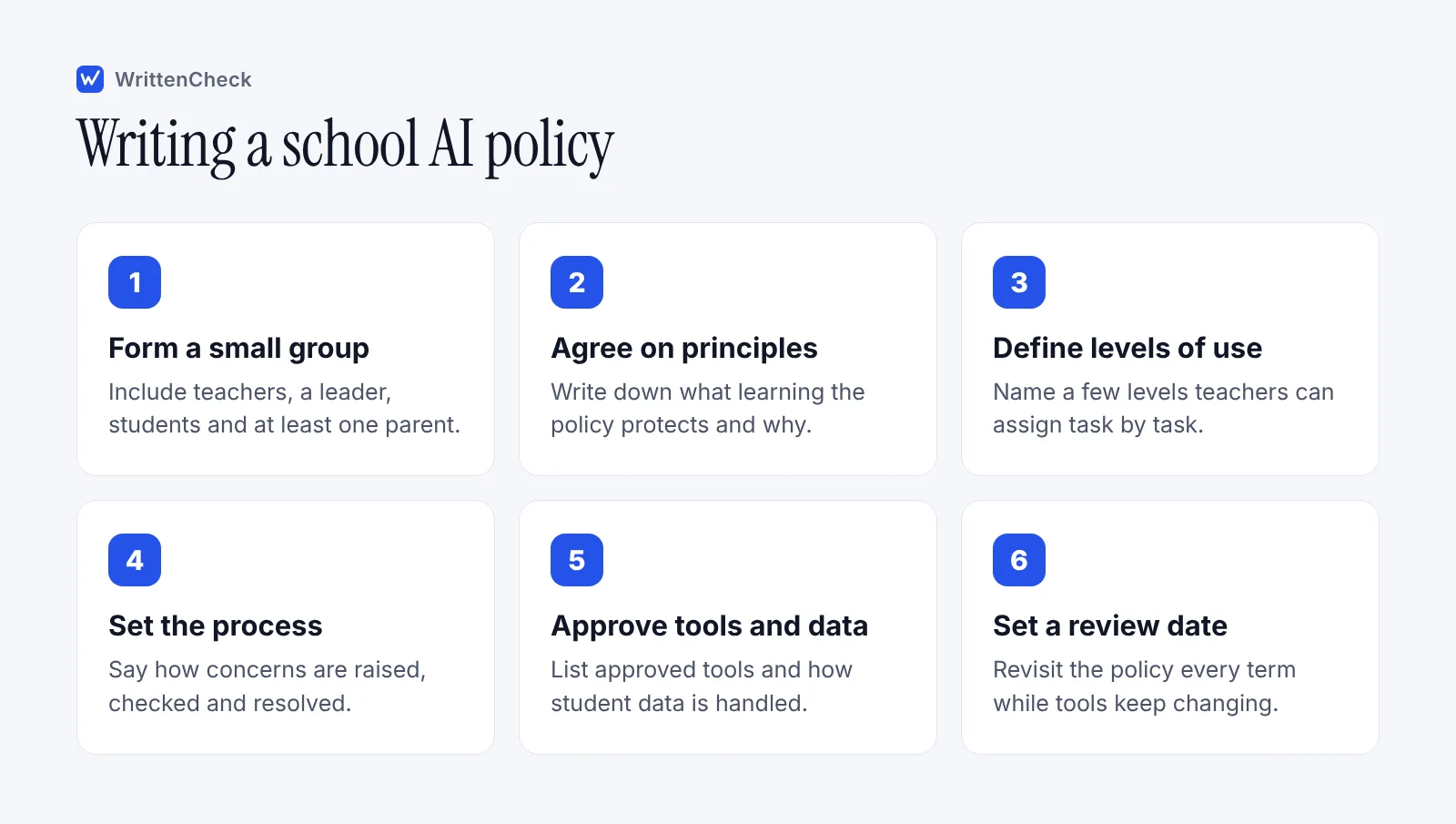
Form a small group. Include classroom teachers from different subjects, a school leader, a couple of students and at least one parent. In July 2025 the US Department of Education issued guidance stressing parent and teacher engagement in guiding the ethical use of AI, and engaging affected stakeholders, especially parents, in decisions about new technology.
Agree on principles. Write three to five sentences on what the policy protects. For example, students should practice core skills without AI, and AI use should always be visible.
Define your levels. Use the three above or adapt the AI Assessment Scale. Say who sets the level for each task, usually the teacher.
Set the process for concerns. Say how a teacher raises a concern, what evidence matters, and how students can explain their work. Link this to your existing academic integrity policy.
Approve tools and protect data. List which AI tools students and staff may use and confirm how each handles data. UNESCO's guidance calls for protecting data privacy and setting age limits. Check each tool's terms for its own age rules too.
Set a review date. Tools change every few months. Put a date on the policy and revisit it.
Some universities have gone further and split all assessment into two kinds. The University of Sydney announced in November 2024 a "two-lane" approach. Lane 1 is secure, supervised assessment without AI. Lane 2 is open assessment where students may use relevant tools and must acknowledge them. It's a useful model if you want a simple rule at the whole-school level.
What should the policy say about AI detectors?
It should say whether detectors may be used, which ones are approved, and that a detector score is never enough evidence on its own. Leaving this out invites inconsistent and unfair decisions.
The Victorian Department of Education tells schools that detection tools can give inaccurate or inconclusive results and that schools should keep using established ways to check authorship, including asking students to explain how they completed an assessment. Your policy can make that explicit. For example, "A detector result may prompt a conversation. It cannot be the sole basis for any penalty."
Our guide to using an AI detector for teachers covers when a check makes sense and how to read a score. If your school allows detectors, teachers can paste a draft into our free AI detector to see which sentences read most like AI, then use those as questions for the student.
How should you communicate the policy?
Say it out loud, put it in writing and repeat it on every assignment. One announcement in September won't stick.
MIT Sloan's teaching and learning team recommends announcing AI policies both verbally and in writing, explaining the reasons behind them and giving concrete examples of acceptable and unacceptable use. In practice:
Teach it in class. Spend fifteen minutes on the levels with real examples from your subject. Ask students where they think the line is for a sample task.
Label every assignment. Put the AI level at the top of each task sheet, in bold, using the same words every time.
Send a short note home. Parents need the levels and the disclosure rule in a few lines, plus who to contact with questions.
Give teachers a shared page. Same wording across subjects means students don't have to decode different rules in each room.
Ask for questions early. Invite students to check with you before using a tool they're not sure about, and thank them when they do.
If you're starting from nothing, draft the three syllabus statements above for your own subject this week, add the AI level to your next assignment sheet, and ask students to fill in the disclosure template on that task. You'll learn more from one assignment cycle than from another month of planning.
Frequently asked questions
What is an AI policy for schools?
An AI policy for schools is a short written set of rules on how students and staff may use artificial intelligence tools, especially AI chatbots that generate text. A good one defines levels of permitted use, explains how students disclose AI use, lists approved tools and data protections, and describes what happens when misuse is suspected. It should be easy for students and parents to read.
Should schools ban AI completely?
A total ban is hard to enforce and leaves students without guidance on a tool they'll meet everywhere. Most guidance favors setting the level per task instead. Some tasks, such as in-class writing or skills checks, should be AI-free, while others can allow AI with disclosure or even require it. The University of Sydney's two-lane approach is one example of a mixed model.
What is an AI syllabus statement?
An AI syllabus statement is a short paragraph in a course syllabus or assignment sheet that tells students whether and how they may use AI for that course or task. Strong statements name the specific uses allowed, give the reason for the rule, explain how to disclose AI use, and tell students to ask before using a tool if they're unsure.
What is an AI disclosure statement?
An AI disclosure statement is a brief note a student adds to their work explaining which AI tool they used, what they used it for, what they asked it, and what they kept or changed. It makes AI use visible so teachers can judge the work fairly. It works alongside a formal citation when a student quotes AI-generated text directly.
How often should we update our AI policy?
At least once a year, and ideally once a term while tools are changing quickly. Put a review date on the policy itself, collect questions and problems from teachers and students as they come up, and adjust wording that keeps causing confusion. Small, regular updates are easier to communicate than a full rewrite every few years.
Do students need to be 13 to use AI in class?
UNESCO's 2023 guidance on generative AI in education recommends an age limit of 13 for using AI tools in the classroom. Check your country's laws and each tool's own terms of use, and build those age rules into the list of approved tools in your policy.
Sources
Guidance for generative AI in education and research, UNESCO (Miao and Holmes), September 2023
UNESCO: Governments must quickly regulate Generative AI in schools, UNESCO, September 2023
U.S. Department of Education Issues Guidance on Artificial Intelligence Use in Schools, Proposes Additional Supplemental Priority, U.S. Department of Education, July 2025
The Artificial Intelligence Assessment Scale (AIAS): A Framework for Ethical Integration of Generative AI in Educational Assessment, Journal of University Teaching and Learning Practice (Perkins, Furze, Roe and MacVaugh), April 2024
The AI Assessment Scale: Reflecting on AI in Assignment Design, University of Iowa Center for Teaching, accessed October 2026
Examples of possible academic integrity policies that address student use of generative AI tools, Carnegie Mellon University Eberly Center, accessed October 2026
Generative Artificial Intelligence: Promoting academic integrity, Victorian Department of Education, updated June 2025
AI Detectors Don't Work. Here's What to Do Instead., MIT Sloan Teaching and Learning Technologies, accessed October 2026
Up in the Air: Educators Juggling the Potential of Generative AI with Detection, Discipline, and Distrust, Center for Democracy and Technology, March 2024
University of Sydney AI assessment policy, University of Sydney, November 2024

Comments