A personal statement has one job. It shows an admissions reader who you are in a way your grades and lists can't. Most weak statements fail for the same reason. They make claims about the writer ("I'm passionate", "I'm a leader") and never prove them.
This guide covers how to write a personal statement that avoids that trap. You'll get the real limits for the Common App, UCAS and medical school, an 8-step method, a copyable outline, before and after examples, and what admissions offices say about using AI.
How do you write a personal statement?
Start with the prompt and the limit, then brainstorm specific experiences that show why you want this path. Pick one or two, and write a first draft that tells them with concrete detail. Open with a real moment, explain what it taught you or how it changed what you do, and connect it to the course or college. Then revise several times, cut anything generic, and get outside feedback before you submit.
What do admissions readers look for?
They want to learn something about you that isn't anywhere else in the application. Purdue OWL suggests asking yourself what's special or distinctive about you or your story, when your interest in the field started, and what sets you apart from other applicants.
The UNC Writing Center's test is simple. Cut any generalization or platitude, or "anything that could be cut and pasted into anyone else's application." That one rule fixes most first drafts.
Readers also check whether you answered the question. Different systems ask different things.
Application | Length | What it asks |
|---|---|---|
Common App personal essay (US) | 250 to 650 words | Choose one of seven prompts, such as a challenge you faced or a topic of your choice |
UC Personal Insight Questions | 4 answers, up to 350 words each | Choose 4 of 8 questions |
UCAS personal statement (UK, 2026 entry onward) | 4,000 characters including spaces | Three set questions about why this subject, how your studies prepared you, and what else you've done |
AMCAS personal comments essay (US medical school) | 5,300 characters including spaces | Why medicine, what motivates you, and what schools should know that isn't elsewhere |
A personal statement for college in the US is usually a story about you. A UCAS statement is more academic. All three UCAS questions are about the subject you want to study. For more on limits and how to plan words, see how long is an essay.
How to write a personal statement in 8 steps
This method works for a 350-word UC answer and a 4,000-character UCAS statement. Give yourself a few weeks if you can. The UNC Writing Center advises allowing time for many drafts, with breaks in between.
Read the prompt twice. Write the exact question at the top of your document. For UCAS, write all three questions.
Brainstorm 10 moments. List specific scenes, not achievements. A conversation, a problem you couldn't solve, a job you did badly at first. Aim for detail you could draw.
Pick the one or two with the most to say. Choose moments that changed what you think or do. A small moment you can explain well beats a big one you can only describe.
Write a messy first draft. Ignore the limit. Tell the story, then explain what it meant and what you did next.
Find your point. Finish this sentence: "This shows that I..." That sentence is your statement's spine. Every paragraph should support it.
Rewrite the opening. Purdue OWL calls the opening paragraph "generally the most important." Start inside the moment, with a detail.
Cut to the limit. Remove anything generic, repeated or already listed elsewhere in your application, as UNC advises.
Get outside eyes, then proofread. The AAMC recommends feedback from objective readers outside your personal circle. Read the final version aloud before you paste it in.
What structure should a personal statement follow?
A simple four-part shape works for most statements: a specific opening moment, what happened and what you did, what it taught you or changed, and where it points next. UCAS statements follow the three set questions instead, so treat each as its own short section.
Copyable outline for a college personal statement
Use this as a planning template. The word counts assume a 650-word Common App essay and are only a starting split.
1. Opening moment (80 to 120 words)
   - One specific scene: where, when, what you saw or did.
   - Stop at the moment of tension or curiosity.

2. What happened (150 to 200 words)
   - What you tried. What went wrong or surprised you.
   - Concrete details only. Names of tools, books, places.

3. What changed (150 to 200 words)
   - What you understand now that you didn't before.
   - One more example showing you act differently now.

4. Where it points (100 to 150 words)
   - What you want to study or do next, and why.
   - Link back to the opening scene in one line.
Copyable outline for a UCAS personal statement
UCAS lets you split the 4,000 characters however you like, as long as each answer has at least 350 characters. UCAS also suggests treating the three answers as one piece and avoiding repeats.
Q1. Why this course or subject?
   - The specific question or idea that pulled you in.
   - What you've read, watched or done to follow it up.

Q2. How have your studies prepared you?
   - Two subjects or projects, and a skill each gave you.
   - One example of applying it.

Q3. What else have you done, and why is it useful?
   - Work, volunteering, clubs, caring roles, reading.
   - For each: what you did, and what it taught you
     that matters for this course.
Personal statement examples: weak and strong openings
The fastest way to improve a statement is to compare a generic version with a specific one. Here's an example opening written to show the most common habits.
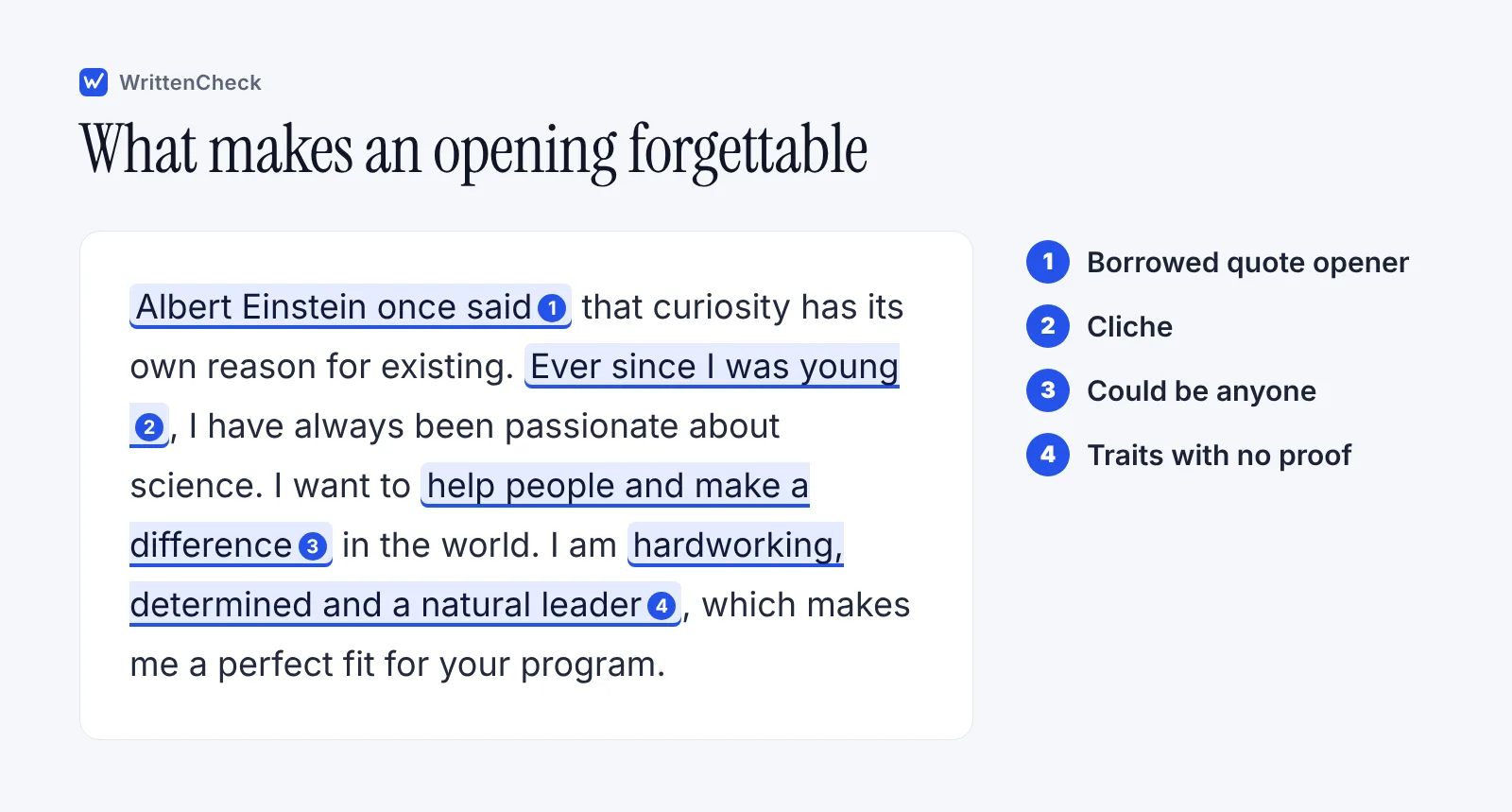
Every sentence in that paragraph could appear in thousands of applications. Now here's an example rewrite for the same applicant, using a real moment.
Example, stronger opening: The water samples from the creek behind our school were supposed to be boring. Ours came back with nitrate levels three times higher than the other groups'. My lab partner blamed the test kit. I wanted to know who was upstream.
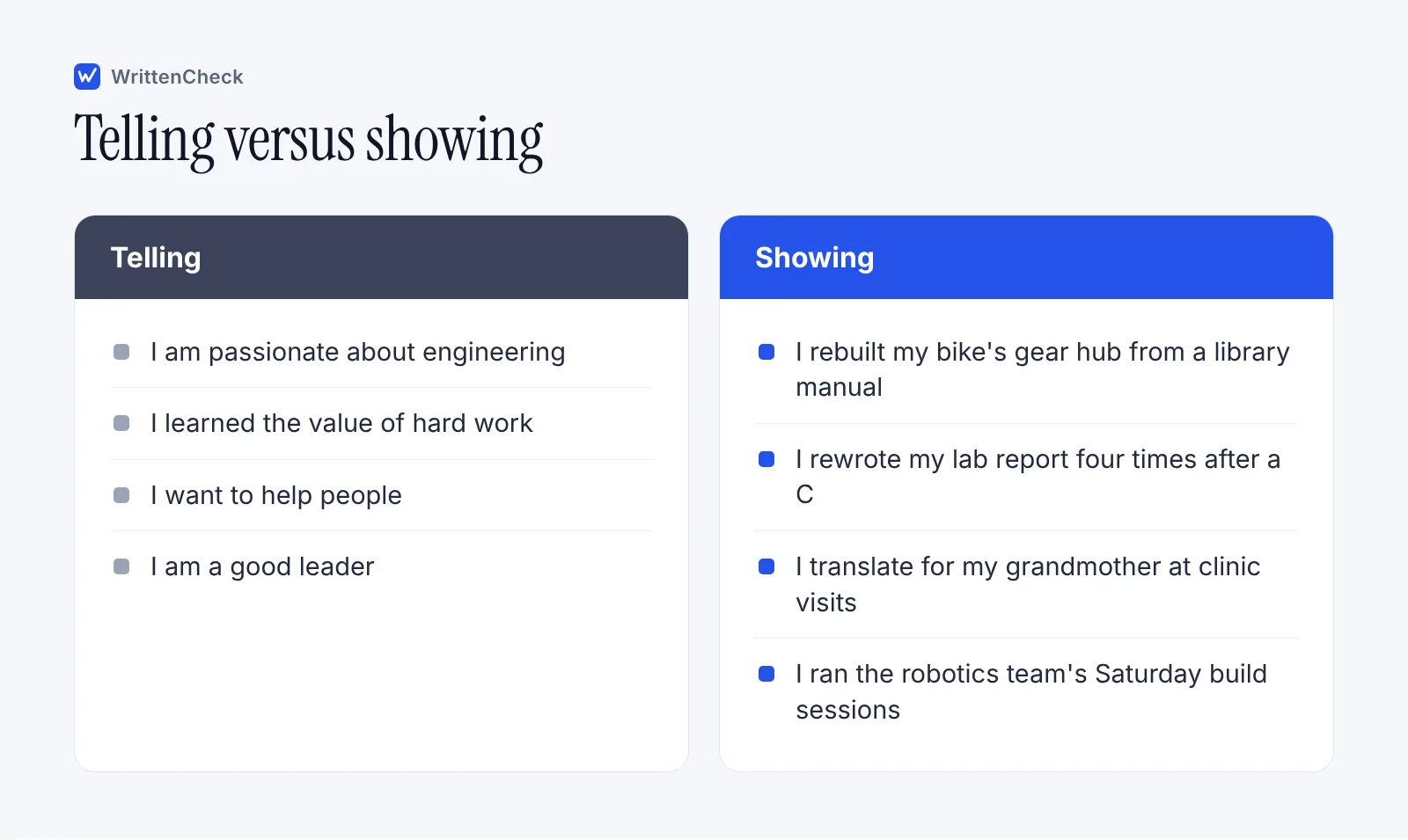
This version shows curiosity instead of claiming it. It gives the reader a scene, a problem and a reason to keep reading. The writer can then explain what they found out, what they did next, and why they want to study environmental science.
The same fix works for the middle of the statement. Turn each trait into proof.
A UCAS example answer, before and after
Before (example): I have always been fascinated by history and I love learning about the past. History is important because it helps us understand the present.
After (example): Reading my great-uncle's 1962 shipping logbook made me ask why his ship was diverted twice in one month. Tracing that question led me to the port records from that year, and to how much trade history depends on dull paperwork.
The second answer gives evidence of real interest and shows the student doing what history students do.
What are the most common personal statement mistakes?
Most mistakes come from writing about yourself in general terms. These are the ones writing centers flag most.
Clichés. UNC gives "Every doctor wants to help save lives" as an example to avoid. Purdue OWL points out that a medical applicant saying they're good at science and want to help people isn't expressing an original thought.
Opening with a famous quote or a dictionary definition. It spends your best line on someone else's words.
Listing achievements. Your activities list already does that. Pick one and go deep.
Melodrama. UNC warns against inventing drama. A small true story told well is stronger.
Writing one statement for every school. Purdue OWL advises tailoring each statement to the question asked.
Going over the limit or shrinking the text to fit. UNC says to follow limits exactly and lean short.
Skipping the proofread. Purdue OWL asks you to type and proofread very carefully. The AAMC notes you can't change your essay after you submit.
Can you use AI for a personal statement?
Only in limited ways, and the rules come from the schools and application systems. Using AI for a personal statement to write content you present as your own counts as fraud under the policies below.
Yale. Yale's admissions office says using an AI platform to check grammar or spelling, or for general advice or topic ideas at the start of the writing process, is allowed. Submitting "the substantive content or output of an artificial intelligence platform" as your own is treated as application fraud.
UCAS. UCAS advises applicants to check anything AI tools suggest, especially facts, and not to copy and paste AI output as final text. Applicants now declare that their statement wasn't copied or provided from another source, "including artificial intelligence software." UCAS also runs similarity checks, and it may notify the universities you applied to if your statement matches others.
Medical school. The AAMC's applicant guide warns that plagiarism or misrepresentation in the personal comments essay may lead to an investigation. Read the current chapter, including what it says about AI tools, before you start.
For most applicants, it comes down to this. Brainstorming help and a grammar check are usually fine where allowed, and the story, the sentences and the reflection must be yours. Our guide to do colleges check for AI explains how admissions offices review essays, and ethical use of AI covers where the line sits for schoolwork.
How do you finish and check your statement?
Put the draft away for a few days, then read it as a stranger would. UNC suggests getting several people to read it, then revising again. Then run the final check.
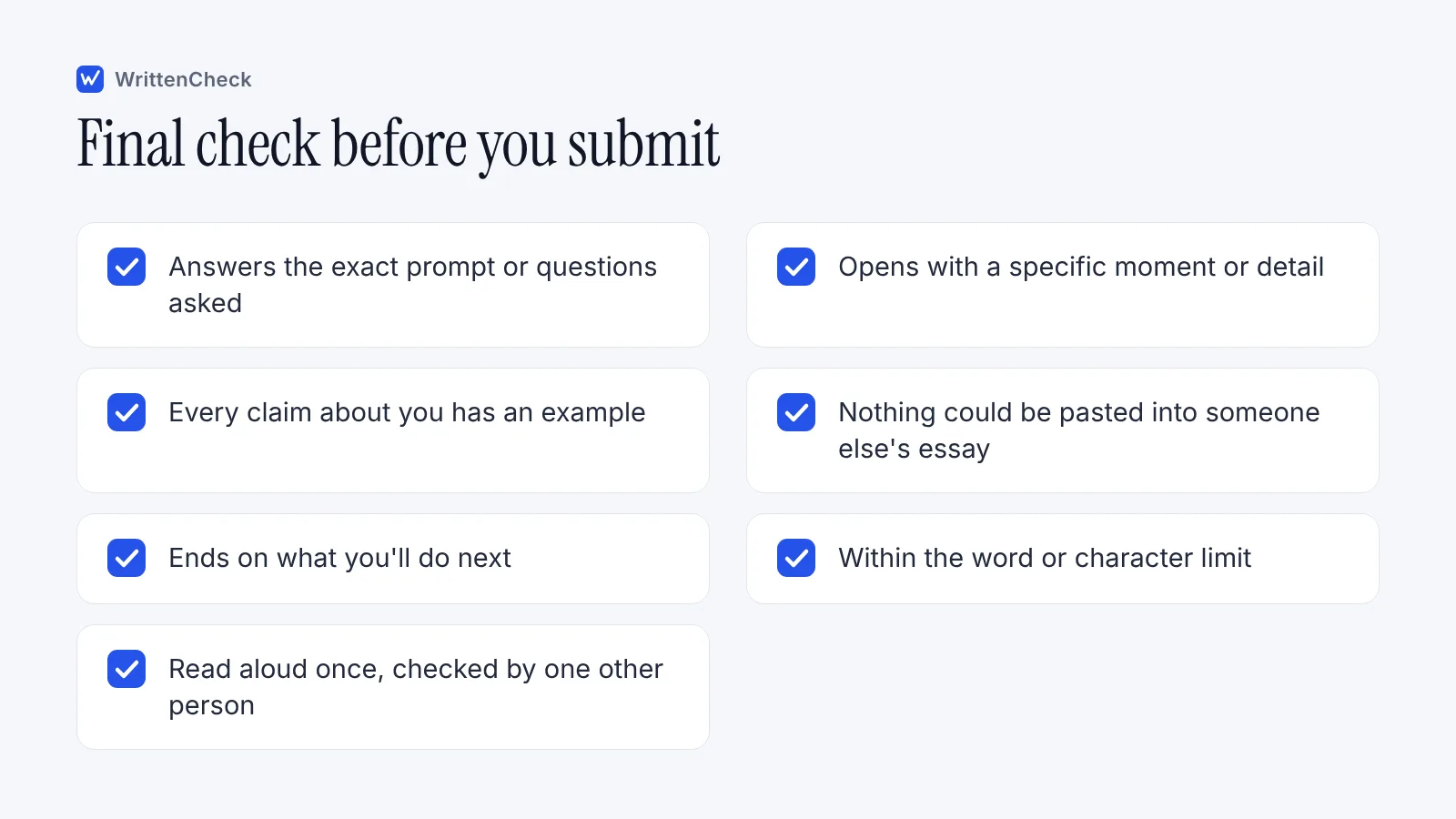
If you want a second look at your wording, you can paste your draft into our free AI detector. It highlights the sentences that read most like AI, which are often the generic ones worth rewriting in your own voice anyway. It works in 16 languages and needs at least 40 words.
Frequently asked questions
How long should a personal statement be?
Follow the limit for your application. The Common App personal essay is 250 to 650 words. Each University of California answer is up to 350 words. UCAS gives 4,000 characters including spaces across three questions, with at least 350 characters per answer. The AMCAS medical school essay is 5,300 characters including spaces. Graduate programs set their own limits, so check each program's instructions.
What should I write my personal statement about?
Write about one or two specific experiences that show why you want this path and how you think. Purdue OWL suggests asking what's distinctive about your story, when your interest began, and what obstacles you've faced. The best topic is often a small moment you can explain in depth, such as a problem you kept working on or a question you couldn't drop.
How do I start a personal statement?
Start inside a specific moment. Purdue OWL calls the opening paragraph the most important part, because it's where you grab or lose the reader. Skip famous quotes, dictionary definitions and lines like "Ever since I was young." Instead, put the reader in a scene with one concrete detail, then explain why that moment mattered to you in the next paragraph.
Is it OK to use AI to help write a personal statement?
Only within each school's rules. Yale allows AI for grammar, spelling and early topic ideas but treats submitting AI-generated content as your own as fraud. UCAS says not to copy and paste AI output as final text and asks you to declare the statement is your own. Check each school's policy, keep your drafts, and make sure every sentence reflects your own experience.
What's the difference between a UCAS and a US college personal statement?
A US college essay, such as the Common App personal essay, is usually a personal story responding to one of seven prompts. The UCAS statement for 2026 entry onward answers three set questions, all about your chosen subject: why you want to study it, how your studies prepared you, and what else you've done. UCAS statements are more academic and are measured in characters.
Who should read my personal statement before I submit it?
At least one person who knows how to give honest feedback, such as a teacher, counselor or writing center tutor. The AAMC recommends objective reviewers outside your personal circle. Family and friends can help, but they already know your story, so they may not notice gaps. Ask readers what they learned about you, and whether any line could describe anyone.
Sources
Application Prompts for 2026-2027, UNC Chapel Hill Undergraduate Admissions, 2026
Personal Insight Questions, University of California Admissions, accessed October 2026
How to write your personal statement: 2026 entry onwards, UCAS, accessed October 2026
A guide to using AI and ChatGPT with your personal statement, UCAS, accessed October 2026
AI Policy Statement, Yale Undergraduate Admissions, accessed October 2026
Writing the Personal Statement, Purdue OWL, accessed October 2026
Application Essays, The Writing Center, UNC Chapel Hill, March 2026
6 Tips for Writing Your AMCAS Personal Comments Essay, AAMC, accessed October 2026
Personal Comments Essay, AAMC, 2027 AMCAS Applicant Guide


Comments