The ethical use of AI in school comes down to a simple test. Could you explain to your teacher exactly what the tool did, and would they be fine with it? If the answer is yes, you're probably on solid ground. If you'd rather they didn't ask, that's your signal.
That test is easy to state and harder to apply on a Tuesday night with an essay due. So this guide breaks it into five checks you can actually run, shows good and bad uses side by side, and ends with study prompts that make you learn more instead of less.
One thing up front. There's no single global rule. Your course, your school and your publisher set the rules, and they differ a lot. The framework below works inside any of them.
What does ethical use of AI mean for students?
Ethical use of AI means using AI tools in ways your teacher or publisher allows, being open about how you used them, checking what they produce, keeping private information out of them, and doing the core thinking yourself. In practice, AI should help you learn or improve your own work. It shouldn't produce work you then present as your own. If you'd hesitate to describe your use out loud, treat that as a warning.
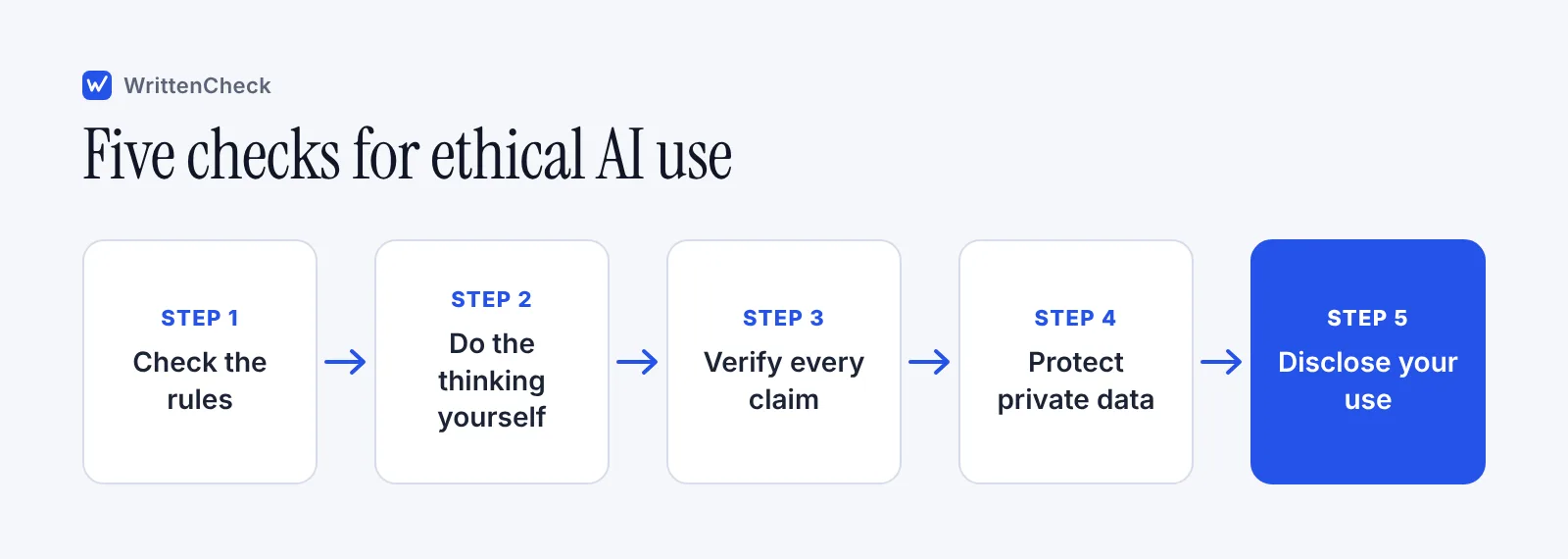
Check 1: What do your course rules actually allow?
The rules for this assignment come first, because the same use can be fine in one class and misconduct in the next. Read the syllabus, the assignment brief and your school's AI policy. If they're vague, ask.
Schools were slow to write rules. When UNESCO surveyed more than 450 schools and universities in 2023, fewer than 10% had institutional policies or formal guidance on generative AI. Even where policies exist now, rules still vary by course. One professor may allow AI for brainstorming. Another may ban it outright for a reflective essay.
Here's an example of a short email you can send when the rules are unclear:
Hi Dr. Patel, for the policy brief due Friday, may I use an AI tool to check my grammar and to quiz me on the readings? I won't use it to draft any text. Happy to include a note on how I used it.
That email takes two minutes. It turns a guess into a permission, and it gives you a written record. If you want to know how these rules are usually written, our guide to AI policies for schools shows the common levels, from "no AI" to "AI encouraged with disclosure."
Check 2: Are you still doing the thinking?
Ethical AI use leaves the hard part of the assignment with you. Ask what the assignment is trying to teach, then make sure the AI isn't doing exactly that.
If the point of an essay is to build an argument, the argument has to be yours. If the point of a problem set is to practice a method, you have to work the method. Grammar help on an argument essay usually leaves the learning intact. Letting the tool pick your thesis does not.
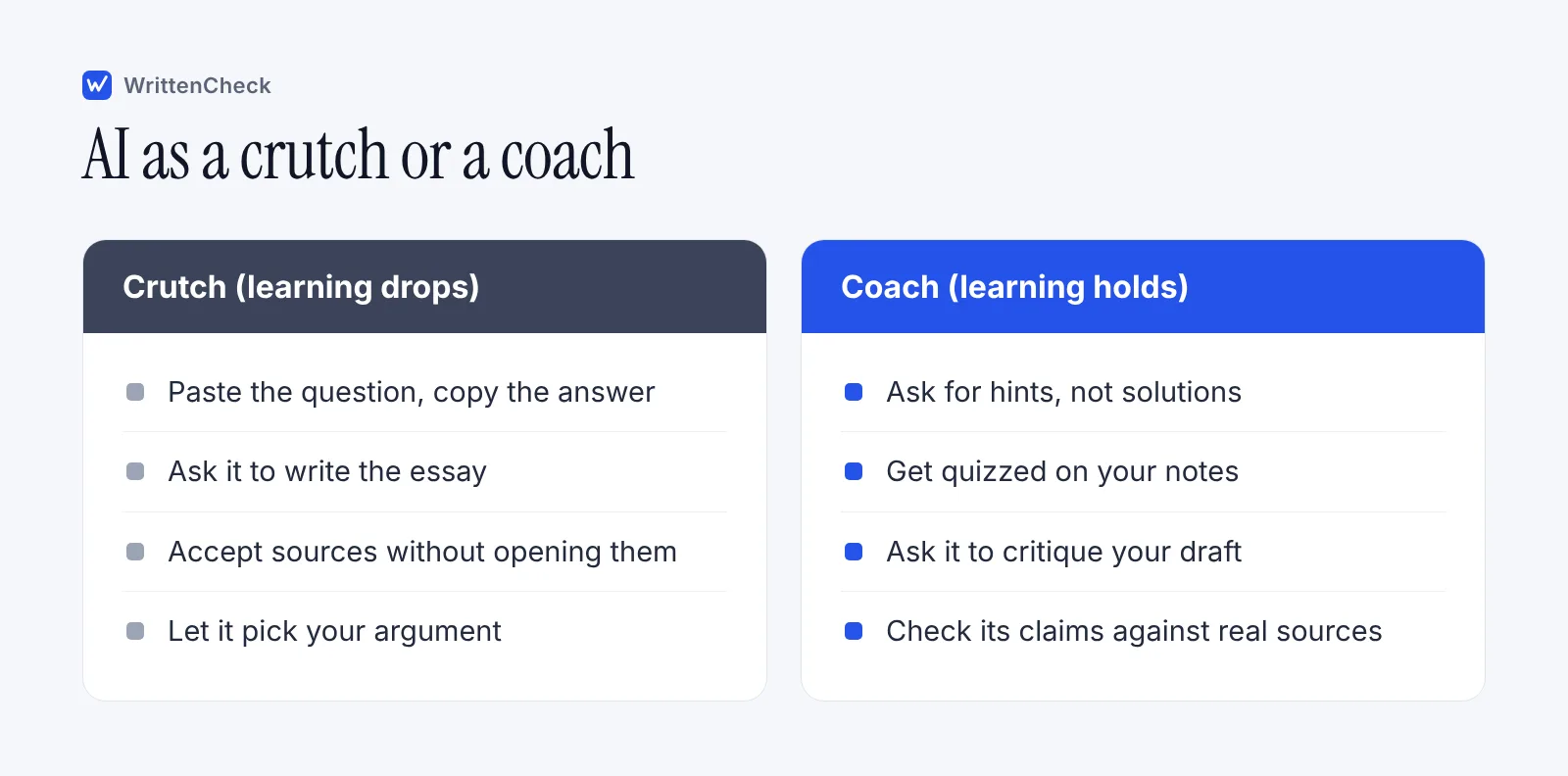
There's real evidence that this matters. In a field experiment published in PNAS in June 2025, Hamsa Bastani and colleagues gave nearly 1,000 high school math students in Turkey access to GPT-4 tutors. During practice, grades rose 48% for students using a standard chatbot and 127% for students using a version with teacher-designed guardrails. Then the tool was taken away. On the exam, students who'd had the standard chatbot scored 17% lower than students who never had AI at all. The authors say those students used it as a "crutch." The guarded version, which pushed students to reason, largely avoided that drop.
The lesson for you is direct. Getting answers feels like progress. It isn't the same as learning.
Check 3: Have you verified what the AI told you?
You're responsible for every claim and citation in your work, whoever drafted it. AI tools produce confident text that can be wrong, and they're especially bad with sources.
In a 2023 study in Scientific Reports, William Walters and Esther Isabelle Wilder checked 636 citations produced by two versions of a popular chatbot. They found 55% of the older model's citations and 18% of the newer model's citations were fabricated. Many fake ones named real journals, which made them look plausible. Even among real works, a large share had errors in details like the year or page numbers.
So build a habit before you cite anything.
Open every source the AI mentions, using a library database or the publisher's site.
Confirm the author, year and title match what you're citing.
Find the specific claim inside the source. Don't trust a summary of it.
Check numbers against the original table or abstract.
Drop anything you can't confirm, even if it fits your argument nicely.
The MLA's guidance on generative AI makes the same point. It tells writers to vet any secondary sources an AI tool cites, because these tools can invent references.
Check 4: Are you protecting private information?
Keep anything private, personal or confidential out of public AI tools. What you type may be stored, reviewed or used to improve the tool, depending on its settings and terms.
Harvard's guidance for its community says people shouldn't enter confidential data into publicly available generative AI tools. That's a sensible rule for anyone. Think about what that covers for a student:
Classmates' names, grades or messages, for example in a group project chat log.
Interview transcripts or survey answers from a research project.
Unpublished data from a lab or internship.
Your own sensitive details, such as health or money matters in a personal statement.
Exam questions your teacher hasn't released.
If you need help with a document that contains any of this, strip out the private parts first. Replace names with "Student A" and remove numbers that identify anyone. For research data, ask your supervisor or ethics board what's allowed before any of it goes near an AI tool.
Check 5: Have you disclosed how you used AI?
Disclose any AI use your rules require, and lean toward disclosing when you're unsure. A short, specific note protects you and lets your teacher judge the work fairly.
The MLA's guidance, first published in March 2023 and updated in August 2025, says to cite AI when you quote, paraphrase or include generated content, and to acknowledge other uses like editing or translating in a note or another suitable place. APA and Chicago have their own formats, which we cover in how to cite AI.
A good disclosure says what tool you used, what you used it for, and what you did with its output. Compare these:
Weak disclosure | Clear disclosure |
|---|---|
"I used AI." | "I used an AI chatbot to quiz me on the readings before drafting. All text is my own." |
"AI helped with editing." | "I pasted my final draft into an AI tool and asked for grammar fixes. I accepted about ten small changes and rejected suggestions that changed my wording." |
"Some ideas came from AI." | "I asked an AI tool for counterarguments to my thesis. I kept one, about cost, and researched it in the sources listed." |
Keep your notes, outlines and drafts as you go. If anyone ever questions your work, that history shows how it grew. Our guide on what to do if you're falsely accused of using AI explains why version history matters so much.
Which uses of AI are ethical, and which cross the line?
Most uses fall along a scale. The closer the AI gets to doing the graded thinking for you, the more likely it crosses a line, even with disclosure.
Use | Usually fine? | Why |
|---|---|---|
Asking it to explain a concept you're stuck on | Yes, if allowed | You still have to understand and apply it |
Getting quizzed on your own notes | Yes | It makes you recall, which builds memory |
Asking for feedback on a draft you wrote | Usually, with disclosure | You decide what to change |
Grammar and spelling fixes | Often, check the rules | Some courses grade mechanics |
Brainstorming topics | Depends on the course | The idea may be part of what's graded |
Writing an outline you then follow | Often not | The structure is part of the thinking |
Writing paragraphs you submit | No, unless the task says so | That's presenting its work as yours |
Answering take-home exam questions | No | Exams test what you know |
Our post on whether using AI is plagiarism goes deeper into where misconduct begins.
How can you use AI for studying in ways that actually help?
Use AI to make you do the work of remembering and explaining. Avoid using it to do that work for you. The prompts below turn a chatbot into a study partner.
The strongest idea here is decades old. In a 2006 study in Psychological Science, Henry Roediger and Jeffrey Karpicke had students either reread passages or take recall tests on them. After five minutes, rereading looked better. After two days and after a week, the students who'd been tested remembered substantially more, even though the rereaders felt more confident. Being quizzed is a better way to learn than reviewing.
Here are prompts that put that to work:
Quiz me. "Here are my notes on cell respiration. Ask me one question at a time. Wait for my answer, then tell me what I got wrong."
Explain it differently. "I don't understand opportunity cost. Explain it with an example about a part-time job, then ask me to make my own example."
Hint, don't solve. "I'm stuck on this proof. Give me a hint for the next step only. Don't show the full solution."
Find the gaps. "Here's my explanation of the causes of World War I. What did I leave out or get wrong? Don't rewrite it."
Critique my draft. "Read my introduction. Tell me where the argument is unclear. Don't suggest new wording."
Argue the other side. "Give me the strongest objection to my thesis so I can respond to it."
Notice the pattern. Each prompt makes you answer, explain or decide. That's the same thing the guarded tutor in the Bastani study did, and it's why students using it didn't lose ground.
What does ethical AI use look like for writers?
For writers, ethical use means being honest with editors, clients and readers about what's yours. Publishers, journals and clients set rules the way schools do, so read the contributor guidelines first.
A few working habits help:
Ask before you use AI on paid or commissioned work, and put the answer in writing.
Do your own reporting and fact-checking. AI tools can't call a source or visit a place.
Use AI for feedback rather than drafts, so the voice stays yours.
Never feed it a client's confidential material.
Label AI-made images and illustrations if the outlet requires it.
Your own voice is also your best asset. Text that leans heavily on AI tends to sound like everyone else's.
What should you do before you submit?
Run the five checks one last time. Then, if you want to see how your draft reads, you can paste it into our free AI detector to see which sentences read most like AI. Treat the result as a prompt to reread those sentences in your own voice. Scores are estimates, not proof, and short texts or very formal writing can be harder to judge.
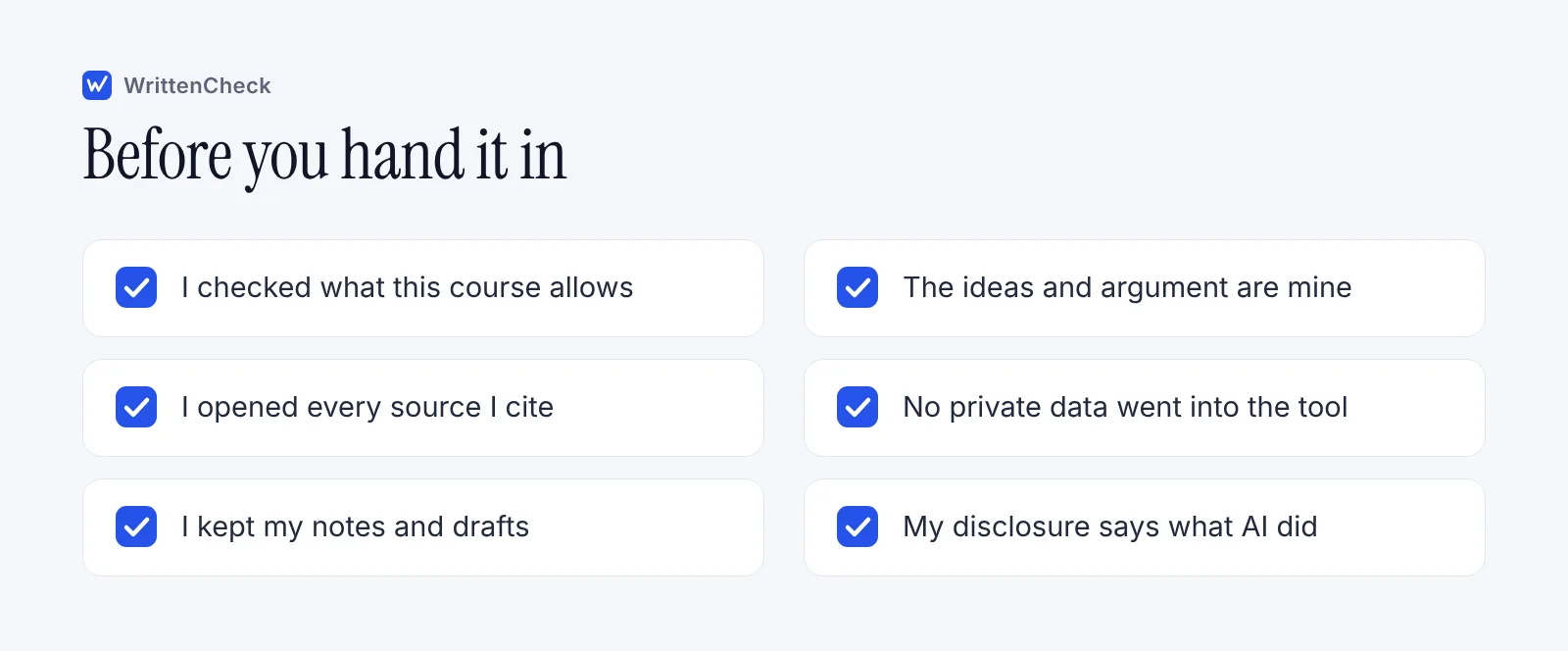
Pick one assignment you have coming up this week. Before you start, write down the course rule on AI and one way you'll use it to quiz yourself. That's the whole habit.
Frequently asked questions
Is it ethical to use AI for homework?
It can be, if your teacher allows the specific use and you're open about it. Using AI to explain a concept, quiz you or give feedback on your draft usually supports learning. Having it produce the answers or text you hand in usually doesn't, because the homework exists to build your skills. When the rules don't say, ask your teacher before you start, and keep a note of how you used the tool.
Do I need to disclose AI if I only used it for grammar?
Check your course rules first, since some require disclosure for any AI use. If the rules are silent, a one-line note is a safe choice and costs you nothing. The MLA, for example, suggests acknowledging functional uses such as editing or translating in a note. Something like "I used an AI tool to check grammar in my final draft" is enough.
Can I use AI to summarize readings I didn't do?
Ethically and practically, it's a weak trade. A summary gives you someone else's selection of what matters, and it can be wrong. You also miss the details that discussions and exams test. A better approach is to read the text, write your own short summary, then ask an AI tool to point out what you missed. That way the tool checks your understanding instead of replacing it.
Why shouldn't I trust sources an AI gives me?
AI chatbots generate text that looks right, and references are a weak spot. A 2023 study in Scientific Reports found that 55% of citations from one chatbot model and 18% from a newer one were fabricated, often naming real journals. Always find the source yourself through a library database or the publisher, and confirm the claim is really in it.
Is it okay to paste my classmates' work into an AI tool?
No, not without their permission, and usually not even then. Their writing is their work and may include personal details. Pasting it into a public tool can store it outside your control. If you're giving peer feedback, read it yourself. If you need help with a group project file, remove names and personal information first.
What's the best way to use AI for studying?
Make it ask you questions. Give it your notes and ask it to quiz you one question at a time, then explain what you got wrong. Research on retrieval practice, including a well-known 2006 study by Roediger and Karpicke, shows that recalling information builds longer-lasting memory than rereading it. Ask for hints rather than full solutions when you're stuck on a problem.
Sources
UNESCO: Governments must quickly regulate Generative AI in schools, UNESCO, 7 September 2023
Generative AI without guardrails can harm learning: Evidence from high school mathematics, Bastani et al., PNAS, 25 June 2025
Fabrication and errors in the bibliographic citations generated by ChatGPT, Walters and Wilder, Scientific Reports, 7 September 2023
Test-Enhanced Learning: Taking Memory Tests Improves Long-Term Retention, Roediger and Karpicke, Psychological Science 17(3), March 2006
How do I cite generative AI in MLA style?, MLA Style Center, 17 March 2023, updated 13 August 2025
Generative AI guidelines, Harvard University Information Technology, accessed October 2026


Comments