You wrote every word yourself. Then a classmate, a teacher or an editor said it "sounds like AI." That's frustrating, and it's more common than you'd think. Formal, careful, by-the-book writing often looks a lot like what AI chatbots produce.
This guide is about how to make writing sound less like AI by making it sound more like you. It's for students and writers doing their own work. You'll get six editing habits, each with a before and after example, plus a revision routine you can run in 20 minutes.
One thing to say plainly before we start. This isn't about hiding AI use or tricking a detector. If your course or publisher requires you to disclose AI help, disclose it. Everything here is ordinary good editing, and it works whether or not anyone ever runs your text through a tool.
How to make writing sound less like AI
To make writing sound less like AI, make it specific and personal. Replace general claims with concrete details, names and numbers. Use plain verbs instead of abstract nouns. Vary sentence length so the rhythm isn't even. Cut stock openers, filler phrases and automatic three-item lists. Add your own view where the task allows it. These are normal editing habits, and they make writing clearer as well as more human.
Why does my writing sound like AI when I wrote it?
Usually because it's correct, formal and general. Those are exactly the habits schools reward and AI chatbots imitate. If you learned to write by following templates, your writing may share a lot with AI output.
Second-language writers face this most. In a 2023 study in Patterns, Weixin Liang and colleagues at Stanford found that AI detectors flagged 61.3% of essays by non-native English writers as AI-generated. The essays used a narrower range of common words, which made them more predictable. That's a fairness problem with the tools, and those writers did nothing wrong.
People judge badly too. In 2023, Maurice Jakesch, Jeffrey Hancock and Mor Naaman found in PNAS that readers spotted AI-written profiles at about chance level. They relied on cues that didn't work. Many believed contractions signaled a human, but contractions were actually more common in the AI text. So the goal isn't to add "human" decorations. It's to write in a way that's clearly yours.
If you've already been accused, read our guide on being falsely accused of using AI.
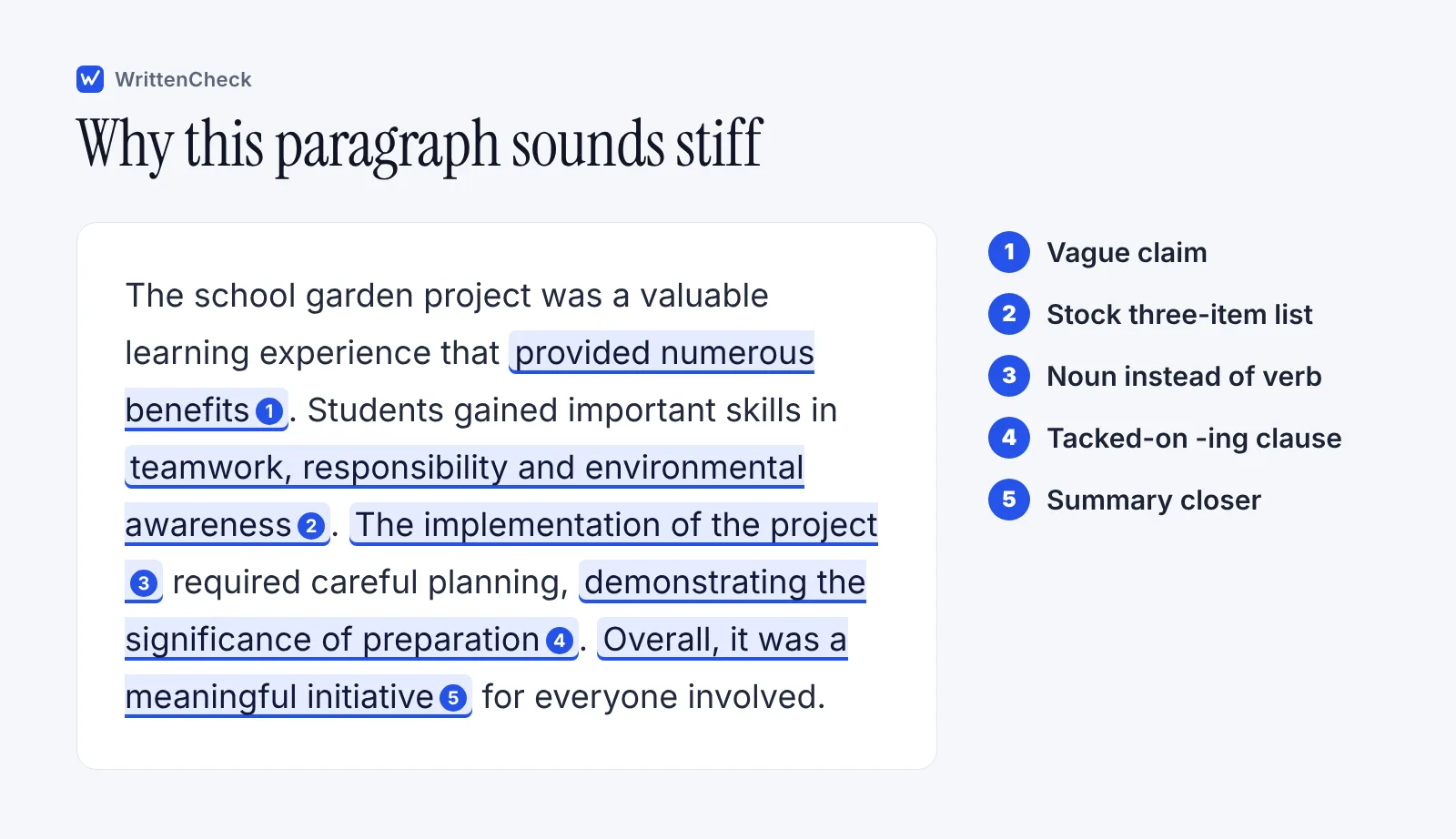
Here's an example paragraph we wrote. It's grammatical and tidy, and it would raise eyebrows anyway.
1. How do you make your writing more specific?
Swap general claims for details only you could supply. This is the single biggest change you can make.
AI text tends to stay general because it doesn't know your life, your data or your sources. When your draft also stays general, it sounds the same. In a 2025 study by Jenna Russell, Marzena Karpinska and Mohit Iyyer, people who often use AI writing tools judged AI text by vocabulary, but also by lack of originality and over-explanation. Specific detail fixes both.
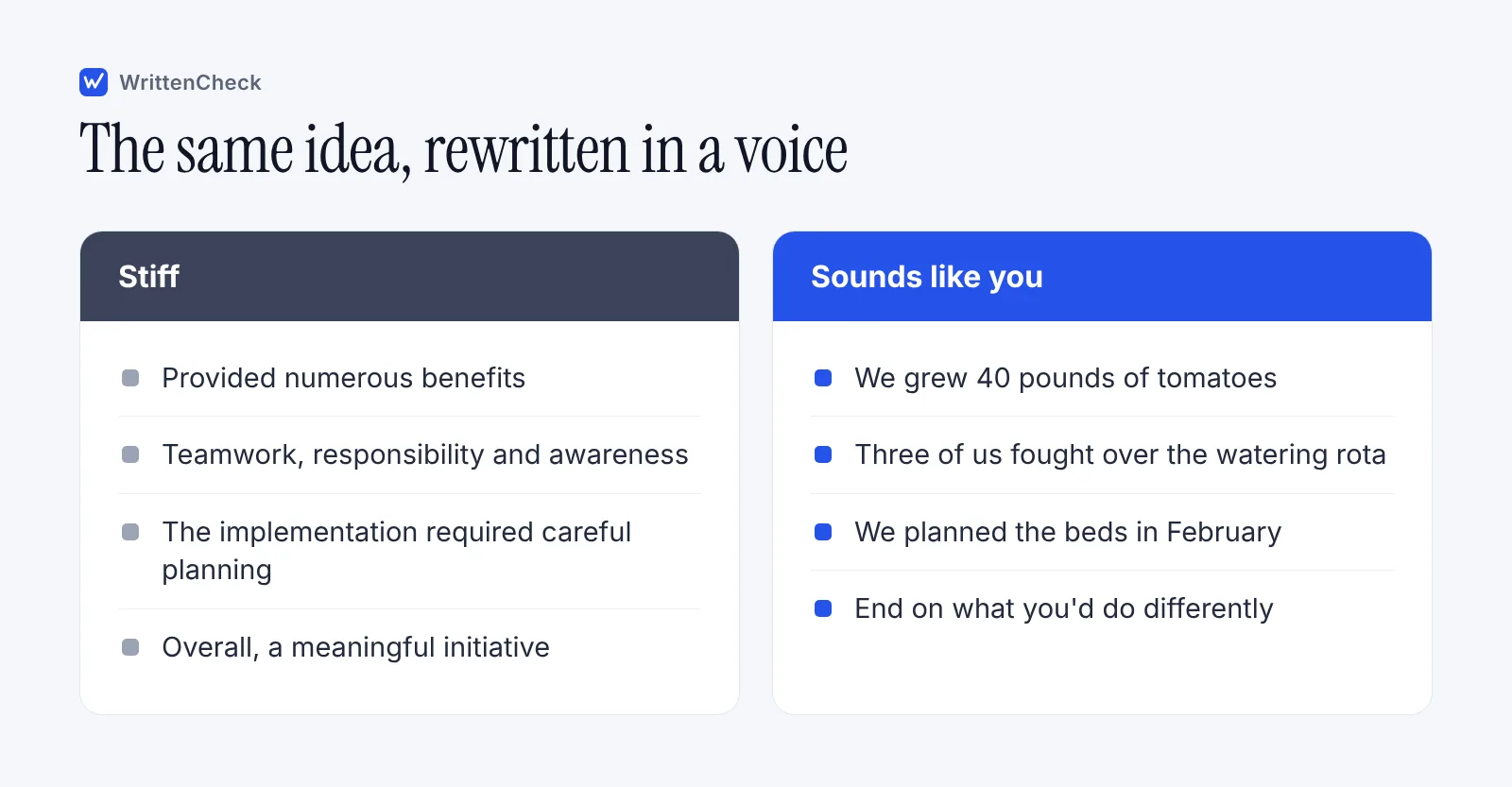
Before: Social media can have negative effects on students' mental health and academic performance.
After: In my first semester I checked my phone during every lecture, and my notes from those weeks are half as long as the rest.
Ask yourself these questions as you revise:
What's the actual number? "Many students" becomes "11 of the 28 people in my seminar."
Which source, exactly? "Research shows" becomes "a 2023 Stanford study found."
What did it look like? "The experiment was challenging" becomes "the samples froze twice."
In academic writing you might not use "I." You can still be specific with data, named sources and precise examples.
2. How do you write in your own voice?
Take a position and sound like a person holding it. Voice is what makes a reader feel someone is behind the words.
AI chatbots tend to balance every point and land nowhere. Human writers usually lean one way. If your assignment allows an argument, make it early and plainly.
Before: There are many perspectives on homework, and both sides raise valid points that should be considered.
After: Homework in primary school mostly measures which kids have a quiet table at home. I'd cut it below age ten.
Voice also shows up in small choices. A dry joke, a question you actually want answered, or an admission that something surprised you all help. The Russell study found expert readers noticed when quotes sounded the same no matter who was speaking. If you quote interviews, keep each person's real wording, including the awkward parts.
3. How do you vary your sentence rhythm?
Mix long and short sentences on purpose. Even, medium-length sentences in a row are one of the most machine-like things about a draft.
Before: The study examined the effects of sleep on memory. The researchers recruited participants from a local university. The participants completed a memory test after different amounts of sleep. The results showed a clear relationship between sleep and recall.
After: The study asked a simple question. Does sleep help you remember? Researchers recruited students from a local university, tested them after different amounts of sleep, and compared their recall. The well-rested group did better.
The facts didn't change. The rhythm did. A short question breaks the pattern, and the longer sentence carries the method. Read your draft aloud. Where you run out of breath or start to drone, change the length.
4. Which phrases should you cut?
Cut openers that only announce the topic, fillers that carry no meaning, and inflated words where a plain one works. These phrases make any writing sound generic.
George Orwell gave this advice in his 1946 essay "Politics and the English Language." Never use a long word where a short one will do, and if it's possible to cut a word out, cut it. The University of North Carolina Writing Center makes the same case in its handout on conciseness, with swaps like "due to the fact that" to "because." The US government's plain language guidance on digital.gov says unnecessary words waste your reader's time.
Stock phrase | What to do instead |
|---|---|
In today's society, ... | Start with your actual claim |
It is important to note that ... | Delete it and state the point |
plays a significant role in | affects, shapes, causes |
due to the fact that | because |
a wide range of | many, or the actual number |
in order to | to |
This highlights the importance of ... | Say who should do what |
Overall, ... / In summary, ... | End on your last real point |
For a longer list of words that read as AI, see our post on AI words to avoid. Treat it as a prompt to reread. A word that fits your meaning can stay.
5. Why should you use verbs instead of nouns?
Because nouns made from verbs make sentences slow and abstract. Research also finds AI text uses them more than people do.
In a 2025 PNAS study, Alex Reinhart and colleagues at Carnegie Mellon found instruction-tuned models used nominalizations, nouns like "implementation" and "utilization," at 1.5 to 2 times the human rate. They used present participial clauses, the "..., demonstrating the importance of X" shape, at 2 to 5 times the human rate.
Before: The implementation of the new policy resulted in a reduction of late submissions, demonstrating the effectiveness of clear deadlines.
After: After the school set firm deadlines, late submissions dropped by a third. Clear dates worked.
Look for words ending in "-tion," "-ment" and "-ance." Ask who did what, and write that. Then look for sentences ending in a comma and an "-ing" verb. Most of them read better as a separate short sentence.
6. How do you break out of templates?
Let the content set the shape of each paragraph. Templates make every paragraph look the same, and readers notice the pattern quickly.
Watch for these habits:
Three of everything. If you list three items each time, check whether you really have two or four.
The contrast frame. "It's not just a tool, it's a partner" is a slogan. Say what it is.
The summary closer. Paragraphs that end by restating themselves add length and nothing else.
Punctuation tics. One em dash is fine. Six in a page start to read as a habit. Our post on the em dash and AI covers when the mark works.
Signposting. "Firstly," "Secondly," "Lastly" in a short piece can usually go.
What should you never do to sound less like AI?
Don't use tricks. Adding deliberate typos, swapping in look-alike characters from other alphabets, inserting hidden or invisible characters, or running text through a tool built to fool detectors is dishonest. It also turns a question about style into a question about integrity.
These tricks also make your writing worse. A reader sees the typos and marks you down. And none of them changes the real problem, which is that the writing is generic.
If you used AI for part of your work, follow your course or publisher rules and say so. Our guide on how to cite AI explains how. The advice in this post is for making your own words sound like you.
A step-by-step revision pass
Here's a routine for a draft you've finished. It takes about 20 minutes for a 1,500-word essay.
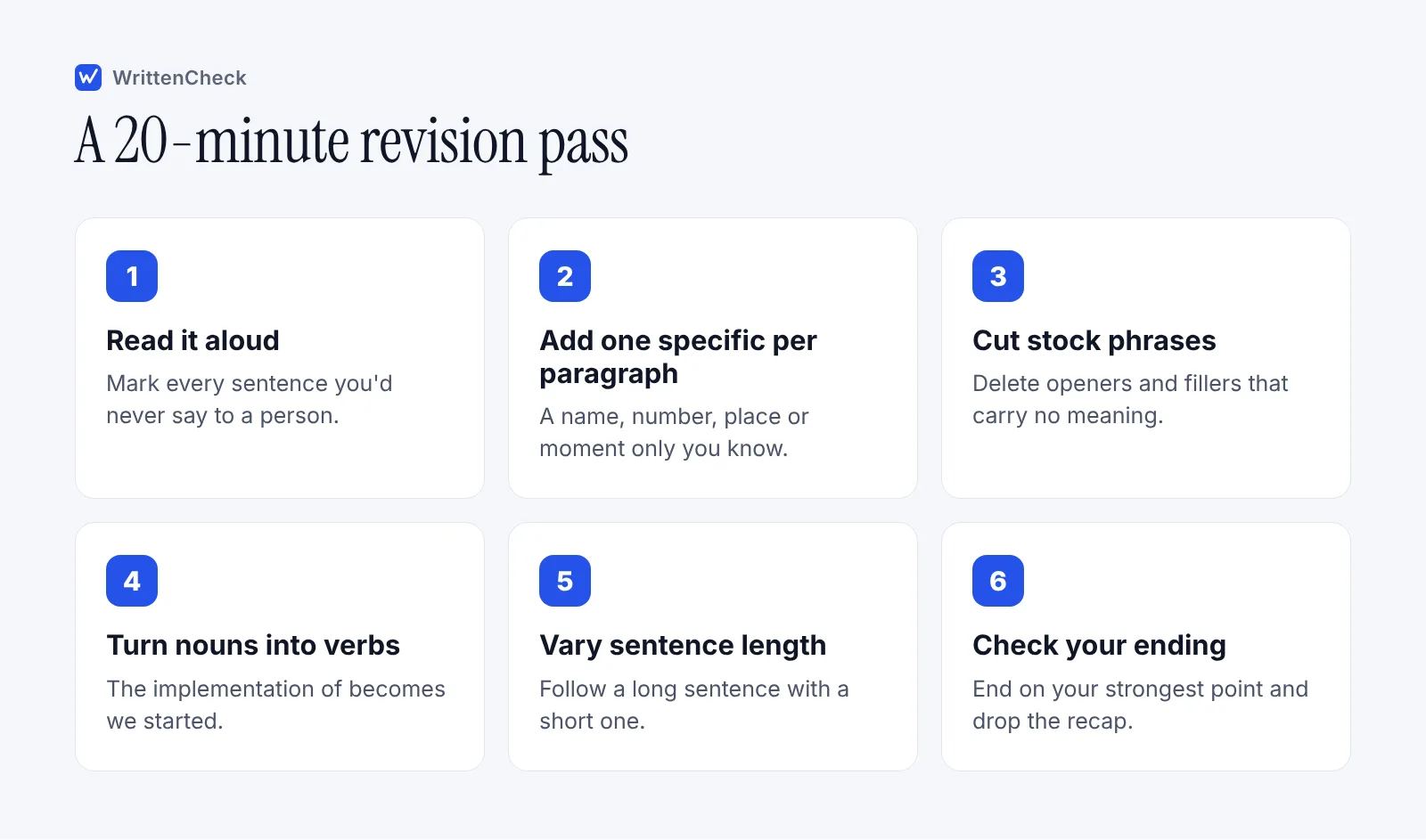
Read the whole draft aloud. Put a mark next to any sentence you'd never say out loud.
Add one specific per paragraph. A number, a name, a place, a quote or a moment.
Search for stock phrases. Use Find for "important to note," "significant role," "in today's" and "overall."
Turn nouns back into verbs. Fix the three worst "-tion" sentences.
Split trailing "-ing" clauses. Make them their own sentences or cut them.
Vary the rhythm. Where three sentences in a row are the same length, change one.
Fix your ending. Finish on your strongest point or the next question, and drop the recap.
How can you check whether your draft still sounds stiff?
Ask someone who knows how you talk to read it, and listen for where they slow down. A tool can help you find sentences worth a second look.
You can paste a draft into our free AI detector to see a score for each sentence, with the ones that read most like AI highlighted. It takes 80 to 3,000 words at a time and doesn't keep your text. Treat a high score as a pointer to sentences worth rereading. Scores are estimates, and they're less reliable for short texts, very formal writing and second-language writers.
Pick the three sentences that stand out most, and rewrite each one with a concrete detail.
Frequently asked questions
Why does my writing get flagged as AI when I wrote it myself?
Formal, generic and evenly paced writing shares many patterns with AI output. Writers who learned from templates, or who write in a second language, are flagged more often. A 2023 Stanford study found AI detectors flagged 61.3% of essays by non-native English writers. Adding specific detail, a clear voice and varied rhythm makes your work more clearly yours and also improves it.
How do I write like a human and not a robot?
Write the way you'd explain your idea to a smart friend, then edit. Use concrete details, plain verbs and your own examples. Mix short and long sentences. Cut phrases that only announce the topic or summarize what you just said. Take a position where the task allows it. Reading your draft aloud is the quickest way to hear where it sounds stiff.
Do typos make writing look more human?
Deliberate typos are a bad idea. They make your work look careless, they cost marks, and adding them to avoid detection is dishonest. Trying to fool a detector turns a style question into an integrity problem. Real human signals are specific detail, a clear point of view and natural rhythm. Those also make your writing better.
Can I use AI and then edit it to sound like me?
That depends on your course or publisher rules. Some allow AI for brainstorming or editing with disclosure. Others ban it for certain tasks. If you use it, follow the rules and disclose it as required. The editing tips in this post are for improving your own writing. They aren't a way to pass off AI text as unassisted work.
Does using contractions make writing sound more human?
Not reliably. A 2023 PNAS study found people assumed contractions signaled a human writer, but contractions were actually more common in the AI-written texts they tested. Use contractions if they suit the tone and your assignment allows them. Specific detail and a clear voice do far more to make writing sound like you.
What are the best AI writing tips for students?
Keep your drafts and notes so your process is visible. Start with your own argument before reading model answers. Use exact sources, numbers and examples. Read your work aloud before submitting. Check your institution's AI policy, and disclose any AI help it requires. These habits protect you if your work is questioned and make it stronger anyway.
Sources
GPT detectors are biased against non-native English writers, Liang et al., Patterns, July 2023
Human heuristics for AI-generated language are flawed, Jakesch, Hancock and Naaman, PNAS, March 2023
People who frequently use ChatGPT for writing tasks are accurate and robust detectors of AI-generated text, Russell, Karpinska and Iyyer, ACL 2025, 2025
Do LLMs write like humans? Variation in grammatical and rhetorical styles, Reinhart et al., PNAS, February 2025
Politics and the English Language, George Orwell, The Orwell Foundation, 1946
Conciseness, The Writing Center, University of North Carolina at Chapel Hill
Short and simple, Plain Language Guide, digital.gov, updated September 2025


Comments