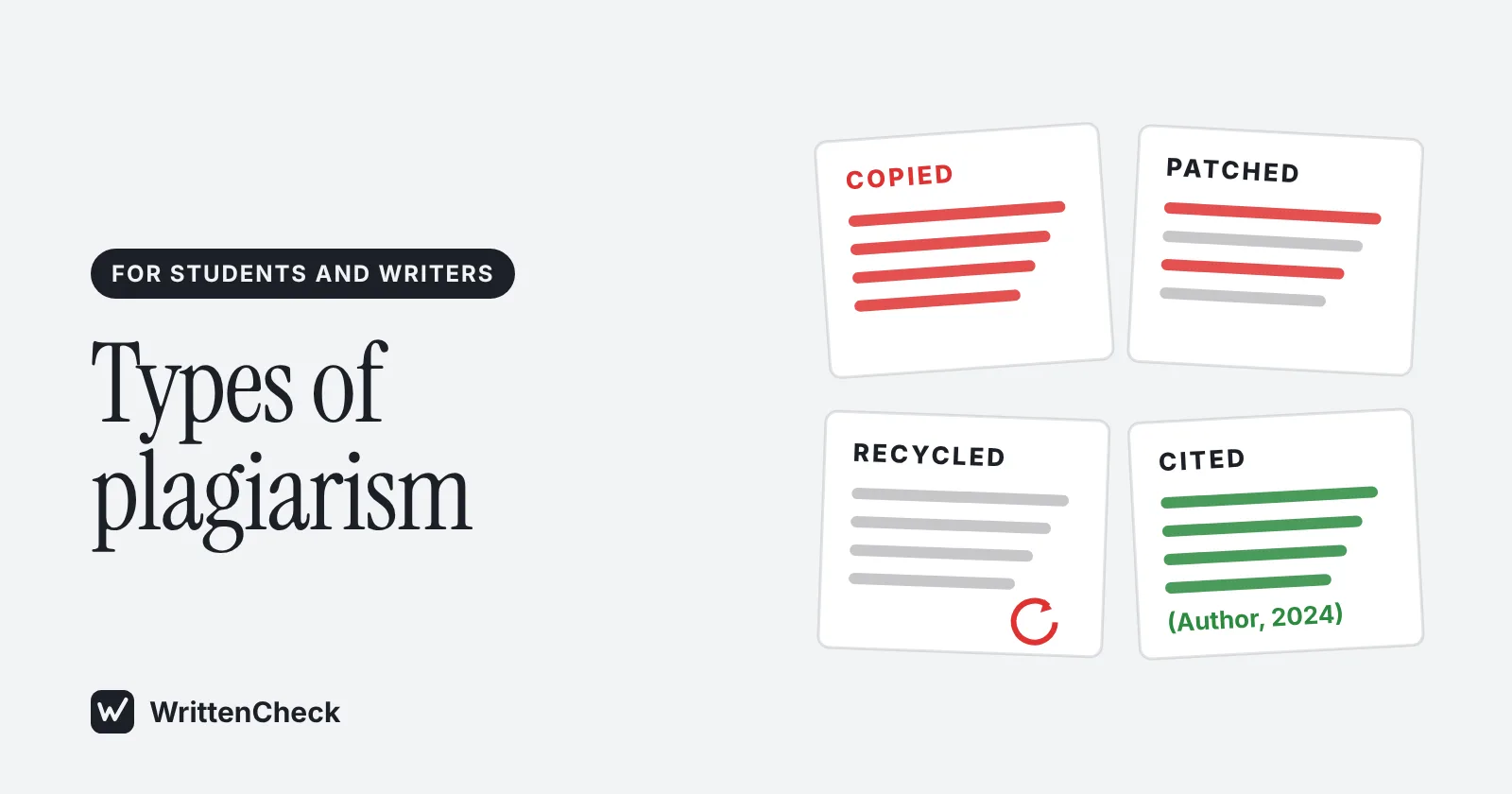
Most students know that copying a paragraph without credit is plagiarism. Fewer know the other types of plagiarism, like swapping a few words in a sentence, reusing your own old essay, or working too closely with a friend. Those count too, even when the writer didn't mean any harm.
This guide covers eight types, with a side-by-side example of each common one, how schools and journals treat them, and a routine to avoid all of them.
What are the main types of plagiarism?
The main types of plagiarism are direct (word-for-word) plagiarism, patchwriting or mosaic plagiarism, uncited paraphrase, self-plagiarism, accidental plagiarism, source fabrication, collusion and contract cheating. They differ in how much text is copied and whether the writer meant to deceive. Many school policies count every type as a breach, intended or not, because the problem is the missing credit.
What is plagiarism?
Plagiarism is presenting someone else's work as your own. The US Office of Research Integrity (ORI) defines it as "the appropriation of another person's ideas, processes, results, or words without giving appropriate credit."
Two parts of that definition catch people out. First, it covers ideas, results and methods as well as words, so a paraphrase without a citation still counts. Second, school policies often apply it whether or not you meant to. Bowdoin College says a lack of intent doesn't excuse plagiarism, and King's College London adds that you can be penalized if someone else copies your work.
What do the types of plagiarism look like side by side?
The fastest way to see the difference is to take one source sentence and write it several ways. Here's the ORI definition from above as our source.
Source: "Plagiarism is the appropriation of another person's ideas, processes, results, or words without giving appropriate credit." (Office of Research Integrity, n.d.)
Here's how that sentence might look in a student essay. These versions are written as examples for this post.
Direct plagiarism (not acceptable).
Plagiarism is the appropriation of another person's ideas, processes, results, or words without giving appropriate credit.
Same words, no quotation marks, no citation.
Patchwriting (not acceptable).
Plagiarism is the taking of someone else's thoughts, methods, findings or language without giving proper acknowledgement.
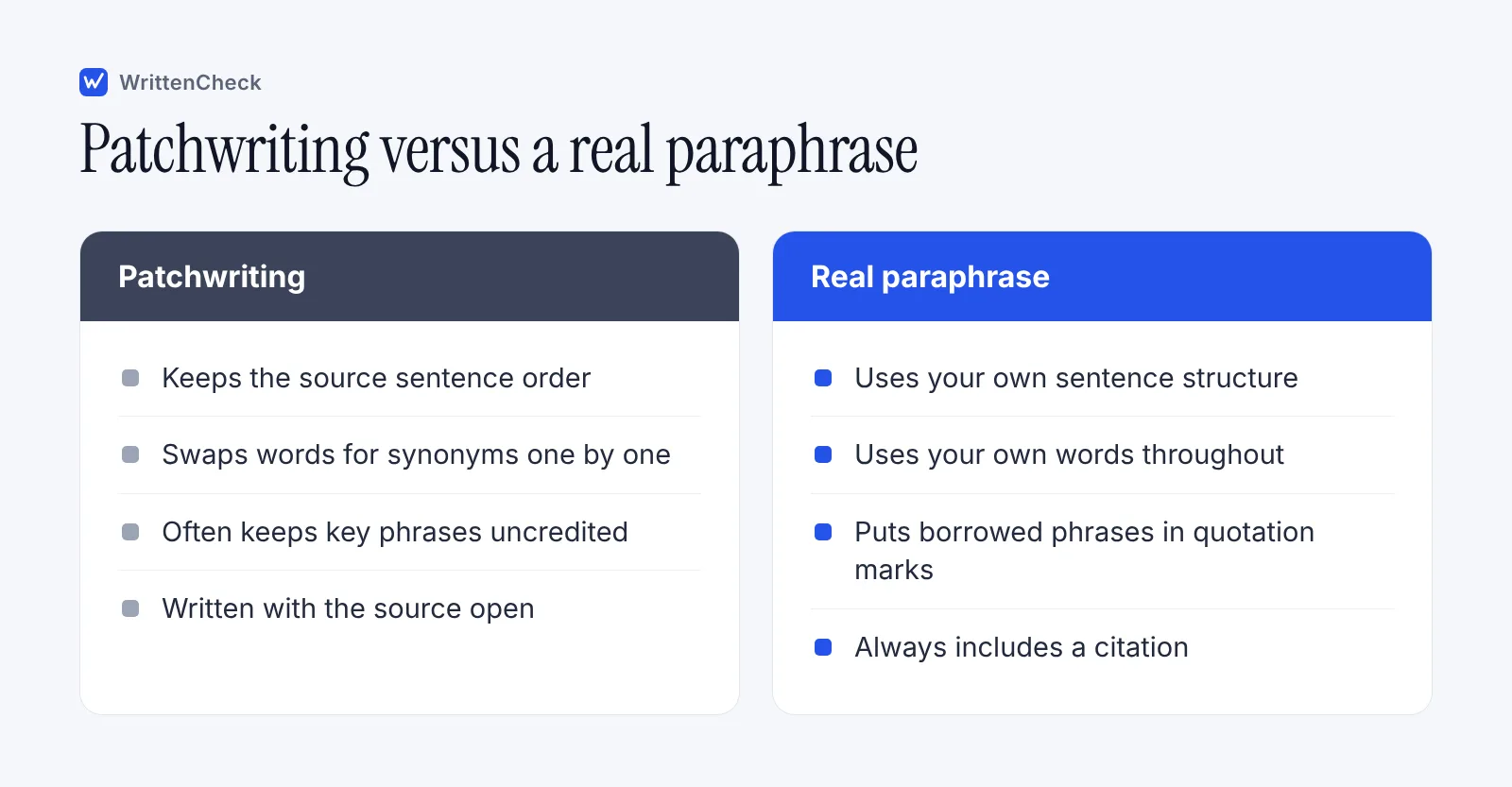
The structure is identical. Each word has just been swapped for a synonym. Even with a citation added, most schools would call this plagiarism, because the wording still belongs to the source.
Uncited paraphrase (not acceptable).
If you use what another person thought, did, found or wrote and don't say it was theirs, you're plagiarizing.
These are new words in a new structure, which is good. But the idea isn't the writer's, and there's no citation.
Correct paraphrase.
The US Office of Research Integrity says you plagiarize when you use what another person thought, did, found or wrote and don't say it was theirs (Office of Research Integrity, n.d.).
Correct quotation.
The Office of Research Integrity defines plagiarism as "the appropriation of another person's ideas, processes, results, or words without giving appropriate credit" (n.d.).
What are all 8 types of plagiarism?
Here are the eight types in one table, with what each looks like and how to avoid it.
Type | What it is | Example | How to avoid it |
|---|---|---|---|
Direct | Copying words without quotation marks or credit | Pasting a paragraph from a website | Quote and cite, or paraphrase and cite |
Patchwriting (mosaic) | Keeping the source's structure while swapping words | Replacing every third word with a synonym | Paraphrase with the source closed |
Uncited paraphrase | Putting an idea in your own words without credit | Explaining a theory you read without naming the author | Cite every idea that isn't yours |
Self-plagiarism | Reusing your own earlier work without permission or disclosure | Handing in a high school essay for a college class | Ask your instructor first, then cite yourself |
Accidental | Missing or wrong citations through carelessness | Losing track of which notes were copied | Mark copied text in notes straight away |
Source fabrication | Citing a source that doesn't exist or wasn't used | Listing references an AI tool invented | Only cite sources you've opened and read |
Collusion | Working with others without permission on individual work | Two students writing near-identical reports | Check what collaboration is allowed |
Contract cheating | Having someone else do the work you submit | Buying an essay, or a relative writing it | Do the work yourself, and ask for help |
Direct plagiarism
Bowdoin College describes direct plagiarism as "word-for-word transcription of a section of someone else's work, without attribution and without quotation marks." Bowdoin calls it deliberate and grounds for disciplinary action, including expulsion.
Patchwriting, or mosaic plagiarism
Rebecca Moore Howard, a writing professor, coined "patchwriting" in 1993. She defined it as copying from a source "and then deleting some words, altering grammatical structures, or plugging in one-for-one synonym-substitutes." Bowdoin calls the same thing mosaic plagiarism and says it counts "whether intentional or not."
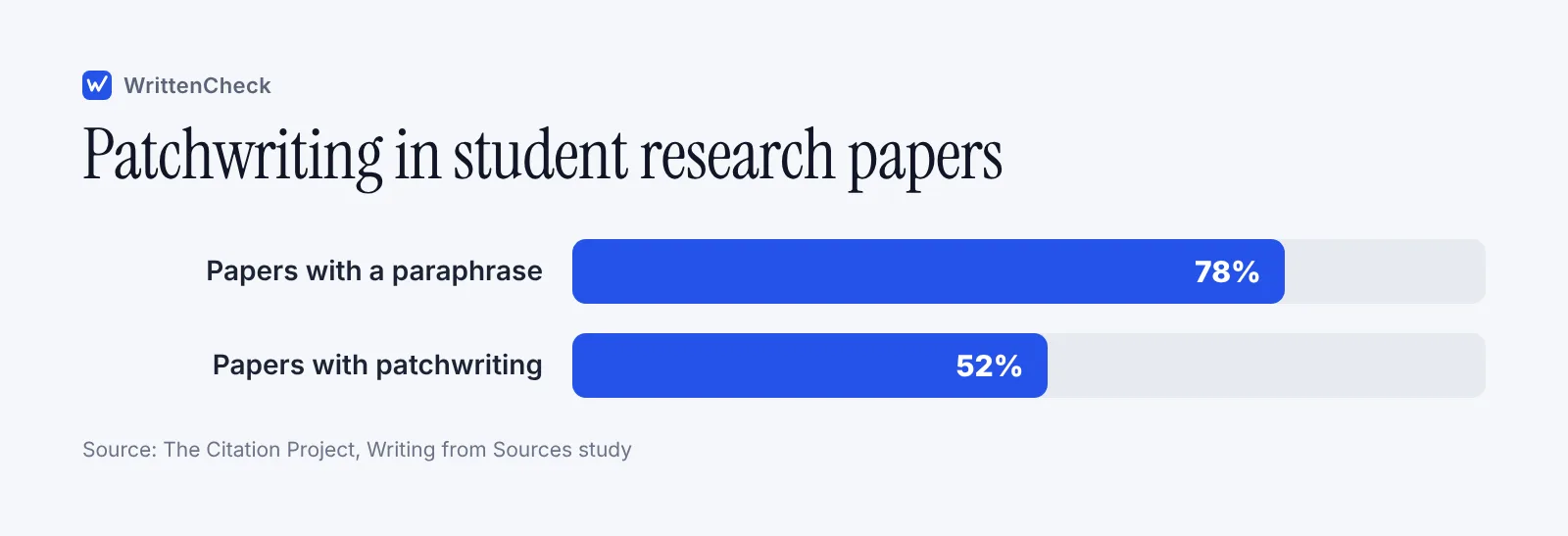
Patchwriting is extremely common. The Citation Project, a research study led by Sandra Jamieson and Rebecca Moore Howard, looked at 174 research papers from 16 US colleges. More than half contained at least one case of patchwriting.
Howard has long argued that patchwriting is often a stage writers pass through while they learn to work with sources. The University of Hawaii's English Language Institute notes that some writers patchwrite a quick first draft, then paraphrase, summarize and quote properly as they revise. That can help in a draft. It's still unacceptable in work you hand in.
Self-plagiarism
Self-plagiarism is reusing your own previous work in a new piece without telling the reader or getting permission. Miguel Roig's guide for the ORI defines it as reusing earlier work "without letting the reader know that this material has appeared elsewhere."
For students, this usually means handing in the same essay for two classes, or reusing a high school paper at college. Bowdoin counts submitting the same work in two courses as self-plagiarism unless both professors agree.
For researchers, there are three common forms.
Duplicate publication. Publishing the same paper in more than one journal.
Salami slicing. Splitting one study into several small papers. Roig describes this as dividing a study "which should have been reported in a single paper."
Text recycling. Reusing your own sentences without saying so. The Committee on Publication Ethics (COPE) says context matters. Reused text in a methods section is generally easier to defend than in a discussion section, but transparency is always required.
Accidental plagiarism
Accidental plagiarism happens when you forget a citation, cite the wrong source or paraphrase too closely without realizing. Bowdoin is clear that "lack of intent does not absolve the student of responsibility." Most cases start in the notes, where copied text and your own words get mixed up.
Source fabrication
Source fabrication is citing work that doesn't exist, or that you never read. It's now often tied to AI tools, which can produce references that look complete but are invented. Our guide to AI hallucination shows how to check every reference.
Collusion and contract cheating
King's College London defines collusion as students working together without permission on individual work so that their assessments "significantly overlap in content, order, structure and/or format." The UK Quality Assurance Agency (QAA) defines contract cheating as a third party completing work that a student submits as their own, where that input isn't allowed. The QAA notes it can involve friends or family and doesn't always involve money.
Is using AI a type of plagiarism?
It can be. Submitting AI-written text as your own work breaks many schools' integrity rules, and AI tools can also produce patchwritten text or invented sources. Whether a particular use is allowed depends on your course policy.
Our full guide on whether using AI is plagiarism covers the details. If AI use is allowed, you'll usually need to say so and cite it. See how to cite AI for formats.
How do you avoid plagiarism?
You avoid plagiarism by tracking sources from the moment you take notes, keeping other people's words clearly marked, and citing every idea you borrow. Several of these steps come straight from the ORI's 28 guidelines on avoiding plagiarism.
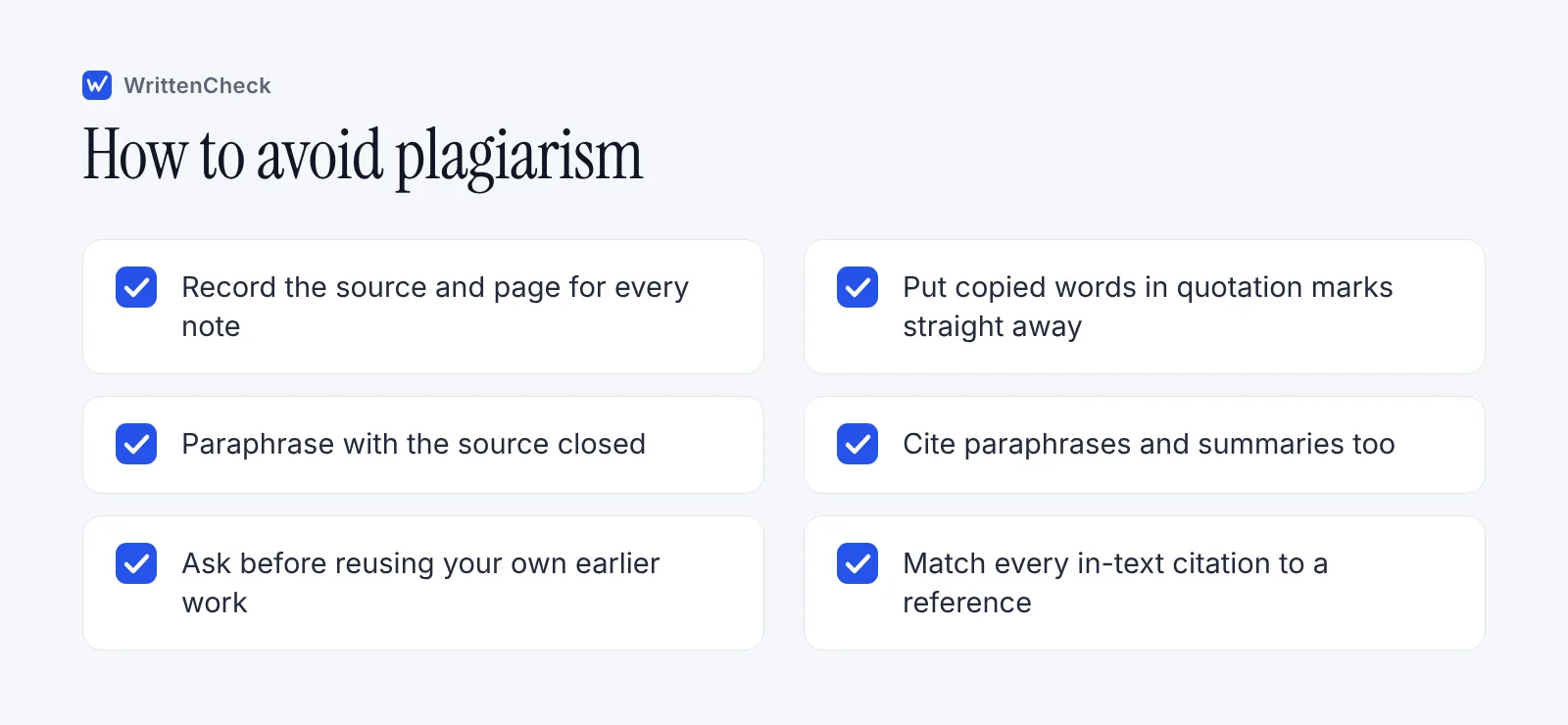
Record every source as you read. Write the author, title, year and page next to each note. Most accidental plagiarism starts with a note you can't trace.
Mark copied words straight away. Put anything you copy in quotation marks in your notes, even a short phrase.
Paraphrase with the source closed. Read the passage, look away, and write the idea in your own words and structure. The ORI's guidelines say a paraphrase needs both your own words and your own sentence structure.
Cite paraphrases and summaries. New words don't make an idea yours. Cite it the same way you'd cite a quote.
Ask before reusing your own work. Get permission from your instructor, and cite your earlier paper.
Check citations before you submit. Make sure every in-text citation matches an entry in your reference list, with the right authors, year and pages.
Which mistakes lead to plagiarism without you noticing?
Most unintentional plagiarism comes from a handful of habits. Watch for these.
Writing with the source open. Your sentences start to follow its structure, which is how patchwriting happens.
Citing only quotes. Paraphrases and summaries need citations too.
Leaning on one or two sentences. The Citation Project found that 94% of citations in its sample came from just one or two sentences of the source. Reading more of the source helps you explain it in your own way.
Mixing notes. If your notes don't show which words are copied, you can't tell later.
Trusting a reference you didn't open. A citation from a friend, a website or an AI tool might be wrong or fake.
What happens if you plagiarize?
Consequences depend on the type, your level and your school's policy, so read yours. Bowdoin, for example, says direct plagiarism is grounds for disciplinary action up to expulsion. In research, the ORI lists plagiarism with fabrication and falsification as research misconduct. COPE's guidance for journals ranges from a correction for minor text recycling to retraction where overlap is substantial.
If you're worried about a paper, talk to your instructor or writing center before you submit. Fixing a citation is easy at that stage. If you're also wondering how your writing reads, you can paste a draft into our free AI detector to see a score for each sentence. It's a separate check from plagiarism, since it looks at writing patterns and doesn't compare your text with sources.
Frequently asked questions
What are the 4 most common types of plagiarism?
Bowdoin College's guide lists four. Direct plagiarism copies words without quotation marks. Mosaic plagiarism, or patchwriting, swaps words but keeps the source's structure. Self-plagiarism reuses your own earlier work without permission. Accidental plagiarism comes from missing or wrong citations. Fuller lists add uncited paraphrase, source fabrication, collusion and contract cheating.
Is self-plagiarism really plagiarism?
Yes, in most academic settings. Your earlier work is a source like any other, and your reader or instructor assumes new work is new. Bowdoin treats submitting the same work in two courses without permission as self-plagiarism. In publishing, COPE calls it text recycling and expects authors to be open about reuse. Ask first, then cite yourself.
Is patchwriting plagiarism if I include a citation?
Usually yes. A citation credits the idea, but patchwriting still copies the source's wording and structure with small changes. Bowdoin says mosaic plagiarism is punishable even with footnotes. Either quote the original exactly with quotation marks or rewrite the idea in your own words and structure, then cite it.
Can you plagiarize by accident?
Yes. Many policies, including those at Bowdoin and King's College London, say a lack of intent doesn't remove responsibility. Accidental plagiarism usually comes from untraceable notes, forgotten citations or paraphrasing too close to the source. Howard, who coined the term patchwriting, argued that it often shows a writer still learning to use sources, so ask for help early.
What counts as common knowledge that doesn't need a citation?
Common knowledge is information that's widely known and easy to find in many general sources, such as the date of a major historical event. Specific numbers, recent findings, opinions and anyone's particular wording all need a citation. The ORI advises that when you're unsure whether something is common knowledge, you should cite it.
Is using a friend's notes plagiarism?
Reading a friend's notes to understand a topic is usually fine. Copying their words or structure into your own assignment is plagiarism, and working together on individual work without permission is collusion. King's College London warns that students who share their work can be penalized too. Check your course rules on collaboration.
Sources
Definition of Research Misconduct, US Office of Research Integrity, HHS, accessed October 2026
Avoiding plagiarism, self-plagiarism, and other questionable writing practices: Self-plagiarism, Miguel Roig, US Office of Research Integrity, accessed October 2026
28 Guidelines at a Glance on Avoiding Plagiarism, Miguel Roig, US Office of Research Integrity, accessed October 2026
The Common Types of Plagiarism, Bowdoin College, accessed October 2026
Words We're Watching: Patchwriting, Merriam-Webster, accessed October 2026
Patchwriting, English Language Institute, University of Hawaii at Manoa, accessed October 2026
Writing from Sources, The Citation Project (Jamieson and Howard), study data 2010 to 2011
Handling text recycling (also known as self-plagiarism), Committee on Publication Ethics, reviewed August 2024
Contracting to Cheat in Higher Education, third edition, Quality Assurance Agency for Higher Education, 2022
What is plagiarism, collusion and cheating?, King's College London, accessed October 2026



Comments