Do colleges check for AI? Some say they do, many don't say either way, and nearly all of them have rules about it. Admissions offices rarely publish whether they run essays through software. What they do publish are integrity statements, and those are clear. The Common App treats passing off AI-written content as your own as fraud.
Coursework is a separate question. Once you're enrolled, each university, and often each instructor, decides how to handle AI. Some universities have switched off the AI feature in their plagiarism checker altogether because of false positives.
Here's what colleges have actually said, school by school, and what that means for your essays and your classes.
Do colleges check for AI in application essays?
Some colleges say they screen applications, but most don't say whether they use AI detectors. What every Common App college does have is a fraud policy that counts AI-written content passed off as your own. Some schools ban any AI use in essays. Others allow brainstorming or grammar help. Readers also compare your essay with the rest of your application, so the safest plan is to write it yourself.
What does the Common App say about AI?
The Common App fraud policy, as quoted by Brown University, lists two kinds of misrepresentation. One is presenting another person's ideas or words as your own. The other is "the substantive content or output of an artificial intelligence platform, technology, or algorithm."
That wording matters. "Substantive content" means the ideas, stories and sentences of your essay. Using a spell check doesn't turn your essay into AI content. Having an AI chatbot write your paragraphs does.
So this rule applies to you at any Common App college, even if that college has no separate AI page.
What do individual colleges say about AI in admissions essays?
Colleges range from a strict ban to guided, limited use. You need to read the rule for every school on your list.
College | What it says about AI in application essays |
|---|---|
Brown University | AI use is "not permitted under any circumstances in conjunction with application content." |
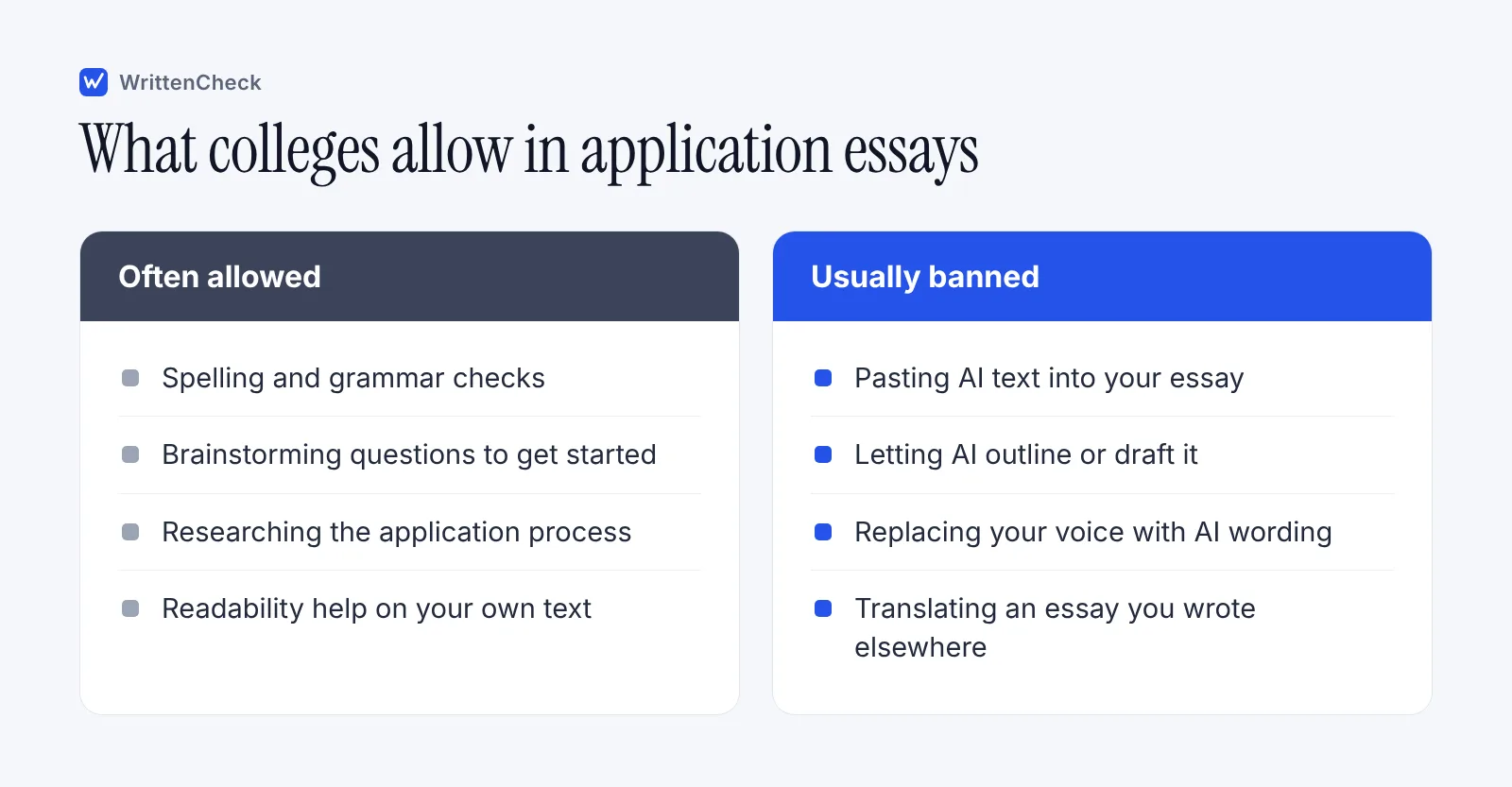
Caltech | Grammar and spelling checks and brainstorming questions are fine. Copying AI text, AI outlines or drafts, and AI translation are unethical. |
Georgia Tech | AI can help with brainstorming and editing, but "your ultimate submission should be your own." |
University of California | AI can "assist with readability," but "content and final written text must be their own." |
Duke University | Stopped giving essays a numerical rating, citing a rise in generative AI and admissions consultants. |
Caltech adds a helpful test. Before you use AI for something, ask whether a trusted adult, like a teacher, could ethically do the same thing for you. A teacher can point out a typo. A teacher shouldn't write your opening paragraph.
Duke's change, reported by The Duke Chronicle in February 2024, shows how admissions offices are adapting. Dean of Undergraduate Admissions Christoph Guttentag said essays would still help readers understand who the applicant is, but they no longer get a score.
Can colleges detect AI in college essays?
Colleges can screen essays, and some say so. The University of California's Statement of Application Integrity, last updated in August 2023, says UC "conducts regular screenings" and "may request authentication." It warns that penalties for false information can go as far as withdrawing an admission offer or revoking a degree.
What most colleges don't publish is whether they use AI detection software, and if so which kind. Many admissions readers don't need it to notice a problem. They read your essay next to your grades, activities, short answers and recommendations. An essay full of polished, general statements that doesn't match anything else in the file stands out.
It's also worth knowing what detectors can't do. They estimate how likely text is to be AI-written. They can't prove it, and they can wrongly flag human writing, especially from students writing in a second language. Our guide on how teachers check for AI explains the other signals people look at.
Do colleges use AI detectors on coursework?
It depends on the university and often on the instructor. Universities that license a plagiarism checker with an AI feature can choose whether to turn that feature on.
Some have said no. In August 2023, Vanderbilt University disabled the AI detection feature in a popular plagiarism checker "for the foreseeable future." Vanderbilt explained that it had submitted about 75,000 papers to that checker in 2022. At the vendor's own claimed 1% false positive rate, around 750 papers could have been wrongly labeled as partly AI-written. It also cited research showing detectors are more likely to flag writing by non-native English speakers.
UC Berkeley didn't turn on that same AI writing feature campus-wide when it came out in April 2023. Its teaching center explained that the tool "provides no such conclusive proof," unlike a plagiarism match to a source. Berkeley later offered instructors an opt-in pilot, which ran from fall 2023 to early 2025.
Other universities leave it to instructors, and some instructors do run checks. So your syllabus is the document that matters most in each class.
How worried should students be about false accusations?
Take the risk seriously, but don't panic. False flags happen, and lots of students worry about them.
In a RAND report published in September 2025, half of the US students surveyed said they worried about being falsely accused of using AI to cheat. That same report found that 54% of students said they used AI for school. In a Pew Research Center survey of 1,458 US teens ages 13 to 17, fielded in fall 2025, 59% said students at their school use AI chatbots to cheat at least somewhat often.
Those numbers explain why colleges are cautious in both directions. They don't want AI essays, and many don't want to accuse students on the strength of a score. If it does happen to you, our guide on what to do if you're falsely accused of using AI walks through the steps.
How can you use AI honestly when applying to college?
Follow the rule at each school, keep the writing yours and keep evidence of your process. Here's what that looks like in practice.
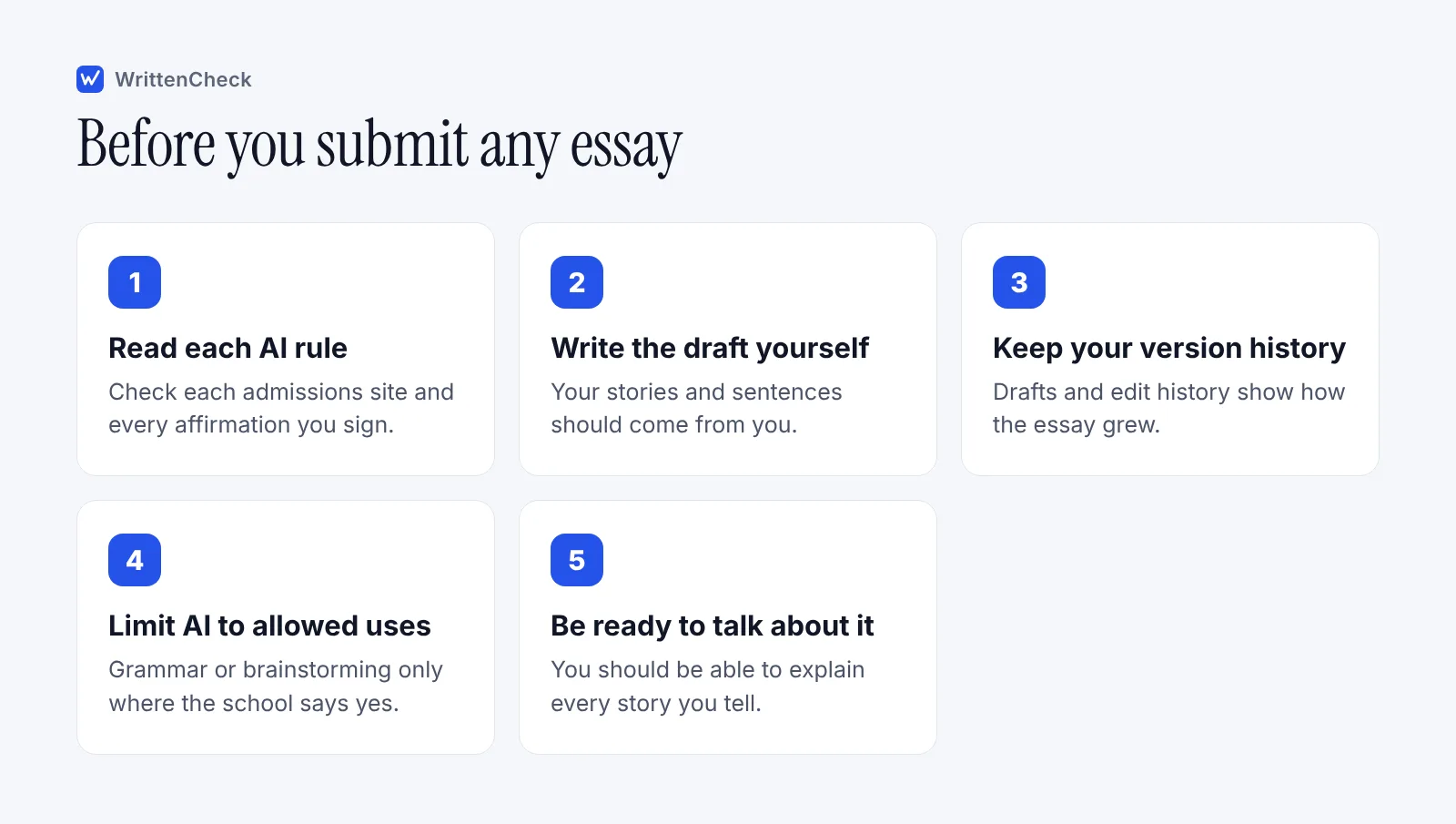
Read the AI rule for every college. Look on the admissions site and read the statement you sign when you submit. If a school bans AI, don't use it for that essay at all.
Draft in a document with version history. Google Docs and Microsoft Word both keep a record of edits. That record shows your essay growing over days.
Brainstorm on paper or out loud first. Write down five moments that mattered to you before you open any tool.
Use AI only for allowed tasks. Where a school allows it, that usually means questions to get you thinking or a grammar check. It never means paragraphs.
Get human feedback. A teacher or counselor can tell you where the essay sounds unlike you.
Read it aloud. If a sentence doesn't sound like something you'd say, rewrite it in your own words.
Keep your notes. If a college ever asks how you wrote it, you'll have the drafts to show.
Here's an example of the difference between help and replacement. Say a student asks an AI chatbot, "What questions could help me find a topic about my family?" and then writes about the night her grandmother taught her to cook. That's brainstorming support, and some colleges allow it. If she asks the chatbot to "write 650 words about my grandmother teaching me to cook," the result isn't her essay, under any of the policies above.
If you've used AI in a class assignment where it's allowed, cite it. Our guide on how to cite AI covers APA, MLA and Chicago formats.
What should you do before you hit submit?
Check that the essay sounds like you, matches the rest of your application and follows the rule at each school. If you want a quick read on which sentences sound generic, you can paste your draft into our free AI detector. It highlights the sentences that read most like AI. Treat any score as a prompt to revise in your own voice, since it's an estimate. We don't keep your text.
Frequently asked questions
Do colleges use AI detectors on application essays?
Most colleges don't say. A few, like the University of California, say they screen applications and may ask you to confirm your work. Others focus on how essays are read and scored, like Duke, which stopped giving essays a numerical rating. Since you can't know which tools a college uses, the only safe approach is to write your own essay.
Can I use AI to brainstorm my college essay?
At some colleges, yes. Caltech lists generating questions to kick-start brainstorming as an ethical use, and Georgia Tech says AI can help with brainstorming. Brown doesn't allow AI use in application content at all. Check each school's admissions site. If a college allows brainstorming help, the stories and sentences should still come from you.
Is using a grammar checker on my essay allowed?
Most published policies allow spelling and grammar checks. Caltech names grammar and spelling review as an ethical use, and the University of California allows AI to assist with readability. Brown's ban covers AI use in application content, so read its wording closely. A grammar fix to your own sentence is very different from AI rewriting your paragraph.
What happens if a college thinks I used AI?
It depends on the school. The Common App fraud policy covers AI content presented as your own, and the University of California says penalties for falsified information can include withdrawal of an admission offer. A college may ask you to explain or verify your work. Drafts and version history are the clearest evidence of how you wrote it.
Do professors check for AI in college classes?
Some do, some don't, and rules can change from one course to the next. Some universities, like Vanderbilt, turned off the AI detection feature in their plagiarism checker. Others leave it to instructors. Read each syllabus. If AI use is allowed, cite it. If it isn't, don't use it, and keep your drafts.
Is an AI detector score proof that I cheated?
No. An AI detector score is an estimate of how much text looks like AI writing. It can be wrong, especially on short texts and writing by people using a second language. Vanderbilt and UC Berkeley both raised these limits when they decided against using the feature. If you're flagged, share your drafts and ask to talk through your work.
Sources
Integrity in the Application Process, Brown University Office of College Admission, accessed October 2026
Ethical Use of AI: Guidelines for Fall Applicants, Caltech Undergraduate Admissions, accessed October 2026
Application Review Process, Georgia Tech Undergraduate Admission, accessed October 2026
Statement of Application Integrity, University of California, August 2023
Duke no longer giving numerical rating to standardized testing, essays in undergraduate admissions, The Duke Chronicle, February 2024
Guidance on AI Detection and Why We're Disabling Turnitin's AI Detector, Vanderbilt University, August 2023
Availability of AI Writing Detection, UC Berkeley Research, Teaching, and Learning, accessed October 2026
AI Use in Schools Is Quickly Increasing but Guidance Lags Behind, RAND Corporation, September 2025
How Teens Use and View AI, Pew Research Center, February 2026

Comments