A thesis statement is the sentence your whole essay has to prove. Get it right and the body paragraphs almost plan themselves. Get it wrong and you end up with five paragraphs that circle a topic without saying anything about it.
This guide shows you how to write a thesis statement from scratch. You'll get a step-by-step method, thesis statement examples in weak and strong versions, templates you can copy and a checklist to test your draft.
The advice draws on university writing centers at UNC Chapel Hill, Harvard, Purdue, UCLA, Illinois and Cornell. Where they agree, we say so. Where they differ, we tell you what to ask your teacher.
How to write a thesis statement
To write a thesis statement, turn your assignment into a direct question, then answer it in one sentence that takes a clear position. Make sure a thoughtful reader could disagree with that answer. Narrow it to what you can prove in the space you have, name the main reasons behind it, and say why it matters. Put it at the end of your introduction and revise it once the draft is done.
What is a thesis statement?
A thesis statement is the central claim of an essay, stated near the start so the reader knows what you're going to prove. The Harvard College Writing Center calls it "your main insight or idea about your source or topic."
The UNC Writing Center describes it as a road map for the paper. It tells the reader how you'll interpret your subject, and it usually sits in a single sentence at the end of the first paragraph.
Three things separate a thesis from a topic.
It answers a question. "Social media and elections" is a topic. A thesis says what is true about them.
It's arguable. Harvard's test is whether a thoughtful reader could disagree. Purdue OWL puts it the same way. A thesis that states something everyone accepts can't persuade anyone.
It's specific. UNC warns against words like "good" or "successful" unless you explain what they mean in your essay.
What is a thesis paragraph?
A thesis paragraph is the introduction that leads up to your thesis. It gives the reader the context they need, sets up the question, then ends on the thesis. The Writers Workshop at the University of Illinois says the thesis belongs in the introduction or, in some longer papers, the second paragraph.
So the thesis is one sentence. The thesis paragraph is the whole runway that gets the reader to it.
How to write a thesis statement step by step
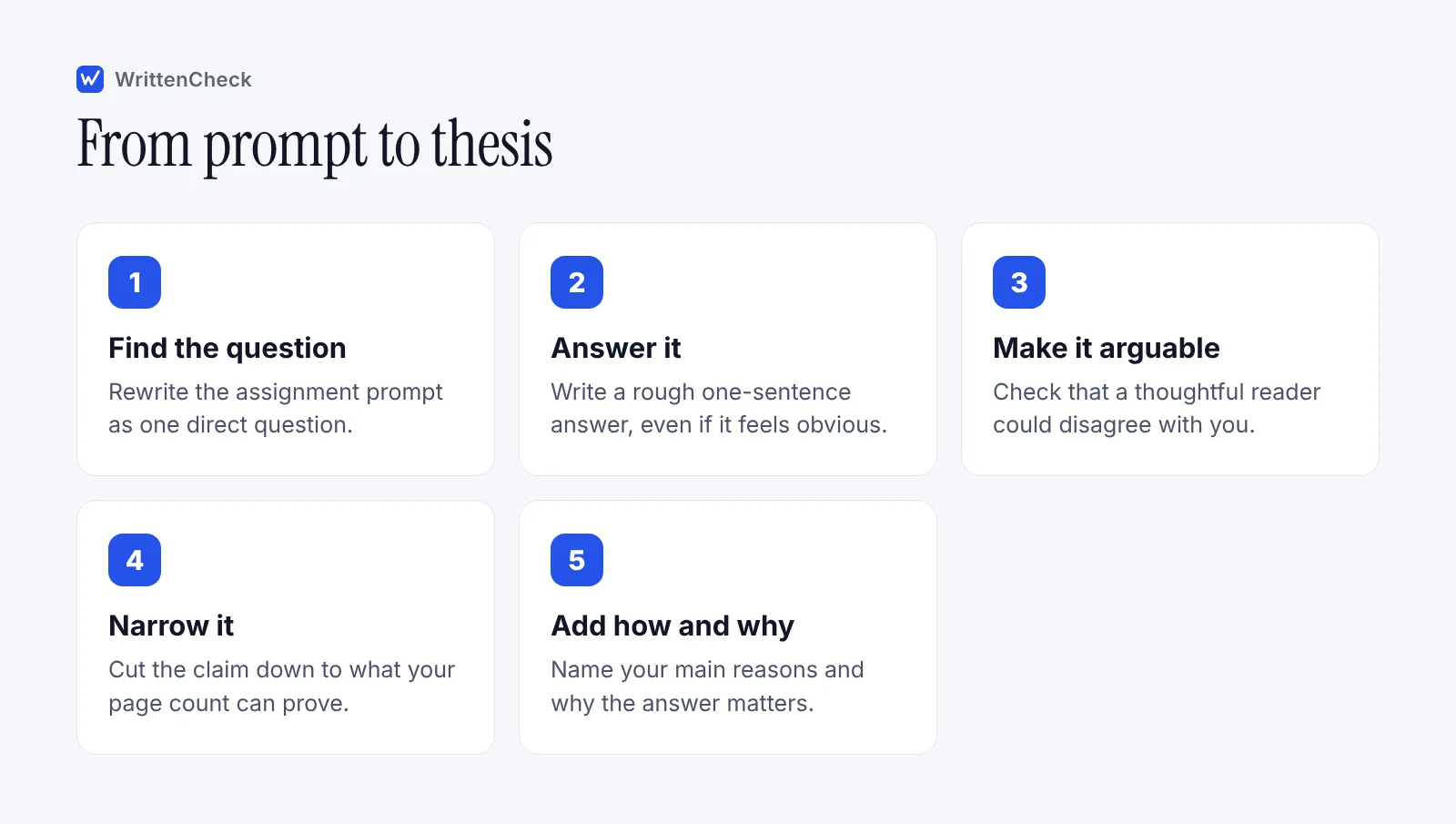
Start from the question and work toward a claim you can defend. Here's how to write a thesis statement from a blank page, in seven moves.
Rewrite the prompt as a question. "Discuss the effects of the school phone ban" becomes "Did the phone ban help students learn?" UNC suggests rephrasing any prompt that isn't already a question, so you can check later that your thesis answers it.
Answer it in one rough sentence. Don't polish yet. "Yes, mostly" is a start.
Make it arguable. Ask who would disagree. If nobody would, you've written a fact.
Narrow it. Purdue OWL notes that broader claims need more evidence to prove. Cut the claim down to one group, one setting or one text.
Add how and why. Name the two or three reasons that will become your body paragraphs.
Add the "so what." Say why a reader should care. UNC calls this the "So what?" test.
Revise after drafting. Reread your body paragraphs and change the thesis to match what you actually proved.
UCLA's Undergraduate Writing Center frames steps 5 and 6 as three questions. "What" is your claim. "How" is your evidence. "So what" is why the claim matters.
What do weak and strong thesis statement examples look like?
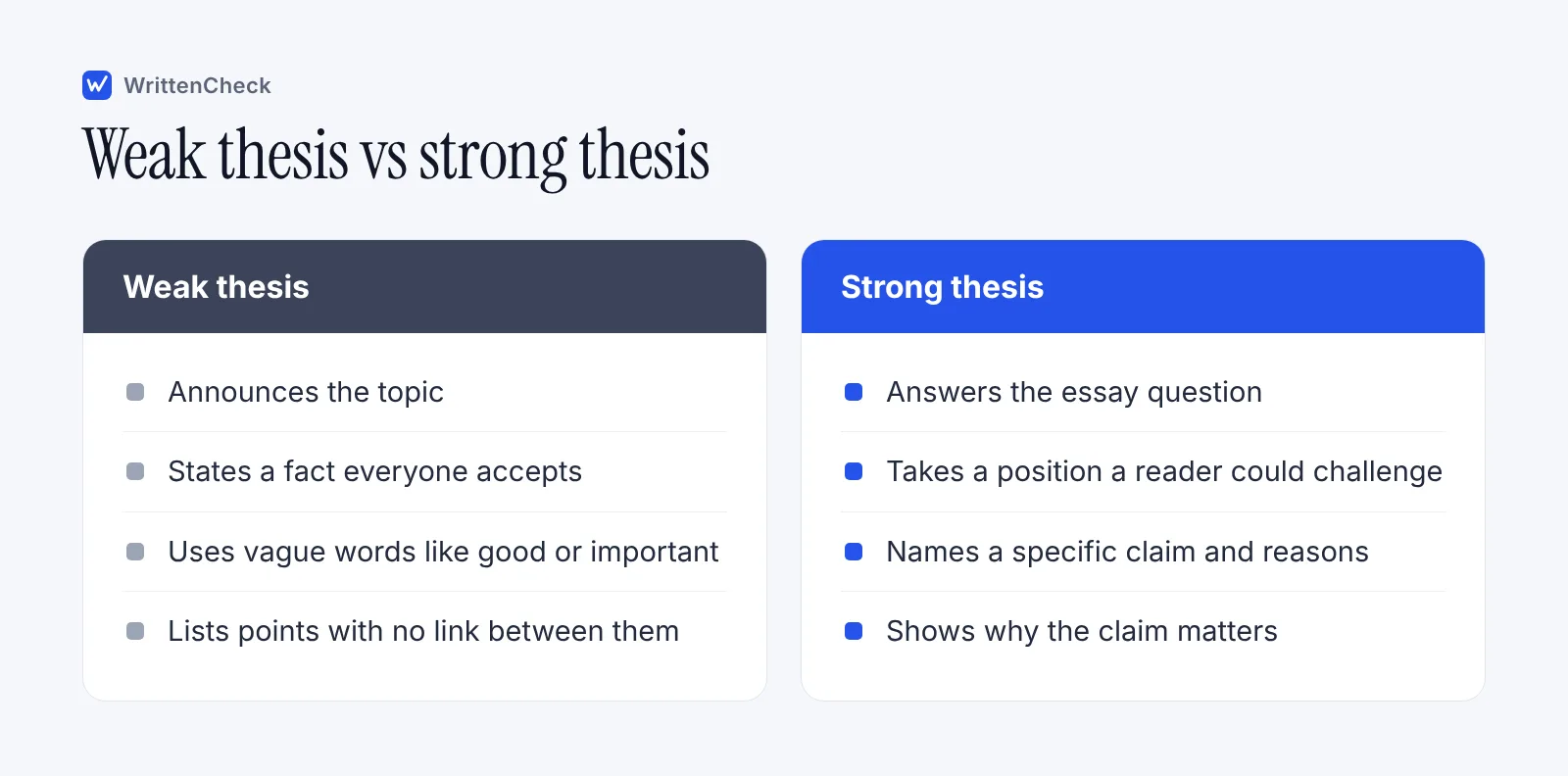
A weak thesis names a topic or a fact. A strong thesis takes a position, gives reasons and hints at why it matters. The examples below are written for this guide to show the difference. Each one answers the same assignment in a weaker and a stronger way.
Example 1: an argumentative essay
Assignment question: Should high schools ban phones during the school day?
Weak: Phones in schools have both advantages and disadvantages.
Better: High schools should ban phones during class.
Strong: High schools should ban phones during class time but allow them at lunch, because a class-time ban removes the biggest distraction from lessons while still letting students reach family and manage after-school jobs.
The weak version could open any essay on any side. The middle version takes a side but gives the reader nothing to test. The strong version commits to a position, limits it to class time and names the two reasons the body will defend.
Example 2: a literary analysis
Assignment question: What does the green light mean in The Great Gatsby?
Weak: The Great Gatsby uses a lot of symbolism, such as the green light.
Strong: In The Great Gatsby, the green light shows that Gatsby loves his idea of Daisy more than Daisy herself, and its fading by the end suggests that this kind of longing can never be satisfied.
The weak version is a fact any reader would accept. The strong version is an interpretation. Someone could argue the light stands for money, or for America, and that's exactly why it works as a thesis.
Example 3: a research or explanatory paper
Assignment question: Why do some students skip office hours?
Weak: Office hours are an important resource that many students don't use.
Strong: Many first-year students skip office hours because they see them as a place to admit failure, so framing office hours as routine check-ins could do more than adding extra hours.
Even an explanatory thesis needs a point of view. The strong version picks one cause and proposes what follows from it, which gives the paper a direction.
Examples from writing centers
Writing centers publish their own before and after pairs. Purdue OWL contrasts "Pollution is bad for the environment" with a claim about spending a set share of the federal budget on limiting pollution. The Illinois Writers Workshop starts from a broad claim about race, gender and class in the film Black Panther and narrows it to one message and the way the film delivers it.
In both cases the revision gets narrower and commits to something a reader could push back on.
Which thesis statement template should you use?
Pick the template that matches your essay type, fill in the brackets, then rewrite it in your own words so it doesn't sound like a form. Templates get you a working draft fast. They shouldn't be the final wording.
Essay type | What the thesis argues | Template you can copy |
|---|---|---|
Argumentative | What should happen | [Group] should [action] because [reason 1] and [reason 2]. |
Argumentative with a counterpoint | Your side, with the other side named | Although [opposing view], [your claim], because [main reason]. |
Literary or film analysis | What a text means | In [title], [author] uses [technique] to show [interpretation]. |
Cause and effect | What caused what | [Cause] led to [effect] mainly because [mechanism]. |
Evaluation | How good or bad something is | [Subject] is [judgment] for [audience] because [criterion 1] and [criterion 2]. |
Any essay | Claim, evidence and stakes | Through [how], we can see that [what], which is important because [so what]. |
The last row is UCLA's "magic thesis formula." The first five rows follow the four kinds of claims Purdue OWL describes. Those are claims of fact or definition, cause and effect, value, and solutions or policies.
What are the most common thesis statement mistakes?
Most weak theses fail in one of six ways. Each one has a quick fix.
The announcement. "This essay will discuss phone bans." That tells the reader your topic and leaves out your view. Replace it with what you'll argue about the topic.
The fact. "Many schools have phone policies." True, and nobody disagrees, so there's nothing to prove. Ask "and so?" until you reach a claim.
The fence-sitter. "Phones have pros and cons." UNC uses a similar social media example as its model of a weak thesis. Pick the side your evidence supports.
The vague word. "Good," "important," "interesting" and "society" sound like claims but say nothing. The Illinois Writers Workshop warns against both vague and abstract words. Say what "important" means.
The list. "Phones are distracting, expensive and addictive." Three points with no link between them make three mini essays. Show how the reasons connect to one claim.
The overclaim. "Phones have destroyed education." Purdue OWL suggests qualifiers like "typically" or "usually" to keep a claim within what you can prove.
How does generic, AI-style phrasing weaken a thesis?
Generic phrasing weakens a thesis because it makes a sentence sound finished while saying very little. Phrases like "plays an important role," "a complex and multifaceted issue" or "both positive and negative effects" fit almost any topic. That's the problem. A thesis that could open anyone's essay doesn't commit you to anything.
If you ask an AI writing tool for a thesis without giving it your evidence or your view, it has nothing to commit to. Expect a safe, general sentence back, which is the fence-sitter mistake above in a polished form. For more on these stock phrases, see our list of AI words to avoid.
If your course allows it, an AI chatbot can still be useful for one honest job. Paste in your own thesis and ask it to argue against you. If it finds an objection you can't answer, Harvard's Writing Center says you may need to revise your thesis or part of your argument. Check your course policy first and disclose the help if the rules require it. Our guide to ethical use of AI covers where the lines usually fall.
How do you know if your thesis statement is strong?
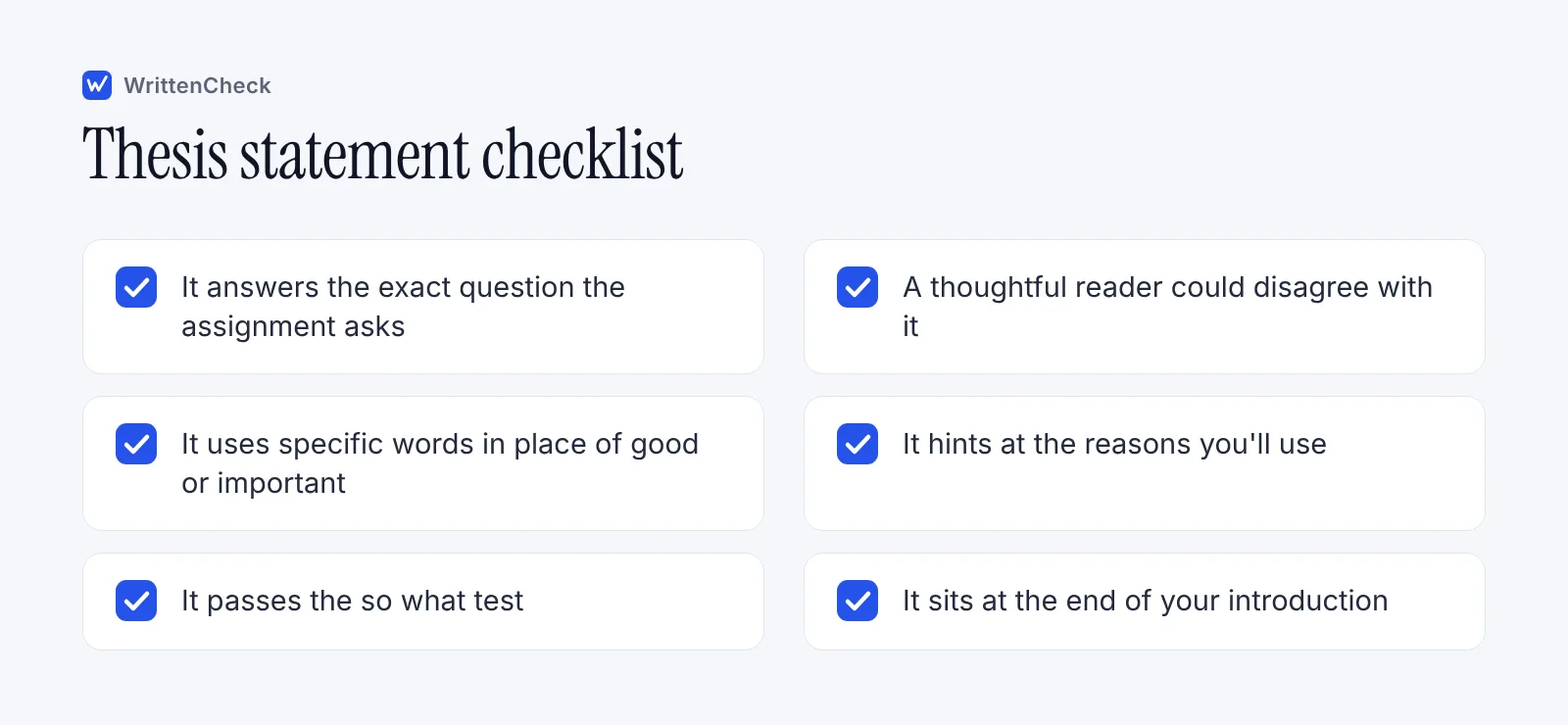
A thesis is strong when it answers the question, takes a position someone could challenge, and is specific enough to guide the essay. UNC's five questions are a good test. Do I answer the question? Have I taken a position others might challenge? Is it specific? Does it pass "so what?" Does it pass "how and why?"
Use the checklist below on every draft.
Cornell's Knight Institute adds two useful moves. Name the main texts, theories or studies you'll use. Then build in some tension by setting what many people believe against what your own reading found. Keep the claim small and precise. Cornell points out that most real findings are modest, so a defensible claim is plenty.
Once you've finished the essay, compare the thesis with your conclusion. If the conclusion argues something the thesis never promised, rewrite the thesis to match. When the draft is done, you can paste it into our free AI detector to see which sentences read as most generic, then rewrite those in your own words. Our guide on making writing sound less like AI has more ways to add specific detail.
Frequently asked questions
What is a thesis statement in simple terms?
A thesis statement is the main point of your essay written as one clear sentence. It answers the question your assignment asks and takes a side a reader could argue with. Everything else in the essay, from the evidence to the examples, is there to prove that sentence. If you can't say your main point in one sentence, the essay probably needs more focus.
How long should a thesis statement be?
Most thesis statements are one sentence. UNC describes it as usually a single sentence near the start of the paper. Longer research papers sometimes use two sentences, one for the claim and one for the reasons. Ask your teacher if you're unsure, and cut any words that don't add a position, a limit or a reason.
Can a thesis statement be a question?
No. A question can lead into your thesis, but the thesis itself has to be the answer. Writing centers such as UNC describe it as your answer to the question the assignment asks. A useful trick is to write your question first, then write the one-sentence answer under it. Keep the answer as the thesis and use the question, if at all, earlier in the introduction.
Should I write "In this essay, I will argue" in my thesis?
It depends on your field and your teacher. Cornell's Knight Institute says it can help to start a first draft of a thesis with "In this essay, I argue" to get the claim on the page. The Illinois Writers Workshop stresses that a thesis should take a clear position, so "this essay will discuss" on its own falls short. If you use "I argue," make sure a real claim follows. When in doubt, ask what your instructor prefers.
Is it OK to change my thesis while I'm writing?
Yes, and you usually should. A thesis written before research is a working thesis. As you draft, you'll find evidence that pushes the claim in a new direction. Harvard's Writing Center says that if you meet a counterargument you can't answer, you may decide to revise the thesis. Do a final check after drafting so the thesis promises exactly what the body delivers.
What is the difference between a topic sentence and a thesis statement?
A thesis statement makes the main claim for the whole essay. A topic sentence makes the main point of one paragraph and supports the thesis. If your thesis names three reasons, each body paragraph usually opens with a topic sentence that states one of them. Read your topic sentences in a row. Together they should sound like a short version of your argument.
Sources
Thesis Statements, The Writing Center, University of North Carolina at Chapel Hill, last modified March 2026
Developing Strong Thesis Statements, Purdue Online Writing Lab, accessed October 2026
Thesis, Harvard College Writing Center, accessed October 2026
Counterargument, Harvard College Writing Center, accessed October 2026
What, How and So What? Approaching the Thesis as a Process, UCLA Undergraduate Writing Center, handout revised 2015
Effective Thesis Statements, The Writers Workshop, University of Illinois Urbana-Champaign, accessed October 2026
Writing Resource: Strong Thesis Statements, Knight Institute for Writing in the Disciplines, Cornell University, accessed October 2026



Comments