AI literacy is quickly becoming a basic school skill, in the same way reading a chart or judging a website once did. Your students already use AI tools. The question is whether they understand what those tools are doing.
This guide gives you the working definitions, the main frameworks from UNESCO, the OECD and the European Commission, and what the EU AI Act requires. Then it gets practical, with classroom activities for each age group and a simple way to assess what students have learned.
What is AI literacy?
AI literacy is the knowledge and judgment people need to understand, use and question artificial intelligence. It covers roughly how AI systems work, what they're good and bad at, how to check their output, and the ethical issues they raise. In a 2020 paper, researchers Duri Long and Brian Magerko defined it as competencies that let people critically evaluate AI, work with it, and use it as a tool at home, online and at work.
Where do the main definitions come from?
Most school frameworks trace back to a handful of sources. Knowing them helps you explain your choices to colleagues and parents.
Long and Magerko (2020). Their paper, "What is AI Literacy? Competencies and Design Considerations," was presented at the 2020 CHI Conference on Human Factors in Computing Systems. It pulled together research from many fields into a set of core competencies. The list published by their lab at Georgia Tech has 17, including recognizing AI, understanding AI's strengths and weaknesses, knowing that computers often learn from data, and identifying ethical issues.
UNESCO (2024). In 2024, UNESCO published two frameworks, one for students and one for teachers. They're designed as global reference points that countries can adapt.
OECD and European Commission (2026). On 18 June 2026, the two bodies released the final version of their AI Literacy Framework for primary and secondary education. It defines AI literacy as knowledge, skills and attitudes that equip learners to understand how AI systems work, critically evaluate their outputs, and use them ethically and creatively. It organizes competences into four domains: Engage with AI, Create with AI, Manage AI and Shape AI. The OECD is also building toward a PISA 2029 assessment of Media and Artificial Intelligence Literacy.
What do the UNESCO AI competency frameworks include?
Both UNESCO frameworks are grids. Each one crosses a few topic areas with three levels of progress, and every cell is a competency.
Students (2024) | Teachers (2024) | |
|---|---|---|
Areas | Human-centred mindset, Ethics of AI, AI techniques and applications, AI system design | Human-centred mindset, Ethics of AI, AI foundations and applications, AI pedagogy, AI for professional development |
Levels | Understand, Apply, Create | Acquire, Deepen, Create |
Competencies | 12 | 15 |
Two things stand out. Both frameworks start with a human-centred mindset, meaning people stay in charge of decisions AI touches. And both put ethics on the same footing as technical skill.
The teacher framework also makes a point about the gap it's trying to fill. UNESCO notes that as of 2022, only seven countries had developed an AI competency framework or training program for teachers. If your school hasn't trained you yet, you're far from alone.
Does the EU AI Act require AI literacy?
Yes, for organizations that provide or deploy AI systems in the EU, though the obligation is about staff, not students. Article 4 of the EU AI Act has applied since 2 February 2025.
The original 2024 text required providers and deployers to take measures to ensure a sufficient level of AI literacy among their staff and others operating AI systems on their behalf. In 2026, the EU passed the Digital Omnibus on AI, Regulation (EU) 2026/1744, which entered into force on 27 July 2026. It changed Article 4 so providers and deployers must now take measures to support the development of AI literacy, taking into account people's knowledge, experience and the context of use. It also added that the Commission and Member States should help organizations, especially small ones, meet this duty.
For teachers in the EU, the practical point is simple. A school or university that deploys AI tools can count as a deployer. That's one more reason your institution may offer AI training, and a good reason to ask for it if it doesn't. Check with your school's legal or data protection lead for how it applies to you.
What are the core AI literacy skills students need?
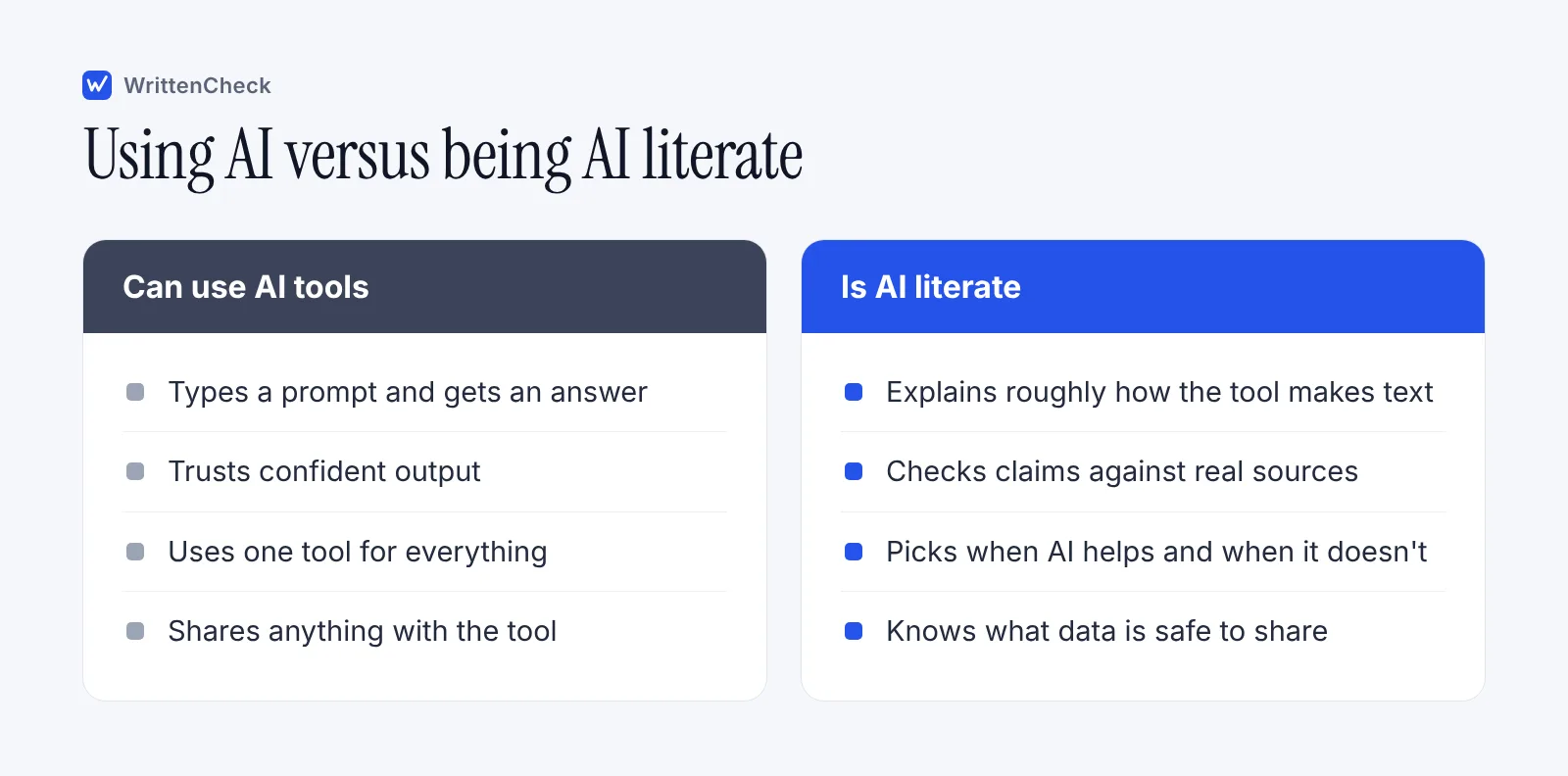
Across the frameworks, the same handful of skills keeps coming up. You can group them into five.
Recognizing AI. Students can tell when a tool, app or device uses AI, and when it doesn't.
Understanding how it works, roughly. They know AI systems learn patterns from data, and that chatbots generate likely-sounding text rather than looking up facts.
Evaluating output. They check claims, spot made-up sources and notice when an answer is confidently wrong.
Thinking about ethics and impact. They can discuss bias, privacy, authorship and who benefits or loses from an AI system.
Using AI with purpose. They decide when AI helps their learning, when it gets in the way, and how to disclose using it.
That last skill connects directly to academic honesty. Our student guide to the ethical use of AI covers it in detail, and you can share it with older students.
How do you teach AI literacy at different ages?
Match the activity to what students can reason about. Young children can sort and predict. Teenagers can test, debate and design. Many of the best activities need no AI tool at all.
Age group | Focus | Classroom activity |
|---|---|---|
5 to 8 | Machines follow patterns people give them | Play "teach the robot." One child gives step-by-step instructions to a classmate acting as a robot to sort fruit by color. Then add a fruit the rules don't cover. |
8 to 11 | AI learns from examples, and examples can be lopsided | Sort picture cards into "cat" and "not cat" using only a few examples. Discuss why a strange photo gets sorted wrong. |
11 to 14 | Chatbots predict words, so they can be wrong | Ask a chatbot (teacher-led, on screen) three questions about your town. Students fact-check each answer with local sources and grade it. |
14 to 16 | Bias, privacy and who decides | Read a news case about an AI system making a bad decision. Groups map who built it, who used it and who was affected. |
16 to 18 | Judgment about use and authorship | Students write an essay plan, ask an AI tool for feedback, then write a reflection on which suggestions they kept and why. |
Check the age limits and terms for any tool you put in front of students. UNESCO's 2023 guidance on generative AI in education recommended an age limit of 13 for using these tools in the classroom, and many tools set their own minimum age.
What does a short classroom unit look like in practice?
A short unit of five lessons can cover the core skills for students around 12 to 16. Each lesson builds on the one before it.
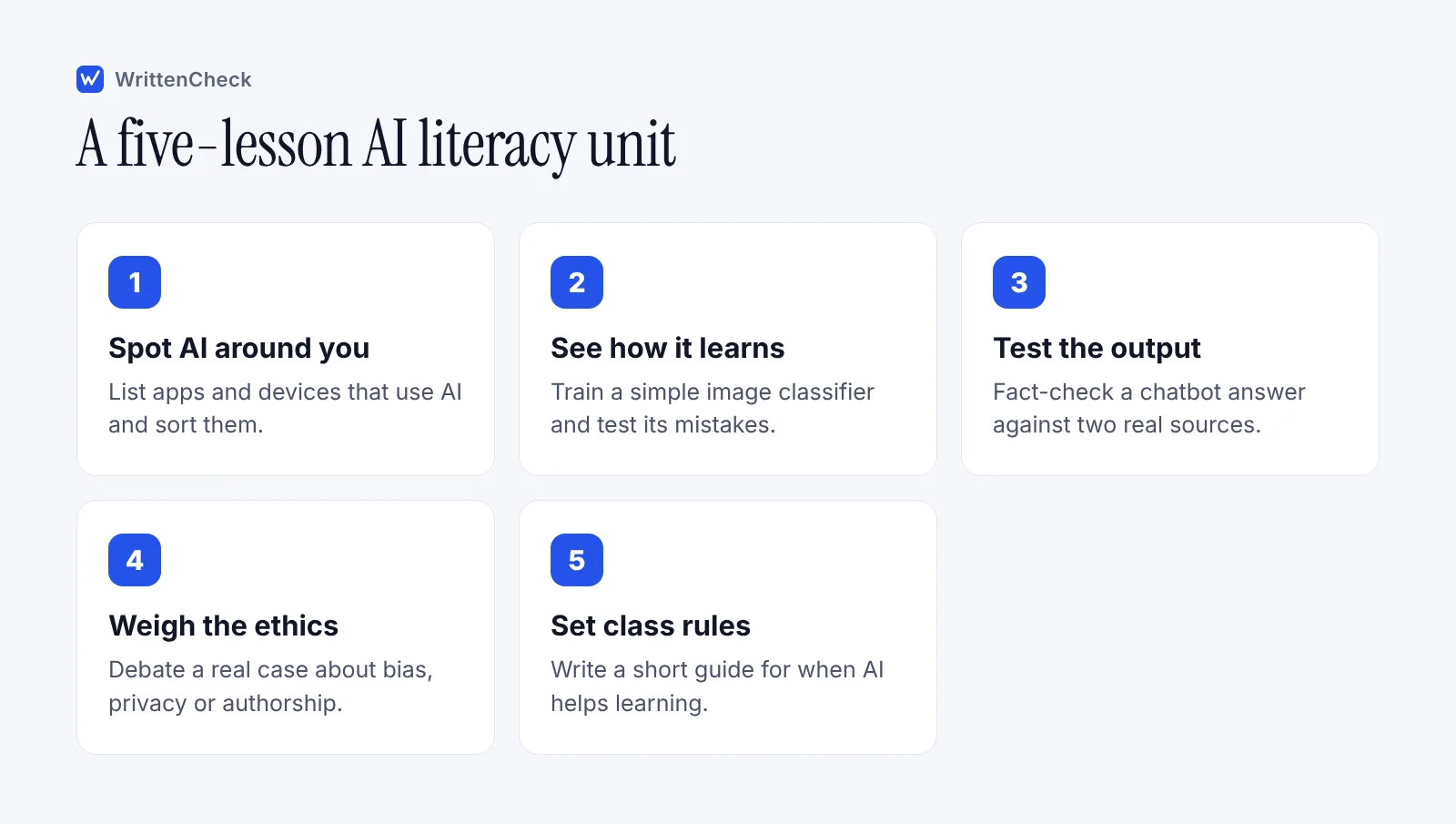
Here's how one lesson might run in practice. Say you're on lesson three, testing the output. Put a chatbot answer about a historical event on the board. Ask students to underline every factual claim. Then split the claims between groups and give them 15 minutes to confirm or disprove each one using two reliable sources. End by asking the class to rate the answer and explain the rating.
Students usually find at least one claim that's off or unsupported. That moment teaches more than any warning you could give them.
How can teachers build their own skills?
Start with the same skills you'll teach, then add the teaching layer. The UNESCO teacher framework's levels of acquire, deepen and create are a useful map.
Acquire. Use one AI tool for a real task, like drafting a rubric, and check every line of what it gives you.
Deepen. Try it on a lesson plan, note where it helps and where it gets your subject wrong, and share notes with a colleague.
Create. Design an activity where students use or critique AI, run it, and adjust it based on what happened.
It also helps to understand the tools around AI in your school, such as AI detectors. Our explainer on how AI detectors work and our post on whether AI detectors can be wrong cover what a score can and can't tell you. That knowledge is part of a teacher's own skill set too.
How do you assess AI literacy?
Watch what students actually do with AI output. Short performance tasks work better than multiple-choice quizzes for most of these skills.
Here are three formats that work well:
Critique tasks. Give students an AI-generated answer with planted errors. Score how many they find and how well they explain each one.
Process logs. On an assignment where AI is allowed, students keep a short log of prompts, what they kept and why. Score the quality of their decisions.
Explain-it tasks. Ask students to explain to a younger student why a chatbot can sound sure and still be wrong. Score accuracy and clarity.
A simple rubric can use four levels for each skill. For example, on evaluating output, a beginning student accepts the answer as given. A developing student checks one claim. A secure student checks every key claim against a reliable source. An advanced student explains why the errors happened.
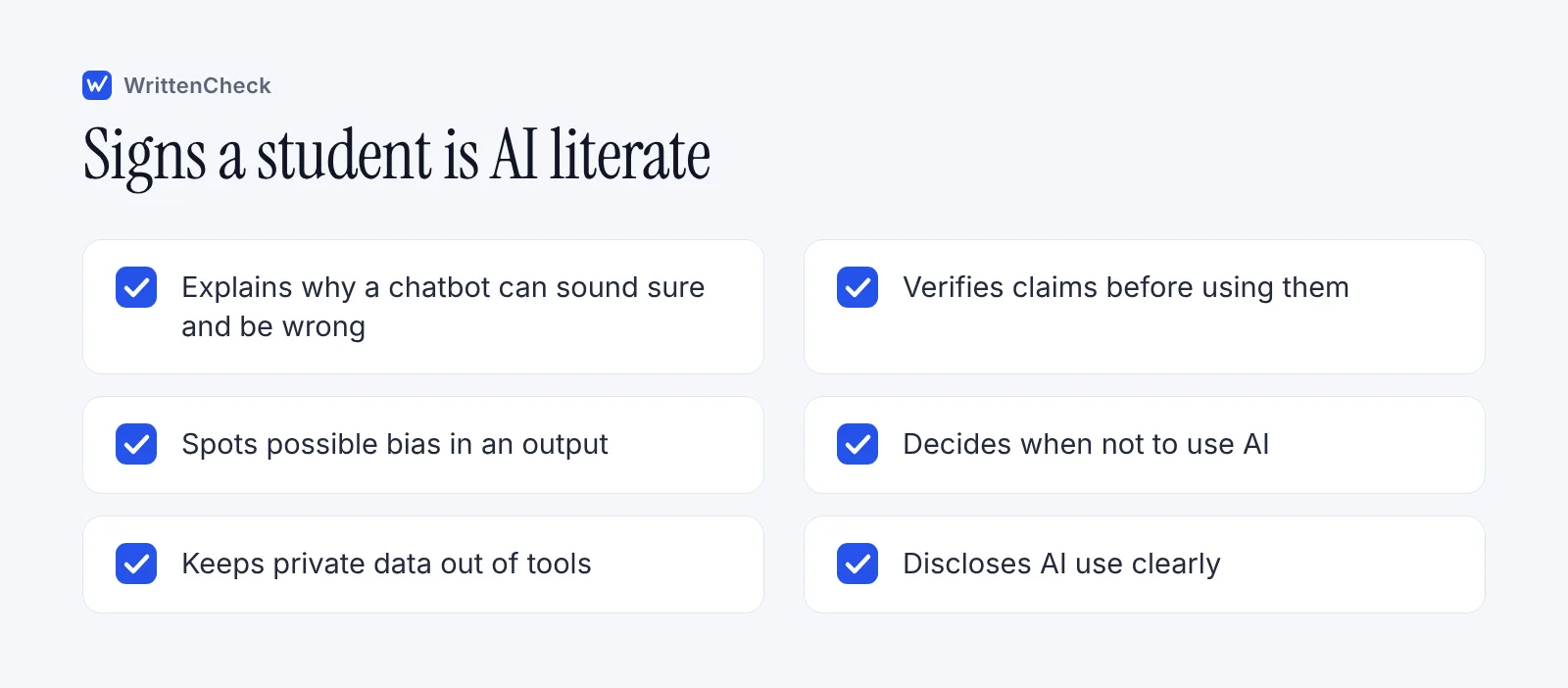
You can also run a quick before-and-after check. Ask the same three questions at the start and end of a unit, such as "Where does a chatbot get its answers?" and "How would you check if an AI answer is right?" Compare the responses.
Where does AI literacy fit with academic integrity?
The two support each other. Students who understand how AI tools work are better at using them honestly and spotting when output is unreliable.
Stanford researcher Victor Lee has compared teaching AI literacy to driver's education, which teaches responsible use of a powerful tool. That framing works well with students, because it treats AI as something you learn to handle with skill and care. Our guide to academic integrity and AI shows how to tie these lessons to your class rules.
If you want a hands-on example for older students, have them paste a paragraph they wrote and a paragraph an AI tool wrote into our free AI detector, then discuss why the scores are estimates and what the highlighted sentences have in common. It's a good way into how these tools judge text, and their limits.
Pick one activity from the age table above and run it this month. Then note what surprised your students, because that's where your next lesson starts.
Frequently asked questions
What is the simplest definition of AI literacy?
AI literacy is knowing enough about artificial intelligence to use it well and question it. That means understanding roughly how AI systems work, checking their output, recognizing their limits and thinking about their effects on people. The OECD and European Commission describe it as knowledge, skills and attitudes for understanding, evaluating and using AI ethically and creatively.
At what age should students start learning about AI?
You can start with young children using unplugged activities about patterns, rules and examples, with no AI tool needed. Hands-on use of generative AI tools usually comes later. UNESCO's 2023 guidance recommended an age limit of 13 for classroom use of these tools, and many tools set their own minimum ages in their terms.
Do teachers need these skills too?
Yes. Teachers need it to set fair rules, design useful tasks and judge AI-related evidence like detector scores. UNESCO's 2024 AI competency framework for teachers sets out 15 competencies across five areas, including AI pedagogy and ethics. In the EU, schools that deploy AI systems also fall under the staff duty in Article 4 of the AI Act.
Is AI literacy the same as digital literacy?
They overlap but aren't the same. Digital literacy covers using devices, finding information and staying safe online. AI literacy adds an understanding of systems that learn from data and generate content, including why they can be biased or confidently wrong. Most frameworks treat it as building on digital and data literacy.
What did the EU AI Act change about AI literacy?
Article 4 of the EU AI Act applied from 2 February 2025 and originally required providers and deployers of AI systems to ensure a sufficient level of AI literacy among their staff. The Digital Omnibus on AI, in force from 27 July 2026, changed it to a duty to support people in developing these skills, with help from the Commission and Member States.
How can I teach AI literacy without giving students AI accounts?
Use unplugged activities and teacher-led demos. Students can sort picture cards to see how examples shape a classifier, act out step-by-step rules, or fact-check a chatbot answer you display on screen. These build the core ideas of how AI learns, where it fails and how to check it, without students needing their own logins.
Sources
What is AI Literacy? Competencies and Design Considerations, Long and Magerko, Proceedings of CHI 2020, April 2020
AI Literacy, AI Unplugged, Georgia Institute of Technology, accessed October 2026
AI competency framework for students, UNESCO, 2024
AI competency framework for teachers, UNESCO, 2024
Empowering learners for the age of AI, European Commission and OECD, 18 June 2026
Article 4: AI literacy, EU Artificial Intelligence Act, accessed October 2026
Regulation (EU) 2026/1744 (Digital Omnibus on AI), EUR-Lex, 2026
EU AI Omnibus enters into force, amending the AI Act, White & Case, 4 August 2026
UNESCO: Governments must quickly regulate Generative AI in schools, UNESCO, 7 September 2023
What do AI chatbots really mean for students and cheating?, Stanford Graduate School of Education, 31 October 2023


Comments