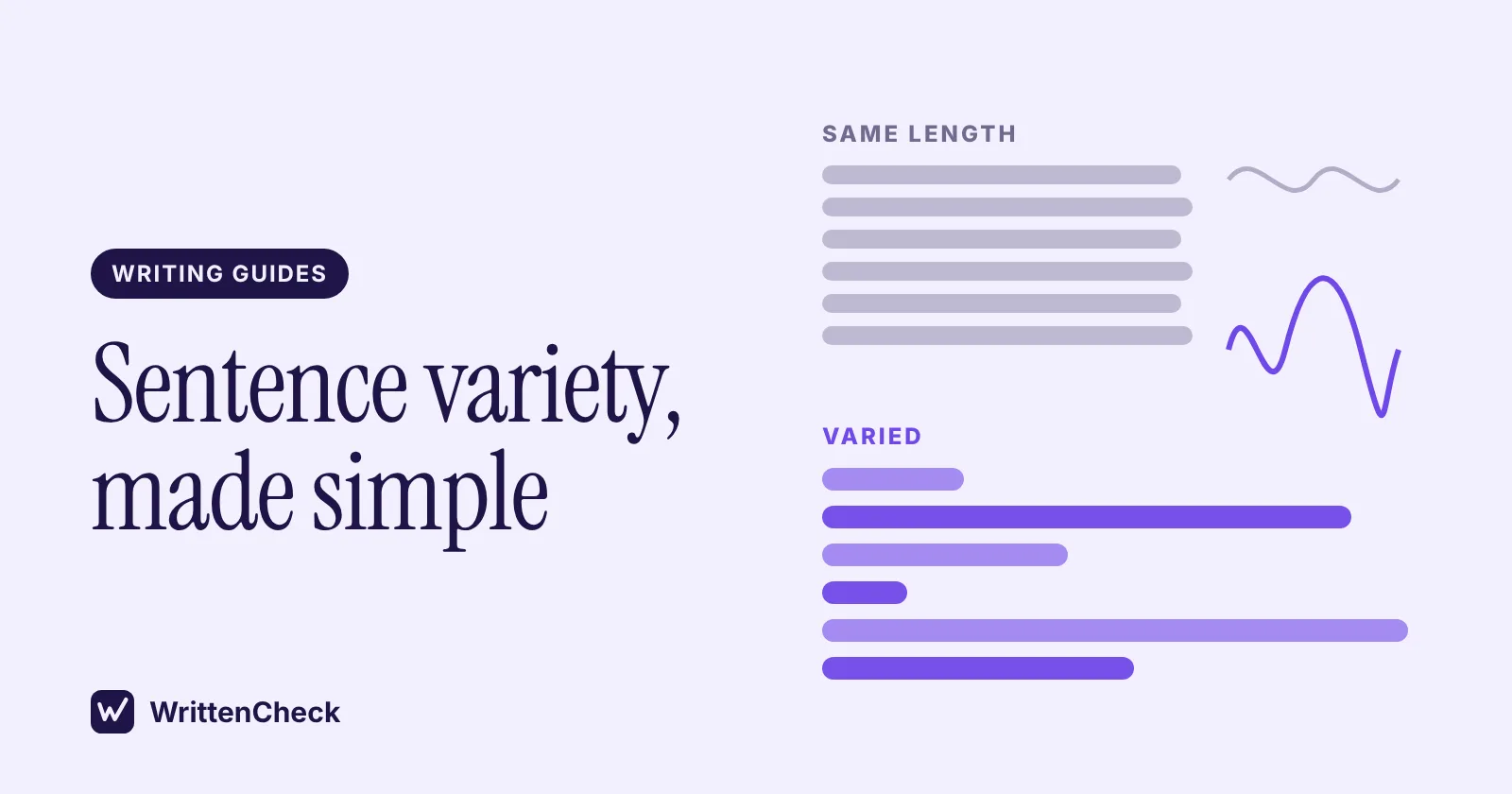
Sentence variety is the mix of short and long sentences, different sentence types and different openings in a piece of writing. It's what gives prose rhythm. When every sentence is the same length and starts the same way, readers drift, even if each sentence is correct on its own.
Teachers write "vary your sentences" in the margin a lot. They rarely say how. This guide shows you how to measure variety in your own draft, the four sentence types, ways to change length and openings, and the mistakes people make when they overcorrect.
What is sentence variety?
Sentence variety is the practice of mixing sentence lengths, sentence types (simple, compound, complex and compound-complex) and sentence openings so that writing doesn't fall into one repeated pattern. It makes prose easier to follow and keeps the reader's attention on the ideas that matter. Short sentences add emphasis. Longer sentences carry detail and show how ideas connect.
The San José State University Writing Center describes it in terms of rhythm. Long sentences give readers room to take in complex information. Short ones build interest and state things directly. The goal is a balance that fits the genre and the purpose.
Why does sentence variety matter?
Sentence variety matters because uniform sentences are tiring to read and hide your main points. If every sentence is medium length, nothing stands out. A short sentence after two long ones lands with force.
The CUNY Graduate Center Writing Center uses a famous example by the writer Gary Provost to show this. His passage starts with sentences of exactly five words each and quickly becomes tedious. Then it mixes short, medium and long sentences, and it suddenly has what he calls "a pleasant rhythm, a lilt, a harmony."
Here's an example paragraph written to show the problem.
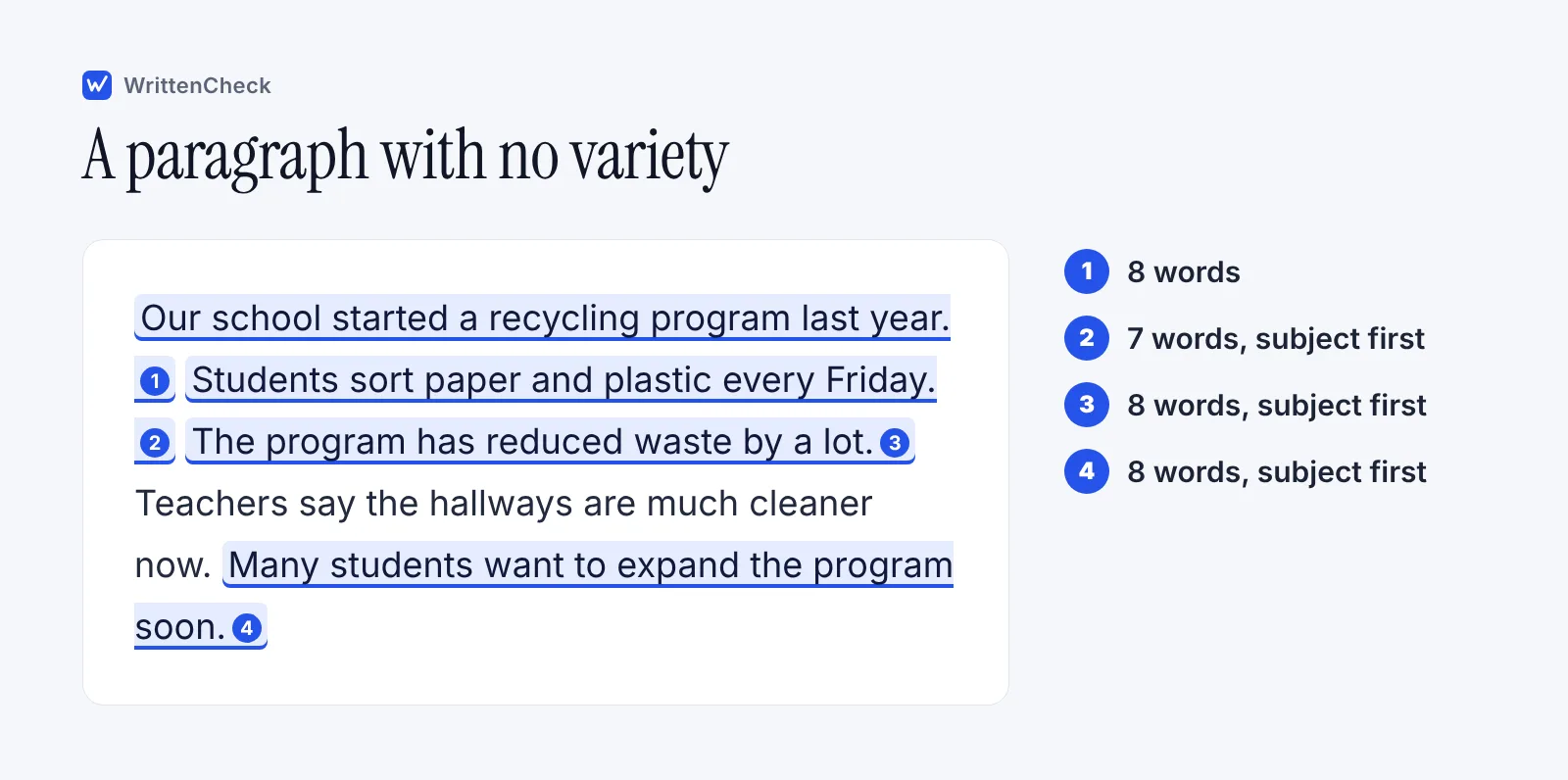
Nothing is wrong with any sentence. Together, they plod. Every sentence starts with its subject, and the word counts run 8, 7, 8, 8, 8. Here's a revised version.
Last year, our school started a recycling program. Every Friday, students sort paper and plastic into blue bins outside each classroom, and by the end of the day the bins are wheeled to the loading dock. It works. Teachers say the hallways are cleaner than they've been in years. Now students want to add a compost bin in the cafeteria.
The word counts are now 8, 28, 2, 11, 11. The long sentence carries the detail. The two-word sentence makes the point. Three of them open with a time word or phrase instead of the subject.
What are the four sentence types?
The four sentence types are simple, compound, complex and compound-complex. They're defined by how many independent and dependent clauses they contain. An independent clause can stand alone as a sentence. A dependent clause can't, because it starts with a word like "because", "when" or "although".
Type | Structure | Example |
|---|---|---|
Simple | One independent clause | The llama spit. |
Compound | Two or more independent clauses, joined by a comma and "and", "but", "or", "so", "yet", "for" or "nor", or by a semicolon | The bus was late, so we walked. |
Complex | One independent clause plus at least one dependent clause | When the bus was late, we walked. |
Compound-complex | Two or more independent clauses plus at least one dependent clause | When the bus was late, we walked, and we still made it on time. |
The definitions follow the Chico State Student Learning Center and the San José State University Writing Center. The first example is Chico State's.
A paragraph of only simple sentences sounds choppy. A paragraph of only compound sentences joined by "and" sounds like a list that won't end. Mixing types changes rhythm and also shows how ideas relate. A complex sentence tells the reader which idea is the main one.
How do you vary sentence length?
Vary sentence length by using short sentences for key claims and longer ones for explanation, evidence and connected ideas. Check your draft by counting the words in each sentence. If most counts in a paragraph fall within two or three words of each other, change at least one sentence.
There's no correct average. Technical writing tends to favor shorter sentences, as SJSU notes, and a novel can stretch further. What matters is the spread within a paragraph.
Three ways to change length
Combine two short sentences. "The test was hard. Most students passed." becomes "The test was hard, but most students passed." or "Although the test was hard, most students passed."
Split one long sentence. If a sentence holds two separate claims joined by "and", try a period. Then make the more important claim the shorter sentence.
Add a short sentence for emphasis. After a long explanation, a sentence of two to five words can sum up the point. Use this once or twice a page, at most.
A worked example
Here's an example paragraph from a student-style lab report.
We heated the water to 80 degrees. We added the salt to the beaker. We stirred the mixture for two minutes. We measured the temperature again. The temperature had dropped to 76 degrees.
Every sentence is 5 to 7 words and starts with "We" or "The". Here's one way to revise it.
We heated the water to 80 degrees, added the salt and stirred for two minutes. When we measured again, the temperature had dropped to 76 degrees. That four-degree drop was larger than we expected.
The new counts are 15, 11 and 8. The steps now sit in one sentence, the result gets its own clause, and the last sentence points to what matters.
How do you vary sentence openings?
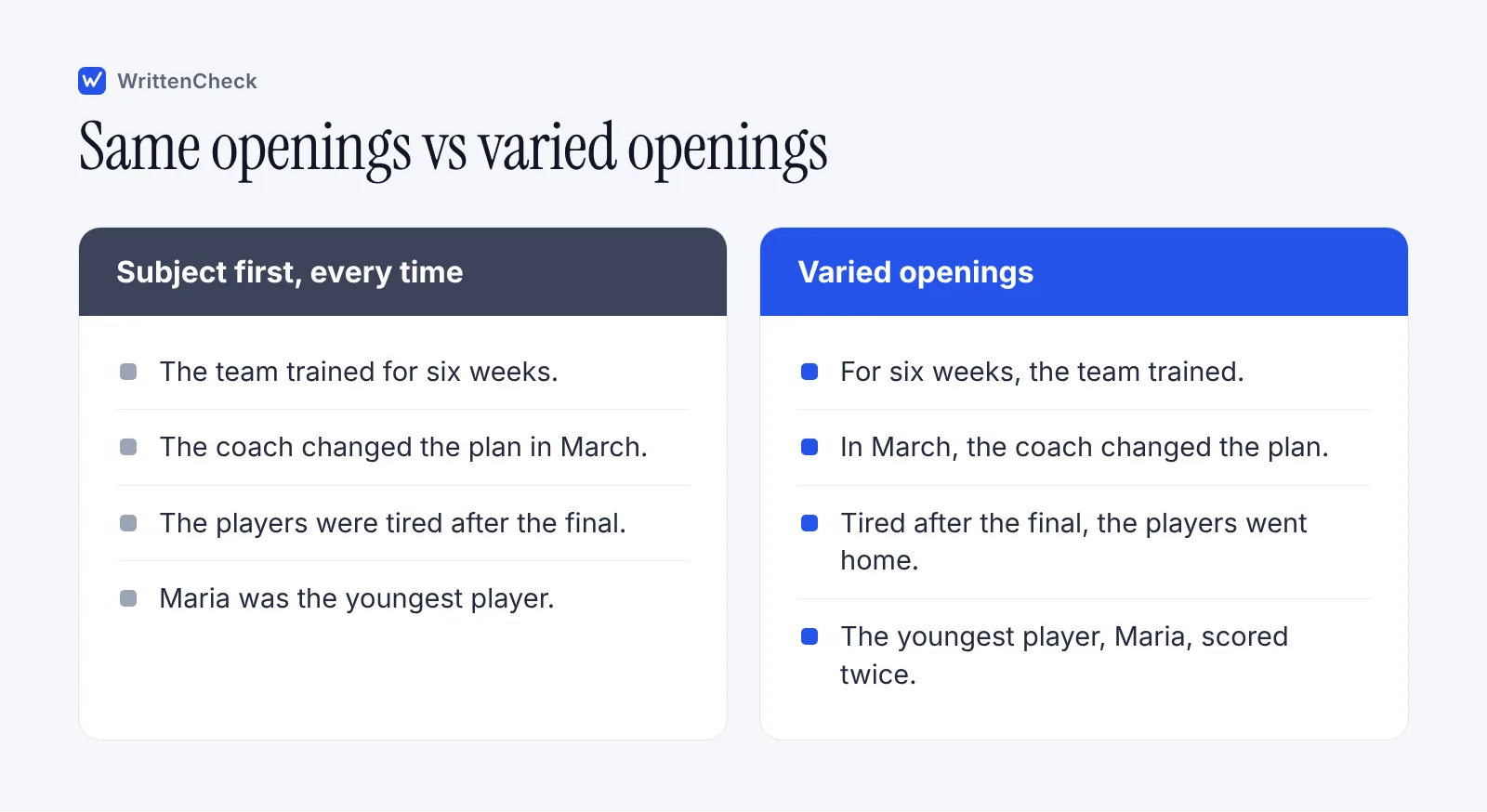
Vary sentence openings by moving something other than the subject to the front. Most English sentences start with the subject, so a paragraph where every sentence does that sounds flat. Try opening with a time phrase, a dependent clause, a descriptive phrase or a short transition.
Here are five openers you can try. Each example starts from "The team trained for six weeks before the final."
Opener | Example |
|---|---|
Time or place phrase | For six weeks before the final, the team trained. |
Dependent clause | Because the final was six weeks away, the team trained every day. |
Participial phrase | Training for six weeks, the team got stronger before the final. |
Appositive (a noun that renames another) | A young squad, the team trained for six weeks before the final. |
Transition word | Even so, the team trained for six weeks before the final. |
Be careful with participial openers. The phrase must describe the subject that comes right after the comma. "Training for six weeks, the final felt easy" says the final did the training. That's a dangling modifier.
For a list of transitions sorted by purpose, see our guide to transition words. Starting every sentence with one is its own kind of sameness, so mix them with the other openers above.
How do you check your own writing for sentence variety?
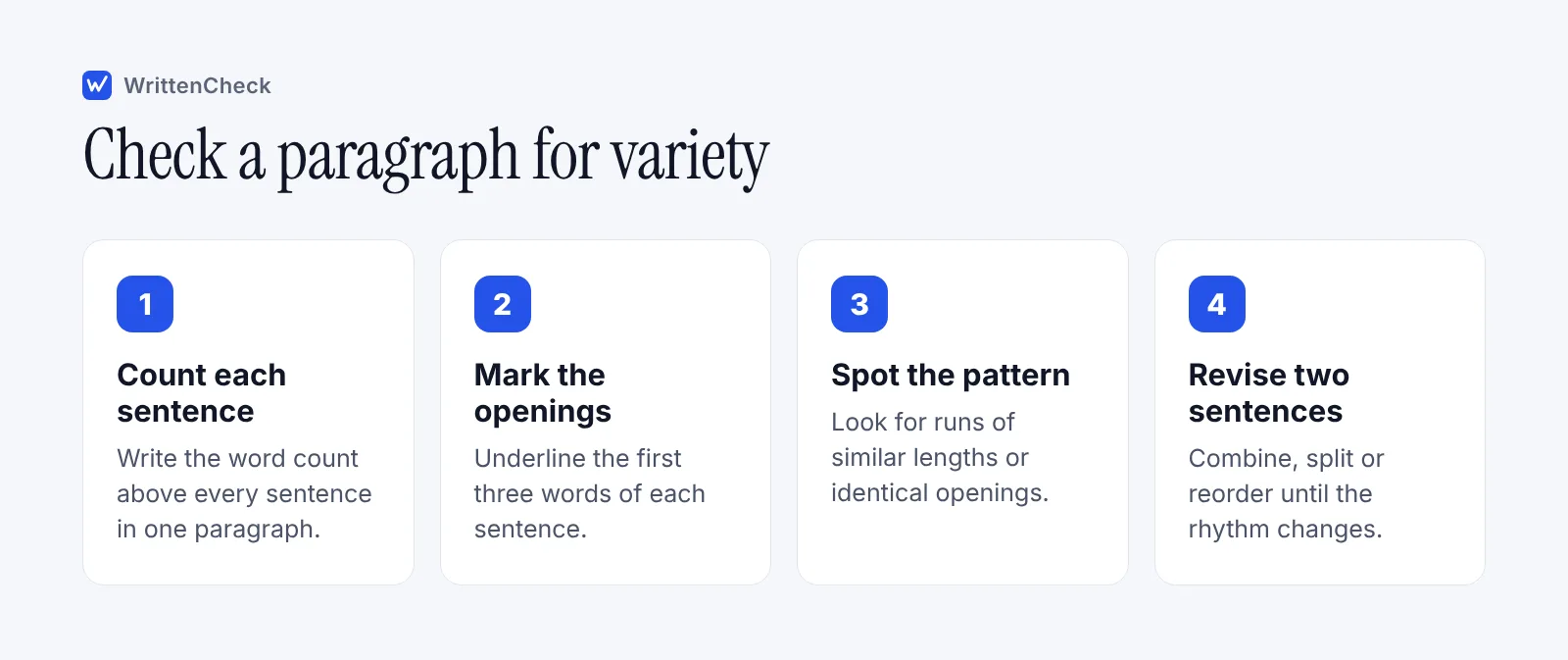
Check one paragraph at a time. Count the words in each sentence, mark how each one opens, and look for runs. The CUNY Graduate Center Writing Center suggests color coding sentences by length, then checking whether each sentence's form fits its job.
Pick a paragraph that carries a key point in your argument. Background paragraphs matter less.
Write the word count above each sentence.
Underline the first three words of each sentence.
Note the type of each sentence (simple, compound, complex or compound-complex).
Look for three or more sentences in a row with similar length, the same type or the same opening.
Revise one or two of them. Don't rewrite the whole paragraph.
Read it aloud. Your ear will catch rhythm problems your eyes miss.
Variety and readability work together. Our guide to Flesch Reading Ease explains how average sentence length affects readability scores, and why a score alone can't tell you if the rhythm works.
What mistakes do people make when varying sentences?
The most common mistake is adding variety for its own sake. Random changes make writing harder to follow. Each change should serve a purpose, such as stressing a point, linking two ideas or slowing down for detail.
Overloading long sentences. A 45-word sentence with three clauses and two lists loses the reader. Split it.
Using fragments by accident. "Because the bus was late." is a dependent clause with no main clause. Short sentences are fine. Fragments in formal essays usually aren't.
Starting every sentence with a clause. Ten sentences in a row that open with "When", "Although" or "Because" are as flat as ten that open with "The".
Asking too many questions. One question can open a section. Several in a row sound like a quiz.
Losing the main idea. In a complex sentence, put the main point in the independent clause. "Although prices rose, sales held steady" stresses the sales.
Does uniform sentence length make writing sound like AI?
It can add to that impression. Research has found that text from large language models tends to be more uniform in sentence length than human writing, though plenty of human writing is uniform too.
In a 2024 study in Artificial Intelligence Review, Alberto Muñoz-Ortiz and colleagues compared human-written news with news from several language models. The models produced more sentences in the 10 to 30 token range, while humans more often wrote longer sentences and showed more variety. In a 2024 study in the International Journal for Educational Integrity, Revell and colleagues asked experienced markers to grade human and AI-written essays on Old English poetry. Markers described the AI essays as having "a stiff uniformity of sentence and paragraph length."
AI detectors pick up on related patterns. The variation from one sentence to the next is often called burstiness, which we explain in how AI detectors work. A flat paragraph isn't proof of anything, though. Many careful human writers produce even sentences, especially in formal or second-language writing.
The fix is good writing in your own voice. Vary sentences where it helps the reader, using the steps above. When your draft is done, you can paste it into our free AI detector to see which sentences read most like AI, then check whether those are the flat, generic ones.
Frequently asked questions
What is an example of sentence variety?
Here's a short example. "The storm hit at midnight. By morning, three streets were flooded and the power was out across the east side of town, so schools stayed closed. Nobody was hurt." The sentences are 5, 21 and 3 words long. They open in different ways, and the short last sentence carries the key fact. That mix of length and openings is sentence variety.
How many words should a sentence have?
There's no fixed number. Good writing mixes short and long sentences, and the right length depends on the reader and the job. Rudolf Flesch, who created the Flesch Reading Ease formula, linked plain English with an average of about 20 words per sentence. Treat that as an average across a text. Individual sentences can be 3 words or 35.
What is the difference between sentence variety and sentence structure?
Sentence structure is how a single sentence is built, such as which clauses it has and in what order. Sentence variety is about the pattern across many sentences. It means mixing structures, lengths and openings so the paragraph doesn't repeat one shape. You can't have variety without knowing a few structures, which is why teachers teach the four sentence types first.
Is it bad to start sentences with "I" or "The"?
No. Subject-first sentences are the most natural shape in English, and most of your sentences will start that way. It only becomes a problem when several sentences in a row open with the same word. Rework one or two of them with a time phrase, a clause or a transition. Leave the rest alone.
How do I vary sentences in a lab report or technical writing?
Technical writing favors short, clear sentences, so variety comes more from structure than from length. Combine steps that belong together into one sentence. Give results their own sentence. Open some sentences with conditions or times, such as "After heating" or "At 80 degrees". Keep terms consistent, since varying technical words can confuse readers.
Can a grammar or style checker fix sentence variety?
It can point out very long sentences or repeated openings, but it can't decide which idea deserves emphasis. That's a writing choice. Use a checker to spot patterns, then revise by hand. Reading the paragraph aloud is still one of the best tests, because rhythm is something you hear.
Sources
Sentence Variety and Rhythm, San José State University Writing Center, Spring 2021
Do Your Sentences All Sound the Same? Try Diversifying Sentence Structure and Length, The Writing Center, CUNY Graduate Center, updated May 2025
Simple, Compound, and Complex Sentences, Student Learning Center, California State University, Chico, 2020
Contrasting Linguistic Patterns in Human and LLM-Generated News Text, Muñoz-Ortiz, Gómez-Rodríguez and Vilares, Artificial Intelligence Review, August 2024
ChatGPT versus human essayists: an exploration of the impact of artificial intelligence for authorship and academic integrity in the humanities, Revell et al., International Journal for Educational Integrity, October 2024
How to Write Plain English, chapter 2, Rudolf Flesch, excerpt hosted by Appalachian State University, accessed October 2026


Comments