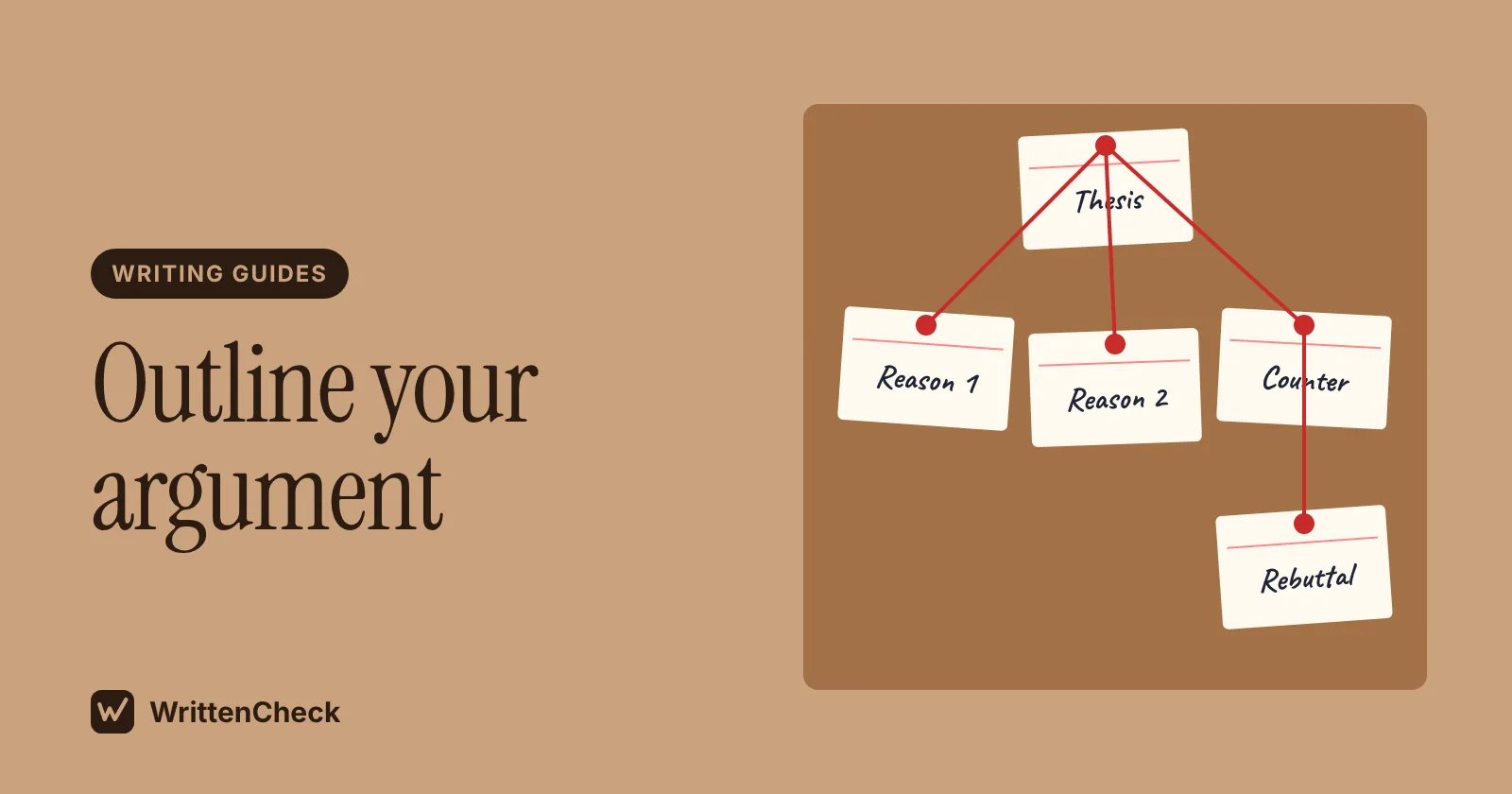
An argumentative essay lives or dies on its plan. If you outline first, you'll spot a missing reason or a weak piece of evidence while it's still a one-line fix. If you skip the outline, you find out at 1 a.m. on paragraph four.
This guide gives you an argumentative essay outline you can copy, a filled-in example, and three structures compared side by side. It also covers the part most outlines skip, the counterargument and rebuttal.
Everything here comes from university writing center guidance, mainly Purdue OWL, UNC Chapel Hill, Harvard and Michigan, plus one large study on persuasion.
What is an argumentative essay outline?
An argumentative essay outline is a short plan that lists your thesis, the reasons that support it, the evidence for each reason, the main counterargument with your rebuttal, and your conclusion, in the order they'll appear. It shows whether your argument holds together before you write full paragraphs. Most outlines fit on one page and use one line per point.
What goes in an argumentative essay structure?
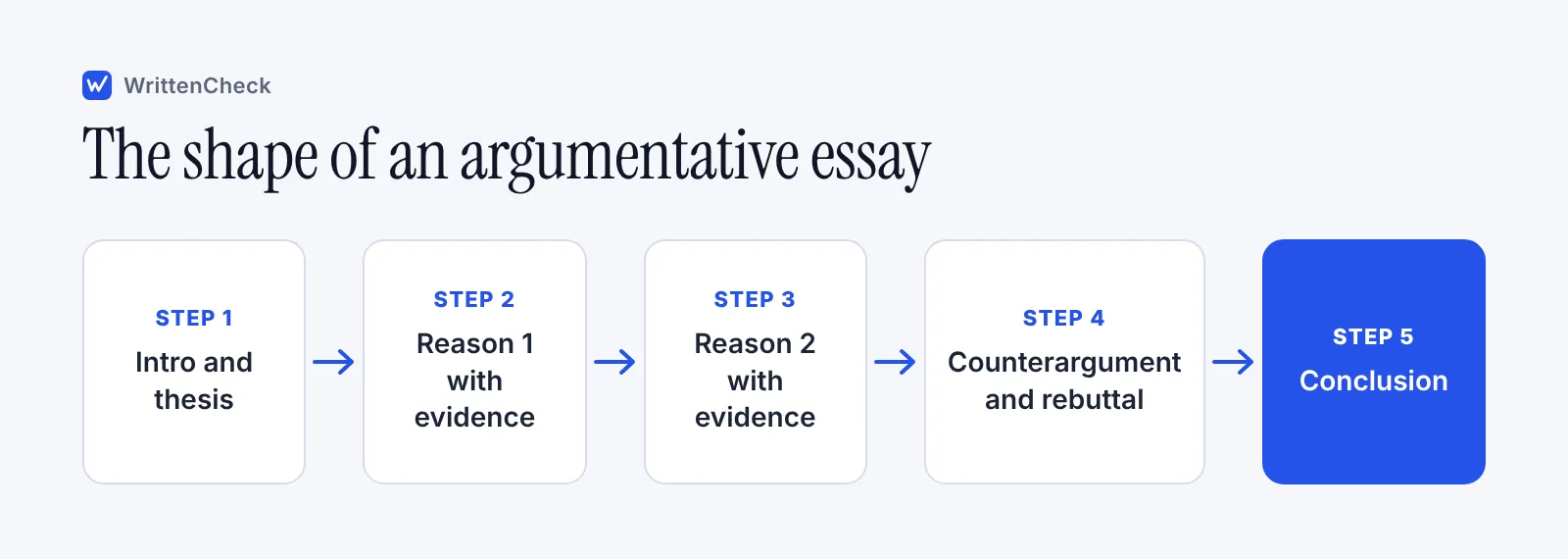
An argumentative essay has an introduction that ends on a thesis, body paragraphs that each prove one reason, at least one paragraph that handles the other side, and a conclusion. Purdue OWL lists the same core parts. Those are a clear thesis in the first paragraph, transitions, focused body paragraphs, evidential support and a conclusion.
Here's what each part has to do.
Introduction. Give context, explain why the issue matters and end on your thesis. Purdue OWL says the thesis should appear in the first paragraph. For help with that sentence, see our guide on how to write a thesis statement.
Body paragraphs. One reason per paragraph. The University of Michigan's Sweetland Center for Writing describes a useful pattern called MEAT. That stands for a Main idea in the topic sentence, Evidence, Analysis that ties the evidence back to the point, and a Transition.
Counterargument and rebuttal. Purdue OWL says argumentative essays should give one or two paragraphs to opposing views. A counterargument is the strongest reasonable objection to your thesis. A rebuttal is your answer to it.
Conclusion. Purdue OWL says the conclusion shouldn't just restate the thesis or bring in new evidence. It should pull your points together and show why they matter.
Argumentative essay outline template
Copy this template and replace each bracket. It follows the five-paragraph model Purdue OWL describes as common, with the counterargument given its own paragraph. For a longer essay, add more reason paragraphs.
Introduction
Hook: [a specific fact, case or question about the issue]
Context: [the two or three things a reader needs to know]
Thesis: [your position] because [reason 1] and [reason 2].
Body paragraph 1, reason 1
Topic sentence: [reason 1 stated as a claim]
Evidence: [source, data, example or quote]
Analysis: [how this evidence proves reason 1]
Body paragraph 2, reason 2
Topic sentence: [reason 2 stated as a claim]
Evidence: [source, data, example or quote]
Analysis: [how this evidence proves reason 2]
Counterargument and rebuttal
Counterargument: [the strongest opposing view, stated fairly]
Concession: [what's true about it]
Rebuttal: [why your position still holds, with evidence]
Conclusion
Restate the thesis in new words
Show how the reasons fit together
So what: [why it matters, or what the reader should do]
How to write an argumentative essay outline step by step
Build the outline from the thesis outward. Purdue OWL's outlining advice starts with your purpose, audience and thesis, then moves to brainstorming, grouping, ordering and labeling.
Write a working thesis. One sentence, one position, two or three reasons.
List every reason and piece of evidence you have. Don't sort yet.
Group them. Put evidence under the reason it supports. Drop reasons with no evidence.
Pick your strongest two or three reasons. Each one becomes a body paragraph.
Find the best counterargument. UNC suggests researching opposing views, talking to others or imagining objections.
Plan the rebuttal. Decide whether you'll concede part of the objection, show a flaw in it, or narrow your thesis.
Order the paragraphs. Try your strongest reason first or last, and read the order aloud to see which feels more convincing. Place the counterargument where a reader would naturally object.
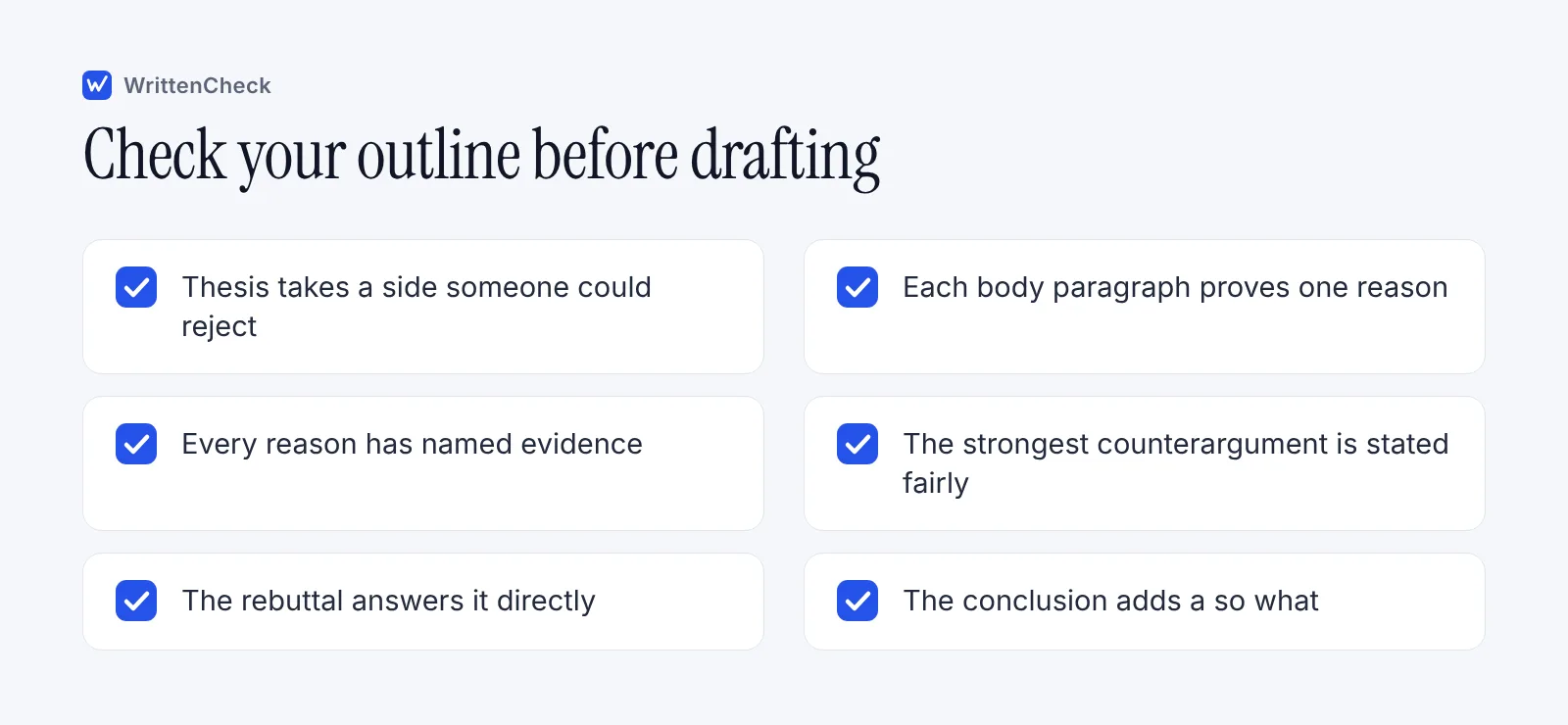
Check every line. Use the checklist below.
What does a finished argumentative essay outline look like?
Here's an example outline written for this guide. The bracketed evidence lines show the kind of source you'd look for. They aren't real data.
Topic: Should a mid-sized city make its buses free?
Introduction
Hook: [one rider's daily trip, from an interview or local news report]
Context: The city is debating a fare-free pilot. Fares cover part of the transit budget.
Thesis: The city should run a two-year fare-free bus pilot, because free fares would help low-income workers reach jobs and would speed up boarding on crowded routes.
Reason 1, access to jobs
Topic sentence: Fares are a real barrier for the workers who most depend on buses.
Evidence: [rider survey from the city transit agency]
Analysis: Removing the fare removes a daily cost for the people with the least room in their budgets.
Reason 2, faster service
Topic sentence: Free fares would make buses faster for everyone.
Evidence: [boarding time data from the agency or a fare-free city's report]
Analysis: No fare collection means shorter stops on the busiest routes.
Counterargument and rebuttal
Counterargument: The city would lose fare revenue and might have to cut service.
Concession: That's a real cost, and cutting routes would hurt the same riders.
Rebuttal: A time-limited pilot with set funding tests the idea before any permanent change, and the city can measure ridership before deciding.
Conclusion
Restate: A pilot lets the city test free fares without betting the budget.
So what: The result will show whether cheaper transit or more frequent service helps riders more.
Notice how the rebuttal narrows the thesis to a pilot. Harvard's Writing Center suggests exactly this move when an objection is strong. Refine your position instead of pretending the objection doesn't exist.
Which outline structure should you use, Classical, Toulmin or Rogerian?
Use the Classical structure for most school essays, the Toulmin structure when your logic needs to be airtight, and the Rogerian structure when your reader already disagrees with you. Purdue OWL describes all three.
Structure | Parts in order | Best for |
|---|---|---|
Classical (Aristotle, Cicero, Quintilian) | Introduction, background, proposition, proof, refutation, conclusion | Most school essays and debates |
Toulmin (Stephen Toulmin, 1958) | Claim, data, warrant, backing, counterclaim, rebuttal | Arguments where the link between evidence and claim is in doubt |
Rogerian (after Carl Rogers) | Introduction, opposing view, statement of validity, your position, contexts, benefits | Divided or hostile readers |
What do the Toulmin terms mean?
Purdue OWL defines the six Toulmin parts this way. The claim is your main argument. The grounds are the evidence. The warrant is the assumption that links the grounds to the claim. The backing supports the warrant. The qualifier shows the claim may not hold in every case, with words like "some" or "many." The rebuttal acknowledges another valid view. Purdue notes that the first three are essential to any Toulmin argument.
How do you write a counterargument and rebuttal?
State the strongest opposing view fairly, admit what's true about it, then explain why your position still holds. Harvard's Writing Center describes this as a turn to the other side and a return to your own. Words like "but" and "however" signal the turn back, and "nevertheless" or "still" show your argument stands.
Here's an example, written for this guide, using the bus fare topic.
Weak: Some people say free buses cost too much, but they're wrong because public transit is important.
Strong: Critics are right that free fares would cut transit revenue, and a cash-strapped city can't ignore that. Still, a two-year pilot with set funding caps the risk, and the ridership data it produces would show whether the cost is worth paying.
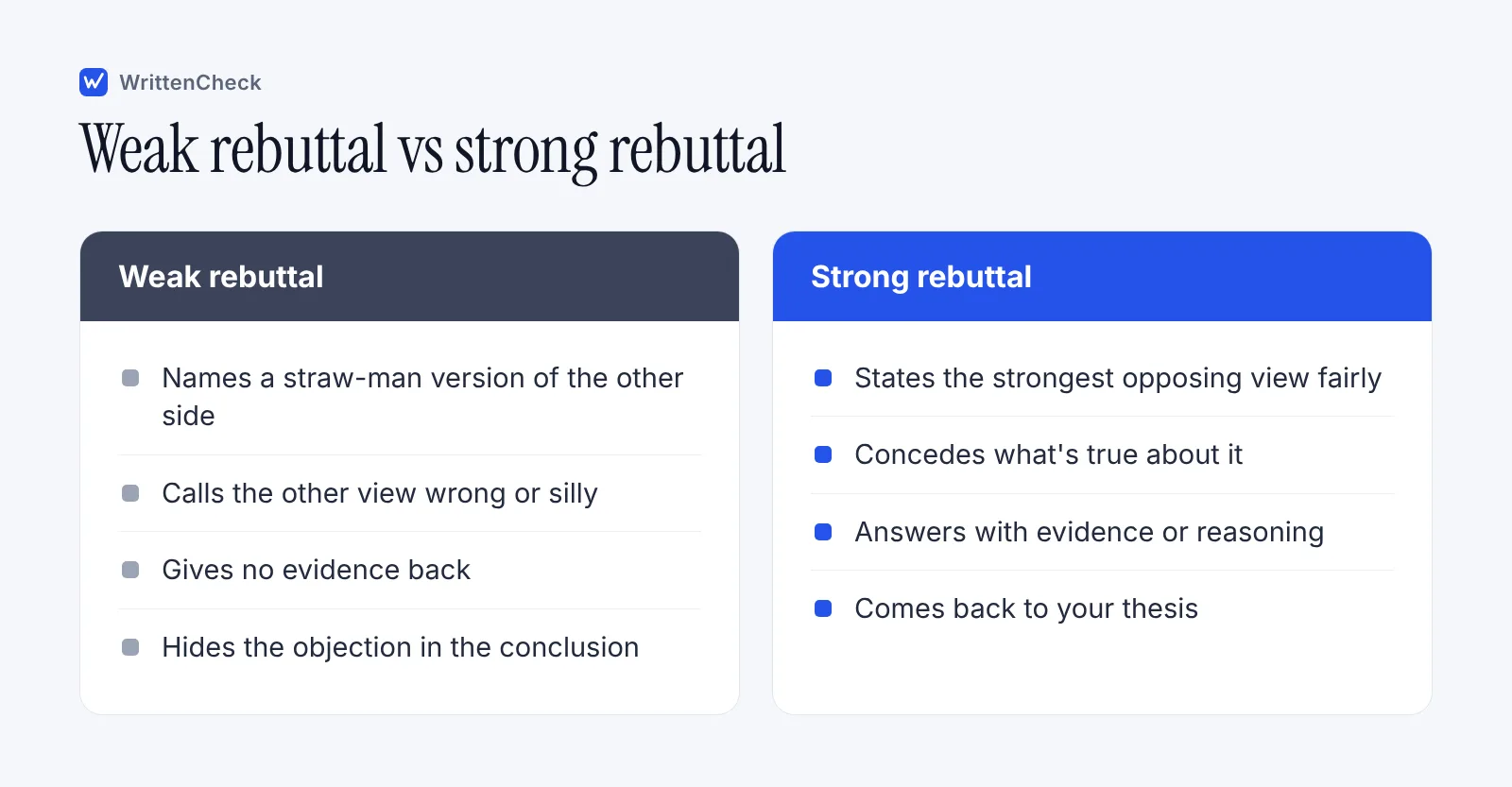
The weak version attacks a thin version of the objection and answers with a vague value. The strong version concedes a real cost and then answers it with a specific plan.
Is the extra paragraph worth it? One large review of the research suggests it is. In a 1999 meta-analysis, communication researcher Daniel O'Keefe reviewed studies of one-sided and two-sided persuasive messages. Two-sided messages that refuted the other side were more credible and more persuasive on topics outside advertising. Two-sided messages that only mentioned the other side, without answering it, were no more credible on those topics and were actually less persuasive than one-sided ones.
So mention the objection and answer it. UNC adds a useful limit. Treat one or two serious counterarguments in depth instead of many in passing.
What mistakes weaken an argumentative essay outline?
Most outline problems show up as gaps you can see on one page. Fix these before you draft.
A thesis nobody would dispute. If no reasonable reader could disagree, you have a report.
Reasons that overlap. "It's cheaper" and "it saves money" are one reason. Merge them.
Evidence lines left blank. Every reason needs a named source, example or data point.
A straw-man counterargument. UNC warns against caricaturing the other side.
Evidence from the wrong field. UNC notes that evidence which convinces an English instructor may not convince a sociology instructor.
No transitions planned. Purdue OWL calls transitions the mortar of the essay. Our list of transition words can help you plan the links between paragraphs.
How do you turn the outline into a draft?
Write one body paragraph at a time, starting with whichever reason you know best. Turn each outline line into one or two sentences, then add your analysis, because that's the part an outline can't do for you.
Check your length target as you go. A five-part outline for a short essay often means one paragraph per part. For longer assignments, see how long an essay should be and expand each reason into two paragraphs.
If your course allows AI tools for feedback, one honest use is to paste in your outline and ask for the strongest objection to your thesis. Then write the rebuttal yourself. Check your course policy first and disclose the help if it's required.
When the draft is done, read it against the outline. Did every planned reason make it in? Did the rebuttal come back to the thesis? You can also paste the draft into our free AI detector to see which sentences read as most generic, then add your own evidence and wording there.
Frequently asked questions
How many paragraphs are in an argumentative essay?
A short argumentative essay often has five paragraphs, which are an introduction, two or three reason paragraphs, a counterargument paragraph and a conclusion. Purdue OWL presents the five-paragraph model as common but not the only option. Longer essays on complex issues need more paragraphs, more sources and a more flexible structure. Let your assignment length and the number of reasons decide.
Where does the counterargument go in an argumentative essay?
It often goes just before the conclusion, but other spots work. Harvard's Writing Center lists options such as after the introduction, before your thesis if you're responding to someone else's argument, or wherever a reader would naturally object. It warns against putting it in the conclusion, where there's no room to answer it. Choose the spot where the objection would come up anyway.
What is the difference between a counterargument and a rebuttal?
A counterargument is the opposing view, the strongest reason a thoughtful reader might reject your thesis. A rebuttal is your response to it. In the rebuttal you might concede part of the objection, show a flaw in its reasoning, or narrow your claim. Toulmin's model uses the terms counterclaim and rebuttal for the same pair, as Purdue OWL explains.
Should an argumentative essay outline use full sentences?
Use full sentences for the thesis and each topic sentence, and short notes for evidence and analysis. Full topic sentences make you commit to a claim, which shows weak spots early. Notes for evidence keep the outline short enough to scan on one page. If your teacher asks for a formal outline, follow their format instead, since some require full sentences throughout.
What is the difference between an argumentative and a persuasive essay?
The two overlap, and teachers use the terms in different ways. Both try to convince the reader. Purdue OWL describes the argumentative essay as one built on research and detailed, current evidence, with opposing views addressed in their own paragraphs. If your assignment says "persuasive," ask whether research and a counterargument are expected. If it says "argumentative," assume they are and plan the outline around them.
Can I use AI to write my argumentative essay outline?
Follow your course policy first. Some courses allow AI for brainstorming or feedback and some don't allow it at all. Even where it's allowed, an outline you build yourself shows you whether you understand the argument, and that's the point of the exercise. A fair use is asking an AI tool to raise objections to your own thesis, then answering them in your own words and disclosing the help if required.
Sources
Argumentative Essays, Purdue Online Writing Lab, accessed October 2026
Organizing Your Argument, Purdue Online Writing Lab, accessed October 2026
Toulmin Argument, Purdue Online Writing Lab, accessed October 2026
How to Outline, Purdue Online Writing Lab, accessed October 2026
Argument, The Writing Center, University of North Carolina at Chapel Hill, last modified March 2026
Counterargument, Harvard College Writing Center, accessed October 2026
How Do I Write an Intro, Conclusion, and Body Paragraph?, Sweetland Center for Writing, University of Michigan, accessed October 2026
How to Handle Opposing Arguments in Persuasive Messages: A Meta-Analytic Review of the Effects of One-Sided and Two-Sided Messages, Daniel J. O'Keefe, Annals of the International Communication Association Volume 22, 1999


Comments