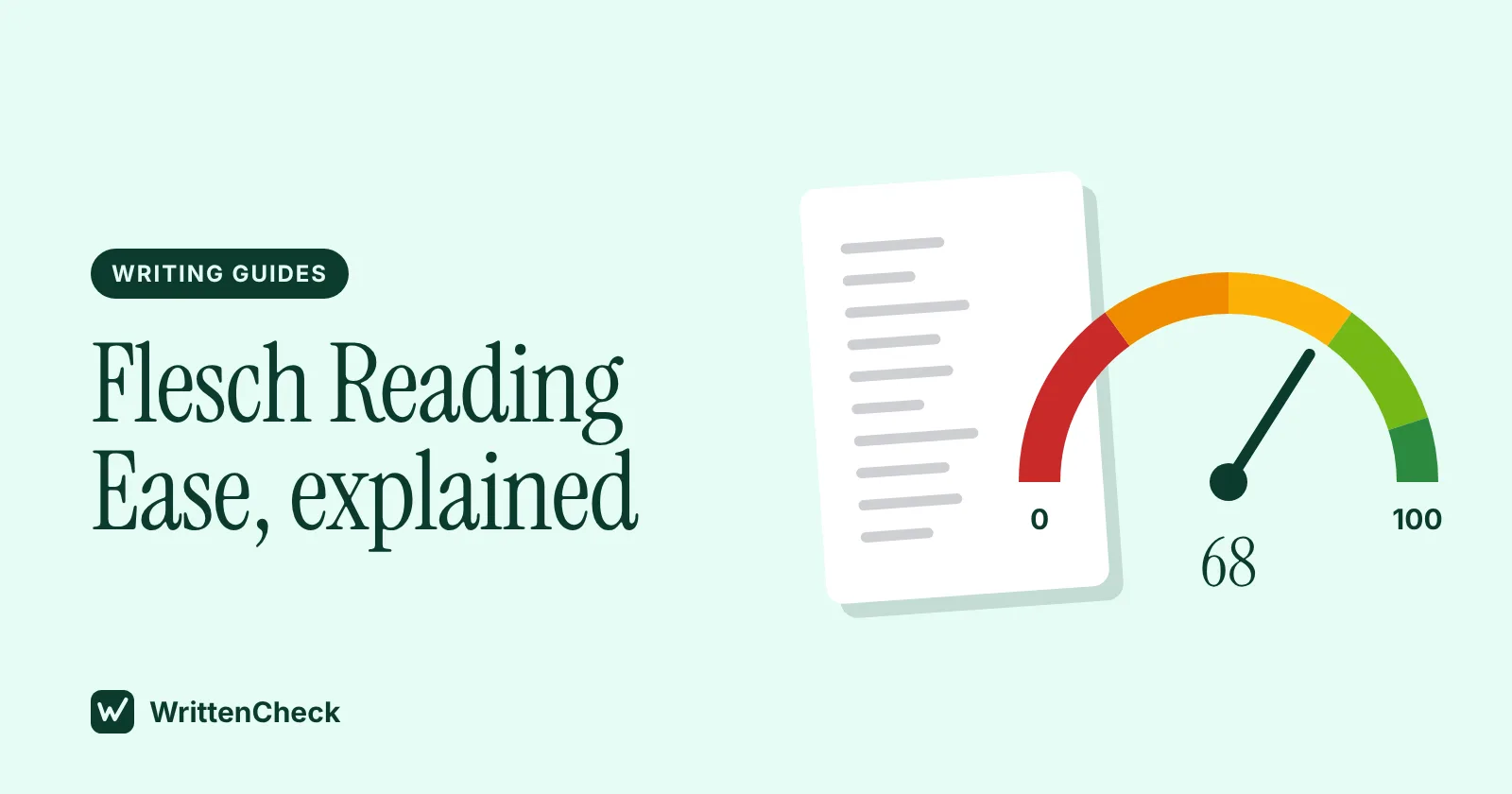
The Flesch Reading Ease score rates how easy a text is to read on a scale that usually runs from 0 to 100. Higher is easier. It uses only two things, how long your sentences are and how many syllables your words have. A score of 60 to 70 is roughly plain English for adults.
The formula is from 1948, and it's still built into word processors and written into state insurance laws. That makes it worth understanding properly, including the parts people get wrong.
Below you'll find the exact formula, the score chart, a calculation done by hand on a short example, the related Flesch-Kincaid grade level, and practical ways to raise a low score. We'll also cover what a readability score can't measure.
What is the Flesch Reading Ease score?
The Flesch Reading Ease score is a readability formula created by Rudolf Flesch and published in the Journal of Applied Psychology in 1948. It estimates how hard a text is to read from two measures, the average number of words per sentence and the average number of syllables per word. Scores run from about 0 (very difficult) to 100 (very easy). Most adult readers handle 60 to 70 comfortably.
A readability formula is any equation that predicts reading difficulty from countable features of a text. Flesch's is one of the oldest still in wide use. Florida law, for example, requires many insurance policies to reach a score of at least 45, and spells out the formula in the statute itself.
What is the Flesch Reading Ease formula?
The formula subtracts two penalties from a fixed starting number. Long sentences cost you points, and long words cost you a lot more.
Flesch Reading Ease = 206.835 - (1.015 × ASL) - (84.6 × ASW)
ASL is average sentence length, the number of words divided by the number of sentences.
ASW is average syllables per word, the number of syllables divided by the number of words.
This is the version given in William DuBay's 2004 review, The Principles of Readability, and in Flesch's own book How to Write Plain English, which describes it in words. Multiply the average sentence length by 1.015, multiply the average word length in syllables by 84.6, add the two, and subtract the total from 206.835.
Notice the size of the two weights. Adding one word to your average sentence costs about 1 point. Adding a tenth of a syllable to your average word costs about 8.5 points. Word length matters far more than sentence length in this formula.
How do you count words, sentences and syllables?
Counting rules change the result, so it helps to follow Flesch's.
Words. Count contractions, hyphenated words, abbreviations, numbers and symbols as one word each. "Wouldn't", "full-length", "TV" and "$15" are each one word.
Syllables. Count syllables the way the word is pronounced. Count numbers, symbols and abbreviations as one syllable.
Sentences. Florida's statute counts any unit ending in a period, semicolon or colon as a sentence, and leaves out headings and captions.
How do you calculate Flesch Reading Ease? A worked example
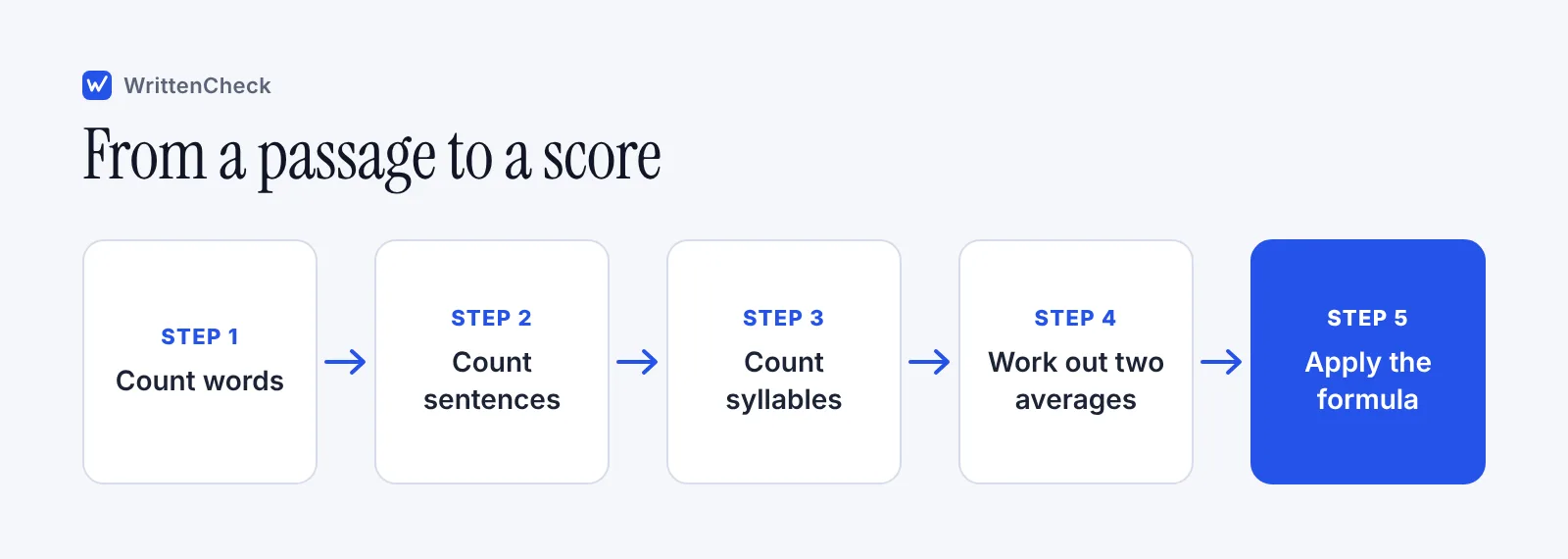
You calculate it by counting words, sentences and syllables, working out two averages, and putting them into the formula. Here's the full process on a short example passage written for this guide.
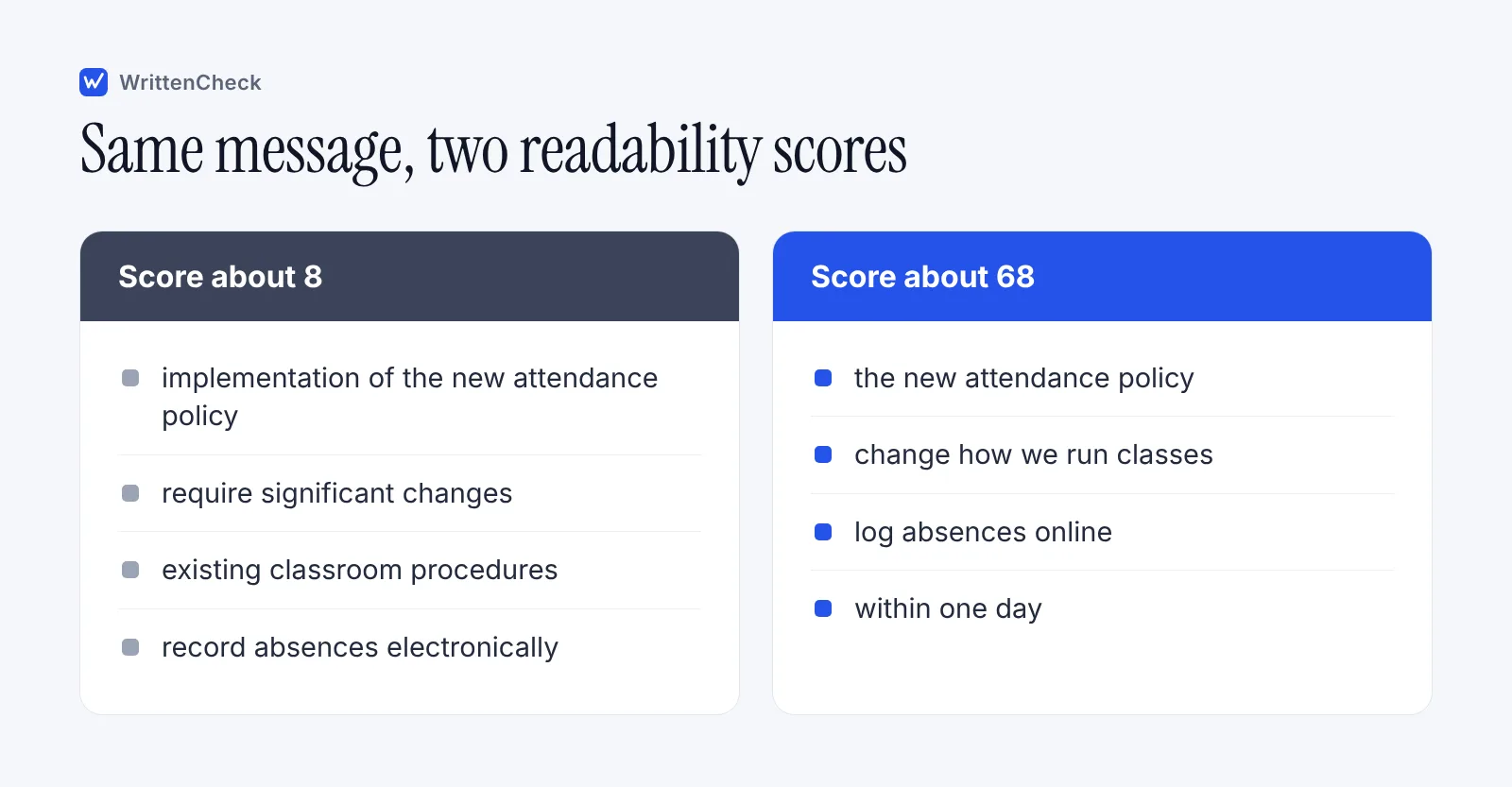
The implementation of the new attendance policy will require significant changes to existing classroom procedures. Teachers are expected to record absences electronically within one day.
Count the words. The first sentence has 15 words and the second has 10, so 25 words.
Count the sentences. There are 2.
Count the syllables. The first sentence has 33 ("im-ple-men-ta-tion" alone has 5). The second has 22, counting "e-lec-tron-i-cal-ly" as 6. That's 55 syllables.
Work out the averages. ASL = 25 ÷ 2 = 12.5. ASW = 55 ÷ 25 = 2.2.
Apply the formula. 1.015 × 12.5 = 12.69. 84.6 × 2.2 = 186.12. Then 206.835 - 12.69 - 186.12 = 8.0.
Flesch's rule is to use the shorter pronunciation when a word has two, and plenty of people say "electronically" in 5 syllables. Count it that way and the score rises to about 11. That one syllable is a small preview of why tools disagree.
Either way, the passage sits in the "very difficult" band. The sentences aren't long, only 12.5 words on average. The long Latin-based words are doing the damage.
Now here's a rewrite of the same example that keeps the meaning.
The new attendance policy will change how we run classes. Teachers need to log absences online within one day.
19 words, 2 sentences, 29 syllables.
ASL = 9.5. ASW = 29 ÷ 19 = 1.53.
206.835 - (1.015 × 9.5) - (84.6 × 1.526) = 206.835 - 9.64 - 129.13 = 68.1.
The score jumped by 60 points. Average sentence length dropped by only 3 words. Most of the gain came from swapping "implementation", "significant" and "electronically" for shorter words.
What is a good Flesch Reading Ease score?
For most writing aimed at the general public, 60 or above is a good Flesch Reading Ease score. Flesch called 60 the minimum for plain English, which works out to about 20 words per sentence and 1.5 syllables per word. Harvard University's digital accessibility guidance suggests aiming for around 60 to 70 for adult readers.
Here's the score chart. Style labels and percentages come from Flesch's 1949 table, as reprinted by DuBay.
Score | Style | Estimated school level | US adults who could read it (Flesch, 1949) |
|---|---|---|---|
90 to 100 | Very easy | 5th grade | 93% |
80 to 90 | Easy | 6th grade | 91% |
70 to 80 | Fairly easy | 7th grade | 88% |
60 to 70 | Standard | 8th and 9th grade | 83% |
50 to 60 | Fairly difficult | 10th to 12th grade | 54% |
30 to 50 | Difficult | 13th to 16th grade (college) | 33% |
0 to 30 | Very difficult | College graduate | 4.5% |
The percentages describe US adults in 1949, so treat them as history. The bands are still the ones tools use today.
Flesch also gave sample scores for well-known publications in How to Write Plain English. Reader's Digest scored about 65, Time about 52 and the Harvard Law Review about 32.
The score can go below zero. In a 2017 study in eLife, Pontus Plavén-Sigray and colleagues analyzed more than 700,000 scientific abstracts published between 1881 and 2015. In 1960, 14% of the abstracts scored below 0. By 2015, 22% did.
What score should students aim for?
Don't aim for a number. A history essay with names, dates and technical terms will score lower than a short story, and that's fine. Use the score to spot sentences that are harder than they need to be, then fix those sentences.
What is the Flesch-Kincaid grade level?
The Flesch-Kincaid grade level is a version of Flesch's formula that gives a US school grade instead of a 0 to 100 score. It was published in 1975 by J. Peter Kincaid and colleagues in a report for the US Navy, based on reading tests with 531 Navy enlisted personnel.
Flesch-Kincaid grade level = (0.39 × ASL) + (11.8 × ASW) - 15.59
It uses the same two inputs. A result of 8.0 means a typical US 8th grader should be able to read the text.
Here's the worked example again.
Version | ASL | ASW | Flesch Reading Ease | Flesch-Kincaid grade |
|---|---|---|---|---|
Original | 12.5 | 2.2 | 8.0 | 15.2 |
Rewrite | 9.5 | 1.53 | 68.1 | 6.1 |
For the original, 0.39 × 12.5 = 4.875 and 11.8 × 2.2 = 25.96, so 4.875 + 25.96 - 15.59 = 15.2 (15.245 before rounding). For the rewrite, 3.71 + 18.01 - 15.59 = 6.1.
The two scores move in opposite directions. Higher Reading Ease is easier. A higher grade level is harder. People mix these up all the time.
Why do readability tools give different scores?
Readability tools give different scores because they count syllables, words and sentences in different ways. Software guesses syllables from spelling, and it handles numbers, abbreviations, bullet points and headings in its own way. Those small choices change the averages, and the formula magnifies them.
This has been measured. In a 2016 study in the Online Journal for Workforce Education and Development, Emily Neuhoff and colleagues found that hand-calculated Flesch-Kincaid grades for test questions averaged 3.04, while a popular word processor gave the same texts an average of 4.31. One version of a certification exam came out at grade 9.6 or 5.8, depending only on how the text had been typed and formatted.
So compare scores only from the same tool, on the same kind of text. Don't treat a difference of a few points as meaningful.
How can you improve your readability score?
You improve a Flesch Reading Ease score by using shorter words and shorter sentences. Word length has the bigger effect, so start there.
Swap long words for short ones. "Use" for "utilize", "help" for "facilitate", "start" for "commence". Each swap cuts syllables.
Turn nouns back into verbs. "Make a decision" becomes "decide". "The implementation of" becomes "putting in place" or just a verb.
Split sentences that hold two ideas. If a sentence has "and" joining two full thoughts, try a period.
Cut empty phrases. "Due to the fact that" is five words. "Because" is one word with two syllables.
Keep needed technical terms, and explain them once. Readers need "photosynthesis" in a biology essay. Don't swap it for something vague.
Vary sentence length. Short sentences help, but a page of five-word sentences is tiring to read.
Transitions matter too. Plain connectors like "but" and "so" score better than "nevertheless" and "consequently". Our guide to transition words sorts them by purpose, with plain options in each row. Many of the long words that drag scores down also show up on our list of AI words to avoid.
What doesn't a readability score measure?
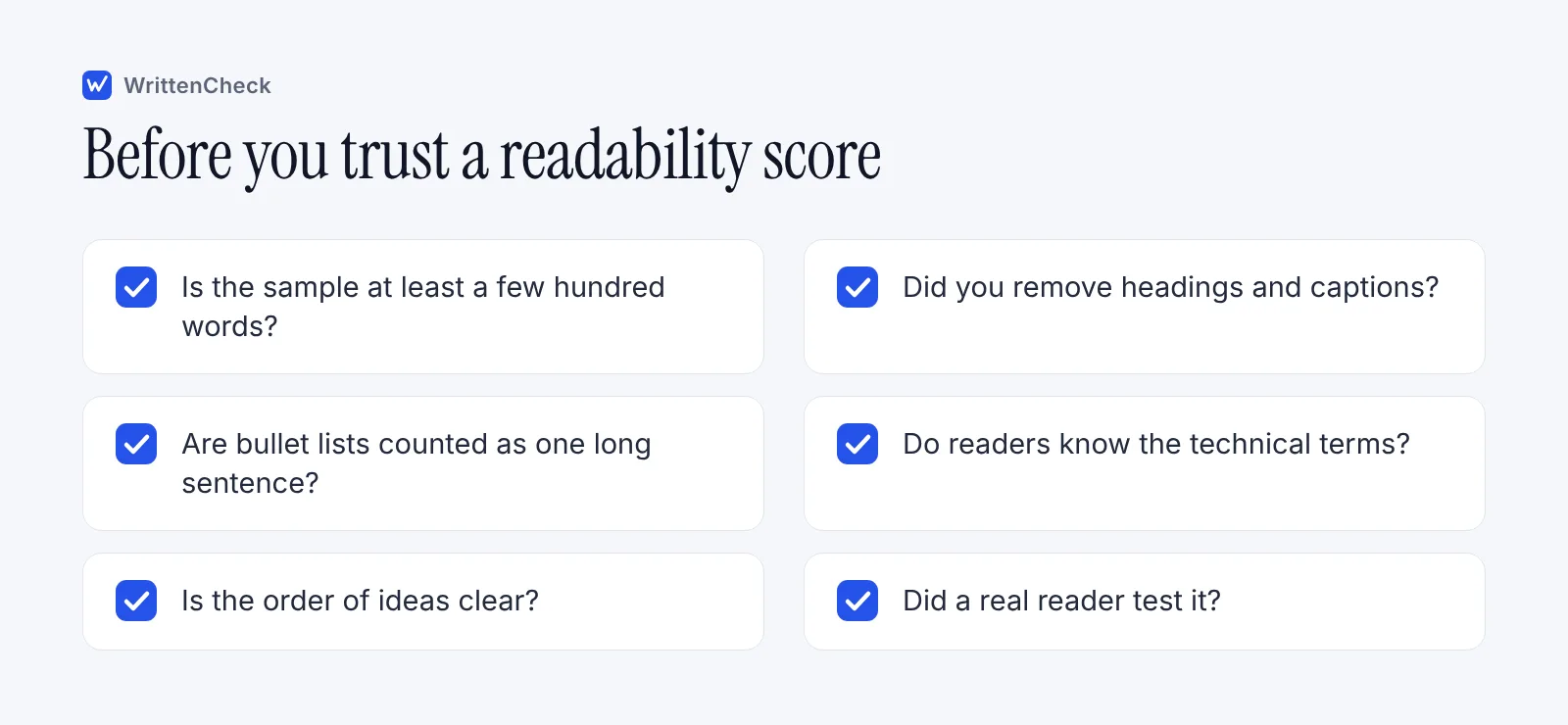
A readability score measures length. It doesn't measure meaning, accuracy, order of ideas, tone or whether readers already know the terms. "Dog bites man" and "Man bites dog" score the same. So does a clear paragraph shuffled into random order.
Experts on plain language have said this for decades. DuBay reports that in 1935 the researchers Gray and Leary listed 228 elements that affect readability, and found they "could not measure content, format, or organization statistically." In a 2022 article for the Government of Canada's Language Portal, editor Gael Spivak sums up research showing that rewriting just to lower the grade level doesn't by itself improve comprehension. Formulas can even punish bullet lists, which often help readers, because a list with no periods gets counted as one long sentence.
The US Indian Health Service plain-language guidance agrees. It says formulas "should not be your only evaluation tool." The best test is a real reader.
Does a readability score show if AI wrote a text?
No. A Flesch score only counts sentence and word length. AI detectors look at different signals, such as how predictable each word is, which we explain in how AI detectors work. A text can score 70 for readability whether a person or an AI writing tool wrote it.
If you want to check both, run your draft through a readability tool for sentence and word length, then paste it into our free AI detector to see which sentences read most like AI. Then fix the sentences each one points to, starting with the longest words.
Frequently asked questions
Is a higher Flesch Reading Ease score better?
A higher score means easier to read, which is usually better for the general public, websites, instructions and forms. It isn't always better for every text. A research paper for specialists will score lower because it needs technical terms. Aim for the lowest difficulty your topic allows, and use the score to find sentences that are harder than they need to be.
What is the difference between Flesch Reading Ease and Flesch-Kincaid?
Both use average sentence length and average syllables per word. Flesch Reading Ease gives a score from about 0 to 100, where higher means easier. The Flesch-Kincaid grade level, from a 1975 US Navy report, turns the same counts into a US school grade, where higher means harder. A Reading Ease of 60 to 70 lines up with roughly grades 8 to 9.
Can a Flesch Reading Ease score be negative or over 100?
Yes. The scale is usually described as 0 to 100, but nothing in the formula stops it at either end. Very long sentences full of long words can push it below zero, which happens with some academic abstracts. Very short sentences of one-syllable words can push it over 100. "The cat sat on the mat" works out to about 116.
How many words do I need for an accurate readability score?
More is better. A score from one or two sentences can swing wildly when you change one word, as our worked example shows. Use at least a few hundred words, or several samples from different parts of a long document. Remove headings, captions, tables and reference lists first, since they distort the sentence count.
What is a good readability score for a college essay?
There's no official target. Flesch's chart puts college-level text at 30 to 50, so a score in that range is normal for an academic essay with subject terms. Use the score as a prompt to fix single sentences that are long and packed with long words. Clear organization, strong evidence and accurate wording matter far more to your grade than any readability score.
Do headings and bullet lists affect the score?
Yes, and often in a misleading way. A formula decides where sentences end by looking for periods and similar marks. A bullet list with no periods can be counted as one huge sentence, which drags the score down even though lists usually help readers. Florida's insurance statute leaves headings and captions out of the count. Do the same, and check how your tool treats lists.
Sources
A new readability yardstick, Rudolf Flesch, Journal of Applied Psychology 32(3), June 1948 (bibliographic record)
How to Write Plain English, chapter 2, Rudolf Flesch, excerpt hosted by Appalachian State University, accessed October 2026
The Principles of Readability, William H. DuBay, Impact Information (ERIC), 2004
Derivation of New Readability Formulas for Navy Enlisted Personnel, Kincaid, Fishburne, Rogers and Chissom, Naval Technical Training Command Research Branch Report 8-75, 1975
Florida Statutes 627.4145, Readable language in insurance policies, Florida Legislature, 2025
Technique: Writing readable content, Harvard University Digital Accessibility, accessed October 2026
The readability of scientific texts is decreasing over time, Plavén-Sigray, Matheson, Schiffler and Thompson, eLife, September 2017
Flesch-Kincaid Reading Grade Level Re-examined, Neuhoff, Feeser, Sutherland and Hovatter, Online Journal for Workforce Education and Development, 2016
Readability formulas, programs and tools: Do they work for plain language?, Gael Spivak, Language Portal of Canada, July 2022
Measuring Readability, Indian Health Service, US Department of Health and Human Services, accessed October 2026


Comments