Most weak conclusions have the same problem. They repeat the introduction, a little shorter, and stop. The reader learns nothing they didn't know a page ago.
This guide shows you how to write a conclusion that earns its place. You'll get a six-step method, a copyable template, conclusion examples in weak and strong versions, and a clear list of what not to put in a conclusion.
The rules come from university writing centers at UNC Chapel Hill, Harvard, Virginia, Toronto and Michigan. They agree on more than you might expect, and we flag where they differ.
How to write a conclusion
To write a conclusion, restate your thesis in fresh words, then show how your main points fit together into one idea. Next, explain why that idea matters, to your reader, your field or a wider question. End with a final thought that looks forward, such as a question, an action or a wider meaning. Keep evidence and new arguments in the body, and keep the paragraph short.
What should a conclusion paragraph do?
A conclusion paragraph should close the argument and show its significance. Harvard's Writing Center says it should bring the reader back to the thesis, remind them of the stakes and leave them with something new to think about.
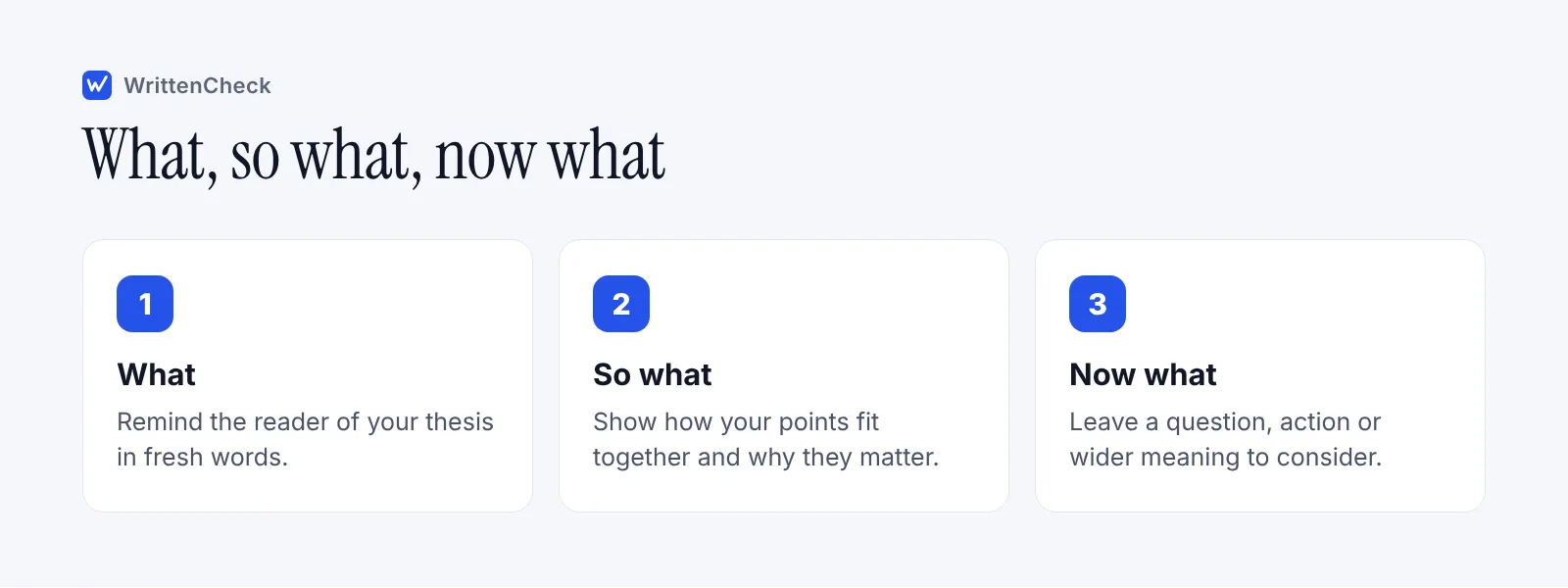
Harvard breaks that into three moves.
What. Remind the reader of your thesis and how far the argument has come.
So what. Show why the argument matters, in a wider context.
Now what. Leave the reader with a new understanding, an open question or a possible action. Harvard suggests asking what readers can now understand that they couldn't before.
The Sweetland Center for Writing at the University of Michigan gives a shorter version. A conclusion usually restates the main points in different language, explains their significance, or does both.
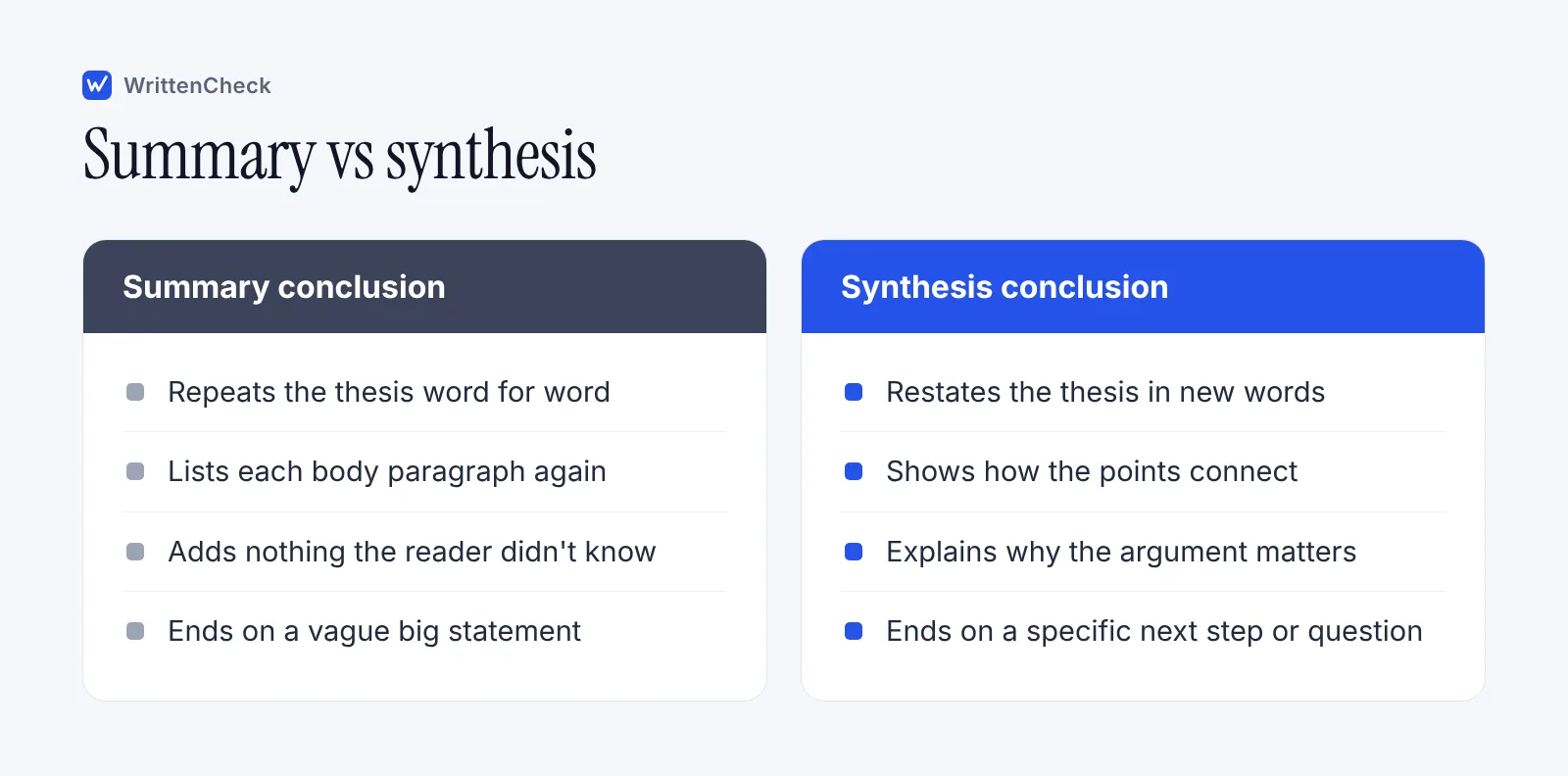
UNC's key rule is to synthesize instead of only summarizing. A summary lists what you said. A synthesis shows the reader how your points and examples fit together.
How to write a conclusion step by step
Write the conclusion after the body is finished, so you're summing up the argument you actually made. These steps work for most school and college essays.
Reread your thesis and topic sentences. Together they're your argument in miniature.
Restate the thesis in new words. Change the wording and, if you can, sharpen it with what the body proved.
Name the link between your points. Ask what your two or three reasons have in common. That shared idea is your synthesis.
Play the "So what?" game. UNC suggests asking "So what?" or "Why should anyone care?" after each sentence until you reach a real answer.
Choose a closing move. Use one strategy from the table below, such as a call to action, a question or a return to your opening.
Cut anything new. If a sentence brings in fresh evidence or a new main point, move it to the body or delete it.
Conclusion paragraph template
Copy this, fill the brackets, then rewrite it in your own voice so it doesn't read like a form.
[Thesis restated in new words]. [How reason 1 and reason 2 connect into one larger point]. [Why that matters, to whom, or in what wider context]. [A final question, action or image that looks forward].
For a longer paper, give each bracket two or three sentences. Toronto's writing advice says one well-developed paragraph suits most essays, and that a two- or three-paragraph conclusion is sometimes appropriate.
What do weak and strong conclusion examples look like?
A weak conclusion repeats. A strong one connects and looks forward. The conclusion examples below are written for this guide, each for a different kind of essay.
Argumentative essay
Thesis: High schools should ban phones during class but allow them at lunch.
Weak: To sum up, phones should be banned during class but allowed at lunch. Phones are distracting in class. Students also need to contact their families. That is why schools should have this rule.
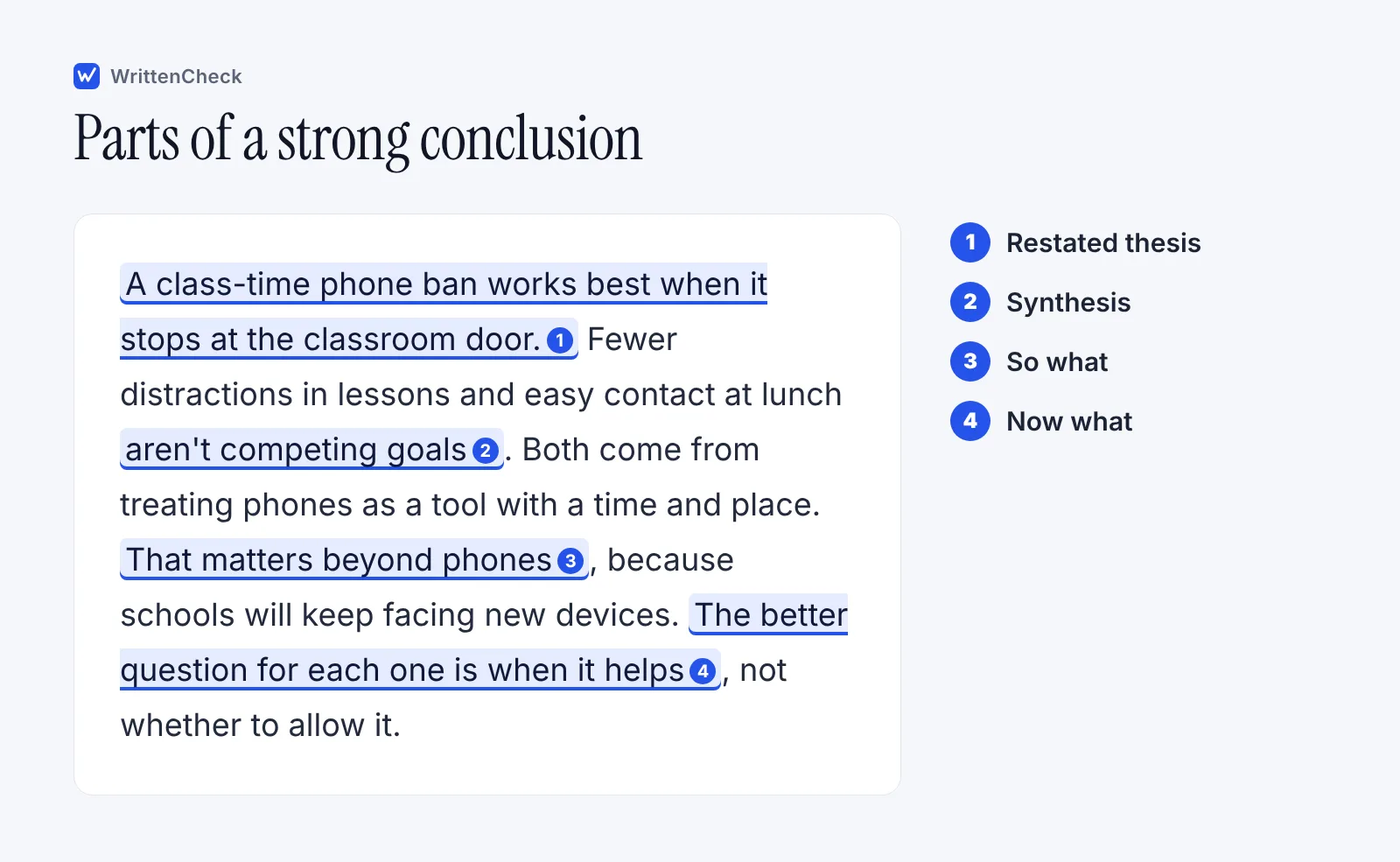
Strong: A class-time phone ban works best when it stops at the classroom door. Fewer distractions in lessons and easy contact at lunch aren't competing goals. Both come from treating phones as a tool with a time and place. That matters beyond phones, because schools will keep facing new devices. The better question for each one is when it helps, not whether to allow it.
The weak version repeats the thesis and lists both reasons again. The strong version shows what the two reasons share and turns that into a wider point.
Literary analysis
Thesis: Victor Frankenstein abandons his creature because he can't face the responsibility of what he made.
Weak: Overall, Frankenstein is a novel with many themes. Victor made a lot of mistakes. Readers can learn many lessons from this classic story.
Strong: Victor's two years of work and single minute of panic tell the whole story in small. He wanted to create life without having to care for it. By the end, the creature's demand for a companion reads less like a threat than a request Victor should have heard at the start.
The weak version could end any essay on any novel. The strong version returns to the hook's detail, two years and one minute, and adds a final reading of the creature.
Research or policy paper
Thesis: The city should run a two-year fare-free bus pilot.
Weak: Free buses have many benefits and some drawbacks. More research is needed. Hopefully the city will make the right choice.
Strong: A two-year pilot lets the city test free fares without staking the whole transit budget on them. The ridership data it produces would settle a question the council has argued about for years. If the city wants that answer, the next step is to fund the pilot in next spring's budget.
"More research is needed" is a dead end unless you say which research. The strong version names the step and who takes it.
Which strategies can you use to end an essay?
Pick one closing strategy that fits your essay type and your thesis. Writing centers suggest several, and you don't need more than one in a single conclusion.
Strategy | What it does | Sentence starter | Best for |
|---|---|---|---|
Return to the opening | Brings back the hook's image or question with new meaning | "That opening scene looks different now..." | Personal, narrative, literary |
Broader implications | Connects your finding to a wider issue | "This matters beyond [topic] because..." | Analytical, research |
Call to action | Says what someone should do next | "The next step is for [group] to..." | Argumentative, policy |
Open question | Leaves a question your essay makes newly possible | "If [finding] is true, then..." | Analytical, literary |
Future research | Names what still needs study | "A useful next study would test..." | Research papers |
Warning | Shows what happens if nothing changes | "Without [change], [consequence]..." | Argumentative, policy |
UNC lists returning to the introduction, proposing action or questions, and pointing to broader implications. The University of Virginia Writing Center adds raising questions, expanding the scope and calling to action. Toronto's advice includes warning about consequences and suggesting further research.
If your essay opened with a strong hook, the first strategy is often the easiest. See how to write a hook for openings that set up a good ending.
What not to put in a conclusion
Leave out anything new, anything apologetic and anything that only repeats. UNC and Harvard agree on most of this list.
New evidence or a new main point. UNC says evidence belongs in the body, and Purdue OWL says a conclusion shouldn't introduce new material. A new idea at the end leaves the reader with something you haven't supported.
The thesis for the first time. UNC calls this the "Sherlock Holmes" conclusion, where the main claim only appears at the end.
A word-for-word repeat. UNC calls the brief restatement the "That's my story" conclusion. Harvard also warns against restating every point.
A stock announcement opener. UNC advises against openers like "In summary," which only announce that the essay is ending. Your reader can already see that.
Sentimental or sweeping claims. UNC's "America the Beautiful" conclusion swaps analysis for emotion. A line like "This shows that love conquers all" usually fits the essay's tone poorly.
A grab bag of leftover facts. UNC's fourth weak type throws in details that didn't fit elsewhere.
Apologies. Harvard advises against apologizing for what you left out.
A big counterargument. Harvard notes there's no room to answer it properly at the end.
Why do generic, AI-style conclusions fall flat?
Generic conclusions fall flat because they could end any essay. Lines like "Overall, this is a complex issue with many sides" or "Only time will tell" sound complete but commit to nothing. An AI writing tool that knows your topic but not your argument has little else to offer, so expect this kind of tidy, balanced ending if you ask one for a conclusion.
The fix is the same as for any weak ending. Name the specific link between your points and the specific reason it matters. Our list of AI words to avoid covers more of these stock phrases.
If your course allows AI for feedback, a fair use is to paste in your thesis and conclusion and ask whether the conclusion adds anything new. Write the revision yourself, and disclose the help if your course requires it.
How long should a conclusion be?
For most essays, one paragraph is enough. Toronto's writing advice says a single well-developed paragraph suits most essays, and two or three paragraphs can be right in some cases, such as a long paper. UVA's Writing Center adds that there's no rigid formula and fields differ, so check your assignment.
A useful check is proportion. If your conclusion is longer than your introduction, it probably repeats too much. If it's two sentences long in a ten-page paper, it probably skips the "so what." For more on how each part fits in an essay, see our guide to essay structure.
When the draft is done, read the introduction and conclusion back to back. They should sound like the same writer at two points in one argument. You can also paste the full essay into our free AI detector to see which sentences read as most generic, then rewrite those with your own specifics.
Frequently asked questions
What are the 3 parts of a conclusion?
A common way to frame them is what, so what and now what, the approach Harvard's Writing Center describes. First, restate your thesis in fresh words. Second, show why the argument matters by connecting your points. Third, leave the reader with a new question, action or wider meaning. Some writing centers describe it as restatement plus significance, which covers the same ground in two parts.
Can you start a conclusion with "In summary" or "To sum up"?
It's better not to. UNC's Writing Center advises against openers like "In summary," because they only announce the ending, and the reader can see the essay is ending already. Start instead with your restated thesis or with the idea that links your points. If your teacher requires a signal phrase, keep it short and follow it with a sentence that says something new.
Can you add new information in a conclusion?
Don't add new evidence or a new main point. UNC says evidence belongs in the body, and a new idea at the end leaves the reader with a claim you haven't supported. You can, however, widen the frame by pointing to implications, open questions or next steps. Those look forward from your argument without asking the reader to accept new, unproven material.
Should a conclusion restate the thesis?
Yes, but in new words and with more weight. The Michigan Sweetland Center says a conclusion usually restates main points using language different from the introduction. Toronto's writing advice warns that a conclusion is more than a re-statement of the thesis. So restate it briefly, then build on it by showing what the essay proved and why it matters.
How do you end an essay with a strong last sentence?
Make the last sentence specific and forward-looking. A strong closing line might name an action, raise a question the essay makes possible, or return to the image from your hook with new meaning. Avoid broad lines that could close any essay, such as "Only time will tell." Read the last sentence alone. If it makes sense without your essay, it's probably too general.
How is a research paper conclusion different from an essay conclusion?
A research paper conclusion usually summarizes the findings, explains their significance and points to limits or future research. An essay conclusion focuses more on the argument and its wider meaning. UNC suggests proposing questions for further study, and Toronto mentions future research for science and social science papers, which suits research papers well. Follow your field's style guide and your instructor's format for any required sections.
Sources
Conclusions, The Writing Center, University of North Carolina at Chapel Hill, last modified March 2026
Conclusions, Harvard College Writing Center, accessed October 2026
Strategies for Effective Conclusion Writing, Yvonne Nguyen, University of Virginia Writing Center, February 2019
Introductions and Conclusions, Leora Freedman and Jerry Plotnick, Writing Advice, University of Toronto, accessed October 2026
How Do I Write an Intro, Conclusion, and Body Paragraph?, Sweetland Center for Writing, University of Michigan, accessed October 2026
Argumentative Essays, Purdue Online Writing Lab, accessed October 2026


Comments