Transition words are the signposts of an essay. Words like "however", "because" and "for example" tell the reader how one idea connects to the next. Pick the right one and the paragraph reads smoothly. Pick the wrong one, or stack too many, and the writing gets stiff and confusing.
Plenty of lists online give you one long alphabetical run of words. That's not much help when you're stuck between two sentences. Below, the transition words list is sorted by purpose, so you can name the link first and then grab a word.
You'll also get before and after examples, the punctuation rules people get wrong, words to start a paragraph, and the habits that make writing sound formulaic.
What are transition words?
Transition words are words and phrases that show how two ideas relate. "However" signals contrast. "Because" signals a cause. "For example" signals that proof is coming. They work inside a sentence, between sentences and between paragraphs. The UNC Writing Center says transitions "tell readers what to do with the information you present to them." Without them, readers have to guess the logic.
Transitions come in three sizes.
Single words, such as "but", "so", "next" or "similarly".
Transitional phrases, such as "on the other hand", "as a result" or "in the same way".
Whole sentences that bridge two paragraphs, such as "That saving matters most to large families."
The UNC handout also makes a point that's easy to forget. Transitions can make good organization clearer, but they can't fix a paper whose ideas are in the wrong order. If a reader says your essay feels "jumpy", check the order of your points before you add any connecting words.
Transition words list, sorted by purpose
Use this table by finding the relationship you need in the left column. The words in each row aren't perfect swaps for each other, so read the notes and check the tone.
Purpose | Transition words and phrases | Example sentence |
|---|---|---|
Add a point | also, and, besides, in addition, too, what's more, equally important, furthermore, moreover, additionally | Uniforms cut costs. They also save time in the morning. |
Show similarity | likewise, similarly, in the same way, just as ... so too | Similarly, many private schools require blazers. |
Show contrast | but, however, yet, still, on the other hand, in contrast, by comparison, whereas, conversely | However, uniforms can cost more than normal clothes. |
Concede a point | although, even though, granted, of course, despite, in spite of, nevertheless, nonetheless | Although uniforms limit choice, students still pick shoes and bags. |
Show cause | because, since, due to, for this reason, given that | Sales fell because the price doubled. |
Show effect or result | so, therefore, as a result, consequently, thus, hence, accordingly | The bus was late. As a result, first period started at 9:20. |
Give an example | for example, for instance, to illustrate, namely, specifically, in this case | For example, one school dropped its blazer rule. |
Emphasize | in fact, indeed, even, above all, most importantly, of course | In fact, the survey found the opposite. |
Show order or sequence | first, second, third, next, then, after that, finally, lastly | First, collect the data. Then clean it. |
Show time | before, after, during, meanwhile, later, previously, at the same time, now, recently | Meanwhile, prices kept rising. |
Show place | above, below, nearby, beyond, here, there, in front, behind | Below the title, add your name. |
Clarify or restate | in other words, that is, put simply, to put it another way | In other words, the rule saves money but costs freedom. |
Summarize or conclude | in short, in brief, overall, on the whole, to sum up, in summary, in the end, in conclusion | In short, the evidence is mixed. |
The groups above follow the categories used by the UNC Writing Center and Purdue OWL, which both sort transitions by logical relationship.
How do you choose the right transition word?
Name the relationship between the two ideas before you pick a word. If you can't say how the ideas connect, no transition will save the sentence. The Harvard College Writing Center suggests explaining the link out loud or in the margin first, then choosing the word.
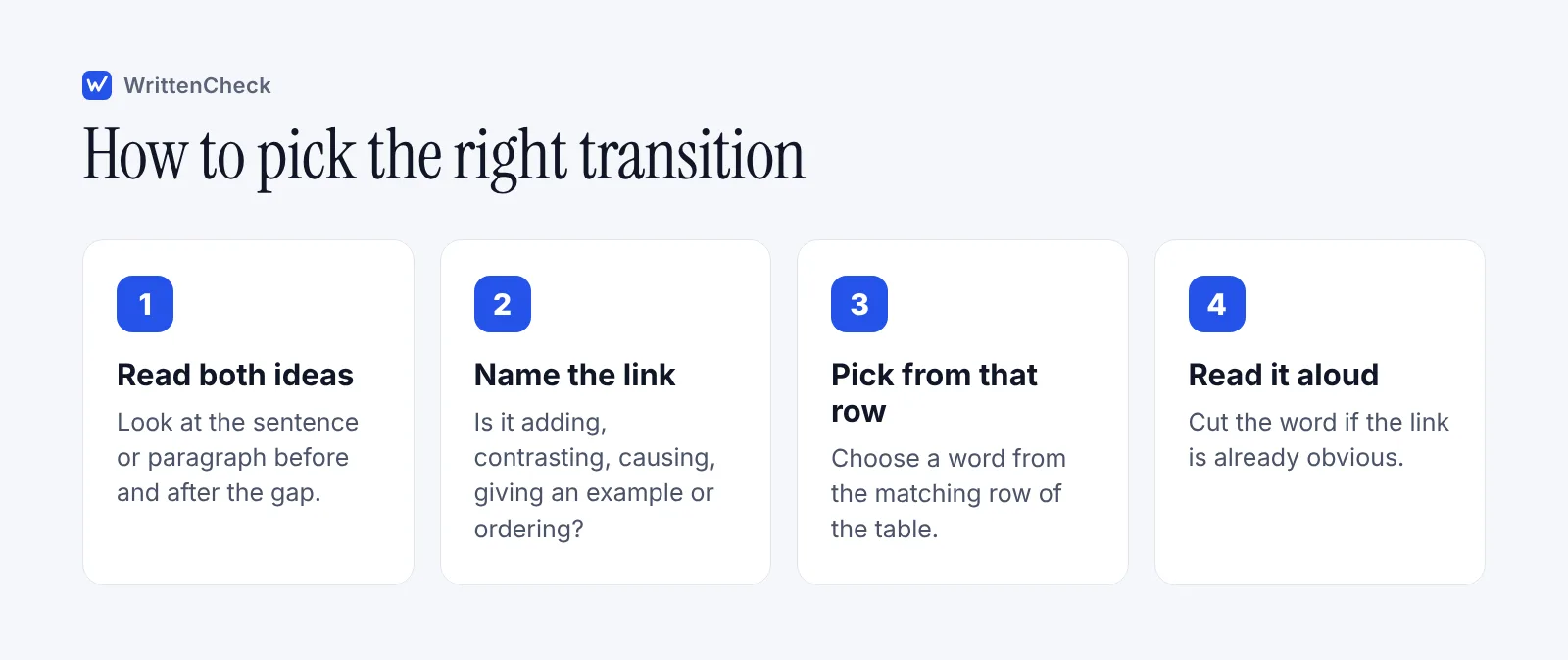
Here's a quick process you can use on any draft.
Underline the last sentence of one idea and the first sentence of the next.
Say the link in plain words, such as "this happened because of that" or "this is an exception".
Find that relationship in the purpose column of the table above.
Pick the simplest word that fits. "But" often beats "nevertheless".
Read the two sentences aloud with and without the word. If they make sense without it, leave it out.
A before and after example
Here's an example of a short paragraph with transitions that point the wrong way.
Remote work saves commuting time. Also, some managers worry about output. Therefore, many companies now use a hybrid schedule. For example, employees come in two or three days a week.
"Also" signals that the next point agrees with the first. It doesn't. Managers' worries are a counterpoint. And "therefore" claims the hybrid schedule follows from the worry alone, when it follows from both points together.
Remote work saves commuting time. But some managers worry about output. To balance the two, many companies now use a hybrid schedule, with employees in the office two or three days a week.
The revision uses "but" for the contrast and a short phrase that names what's being balanced. It also folds the example into the sentence, which removes one transition word entirely.
What are good words to start a paragraph?
Good words to start a paragraph signal how the new paragraph relates to the last one. Use contrast words ("However", "In contrast", "On the other hand") when you turn to a counterpoint. Use addition or order words ("Another", "Second", "Beyond cost") when you add a new reason.
Strong paragraph openers usually do one more thing. They repeat an idea from the paragraph before. Purdue OWL calls this out in its guide to writing transitions. It rewrites vague openers into ones that refer to the key phrase of the previous paragraph, such as "these impressive profits are largely due to...".
Here are some opener patterns you can copy and adapt.
To add a reason. "Cost isn't the only reason schools keep uniforms."
To turn to a counterargument. "Not everyone agrees that uniforms reduce bullying."
To show a result. "Because of that early mistake, the second test changed."
To move in time. "By the 1990s, the policy had spread to most state schools."
To give a closer example. "One school in the study shows how this works."
To narrow the focus. "Of these three causes, the second matters most."
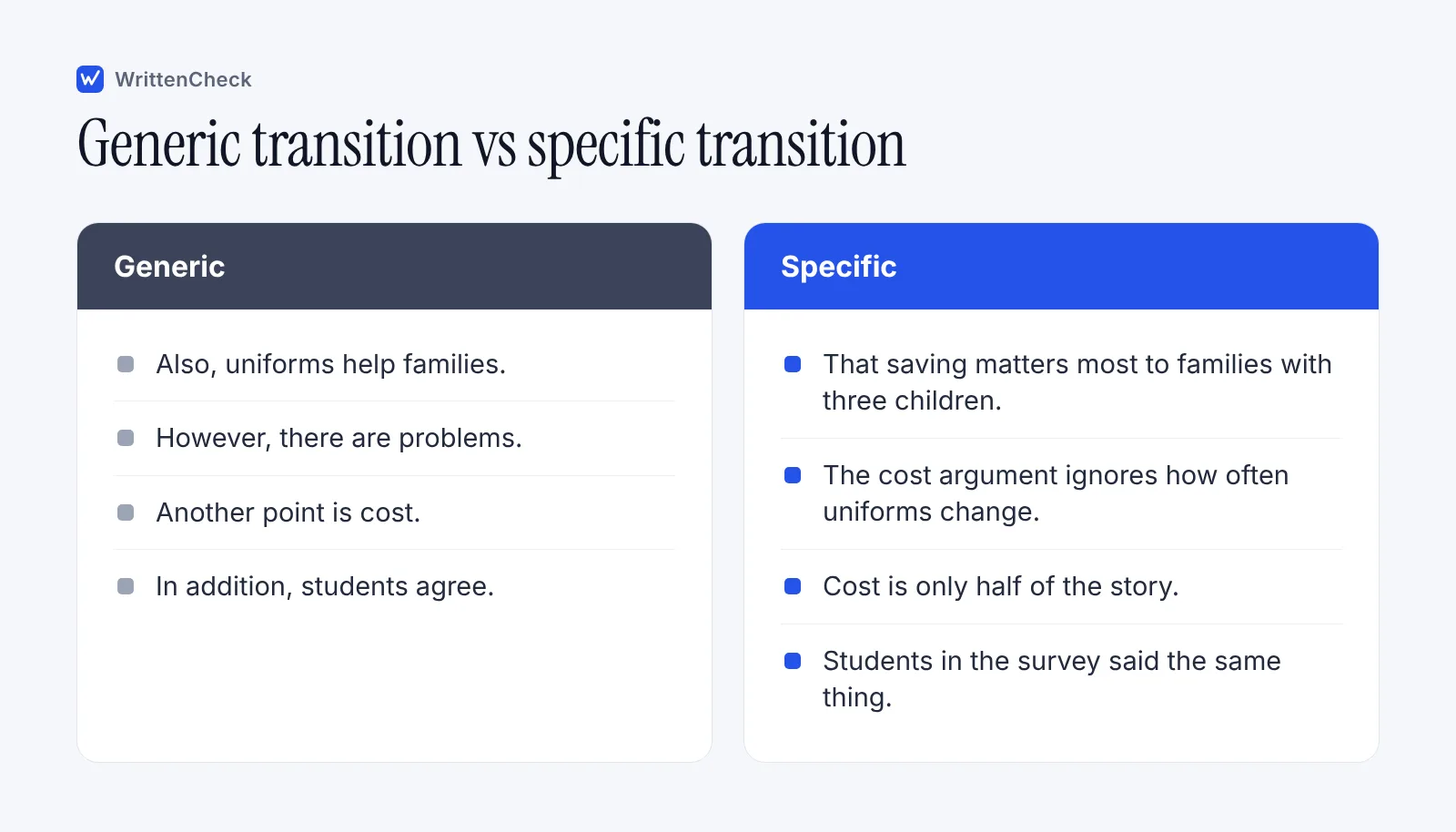
Notice that most of these don't use a word from a list. They're whole sentences that bridge two ideas. That's what writing centers mean when they say the best transitions are specific. For a body paragraph that ties back to your main claim, see our guide on how to write a thesis statement.
How do you punctuate transition words?
Words like "however", "therefore" and "for example" can't join two complete sentences with just a comma. Grammar books call these conjunctive adverbs. Joining two full sentences with one creates a comma splice, as the San José State University Writing Center explains in its handout on the topic.
There are three safe patterns.
Pattern | Example |
|---|---|
Start a new sentence, comma after the word | The test was hard. However, most students passed. |
Semicolon before, comma after | The test was hard**; however,** most students passed. |
Mid-sentence, commas on both sides | Most students, however, passed the test. |
And here's the error to avoid.
The test was hard, however most students passed.
Short joining words work differently. "And", "but", "or", "so" and "yet" can join two full sentences with a comma ("The test was hard, but most students passed"). Words like "because" and "although" start a dependent clause, so they don't need a comma when the clause comes second ("Most students passed although the test was hard").
What mistakes do people make with transitions?
The most common mistake is using transitions as decoration. Writers drop in "in addition" or "consequently" to sound academic, when the sentence needs a clearer link or no link at all. Harvard's writing center makes the same point. Including a word like "therefore" or "also" isn't enough on its own.
Watch for these five problems.
Stacking addition words. Three sentences in a row that start with "In addition", "Also" and "Another" read like a list. Cut most of them or merge the points.
Using the wrong relationship. "Therefore" claims a cause. "However" claims a contrast. If neither is true, the reader gets lost.
Starting every sentence with a transition. If each sentence opens with a connector, none of them stands out. Many sentences connect fine through their content.
Using a formal word where a plain one works. "Consequently" and "so" usually mean the same thing in an essay. The short word is easier to read.
Announcing the end too early. A summary phrase in the third sentence of a paragraph, or a stock "to sum up" at the start of every final paragraph, adds nothing. Your reader can see the essay is ending.
Here's an example paragraph that makes several of these mistakes at once.
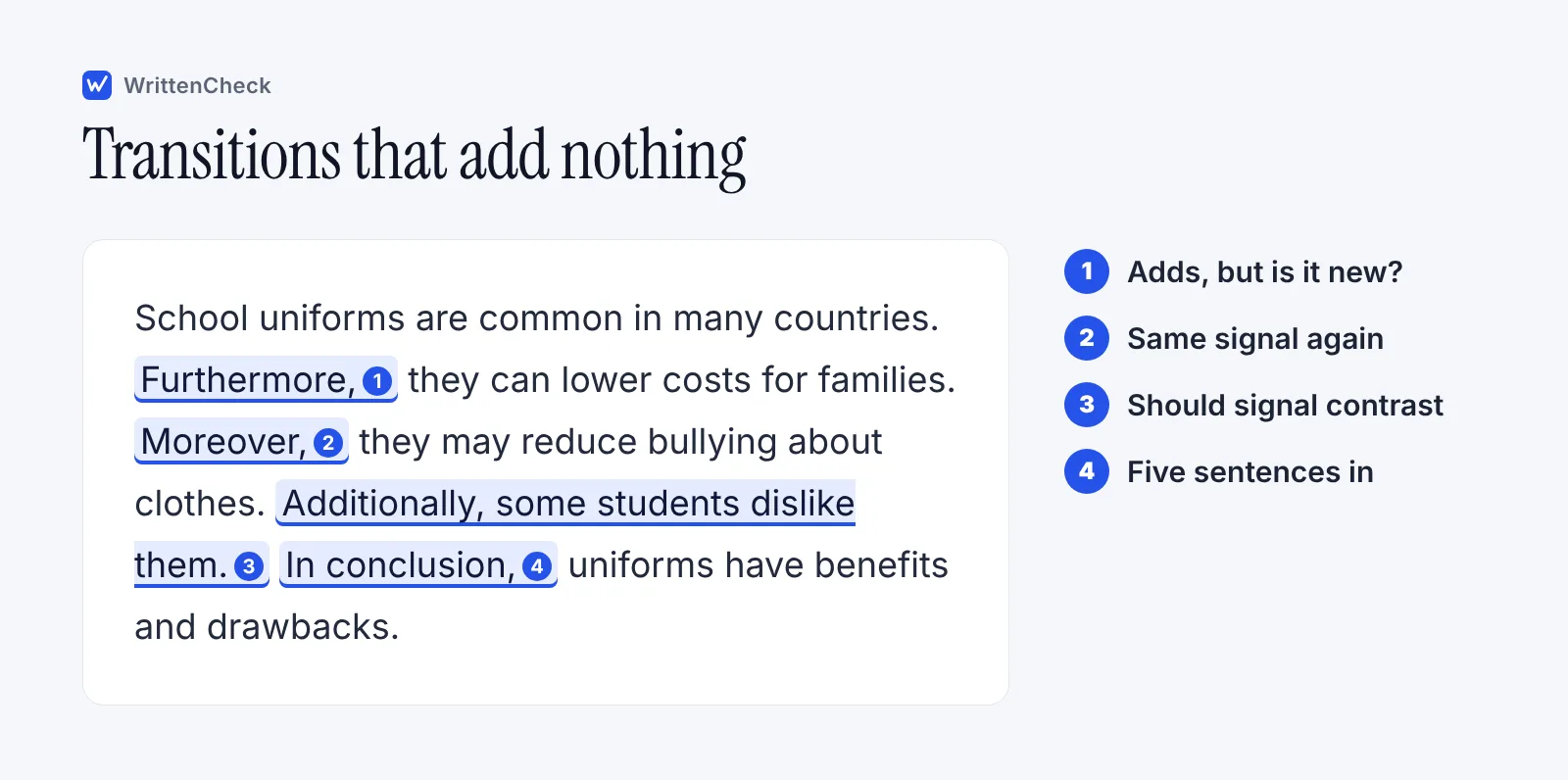
The first two connectors both say "here's another point". The third says the same, even though the point about students disliking uniforms is a contrast. A cleaner version needs only one transition.
School uniforms are common in many countries. They can lower costs for families and may reduce bullying about clothes. But some students dislike them, and that matters if the goal is a happier school.
Do overused transition words make writing sound like AI?
They can add to that impression. Some formal connectors became much more common in academic writing after AI writing tools spread. Still, that's a pattern across millions of texts. One formal transition in your essay proves nothing about who wrote it.
In a 2025 study in Science Advances, Dmitry Kobak and colleagues analyzed more than 15 million biomedical abstracts from 2010 to 2024. They found a sudden rise in certain style words after AI writing tools became widely available. For one of their two estimates they picked ten common words that had jumped in use, and "additionally" and "notably" were on that list. Their combined estimate was that at least 13.5% of 2024 abstracts were processed with AI tools.
The fix is the same as for any padded writing. Choose the transition that names the real relationship, use plain words, and cut the ones you don't need. Our list of AI words to avoid covers other words that became common for the same reason. For more on voice and rhythm, read how to make writing sound less like AI.
How many transition words should an essay have?
There's no set number. Use a transition when the reader would otherwise have to guess how two ideas connect. Most well-written paragraphs need one or two connecting words, plus a topic sentence that links back to the paragraph before.
A quick check works better than a count.
Highlight every transition word in one paragraph.
If more than half the sentences start with one, cut some.
If two transitions in a row signal the same relationship, keep the clearer one.
Read the paragraph aloud without the highlighted words. Put back only the ones you miss.
Once your transitions are clean, you can paste a draft into our free AI detector to see which sentences read most like AI. The sentence scores show where to look, and the fix is usually clearer, more specific writing.
Frequently asked questions
What are transition words for essays?
Transition words for essays are words and phrases that link ideas inside a sentence, between sentences or between paragraphs. Common ones include "however", "for example", "as a result", "similarly" and "in short". Each signals a relationship, such as contrast, cause, example or summary. In essays, the most useful transitions often repeat a key idea from the paragraph before, so the reader sees exactly how the argument moves forward.
What is the difference between transition words and transitional phrases?
A transition word is a single word, such as "but", "so", "next" or "however". A transitional phrase is a group of words that does the same job, such as "on the other hand", "as a result" or "in other words". Both signal how ideas relate. Phrases are often clearer when one word could be read two ways. Some transitions are whole sentences that bridge two paragraphs.
Can you start a sentence with "But" or "And"?
Yes. The Chicago Manual of Style says there's no historical or grammatical basis for calling it an error. Its advice is to do it only when the result is clear and works better than the alternative. "But" often reads more naturally than "However". Some instructors still prefer formal openers in academic essays, so if your course has that rule, follow it for the assignment.
Is "however" followed by a comma?
Usually, yes. When "however" starts a sentence and means "on the other hand", put a comma after it. When it joins two complete sentences, use a semicolon before it and a comma after it. A comma alone in front of "however" creates a comma splice. When "however" means "in whatever way" ("however you choose"), it takes no comma.
What are some good transition words to start a body paragraph?
It depends on how the paragraph relates to the one before. For a new reason, try "Another reason", "Second" or "Beyond cost". For a counterargument, try "However", "On the other hand" or "Critics argue that". For a result, try "As a result" or "Because of this". The best openers also repeat a key word from the last paragraph.
Why does my teacher say my transitions are weak?
Weak transitions usually mean the words don't match the relationship between ideas, or they're too generic. "Also" and "another" tell the reader little. Teachers want to see how each point connects to the one before and to your thesis. Try opening each body paragraph with a sentence that names the previous point and says how the new one builds on it.
Sources
Transitions, The Writing Center, University of North Carolina at Chapel Hill, updated March 2026
Transitional Devices, Purdue Online Writing Lab, accessed October 2026
Writing Transitions, Purdue Online Writing Lab, accessed October 2026
Transitions, Harvard College Writing Center, accessed October 2026
Conjunctive Adverbs, San José State University Writing Center, Spring 2021
Can I start a sentence with "and" or "but"? (Usage Q&A), The Chicago Manual of Style Online, University of Chicago Press, accessed October 2026
Delving into LLM-assisted writing in biomedical publications through excess vocabulary, Kobak, González-Márquez, Horvát and Lause, Science Advances, July 2025


Comments