Academic integrity used to feel settled. Students knew copying a friend's essay was wrong, and teachers knew roughly what plagiarism looked like. Then AI writing tools arrived and made a lot of old questions new again.
The good news is that the values underneath haven't changed. This guide covers the standard definition of academic integrity, the six values most schools build on, how AI pressures each one, and classroom steps that build honest work instead of just hunting for dishonest work.
What is academic integrity?
Academic integrity is a commitment to doing and representing academic work honestly. The International Center for Academic Integrity (ICAI) defines it as a commitment, even in the face of adversity, to six fundamental values: honesty, trust, fairness, respect, responsibility and courage. In practice, it means students submit their own work, credit others' ideas, follow the rules for each task, and teachers assess fairly and transparently.
What are the six fundamental values of academic integrity?
The six values come from the ICAI's guide The Fundamental Values of Academic Integrity. The third edition, released in February 2021, lists honesty, trust, fairness, respect, responsibility and courage. The first edition, published in 1999, listed the first five. Courage was added in a later edition.
Here's what each value means in the ICAI framework, in short:
Value | What it means |
|---|---|
Honesty | Being truthful and free from deception. The ICAI treats it as the base the others grow from. |
Trust | Being able to rely on others' truthfulness, in both directions. |
Fairness | Applying the same standards to everyone, without favoritism. |
Respect | Valuing yourself and others, including the intellectual work of others. |
Responsibility | Personal and shared accountability for integrity, including standing up to wrongdoing. |
Courage | Acting on your values even when you're afraid to. The ICAI calls it a capacity that develops through practice. |
Notice that none of these values mentions a specific technology. That's why they still work as a guide when the tools change.
How does AI change each of the six values?
AI doesn't replace any of the values. It moves the pressure points. Each one now shows up in situations that didn't exist a few years ago.
Honesty
The core question becomes "Did you say how this work was made?" A student can now submit text they didn't write without copying a single source, which old plagiarism rules didn't always cover. Honesty with AI usually means disclosure. Students should say which tool they used and what for, in the format your course asks for.
Trust
Trust runs both ways, and AI strains it from both sides. Students worry about being wrongly suspected. Teachers worry about being fooled. Australia's higher education regulator, TEQSA, noted in its November 2023 paper on assessment reform that it appears almost impossible to reliably detect whether these tools were used. Leaning on suspicion alone erodes trust fast. Clear rules and visible process rebuild it.
Fairness
Fairness now has new angles. Is it fair if some students pay for advanced AI tools and others can't? Is it fair to accuse a student based on a single score? Fairness means applying the same rules to everyone and the same standard of evidence before any accusation. If you use an AI detector, treat its score as one signal that starts a conversation. It shouldn't be the verdict.
Respect
Respect covers the people whose ideas feed into a piece of work. AI tools draw on huge amounts of human writing, often without showing where an idea came from. Respect means students still find and credit real sources, and don't present a tool's output as original insight.
Responsibility
Responsibility means students own every claim in their work, including the ones an AI tool drafted. If a chatbot invents a citation and a student submits it, the student is accountable. It's also shared. Teachers carry part of it too, by writing rules students can actually follow.
Courage
Courage might be the value AI tests most. It takes courage for a student to admit "I used AI more than allowed on this draft" before anyone asks. It takes courage to hand in honest, imperfect work when a polished version is one prompt away. Teachers can make that easier by treating early disclosure differently from concealment.
Are students using AI to cheat more than before?
The evidence is mixed, and it depends on what you measure. Self-reported cheating rates haven't clearly jumped, but recorded AI misconduct cases have.
Stanford education researchers Denise Pope and Victor Lee, working with the nonprofit Challenge Success, reported in October 2023 that 60% to 70% of high school students had admitted to at least one cheating behavior in the past month before AI chatbots arrived. In 2023 surveys, that share stayed about the same or dropped slightly.
University records tell a different story. A Guardian investigation of UK universities, reported by University World News in June 2025, found nearly 7,000 proven cases of AI-assisted cheating in 2023 to 2024. That's 5.1 cases per 1,000 students, up from 1.6 per 1,000 the year before. At the same time, traditional plagiarism cases fell.
Put together, the data suggests students who were going to cut corners found a new way to do it. That's a reason to look at why students cheat, not just how.
Why do students cheat in the first place?
Students cheat most when they feel overloaded, unsupported, or unsure the work matters. Pope has described cheating as generally a symptom of deeper problems. The causes she lists include struggling with the material, too much homework for the time available, busywork, and pressure for high grades.
Older research points the same way. In a 2001 review of a decade of studies in Ethics & Behavior, Donald McCabe, Linda Treviño and Kenneth Butterfield found that contextual factors, especially students' perceptions of what their peers do, were the strongest influence on cheating. Honor codes were linked to less cheating, but only when the school actually lived by them. A code on paper alone was described as window dressing.
The practical takeaway is that the classroom you build matters as much as the rules you write.
How can teachers build a culture of integrity instead of policing?
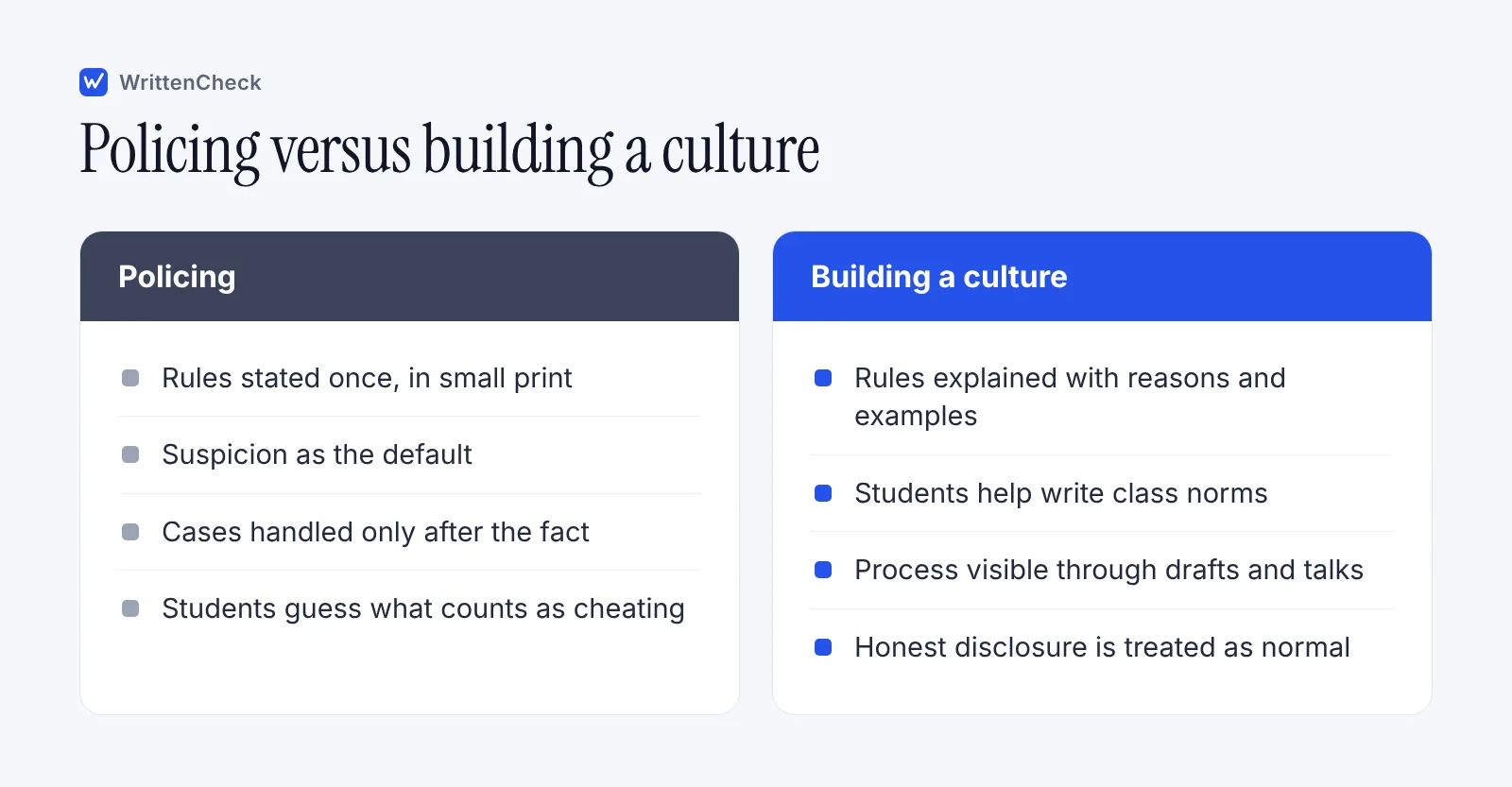
Start by making the rules clear, the purpose visible and honesty the easy path. Penalties still have a place, but they can't carry the weight alone.
Here's a sequence that works in most courses:
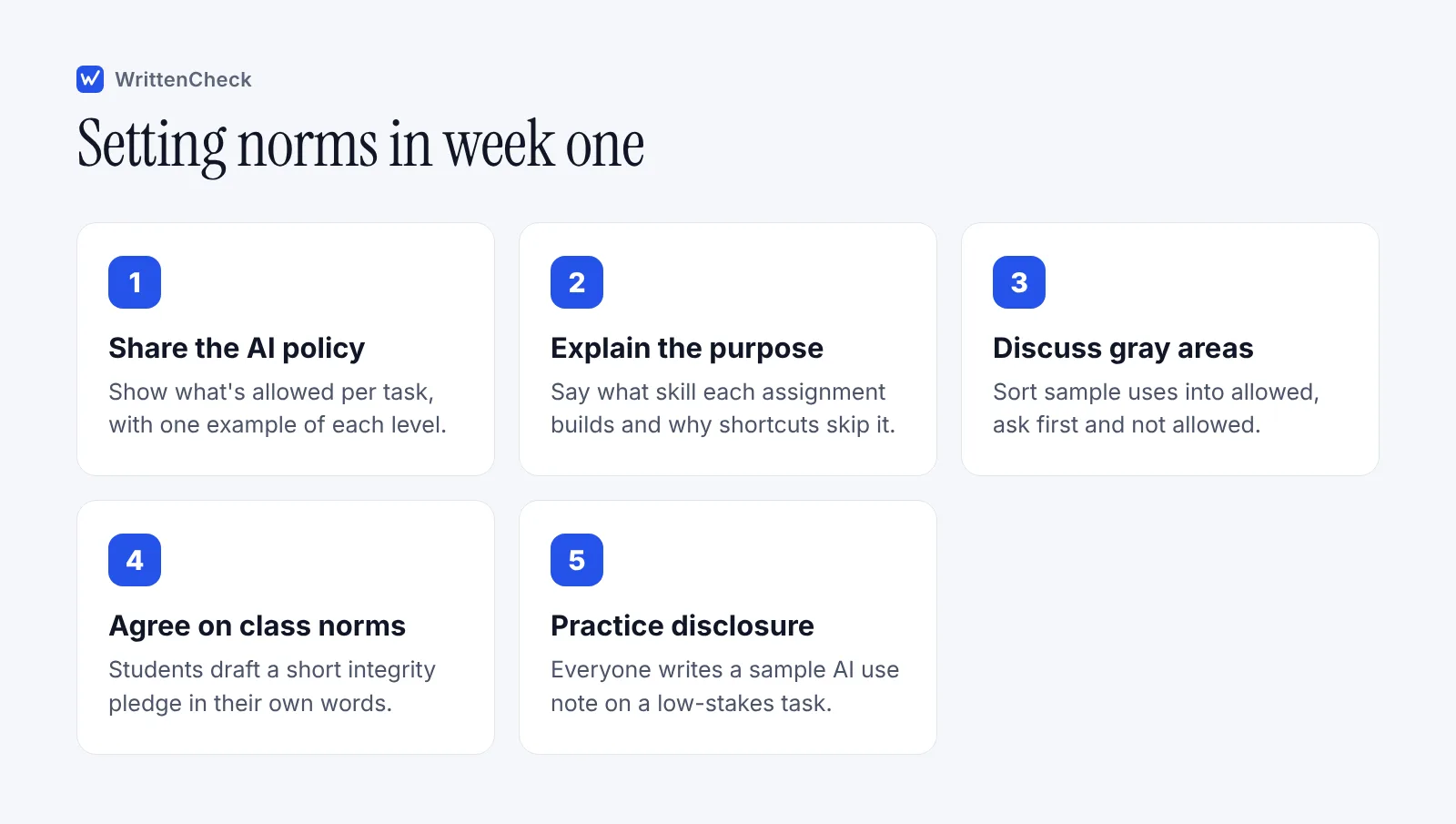
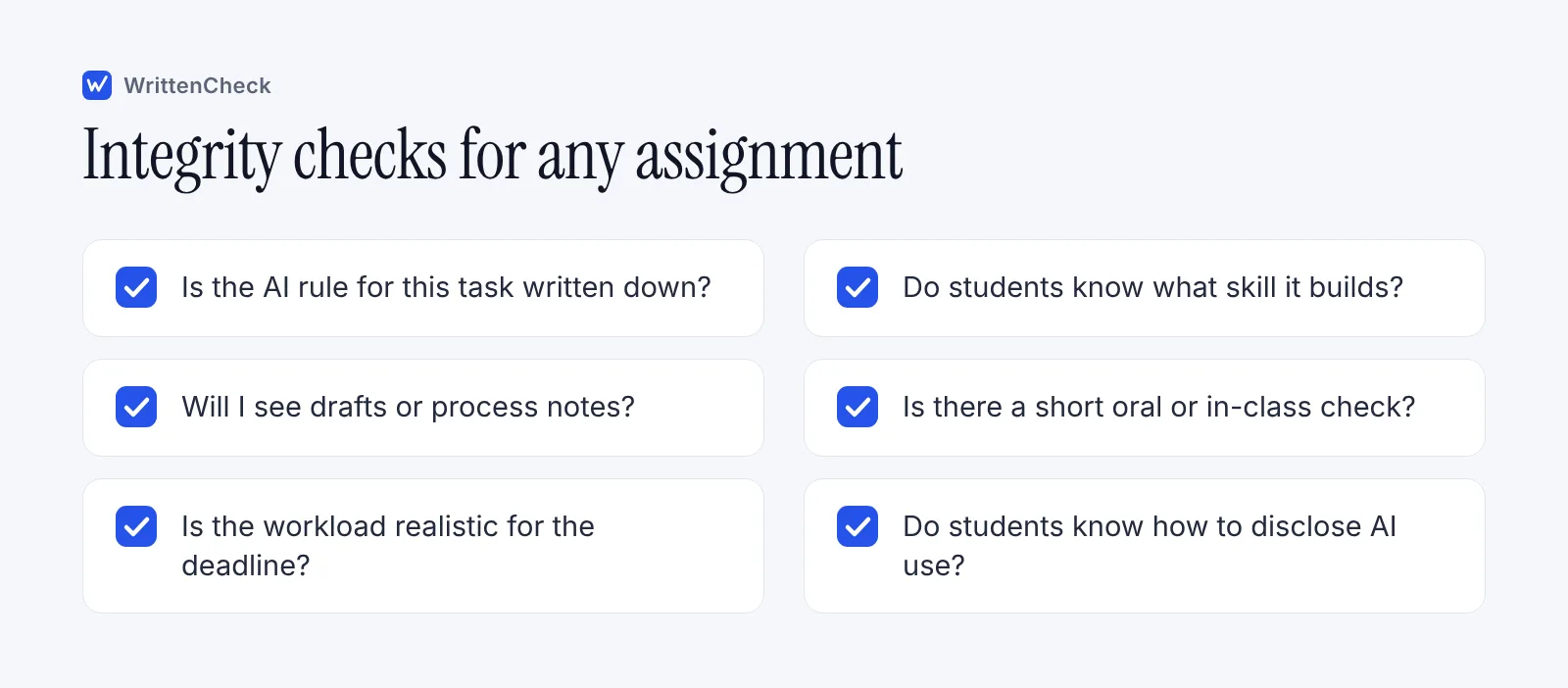
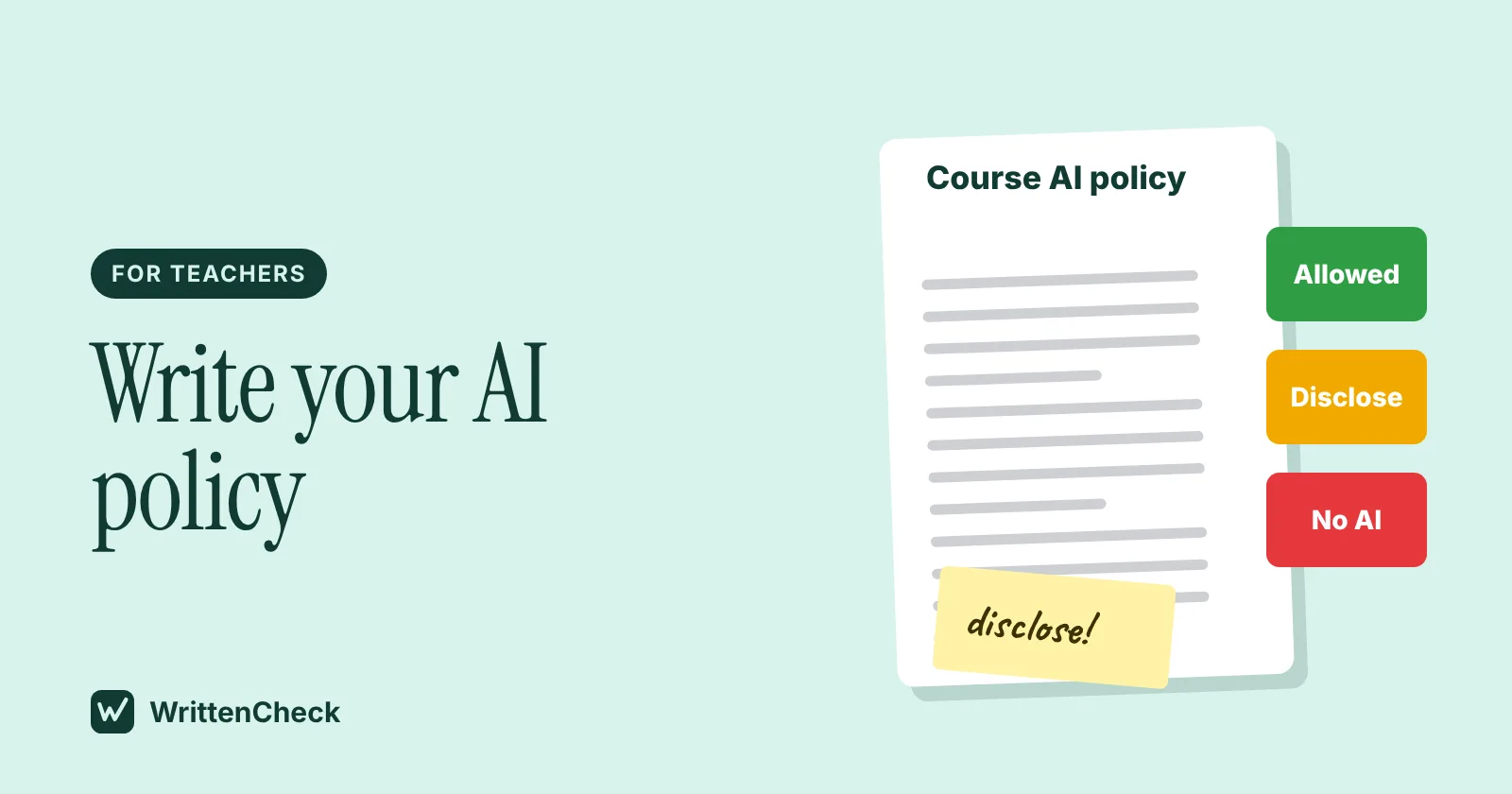
Write an AI rule for each assignment. A course-wide statement isn't enough when one task allows AI brainstorming and another bans all AI. Our guide to AI policies for schools has sample wording for each level.
Explain why each task exists. Students skip work that feels pointless. If they know the reflection essay is the only place they'll practice judgment, a shortcut looks less tempting.
Talk through gray areas with examples. Give students ten sample uses and have them sort them into allowed, ask first and not allowed. You'll learn where they're confused.
Make disclosure normal. Ask for a short AI use note on every assignment, even if the note is "No AI used." When everyone does it, honesty stops feeling like a confession.
Collect process, not just products. Ask for outlines, drafts or version history at checkpoints.
Check workload and deadlines. Overloaded students are more likely to cut corners, so stagger deadlines across courses when you can.
Respond to problems with a conversation first. Ask the student to explain their work. Our guide on how to tell if a student used AI walks through how to run that talk fairly.
What does this look like in an actual classroom?
Small, routine moves do most of the work. Here are examples you can adapt.
An integrity pledge students write themselves. Instead of signing a stock statement, a class drafts three sentences together. Here's an example from a sample class:
We'll say when we used AI and what for. We won't hand in work we can't explain. If we're unsure about a tool, we'll ask before we use it.
A two-minute process check. After a paper is due, ask each student two quick questions in class, such as "Which source changed your mind?" or "What did you cut from your first draft?" Students who did the work answer easily.
An amnesty window. Give students 48 hours after submission to add or correct their AI disclosure without penalty. This rewards the courage value directly.
Assignments that need the student. Tasks tied to class discussion, local data or personal experience are harder to hand off. Our post on AI-resistant assignments has more ideas.
Secure checks at key points only. TEQSA's 2023 paper suggests placing security at meaningful points across a program rather than on every task. In practice, that might mean one in-class essay per term, with the rest open to approved AI use.
Where do AI detectors fit into academic integrity?
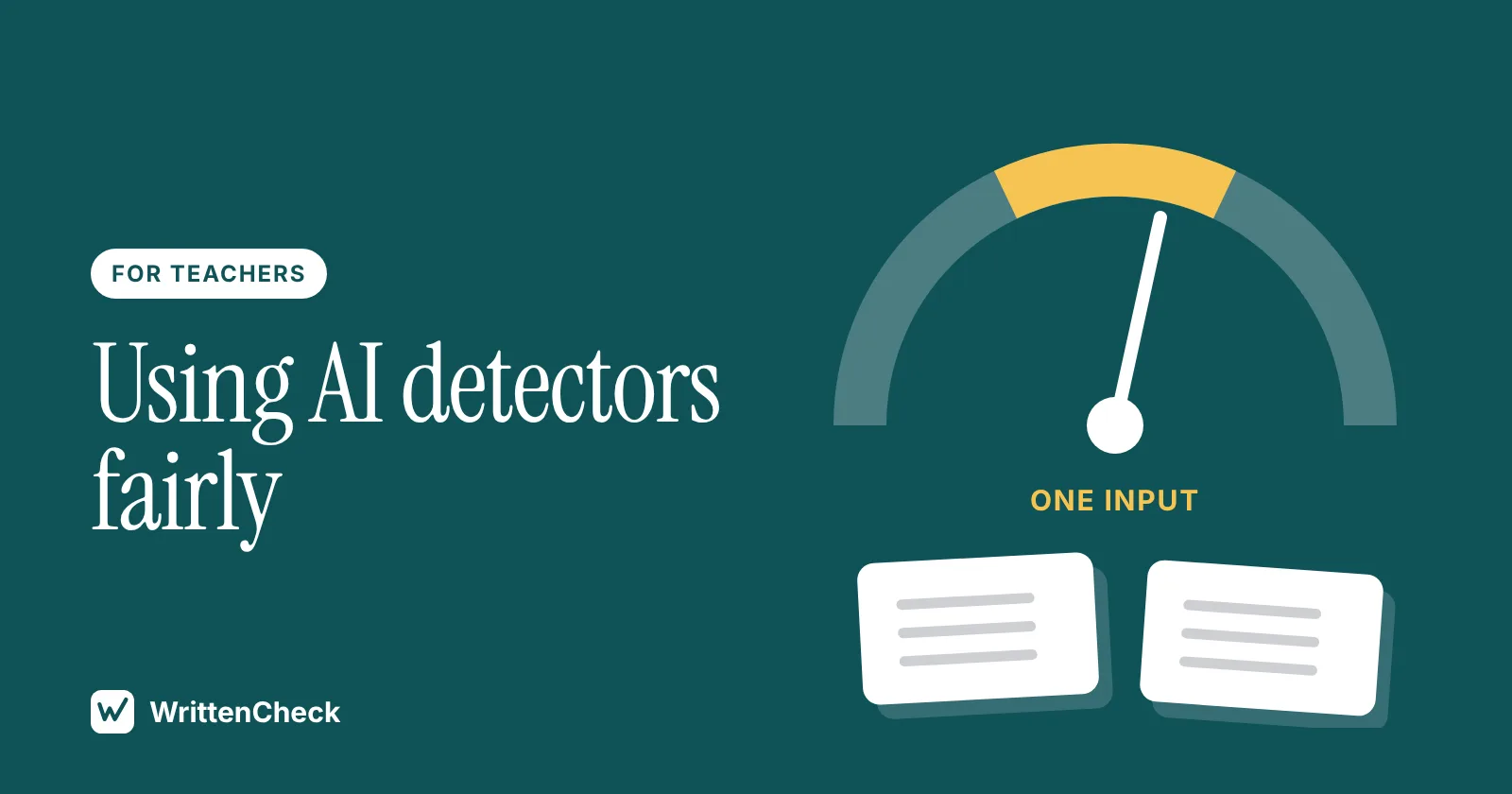
AI detectors can support integrity when used as one signal among several. They shouldn't be the only evidence for a misconduct finding. Scores are estimates, and they're less reliable on short texts, heavily edited AI drafts, very formal writing, and writing by people using a second language.
If you use one, run it alongside drafts, version history and a conversation. You can paste a student's text into our free AI detector to see an overall score and which sentences read most like AI, then use those sentences as talking points. Our page on how it works explains what the score means.
Students also benefit from seeing the ethical side spelled out. You can share our student guide to the ethical use of AI, which walks them through checking rules, disclosing and verifying.
Before your next assignment goes out, take it through the checklist above and add one line to the brief saying exactly what AI use is allowed.
Frequently asked questions
What is the simplest definition of academic integrity?
Academic integrity means being honest in how you do and present academic work. Students do their own work, credit other people's ideas and follow the rules for each task. Teachers assess fairly and explain their rules clearly. The International Center for Academic Integrity frames it as a commitment to six values: honesty, trust, fairness, respect, responsibility and courage.
Is using AI a violation of academic integrity?
Not automatically. It depends on the rules for the specific task and whether the student is open about it. Using AI in ways the teacher allows, with a clear disclosure, fits within academic integrity. Using it where it's banned, or hiding how much it did, breaks the honesty value. That's why task-by-task rules matter so much.
Why was courage added to the values of academic integrity?
The ICAI's first edition in 1999 listed five values, and courage appears in later editions. The third edition describes courage as more a quality of character than the other values, one that grows with practice. It matters because acting with integrity often means doing something uncomfortable, like admitting a mistake or reporting a problem.
Did AI chatbots make students cheat more?
Not clearly, if you go by self-reports. Stanford researchers found 60% to 70% of high schoolers reported recent cheating before AI chatbots, and the share held steady or dipped slightly in 2023 surveys. Recorded AI cases at UK universities did rise sharply in 2023 to 2024, which suggests students changed methods more than habits.
Do honor codes work?
They can, if the school takes them seriously. A 2001 review by McCabe, Treviño and Butterfield found honor code schools reported less cheating, but codes only worked when they were part of the campus culture. A code that nobody discusses or enforces does little. A strong integrity culture can also exist without a formal code.
How should a teacher respond to suspected AI misuse?
Start with a private, calm conversation. Ask the student to talk through their argument, sources and drafts. Check the assignment's AI rule and whether it was clear. Look at version history if it's available. Treat any detector score as a reason to look closer. If concerns remain, follow your school's formal process rather than deciding alone.
Sources
The Fundamental Values of Academic Integrity, Third Edition, International Center for Academic Integrity, 2021
ICAI releases The Fundamental Values of Academic Integrity, third edition, International Center for Academic Integrity, 11 February 2021
The Fundamental Values of Academic Integrity: Honesty, Trust, Respect, Fairness, Responsibility (ED452778), ERIC, October 1999
What do AI chatbots really mean for students and cheating?, Stanford Graduate School of Education, 31 October 2023
Cheating in Academic Institutions: A Decade of Research, McCabe, Treviño and Butterfield, Ethics & Behavior 11(3), 2001
Assessment reform for the age of artificial intelligence, Lodge, Howard, Bearman, Dawson and Associates, TEQSA, November 2023
Thousands of UK university students caught cheating using AI, University World News, 18 June 2025


Comments