Students are already using AI. The real question for AI in the classroom is whether they use it in ways that build their thinking or skip it. The research now gives a fairly clear answer. The tool matters less than the task around it.
In nationally representative RAND surveys from 2025, 54% of US K-12 students and 53% of English, math and science teachers said they used AI for school. Yet more than 80% of students said their teachers hadn't explicitly taught them how to use it for schoolwork.
This guide covers what the evidence says about the benefits and risks, how to protect critical thinking, and classroom activities with guardrails you can run this week.
What does AI in the classroom look like today?
AI in the classroom usually means students and teachers using AI chatbots to explain topics, give feedback, generate practice and help with writing. Use is spreading fast. RAND found that student and teacher use for school rose by more than 15 percentage points compared with one to two years earlier. Training and policy lag behind. Only 34% of teachers in that RAND study said their school or district had a policy on AI and academic integrity.
Other surveys show the same picture. In a survey released in October 2025, the Center for Democracy & Technology found that 85% of US public school teachers in grades 6 to 12 and 86% of students in grades 9 to 12 used AI during the 2024 to 2025 school year. Only 10% of those teachers had been trained on how to respond when students' AI use is harmful.
So most classrooms already have AI in them, whether or not a lesson plan mentions it. If you need a plain explainer to share with students first, our guide to what generative AI is covers how these tools produce text.
What are the benefits of AI in education?
The clearest benefits of AI in education come from tutoring that's designed to teach. Fast feedback, extra practice and patient explanations help when the tool is built to make students think.
The strongest evidence so far comes from Harvard. In a study published in Scientific Reports in June 2025, Greg Kestin, Kelly Miller and colleagues ran a randomized trial with 194 students in an introductory physics course. Students who learned from an AI tutor at home had learning gains more than double those from an in-class active learning session. The median student spent 49 minutes. The tutor wasn't an open chatbot. The team built it around teaching practices like working through problems step by step, managing how much students take in at once, and using pre-written solutions to keep it accurate.
Other benefits are more everyday.
Practice on demand. A student can ask for one more worked problem at 9 p.m. without waiting for office hours.
Different explanations. A student who didn't follow the textbook can ask for the idea explained another way.
Feedback on drafts. Students can get quick comments on structure before a teacher reads the final version.
Getting unstuck. In an October 2024 Purdue University piece, professor Daniel Guberman said picking what to explore is one of the hardest parts of a project, and he encourages students to use AI to generate ideas.
What are the risks of AI in the classroom?
The biggest risk is that AI does the thinking students are supposed to do. Other risks include wrong facts, privacy, cheating and weaker relationships between students and teachers.
The best evidence on the first risk is a 2025 study in the Proceedings of the National Academy of Sciences by Hamsa Bastani and colleagues. The field experiment ran at a large high school in Turkey in fall 2023, with nearly 1,000 math students in grades 9 to 11. Over four 90-minute practice sessions, students worked either with no AI or with one of two AI tutors. One worked like a standard AI chatbot. The other had guardrails and was designed to give hints rather than answers. Then everyone sat an exam without AI.
Group | Practice scores with AI | Exam scores after AI was removed |
|---|---|---|
Standard AI chatbot | 48% higher | 17% lower than students who never had AI |
AI tutor with guardrails | 127% higher | No significant difference from students who never had AI |
The standard chatbot made practice easier and learning worse. Students leaned on it as a crutch. The guardrails version helped during practice without that later drop, though it didn't raise exam scores either.
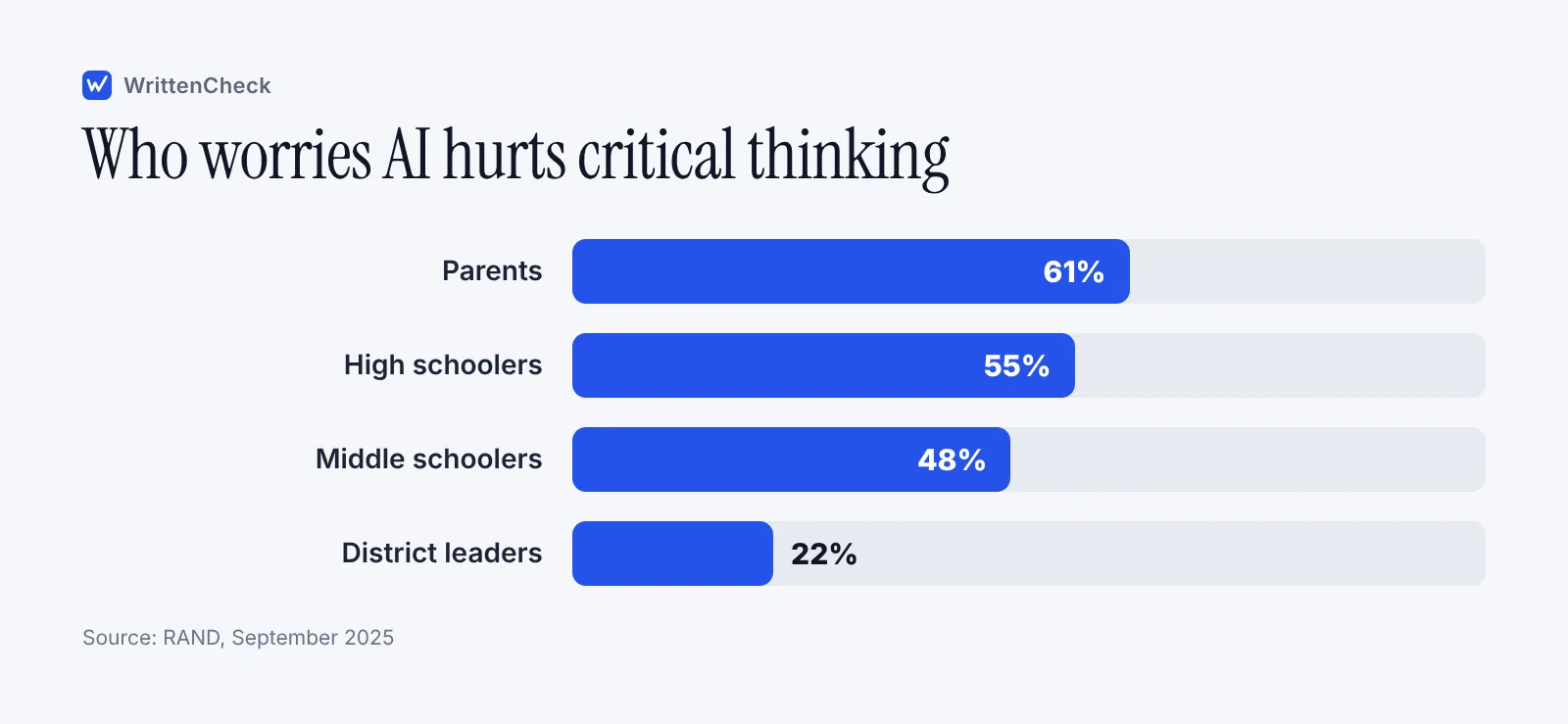
Teachers and families see this risk too. In a Gallup and Walton Family Foundation survey of 2,232 US public K-12 teachers, run in March and April 2025, 57% predicted that weekly AI use by students would reduce their independent thinking. RAND found the same worry across groups.
Other risks to plan for:
Wrong facts. AI chatbots can state errors and make up sources with confidence. Our guide to AI hallucination shows what this looks like.
Cheating. In a Pew Research Center survey of US teens ages 13 to 17, run in fall 2025 and published in February 2026, 59% said students at their school use AI chatbots to cheat at least somewhat often.
Relationships. In the CDT survey, half of students agreed that using AI in class makes them feel less connected to their teachers.
Privacy. Students may paste personal details into tools the school hasn't checked.
How do you protect critical thinking when students use AI?
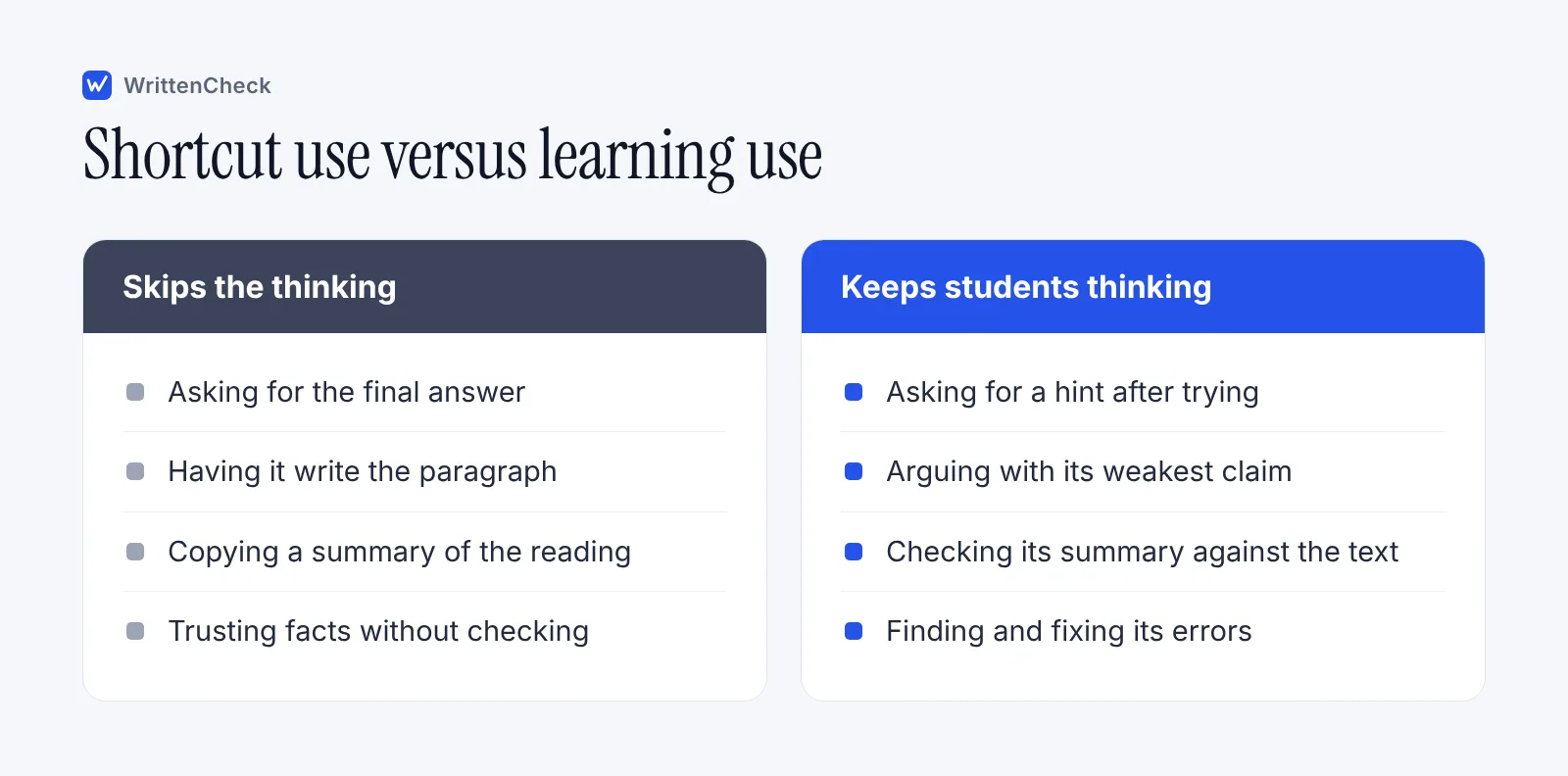
Make students think first and use AI second, and give the AI a job that requires them to judge its output. That's the lesson from the Bastani study, where hints instead of answers made the difference.
Here are concrete rules that work in practice.
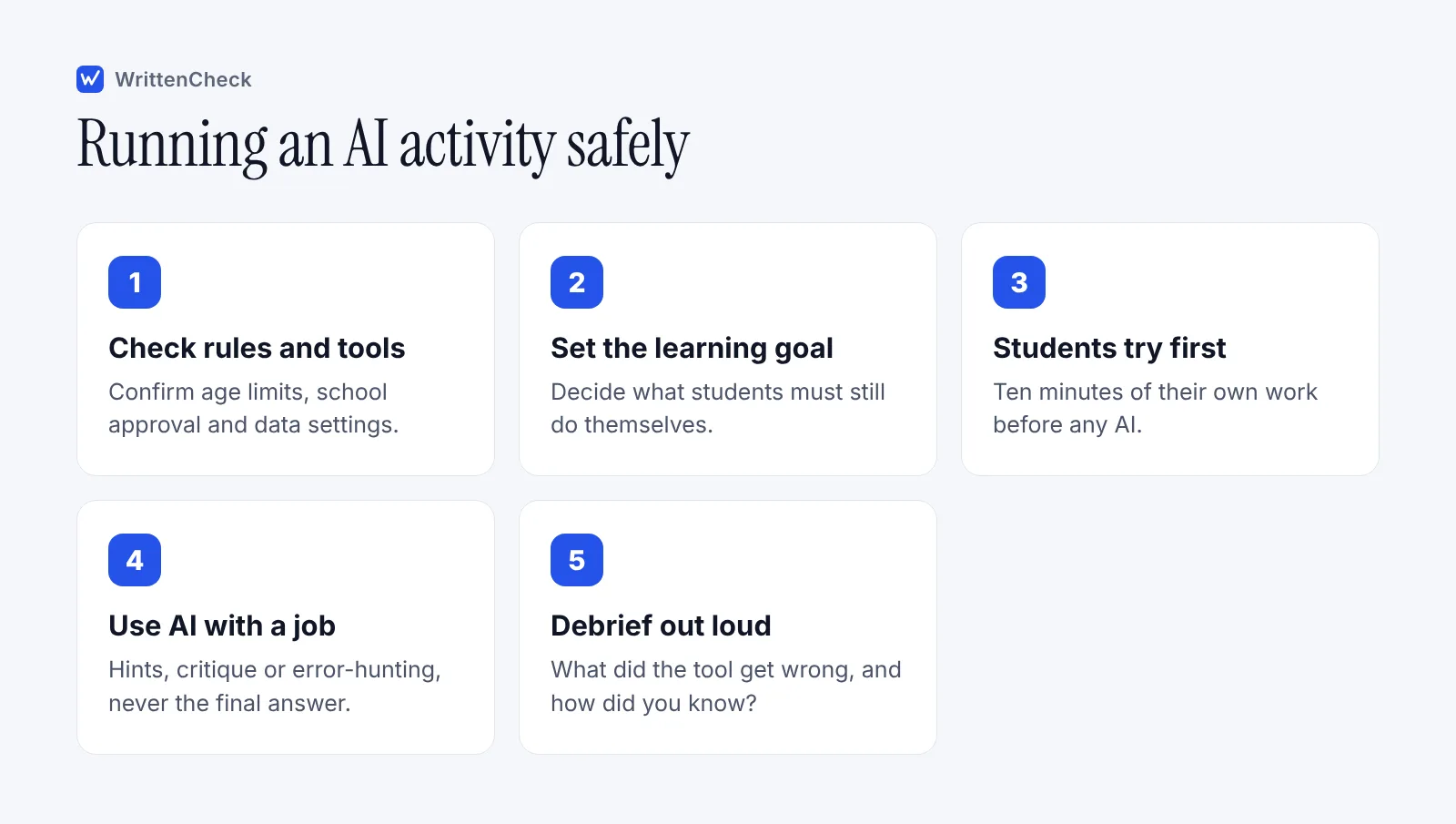
Try first. Students spend 10 minutes on the problem or paragraph before they open any tool.
Ask for hints, not answers. Teach a prompt like "Don't solve this. Ask me one question that helps me find my mistake."
Keep a log. Students paste their prompts and the replies into a short log they hand in.
Check against a source. Every fact the AI gives must be confirmed in the textbook or a source you provide.
Explain it back. Students explain the idea in their own words, out loud or on paper, without the tool.
Grade the thinking. Put points on the log, the corrections and the explanation, so the final product isn't the only thing that counts.
For assignments where AI use isn't allowed, the design matters as much as the rule. Our guide to AI-resistant assignments has examples built around personal experience, class discussions and in-class drafting.
What AI activities can you run in class?
The best activities make students evaluate AI output instead of accepting it. Here are four you can adapt, with example prompts that use a generic AI chatbot.
Find the errors
Generate a short explanation of a topic you just taught, then ask students to find what's wrong or missing. Prompt: "Explain the causes of the French Revolution in 150 words for 9th graders." Students mark each claim as confirmed, wrong or unclear, using their notes. Even when the AI version holds up, students practice checking claims against evidence, which is the habit you want.
Argue with it
Students write a claim, ask the AI chatbot for the strongest counterargument, then write a rebuttal in their own words. Prompt: "Here is my claim: [student claim]. Give me the single strongest argument against it in under 100 words." The thinking happens in the rebuttal.
Socratic tutor
Give students a prompt that forbids answers. "I'm working on this problem: [problem]. Don't give me the answer or the next step. Ask me one question at a time to help me find it myself." This mimics the hints-only design from the Bastani study.
Compare two explanations
Students read the textbook explanation and an AI explanation of the same idea, then write which is clearer and why, citing specific sentences. This builds reading skill and shows that fluent writing can still be wrong.
What rules should be in place first?
Check age limits, school approval and data settings before students use any AI tool. UNESCO's 2023 guidance on generative AI in education recommends a minimum age of 13 for classroom use. Some tools also set their own age limits in their terms of use, so read them.
The US Department of Education's July 2025 guidance said K-12 AI work should be "educator-led" and "in compliance with federal data privacy laws." In practice, that means:
Use tools your school or district has approved.
Tell students never to enter names, addresses, grades or personal stories into a tool that isn't approved.
Put your AI rule in writing for each assignment, whether that's allowed, allowed with disclosure, or not allowed.
Tell families which tools students will use and why.
For your own planning and grading, our guide to AI for teachers covers prompts and privacy rules from the teacher's side. If you want to see which sentences in a student draft read most like AI, you can paste it into our free AI detector. Treat the score as a reason to talk with the student, since it's an estimate and never proof.
Frequently asked questions
What are the pros and cons of AI in education?
The main pros are on-demand practice, different explanations of hard ideas and fast feedback. A 2025 Harvard trial found a carefully designed AI physics tutor beat an active learning class on learning gains. The main cons are students skipping the thinking, wrong facts, cheating and privacy risks. A 2025 math study found open chatbot access lowered later exam scores.
Does AI hurt critical thinking?
It can, when students use it to get answers. In a 2025 study of nearly 1,000 high school math students, those with a standard AI chatbot scored 17% lower on exams once access was removed. Students using a version that gave hints instead of answers largely avoided that drop. The way students use AI matters more than whether they use it.
What age should students start using AI in class?
UNESCO's 2023 guidance on generative AI in education recommends a minimum age of 13 for classroom use of AI tools. Some tools also set age limits in their terms of use, and your school or district may have its own rule. Younger students can still learn about AI through teacher-led demonstrations without their own accounts.
How do I stop students from using AI to cheat?
You can't fully stop it, but you can make it less useful and less tempting. Set a clear rule for each assignment, design tasks around class discussion and personal experience, do some writing in class and grade the process as well as the product. When you suspect misuse, talk with the student about their work before reaching conclusions.
Should students cite AI when they use it in class?
Yes, when your rules allow AI and students used it for ideas, wording or information. Ask them to note the tool, the date and what they used it for, and to keep a log of prompts. APA, MLA and Chicago each have formats for citing AI-generated text. Disclosure also helps you see how students are actually using it.
What is the best way to start using AI in the classroom?
Start with one low-stakes activity where students judge AI output, such as finding errors in an AI explanation of a topic you just taught. Check age limits and school approval first. Run it in class so you can see how students use the tool, then debrief what the AI got wrong and how they could tell.
Sources
AI Use in Schools Is Quickly Increasing but Guidance Lags Behind: Findings from the RAND Survey Panels, RAND Corporation, September 2025
CDT Survey Research Finds Use of AI in K-12 Schools Connected to Negative Effects on Students, Center for Democracy & Technology, October 2025
AI tutoring outperforms in-class active learning: an RCT introducing a novel research-based design in an authentic educational setting, Kestin, Miller et al., Scientific Reports, June 2025
Generative AI without guardrails can harm learning: Evidence from high school mathematics, Bastani et al., Proceedings of the National Academy of Sciences, July 2025
Teaching for Tomorrow: Unlocking Six Weeks a Year With AI, Gallup and Walton Family Foundation, June 2025
How Teens Use and View AI, Pew Research Center, February 2026
UNESCO: Governments must quickly regulate Generative AI in schools, UNESCO, September 2023
Education Department issues AI priorities. But what if the agency closes?, K-12 Dive, July 2025
Is artificial intelligence enhancing student learning or hindering critical thinking?, Purdue University, October 2024


Comments