Most people edit by rereading their draft from the top and fixing whatever jumps out. That catches a few typos and misses the bigger problems, like a fuzzy thesis or a paragraph in the wrong place. An editing checklist fixes that. It tells you what to look for, in what order, so you're not relying on your tired eyes to spot everything at once.
Below is a copyable editing checklist that works from big issues down to small ones. It's built on advice from university writing centers, including UNC, Purdue OWL and George Mason, and on the US government's plain language guidance.
You'll also see a worked before-and-after example paragraph and a short proofreading routine for the final pass.
What is an editing checklist?
An editing checklist is a list of questions you ask about your draft, in order, from the big picture to the small details. It covers your argument and purpose first, then structure, paragraphs, sentences, word choice and sources, and ends with a proofread for spelling, grammar and punctuation. Working in separate passes helps you catch problems you'd miss in one read-through, and makes editing your own writing far less overwhelming.
What's the difference between editing and proofreading?
Editing is about what you say and how it's organized. Proofreading is about surface errors. The UNC Writing Center says editing looks at content, structure, clarity, style and citations, while proofreading targets spelling, grammar and punctuation.
You need both, in that order. If you proofread first, you'll fix commas in sentences you end up deleting. George Mason University's Writing Center orders its checklist the same way. It starts with the assignment, the thesis and paragraphs, and leaves sentence-level and mechanical checks for the end.
In what order should you edit?
Start with the largest problems and finish with the smallest. Each pass has one job.
Pass | What you're checking | Quick test |
|---|---|---|
1. Purpose | Does the draft answer the assignment or brief? | Can you state your main point in one sentence? |
2. Structure | Are sections in the best order? | Read only the first line of each paragraph. Does it flow? |
3. Paragraphs | Does each paragraph make one point? | Does every sentence support that point? |
4. Sentences | Are they clear, active and varied? | Read aloud. Where do you stumble? |
5. Words | Plain, specific, consistent words? | Can a shorter word do the job? |
6. Sources | Every claim backed and cited correctly? | Does each quote have a citation? |
7. Proofread | Spelling, grammar, punctuation, format | One error type per pass |
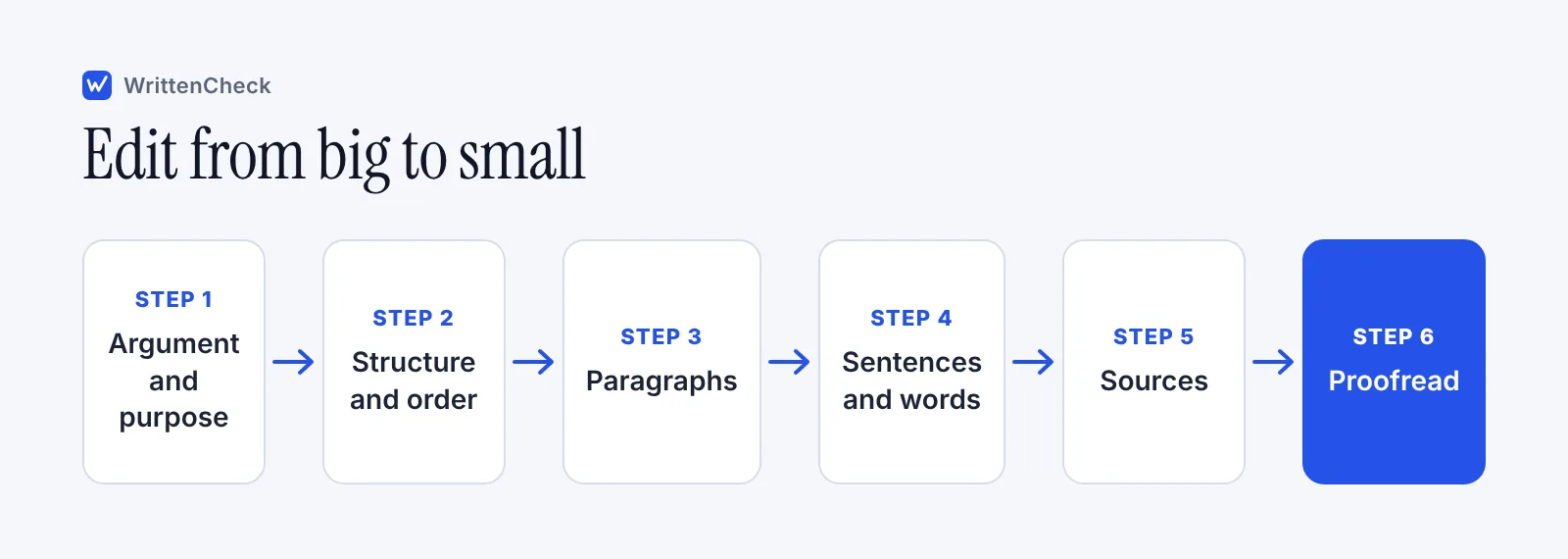
Purdue OWL suggests a similar order in its steps for revising. Find your main point, check your evidence, keep only what supports the thesis, then cut extra words, and only then fix grammar, punctuation and spelling.
The editing checklist (copy this)
Copy this list into your notes or print it. Tick each item before you move to the next pass.
Purpose and argument
The draft does what the assignment, prompt or brief asks.
I can state my main point in one sentence.
The thesis or main point appears early and is specific.
Every section supports the main point. Anything that doesn't is cut.
My evidence is enough to convince a skeptical reader.
Structure and paragraphs
The introduction tells the reader what to expect.
Each paragraph starts with a topic sentence that links to the main point.
Each paragraph makes one point.
Paragraphs are in a logical order, with clear transitions between them.
The conclusion does more than repeat the introduction.
Sentences and words
Most sentences use active voice and name who does what.
Sentence length varies. Not every sentence is the same shape.
Every "this," "it" and "they" clearly points to one thing.
Wordy phrases are cut ("in order to" becomes "to").
The same term means the same thing throughout. I don't swap synonyms for key terms.
The tone fits the reader.
Evidence and citations
Every fact, number and quote has a source.
Quotes are introduced and explained, never dropped in alone.
Citations follow the required style, such as APA, MLA or Chicago.
Paraphrases are in my own words and still cited.
Proofreading
Spelling, including names and technical terms.
Commonly confused words, like your/you're, its/it's, their/there/they're, affect/effect.
Punctuation, especially commas and apostrophes.
Complete sentences, with no fragments or run-ons.
Consistent verb tense.
Formatting, including headings, spacing, page numbers and title.
For more on two of these items, see our guides to transition words and sentence variety.
How do you edit your own writing?
Put distance between writing and editing, then work through the checklist one pass at a time. Here's the routine.
Take a break. The UNC Writing Center suggests putting the paper aside for a few hours, days or weeks. Purdue OWL suggests setting your writing aside at least twice during the process.
Write your main point in one sentence. If you can't, fix that before anything else.
Make a reverse outline. Write one line summing up each paragraph. Gaps and repeats show up fast.
Cut what doesn't belong. Purdue OWL asks whether all of your ideas relate back to the thesis. If one doesn't, cut it or save it for another piece.
Edit sentences aloud. Reading aloud slows you down, and you'll hear sentences that are too long or tangled.
Swap in plain words. Use the plain-word table below.
Check every source. Match each quote and number to its citation.
Proofread last. Use the five-minute pass further down.
Read it as a stranger. Purdue OWL suggests pretending you're reviewing someone else's work.
What does a good edit look like?
A good edit makes the writing clearer and more specific without changing what the writer meant. Here's an example paragraph with common problems.
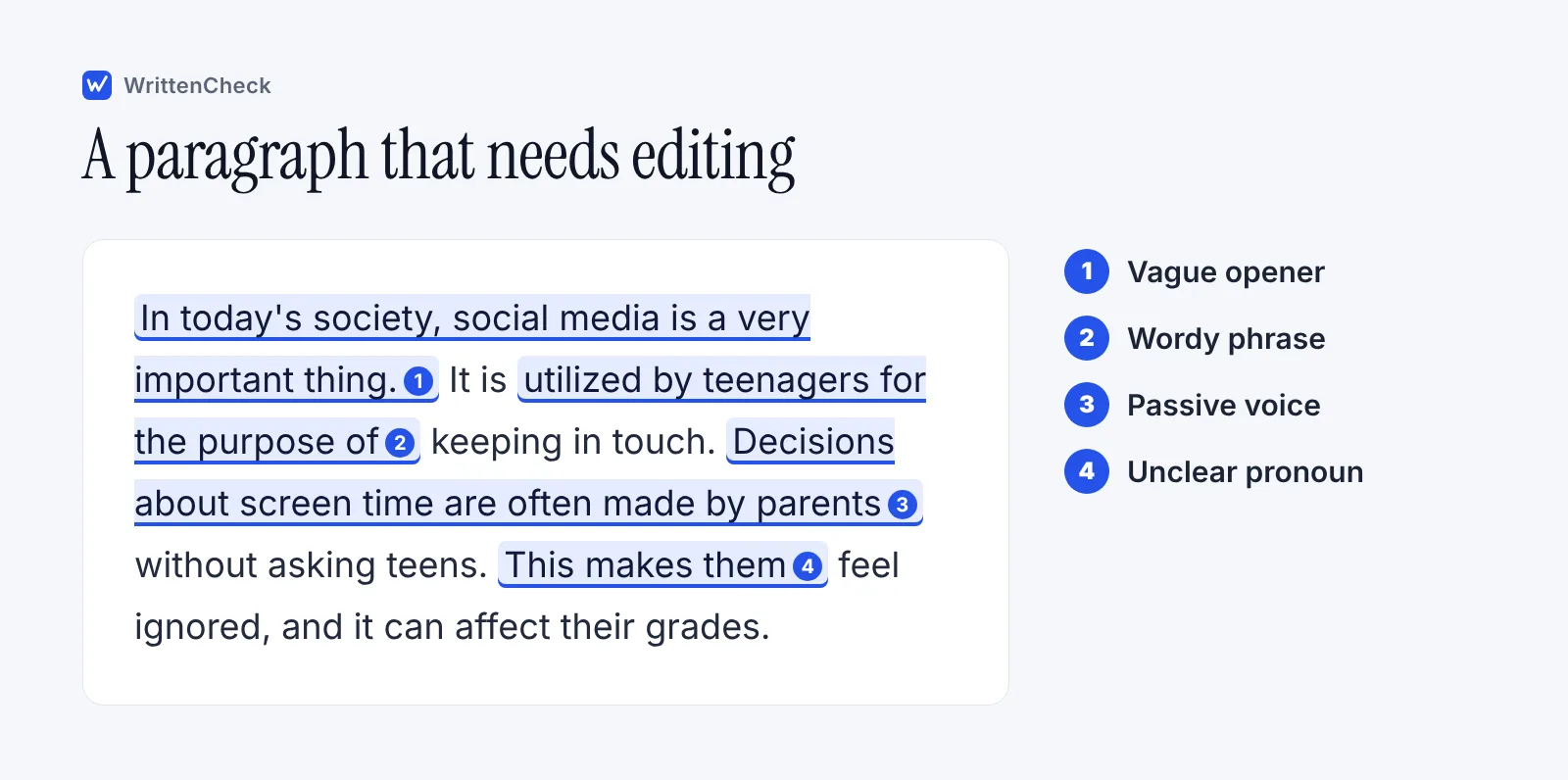
And here's the same paragraph after an edit.
Most teenagers use social media to keep in touch with friends. But parents often set screen-time rules without asking them. When that happens, many teens feel ignored. Some say it affects their schoolwork too.
What changed:
The vague opener went. "In today's society" and "a very important thing" said nothing.
"Is utilized by teenagers for the purpose of" became "use ... to." Shorter, and active.
"Decisions ... are often made by parents" became "parents often set ... rules." Now the reader knows who acts first.
"This makes them" was unclear. Does "them" mean parents or teens? The edit names the group.
"It can affect their grades" was a claim with no support. The edit softens it to what teens report. In a real essay, you'd add a source or an example.
Which words should you swap for plainer ones?
Swap long or formal words for short, common ones when they mean the same thing. The US National Archives, in its guide to clear writing for federal documents, recommends action verbs and simple words, with swaps like "utilize" to "use."
Instead of | Try |
|---|---|
utilize | use |
give consideration to | consider |
is applicable to | applies to |
terminate | end |
construct | make |
in order to | to |
for the purpose of | to, for |
at this point in time | now |
The first five swaps come from the National Archives guide. The rest follow the same idea. The government's plain language guidance, now carried on Digital.gov, adds a few more habits. Start with a topic sentence, use the active voice, and use lists and tables where they help.
How do you proofread effectively?
Proofread slowly, for one kind of error at a time, after the content is final. The UNC Writing Center recommends going slowly enough to look at every word, and it suggests a few tricks that make your brain see the text fresh.
Read aloud. You can't skip words when you say them.
Read backwards, sentence by sentence. This pulls your attention off the meaning and onto each sentence's grammar.
Change how it looks. A new font, size or color makes a familiar page look new.
Use a ruler or a blank sheet. Cover everything below the line you're reading.
Circle every punctuation mark. Then check each one.
Work in short sessions. Proofreading for hours in a row makes you miss things.
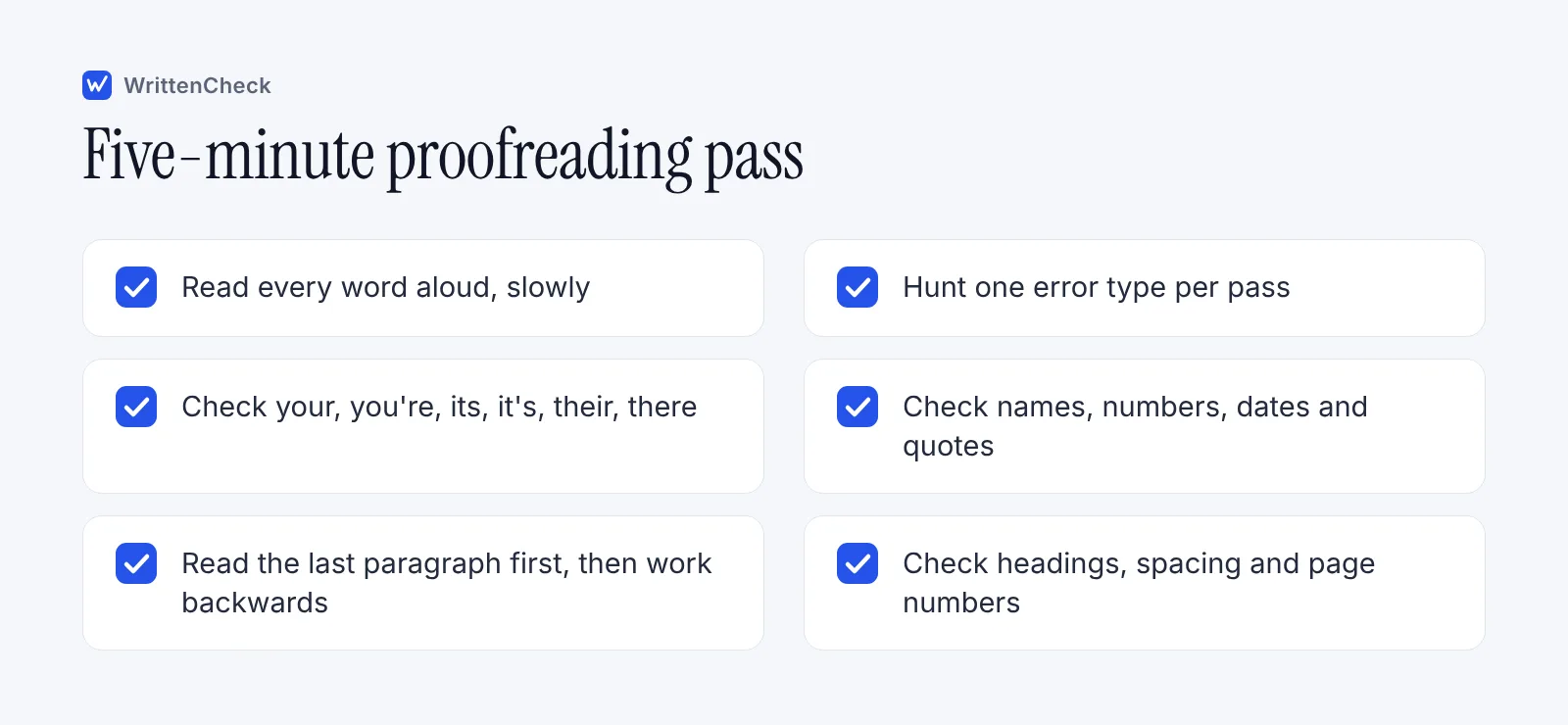
Don't lean on spell check alone. UNC points out that spell checkers miss homophones like "your" and "you're," and grammar checkers work from a limited set of rules and often get things wrong. Use them as a first sweep, then read it yourself.
Can AI tools help you edit?
AI tools can point out unclear sentences, grammar slips and repetition, but they can also flatten your voice. In a Pew Research Center survey of US teens ages 13 to 17 from fall 2025, 35% said they had used AI chatbots to edit something they wrote.
If your class or workplace allows it, use AI as a second reader. Ask it to flag problems, then fix them yourself. A prompt like "List the three least clear sentences in this paragraph and say why. Don't rewrite them" keeps the writing yours. If you accept rewritten sentences wholesale, your draft can start to sound generic, and your teacher may count AI rewriting as AI writing. Check your rules first.
Want to see which of your sentences sound most generic? Paste your draft into our free AI detector. It highlights the sentences that read most like AI. Those are often the ones that need a specific example, which is good editing advice either way. For word-level patterns to watch, see our list of AI words to avoid.
Frequently asked questions
What should be on an editing checklist?
A good editing checklist covers purpose, structure, paragraphs, sentences, word choice, sources and proofreading, in that order. Ask whether the draft answers the brief, whether each paragraph makes one point, whether sentences are clear and active, whether every claim is cited, and finally whether spelling, grammar and punctuation are right.
What is the difference between a proofreading checklist and an editing checklist?
A proofreading checklist covers surface errors, such as spelling, grammar, punctuation, confused words and formatting. An editing checklist covers more, including your argument, organization, paragraph focus, clarity and sources. Most writers need both. Use the editing checklist first, while the draft can still change, and save the proofreading checklist for the final pass.
How many times should I edit a paper?
There's no fixed number, but plan at least two separate sessions with a break between them. Purdue OWL suggests setting your writing aside at least twice during the process. A practical plan is one session for big issues like argument and structure, one for sentences and sources, and a final short proofread.
How do I proofread my own writing when I can't see the mistakes?
Make the text look unfamiliar. Read it aloud, change the font or size, print it, or read it backwards one sentence at a time. Hunt for one kind of error per pass, such as apostrophes, then commas. The UNC Writing Center recommends all of these, along with taking a break so you come back with fresh eyes.
Is it okay to use a grammar checker?
Yes, as a first sweep. Grammar checkers catch many simple slips. But they miss words that are spelled correctly and used wrongly, and they flag things that aren't errors. Read each suggestion before accepting it. If you're a student, check whether your class allows AI writing tools, since some go well beyond grammar.
How can I improve my writing skills over time?
Keep a short list of the mistakes you make most often, and check for those first every time you edit. Read your work aloud, ask someone else to read it, and study how edits change your sentences. Over time the checklist becomes a habit, and your first drafts get cleaner.
Sources
Editing and Proofreading, The Writing Center, University of North Carolina at Chapel Hill, updated March 2026
Steps for Revising Your Paper, Purdue Online Writing Lab, Purdue University, accessed October 2026
Editing Checklist, The Writing Center, George Mason University, accessed October 2026
Principles of Clear Writing, Office of the Federal Register, US National Archives, reviewed March 2022
Principles of plain language, Digital.gov, US General Services Administration, September 2025
Plain language guide series, Digital.gov (content carried forward from PlainLanguage.gov), September 2025
How Teens Use and View AI, Pew Research Center, February 2026

Comments