A research paper outline is the plan you write between collecting sources and drafting. It lists your thesis, your main points in order, and the evidence under each one. With a good outline, drafting becomes filling in boxes. Without one, you'll often end up with 3,000 words of notes and no argument.
This guide shows how to build a research paper outline that you'll actually use, with the main outline formats, copyable templates for argument papers and IMRaD science papers, and a worked example.
What is a research paper outline?
A research paper outline is a structured plan of your paper written before the full draft. It states your research question or thesis, lists the main sections in order, and places the evidence and sources that support each point beneath it. Most outlines use numbered levels, such as Roman numerals for sections and letters for sub-points. The outline helps you see gaps, repeats and weak points before you start writing.
Which outline format should you use?
Use the format your instructor asks for. If there's no instruction, pick the one that fits how you think. The MLA Style Center explains that the MLA doesn't set its own outline format, and that your instructor will usually tell you which form to use.
Purdue OWL describes three common formats.
Format | How it's numbered | Best for |
|---|---|---|
Alphanumeric | I, A, 1, a, then (1) and (a) if you need more levels | Most class papers, humanities and social sciences |
Decimal | 1, 1.1, 1.1.1 | Showing how each level fits into the whole, common in science and technical work |
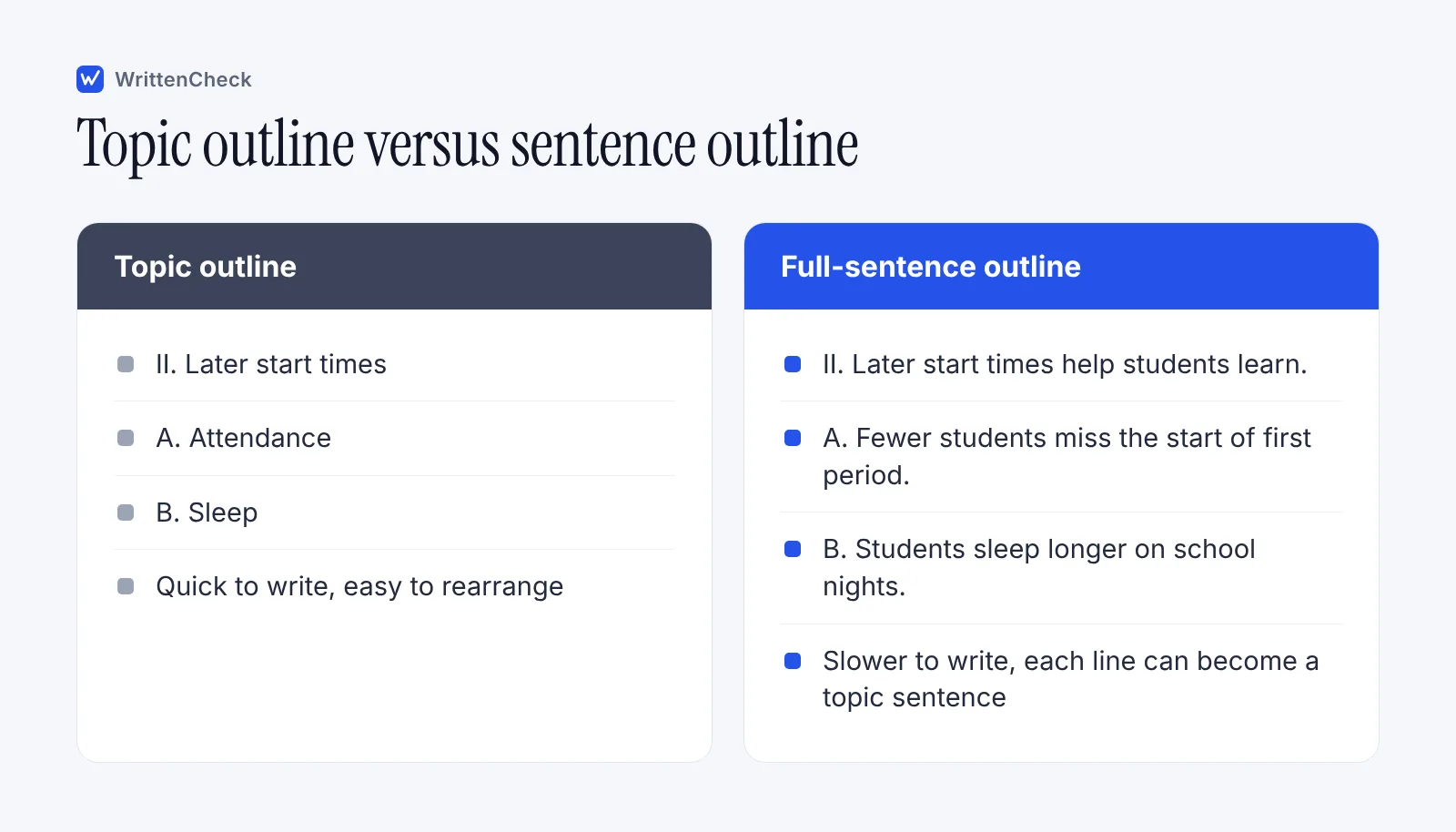
Full-sentence | Either system, with a full sentence at every level | Papers where each line will become a topic sentence |
Purdue OWL's own outlining advice is to create main headings and subheadings, and arrange material from general to specific or from abstract to concrete.
What is the structure of a research paper?
It depends on the kind of paper. Purdue OWL separates two common types. An argumentative research paper takes a stance in the introduction and tries to persuade. An analytical research paper starts from a research question the writer hasn't taken a stance on, then explores and evaluates.
Empirical papers that report a study or experiment usually follow IMRaD. IMRaD stands for Introduction, Methods, Results and Discussion. The International Committee of Medical Journal Editors (ICMJE) says original research articles are "usually divided" this way, and calls it a reflection of the process of scientific discovery.
Paper type | Typical research paper structure | Where the thesis or question goes |
|---|---|---|
Argumentative research paper | Introduction, body sections that build the argument, counterargument, conclusion | Thesis stated in the introduction |
Analytical research paper | Introduction with research question, body sections exploring evidence, conclusion with your interpretation | Question in the introduction, answer built through the paper |
Empirical (IMRaD) paper | Introduction, Methods, Results, Discussion, References | Question or hypothesis at the end of the introduction |
For research paper format, check your style guide. Purdue OWL's APA guide lists four major sections for an APA paper: title page, abstract, main body and references. It also notes that abstracts aren't typically required for student papers unless your instructor asks.
How do you write a research paper outline?
Build it in stages, alongside your research. Here's the method.
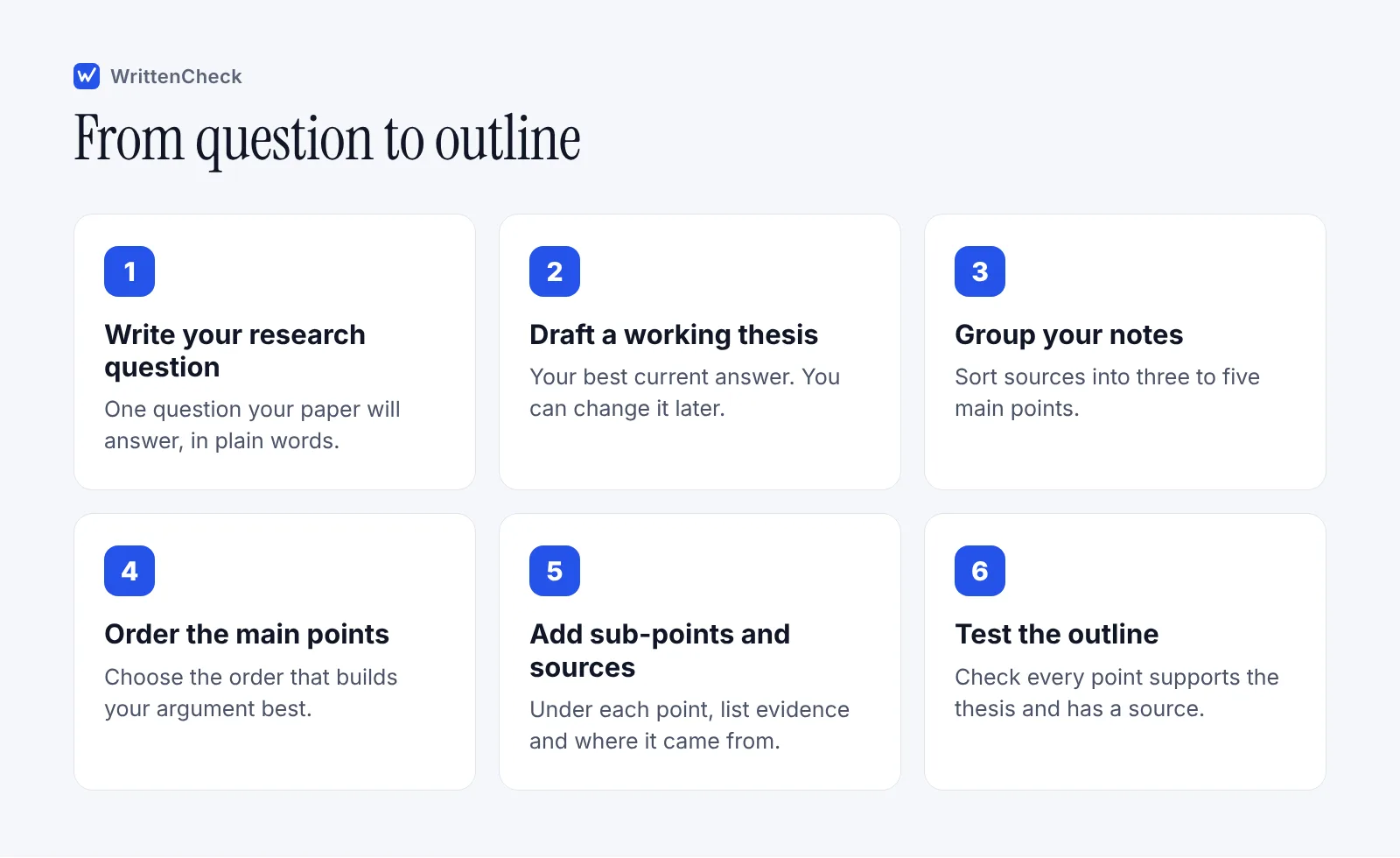
Write your research question. One sentence. For example: "Does a later school start time improve attendance?"
Draft a working thesis. Your best current answer. In an analytical paper, it can be a hypothesis you'll test. Our guide on how to write a thesis statement shows how to make it specific.
Group your notes. Sort what you've found into three to five clusters. Each cluster is a candidate main point.
Order the main points. Put them in the order that builds your argument, such as background first, then strongest evidence, then the objection.
Add sub-points with sources. Under each main point, list the evidence and the source it comes from, with an author and year.
Mark the gaps. Where a point has no source yet, write "NEED SOURCE." That's your research to-do list.
Test it against your thesis. Every main point should help answer the question. Cut or move anything that doesn't.
This is also how to write a research paper without stalling. Once the outline holds, each section can be drafted on its own, in any order.
Research paper outline template for an argument or analysis paper
Copy this alphanumeric template and fill in the brackets. It suits most humanities and social science papers.
Working title: [ ]

I. Introduction
   A. Opening context: [why this topic matters now]
   B. Background: [key terms, short history]
   C. Research question: [ ]
   D. Thesis: [your answer, in one sentence]

II. Main point 1: [claim]
   A. Evidence: [fact, quote or data] (Source, year)
   B. Evidence: [ ] (Source, year)
   C. Analysis: [what this shows about the thesis]

III. Main point 2: [claim]
   A. Evidence: [ ] (Source, year)
   B. Analysis: [ ]

IV. Main point 3: [claim]
   A. Evidence: [ ] (Source, year)
   B. Analysis: [ ]

V. Counterargument
   A. Strongest objection: [ ] (Source, year)
   B. Your reply: [ ]

VI. Conclusion
   A. What the points add up to
   B. Limits of your research
   C. What should be studied or done next

References / Works Cited
If you need help structuring the body sections, our guide to essay structure covers paragraph order and the claim, evidence and analysis pattern.
IMRaD research paper outline template for scientific papers
Use this decimal template for lab reports and papers that report your own study. The section contents follow ICMJE guidance and the UNC Writing Center's handout on scientific reports.
Title
Abstract (if required)

1. Introduction
   1.1 Background and what's already known (key sources)
   1.2 The gap or problem
   1.3 Purpose, research question or hypothesis

2. Methods
   2.1 Participants, materials or samples
   2.2 Procedure, in enough detail to repeat
   2.3 How data were collected
   2.4 How data were analyzed

3. Results
   3.1 Main finding (table or figure)
   3.2 Other findings
   (Report results here. Save interpretation for section 4.)

4. Discussion
   4.1 Do the results support the hypothesis?
   4.2 How they compare with earlier studies
   4.3 Limitations
   4.4 Implications and next steps

References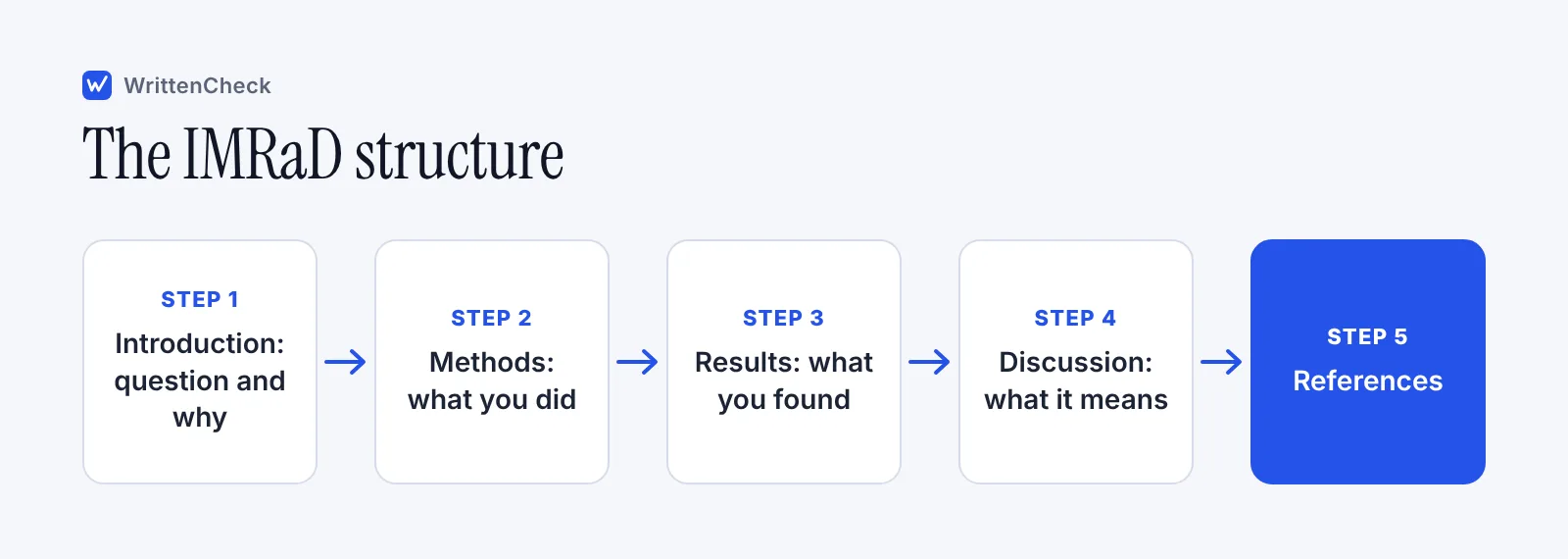
The UNC Writing Center says the methods should be detailed enough that other researchers could follow the same procedure. It also says results should be presented without drawing conclusions, which belong in the discussion.
You don't have to write in IMRaD order. UNC notes that many writers draft Methods and Results first, because it clarifies their idea of the experiment. Write the introduction once you know what you found.
Research paper outline example
Here's a worked example of a full-sentence outline for a short argumentative paper. The topic and claims are an example to show the format, and the "Source" placeholders show where real citations would go.
Research question: Should our district move high school start
times to 8:30 a.m. or later?

I. Introduction
   A. Many students in the district start first period before 8 a.m.
   B. Thesis: The district should move start times to 8:30 a.m.,
      because it would improve attendance and sleep, and the
      transport problems can be solved.

II. Later starts improve first-period attendance.
   A. Districts that changed start times reported fewer late
      arrivals. (Source, year)
   B. Missed first periods mean missed instructions that students
      must catch up on alone.

III. Later starts give students more sleep.
   A. Health guidance sets a recommended amount of sleep for
      teenagers. (Source, year)
   B. Student surveys after a change show longer sleep on school
      nights. (Source, year)

IV. Bus costs are the strongest objection.
   A. Shared buses run elementary and high school routes in
      sequence. (District transport report, year)
   B. Reply: Staggering routes differently can keep costs flat.
      (Source, year)

V. Conclusion
   A. Attendance and sleep gains outweigh a solvable bus problem.
   B. Next step: a one-year pilot at two high schools.
Each line is a claim you can turn into a topic sentence. Each claim has a source slot. That's what makes the outline usable.
What are the most common outline mistakes?
Most outline problems come from outlining your notes instead of your argument.
Main points that are topics. "Sleep" is a topic. "Later starts give students more sleep" is a point you can prove.
No sources under points. If a point has no evidence listed, you'll stall when you reach it in the draft.
One-item levels. If you have a "1" with no "2", fold it into the line above or find a second point.
Mixing results and interpretation. In IMRaD papers, UNC says to save conclusions for the discussion.
Unchecked AI-suggested sources. Look up every citation before it goes in your outline.
Treating the outline as fixed. If research changes your answer, change the thesis and the outline.
Once you've drafted from your outline, you can paste a section into our free AI detector to see which sentences read most like AI. It checks 40 to 3,000 words at a time and gives a score for each sentence.
Frequently asked questions
How long should a research paper outline be?
Long enough to show every main point and its evidence. For a short paper, that might be one page of topic lines. For a longer paper, a full-sentence outline can run several pages. A useful test is whether you could draft any section from the outline alone, without rereading all your notes. If you can't, add the missing evidence or analysis lines.
Is there an official MLA or APA outline format?
No. The MLA Style Center explains that the MLA doesn't set its own outline format and leaves the choice to your instructor. Common choices are the alphanumeric format (I, A, 1, a) and the decimal format (1, 1.1, 1.1.1), both described by Purdue OWL. If your instructor gives a template or format, follow it exactly, since it may be part of the grade.
What is IMRaD?
IMRaD stands for Introduction, Methods, Results and Discussion. It's the standard structure for papers that report original research, especially in science and medicine. The International Committee of Medical Journal Editors describes it as reflecting the process of scientific discovery. The introduction poses the question, methods explain what was done, results report findings, and the discussion interprets them.
Does a student research paper need an abstract?
Usually not, unless your instructor asks for one. Purdue OWL's APA guide notes that abstracts are common in journal articles but not typically required for student papers. Check your assignment sheet. If an abstract is required, write it last, after the paper is finished, so it accurately summarizes your question, method, findings and conclusion.
Should I write the outline before or after research?
Both. Start a rough outline once you have a research question and a few sources, so you know what to look for. Then update it as you read. Before drafting, tighten it into a final version with a thesis, ordered main points and a source under each. Writing the outline only at the end, after all the research, often leaves you with notes that don't fit together.
Can I use AI to make a research paper outline?
Only if your course allows it, and then carefully. Some instructors permit AI for brainstorming structure, while others ban it, so check the policy and disclose use where required. Never take sources from an AI tool without finding and reading each one yourself, because AI tools can invent citations. The outline's points and evidence should come from your own reading.
Sources
Types of Outlines and Samples, Purdue OWL, accessed October 2026
How to Outline, Purdue OWL, accessed October 2026
Does the MLA offer guidance for outlines?, MLA Style Center, August 2018
Genre and the Research Paper, Purdue OWL, accessed October 2026
General Format (APA), Purdue OWL, APA 7th edition, accessed October 2026
Preparing a Manuscript for Submission to a Medical Journal, International Committee of Medical Journal Editors, accessed October 2026
Scientific Reports, The Writing Center, UNC Chapel Hill, March 2026


Comments