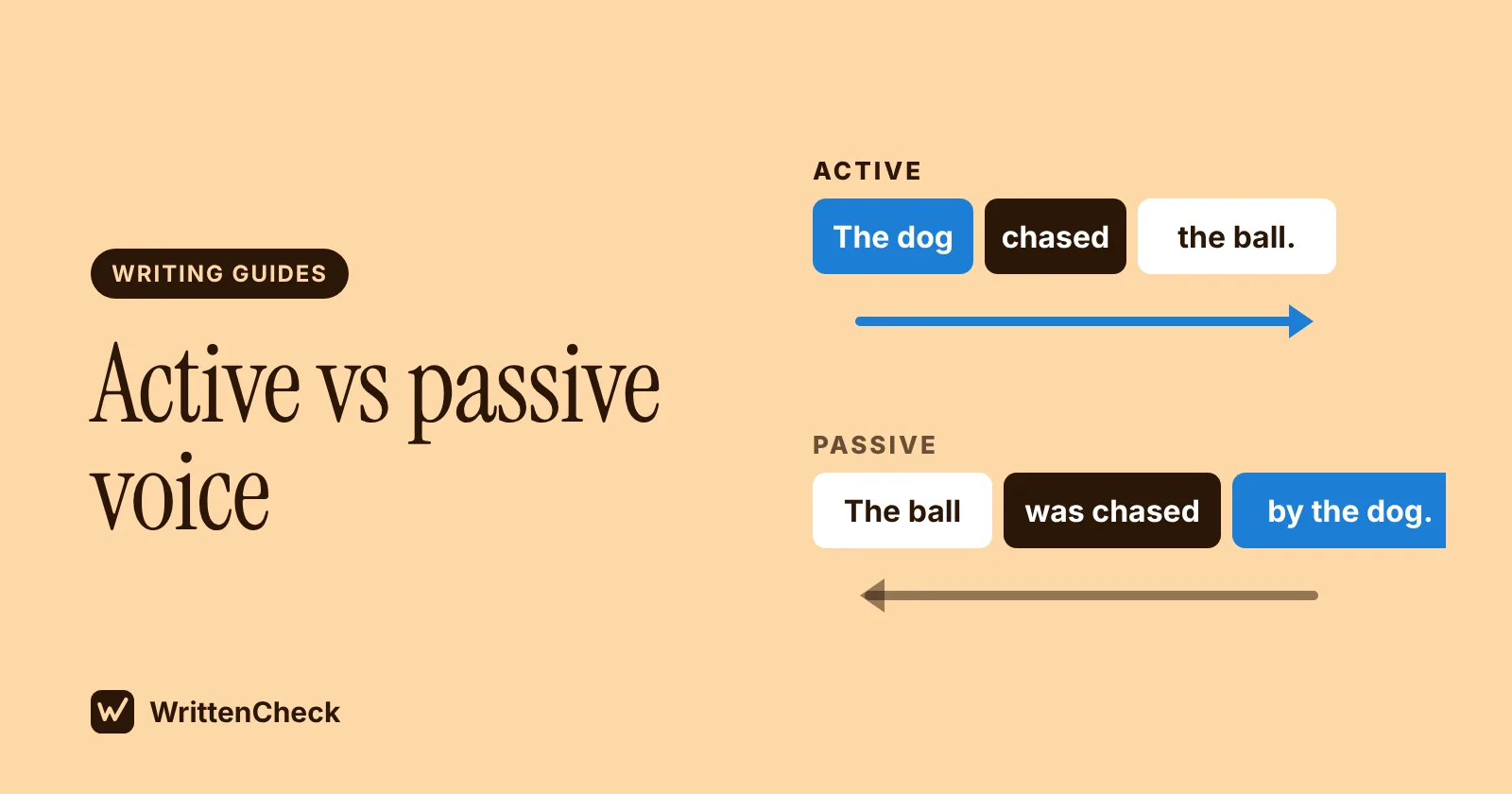
Active vs passive voice comes down to one question. Who is doing the action, and where do they sit in the sentence? In active voice, the doer comes first ("The committee approved the budget"). In passive voice, the thing being acted on comes first ("The budget was approved by the committee"), and the doer can disappear entirely.
Neither voice is a grammar mistake. Passive voice has real uses. But writing centers and style guides agree that active voice is usually the clearer choice, because it shows who did what.
This guide shows you how to spot passive voice in any tense, when it's the right choice, and how to rewrite it. Every rule comes with examples you can copy.
What is the difference between active vs passive voice?
In active voice, the subject of the sentence performs the action. "The dog bit the boy." In passive voice, the subject receives the action, and the doer either moves to a "by" phrase or vanishes. "The boy was bitten by the dog" or just "The boy was bitten." Active voice is usually shorter and clearer about who acted. Passive voice shifts attention to the person or thing affected.
Purdue OWL defines active voice the same way. The subject "performs the action expressed in the verb." Passive voice flips that order.
Here are a few pairs that show the difference.
Active voice | Passive voice |
|---|---|
The chef cooked the meal. | The meal was cooked by the chef. |
Researchers tested the vaccine. | The vaccine was tested (by researchers). |
You must submit the form by Friday. | The form must be submitted by Friday. |
The drafter wrote the regulation. | The regulation was written by the drafter. |
The last pair is from the US Office of the Federal Register, which tells writers of government rules to write in active voice so readers know who has to do what.
How do you identify passive voice?
Look for a form of "to be" followed by a past participle. Forms of "to be" include is, are, was, were, be, being and been. A past participle is the verb form that usually ends in "-ed" or "-en", such as "tested", "written" or "chosen". The UNC Writing Center uses this same formula.
The "by zombies" test
A popular classroom trick gives you a quick test. If you can add "by zombies" after the verb and the sentence still makes grammatical sense, it's passive.
"The window was broken by zombies." Makes sense, so it's passive.
"The students broke the window by zombies." Doesn't make sense, so it's active.
Passive voice examples in every tense
Passive voice works in any tense, which is why it's easy to miss. Here are passive voice examples built on one sentence.
Tense | Active | Passive |
|---|---|---|
Present | The teacher grades the essays. | The essays are graded. |
Past | The teacher graded the essays. | The essays were graded. |
Present perfect | The teacher has graded the essays. | The essays have been graded. |
Future | The teacher will grade the essays. | The essays will be graded. |
Present progressive | The teacher is grading the essays. | The essays are being graded. |
With a modal verb | The teacher must grade the essays. | The essays must be graded. |
What isn't passive voice?
Three things often get mistaken for passive voice.
Past tense. "She wrote the report" is past tense and active. Tense and voice are separate.
"To be" plus an adjective. "The room was quiet" has no action at all. Some participles act like adjectives too ("I was tired"). If no one could have done the action to the subject, it isn't passive.
Progressive verbs. "The students were writing essays" uses "were", but the students are doing the writing. That's active.
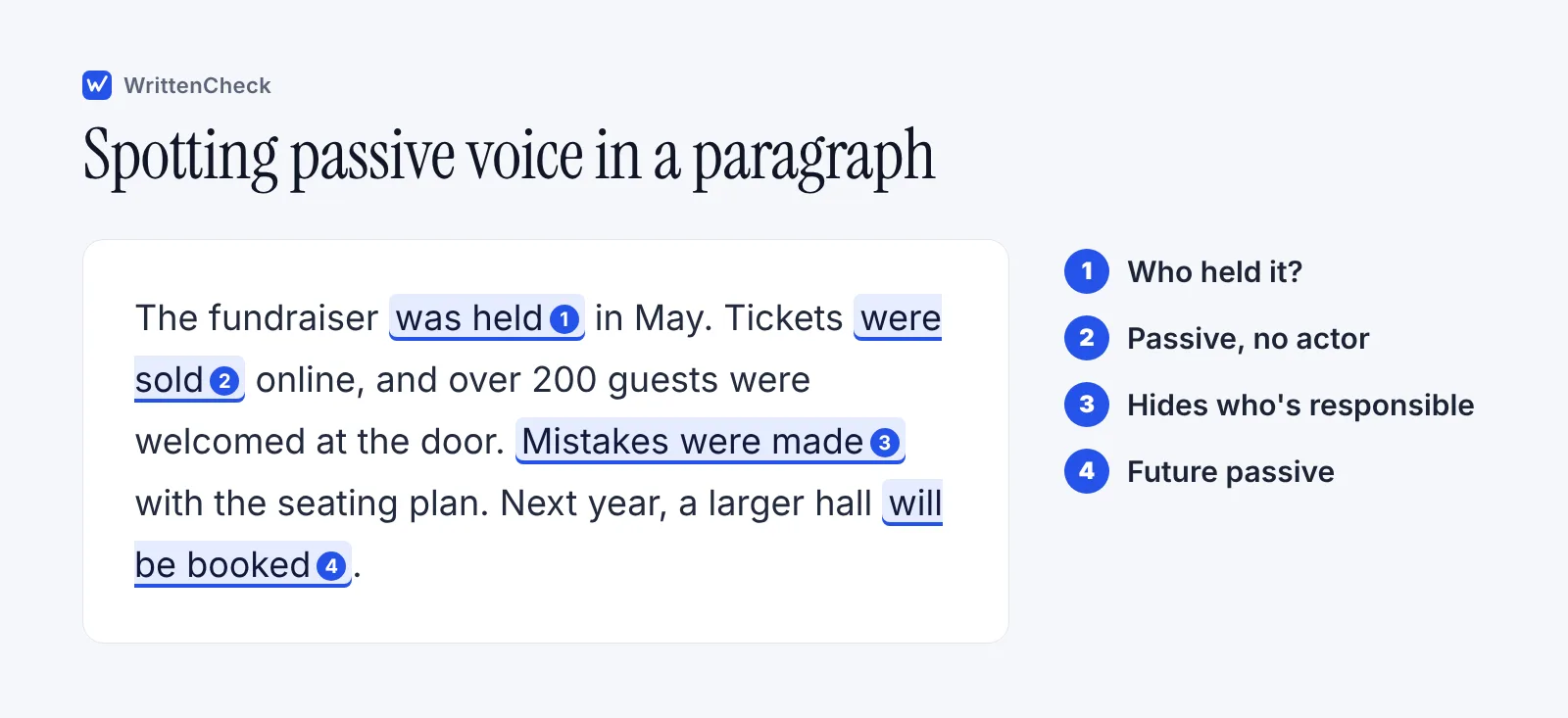
Here's an example paragraph with the passive verbs marked.
When should you use passive voice?
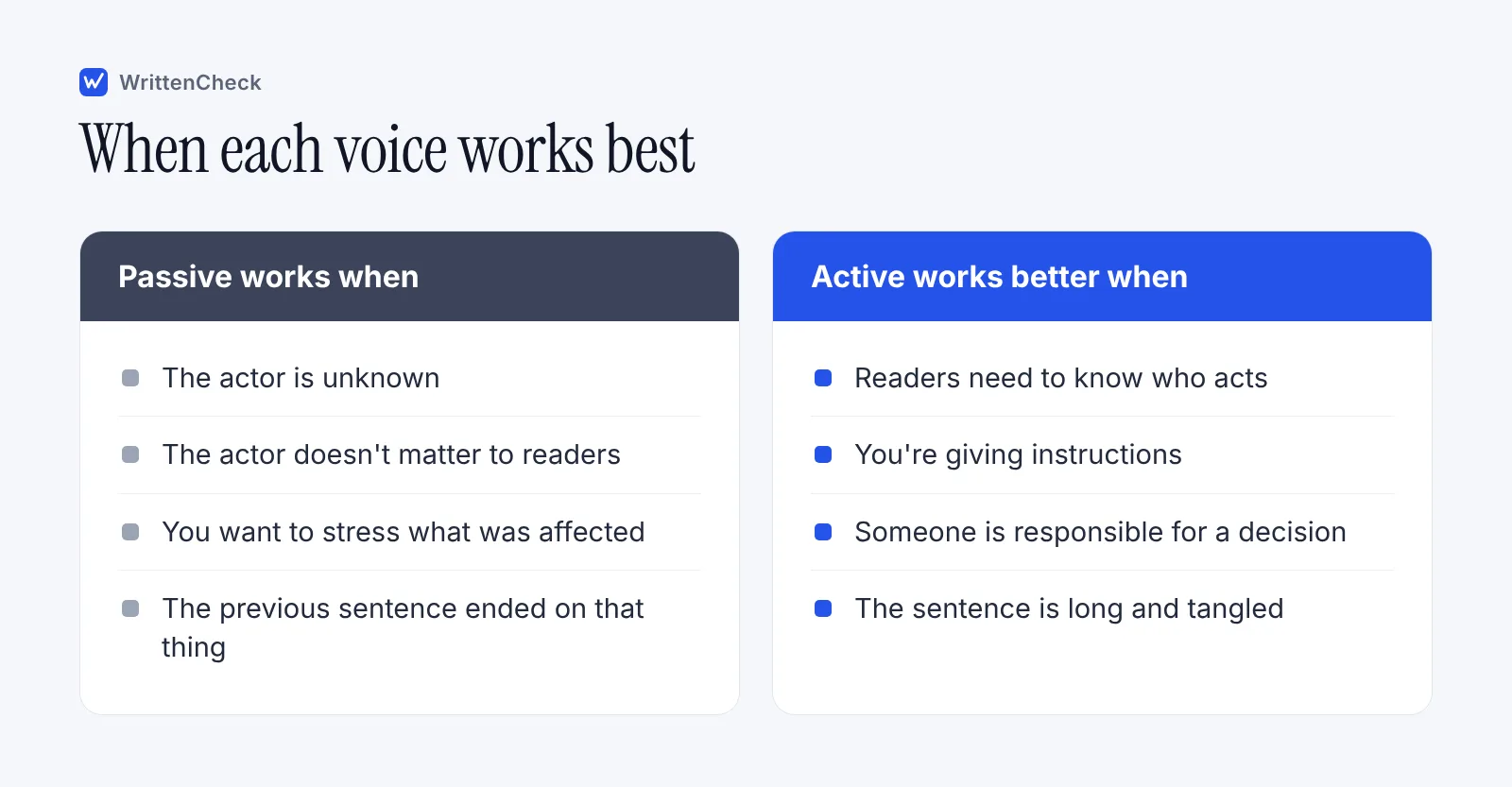
Use passive voice when the actor is unknown, unimportant or obvious, or when you want to put the focus on what happened to something. Active voice is the better default, but passive voice is a tool, and good writers use it on purpose.
The UNC Writing Center lists most of these uses, and the examples come from its handout.
To stress the thing acted on. "One hundred votes are required to pass the bill." The votes matter more than who requires them.
When the actor is unknown. "Over 120 contaminants have been dumped into the river." No one knows who dumped them.
When readers don't need to know. A birth announcement says the baby "was delivered at 3:30 a.m.", without naming the doctor.
In some lab reports. Some instructors and fields still prefer passive voice for methods sections, so check what yours expects.
The US government's plain language guidance on Digital.gov adds a case from legal writing. When one action follows another as a matter of law, and nobody besides the law does the second action, a passive sentence may be the best choice.
Passive voice can also help paragraphs flow. The Duke University Graduate School guide to scientific writing notes that passive voice lets you start a sentence with information the reader just saw. Compare these two examples.
The lab tested three samples. The second sample was contaminated by a cleaning agent.
The lab tested three samples. A cleaning agent contaminated the second sample.
The first version keeps "the second sample" near the start, where the reader expects it after the first sentence. Here, passive voice is the better choice.
What does APA say about passive voice?
APA Style prefers active voice but accepts passive voice in some cases. Walden University's Writing Center, summarizing section 4.13 of the APA Publication Manual (7th edition), says active voice makes clear who is acting. It lists cases where passive voice is acceptable, such as when readers already know the actor, in background writing, or when you want to stress the object of the action.
APA also encourages the first person ("I" or "we") to describe your own work. So "I interviewed 12 teachers" is fine in APA style. You don't need "Twelve teachers were interviewed" to sound objective.
On active vs passive voice, journals have moved the same way. Nature Portfolio's advice to authors says that using active voice, as in "we performed the experiment", typically helps readers understand concepts and results.
How do you change passive voice to active voice?
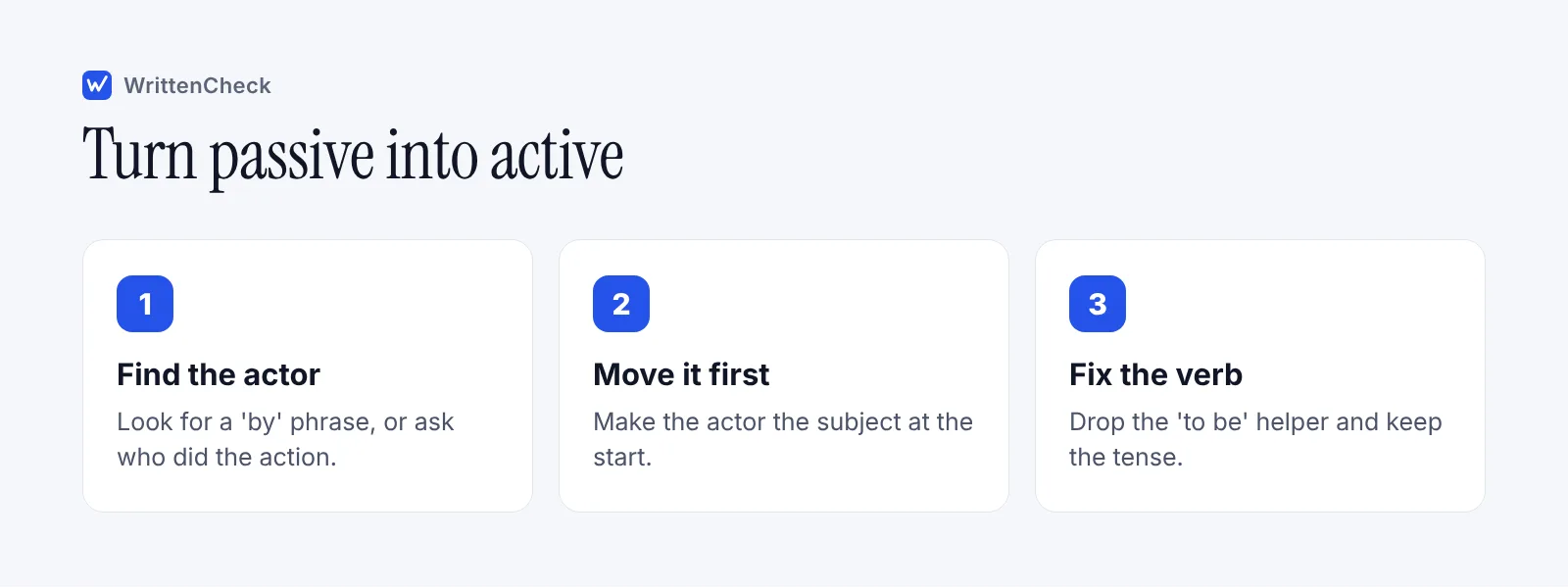
To change passive to active voice, find who did the action, make that person or thing the subject, and rewrite the verb without the "to be" helper. Keep the tense the same. If the sentence never names an actor, you'll have to decide who it is.
Find the actor. Look for a "by" phrase. If there isn't one, ask who did the action.
Move the actor to the front. Make it the subject of the sentence.
Rewrite the verb. Remove "is", "was", "has been" and so on, and put the main verb in the matching active tense.
Put the old subject after the verb. It becomes the object.
Read it back. Check that the meaning hasn't changed.
Here are worked examples, from easy to tricky.
Passive | Step | Active |
|---|---|---|
The ball was kicked by Sam. | Actor is in the "by" phrase | Sam kicked the ball. |
The results will be announced on Monday. | Actor missing, so supply it | The school will announce the results on Monday. |
It was decided that the trip would be cancelled. | Two passives, no actor | The principal decided to cancel the trip. |
Mistakes were made. | Actor hidden | I made mistakes. / The team made mistakes. |
The metropolis has been scorched by the dragon's fiery breath. | Keep the tense | The dragon's fiery breath has scorched the metropolis. |
The passive version in the last row is from the UNC Writing Center handout.
What mistakes do people make with passive voice?
The biggest mistake is using passive voice by habit, so readers can't tell who did what. The second biggest is treating every passive sentence as an error and rewriting good ones.
Hiding responsibility. "Mistakes were made" and "The decision was taken" leave out who acted. In a report, an apology or a policy, readers usually need to know.
Stacking passives. "It is believed that changes will be needed" has two passives and no people. Try "We think the school needs to change."
Vague claims. "It has been argued that..." Argued by whom? In an essay, name the source. The UNC handout warns that passive voice can hide the people and decisions behind an event, which weakens analysis.
Switching voice mid-sentence. "The class read the novel, and an essay was written about it" mixes active and passive. "The class read the novel and wrote an essay about it" is smoother.
Calling past tense passive. As shown above, "was" alone doesn't make a sentence passive.
Vague, agentless phrases like "it is widely believed" also make writing sound generic. Our guide on how to make writing sound less like AI covers that habit and others.
How do you check a draft for passive voice?
Treat active vs passive voice as a choice you make sentence by sentence. Search your draft for "was", "were", "been" and "being", then check each hit with the "by zombies" test. Decide case by case. Keep the passive sentences that do a job. Rewrite the ones that hide the actor for no reason.
A few tips make this faster.
Start with the thesis and topic sentences. The UNC handout tells writers to think twice before using passive voice in a thesis, where precision matters most.
Check instructions and policies closely. Active voice and the imperative ("Submit the form by Friday") tell readers exactly what to do.
Read for rhythm afterward. Rewriting voice changes sentence length and openings. Our guide to sentence variety shows how to check that the paragraph still flows.
For a full pass over grammar, clarity and style, use our editing checklist. And when your draft is done, you can paste it into our free AI detector to see which sentences read most like AI.
Frequently asked questions
Is passive voice grammatically wrong?
No. Passive voice is correct grammar in English. Style guides discourage overusing it because it can be wordy and can hide who did the action. They don't ban it. APA Style, writing centers and government plain-language guides all accept passive voice when the actor is unknown or unimportant, or when the focus belongs on what was affected.
Is "I was born in May" passive voice?
Yes. "Was born" is a form of "to be" plus the past participle of "bear", so it's passive. It's also the natural way to say it in English, since the person being born is the focus. The UNC Writing Center uses birth announcements as an example of passive voice that works. Not every passive sentence needs a rewrite.
Should scientific papers use passive voice?
Many older papers used passive voice heavily in methods sections, and some instructors still expect it. Today, many journals and APA Style prefer active voice where it fits. Nature Portfolio's author guidance says active voice, as in "we performed the experiment", typically helps readers understand results. Check your journal's or instructor's guidelines and mix the two where it helps the reader.
Can a sentence be passive without a "by" phrase?
Yes, and most passive sentences don't have one. "The essays were graded" is passive even though it never says who graded them. That missing actor is one reason style guides warn about passive voice. If readers need to know who acted, add the actor back or rewrite the sentence in active voice.
Is passive voice bad in a thesis statement?
Usually, yes. A thesis should say clearly who did what and why it matters. The UNC Writing Center says to think twice before using passive voice in a thesis, and warns that passive summaries can hide the people and decisions behind an event. "Mistakes were made in the war" says little. Naming the actor gives you something to argue about.
Does active voice improve a readability score?
Sometimes, but only by accident. Readability formulas such as Flesch Reading Ease count sentence length and syllables. They don't look at voice. Active sentences are often shorter, so the score may rise a little. Our guide to Flesch Reading Ease explains what those scores do and don't measure.
Sources
Passive Voice, The Writing Center, University of North Carolina at Chapel Hill, updated March 2026
Active and Passive Voice, Purdue Online Writing Lab, accessed October 2026
Scholarly Voice: Active and Passive Voice, Walden University Writing Center, accessed October 2026
Plain Language: Write in Active Voice, Office of the Federal Register, August 2011
Writing for understanding, Digital.gov, US General Services Administration, September 2025
Passive Voice in Scientific Writing, Scientific Writing Resource, Duke University Graduate School, accessed October 2026
How to write your paper, Nature Portfolio, accessed October 2026



Comments