Paraphrasing is putting someone else's idea into your own words and your own sentence structure, then citing where it came from. That's the full answer to "what is paraphrasing?" Most of the trouble comes from the middle part. Changing the words is easy. Changing the structure, while keeping the meaning exact, takes practice.
Good paraphrasing shows you understood a source. It lets you blend evidence into your own argument instead of stacking quotes. Weak paraphrasing slides into patchwriting, which schools such as Bowdoin College count as plagiarism.
This guide gives you a clear definition, one source passage rewritten five ways, a 5-step method, APA and MLA citation formats, and the mistakes that trip people up.
What is paraphrasing?
Paraphrasing is restating a specific passage from a source in your own words and your own sentence structure, while keeping its meaning, and crediting the original author with a citation. Purdue OWL defines a paraphrase as "your own rendition of essential information and ideas expressed by someone else, presented in a new form." A paraphrase is usually about as detailed as the original. It's a skill for using evidence honestly. The idea still belongs to the source.
Two guidelines from the US Office of Research Integrity (ORI) set the bar. A paraphrase must use your own words and your own sentence structure (guideline 4), and you must name the source (guideline 5).
What's the difference between quoting, paraphrasing and summarizing?
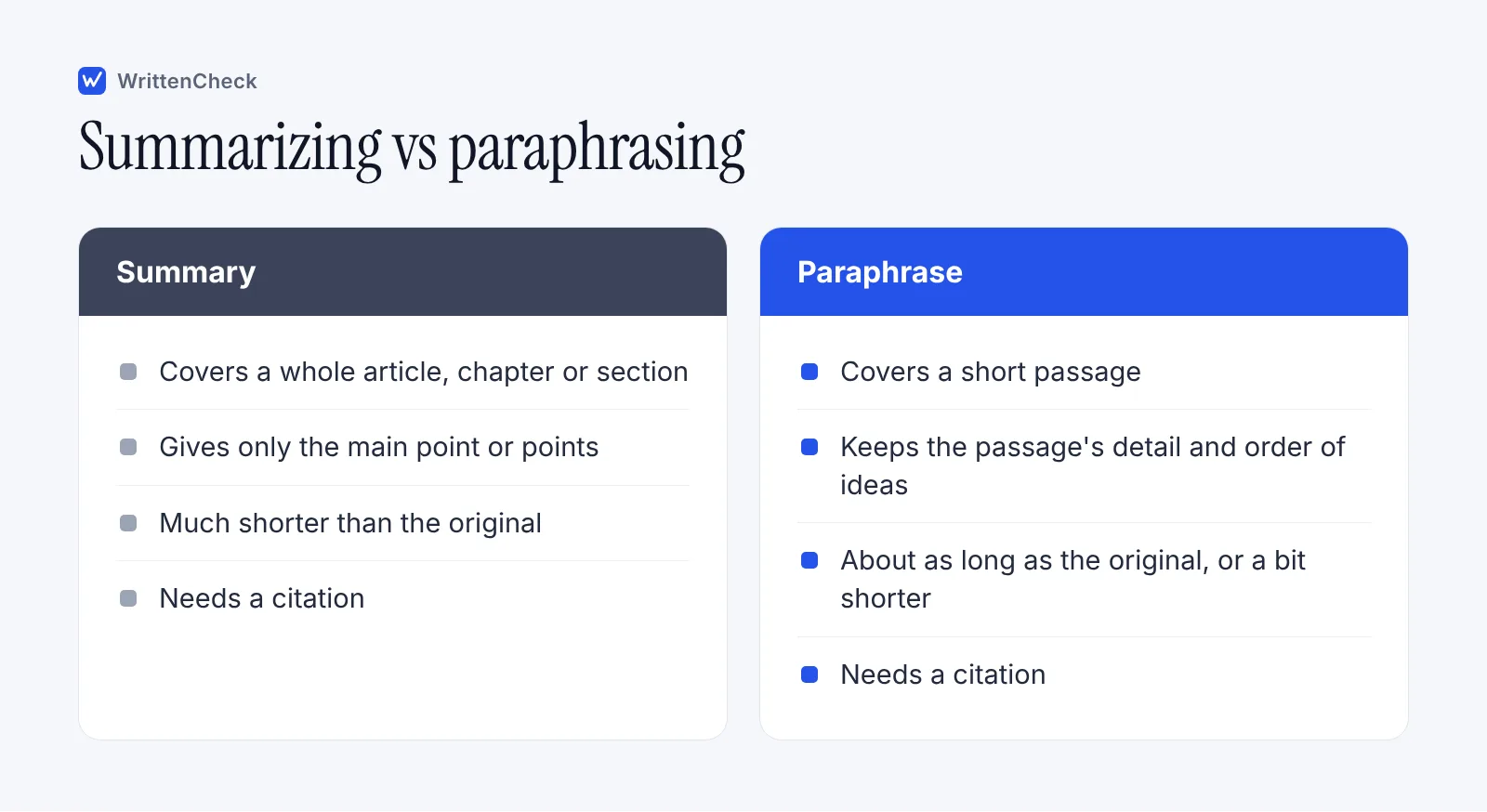
Quoting copies exact words. Paraphrasing restates one passage in your own words at similar detail. Summarizing gives only the main idea of a longer text, much more briefly. All three need a citation.
Quote | Paraphrase | Summary | |
|---|---|---|---|
Wording | Exact words of the source | Your own words and structure | Your own words |
Length | Short, as few words as possible | About the same as the passage, or a bit shorter | Much shorter than the original |
Covers | A phrase or sentence | A short passage | A whole article, chapter or section |
Quotation marks | Yes | Only around any borrowed phrase | Only around any borrowed phrase |
Citation needed | Yes | Yes | Yes |
Best for | Distinctive wording you'll analyze | Detailed evidence in your own flow | The big picture of a source |
Writing guides differ slightly on length. Purdue OWL says a paraphrase is usually somewhat shorter than the original, while the University of Utah Writing Center says a paraphrase will be as long as the original, or possibly longer. Both agree a summary is much shorter.
When to quote instead of paraphrase
Quote when the exact words matter. The UNC Writing Center suggests quoting when you're analyzing someone's language, when the wording is especially vivid, or when you need to discuss an argument precisely. Otherwise, paraphrase. UNC also advises using "as few words as possible" when you do quote, so your paper stays mostly in your own words.
What does a good paraphrase look like? Worked examples
Here's one source passage rewritten five ways. The passage and its author are invented for this post, so you can see the moves clearly.
Example source passage (Rivera, 2022, p. 14): Street trees do more than make a city look pleasant. Their shade cools pavements and buildings, which cuts the energy residents spend on air conditioning in summer. Their roots soak up rainwater that would otherwise rush into storm drains, and their leaves trap some of the dust that traffic throws into the air.
1. Patchwriting (not acceptable)
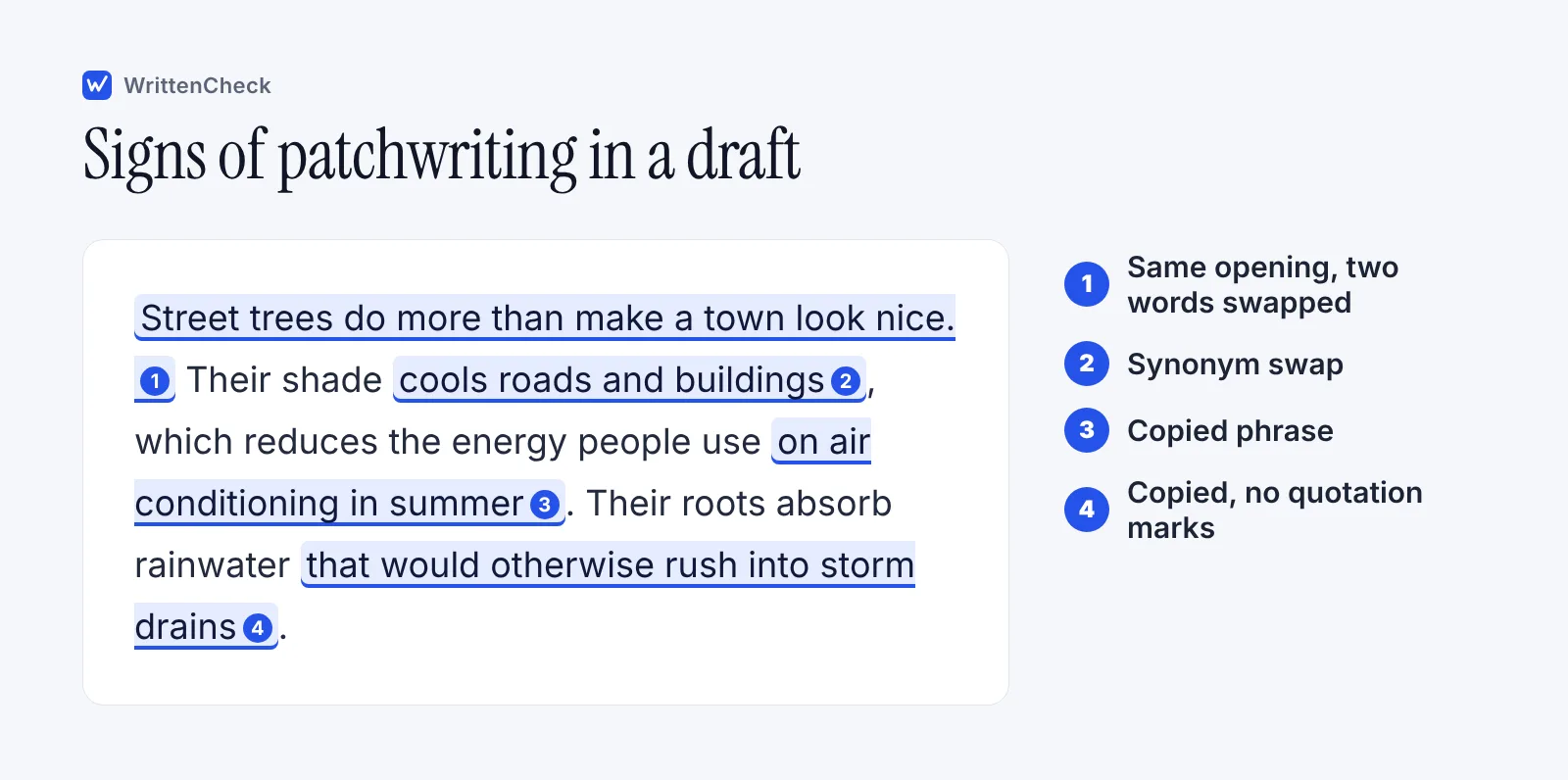
Street trees do more than make a town look nice. Their shade cools roads and buildings, which reduces the energy people use on air conditioning in summer. Their roots absorb rainwater that would otherwise rush into storm drains (Rivera, 2022).
It has a citation, but it's still patchwriting. Rebecca Moore Howard, who coined the term in 1993, described it as copying a source and then "plugging in one-for-one synonym-substitutes." The sentence order is the source's, and whole phrases are copied without quotation marks.
2. A real paraphrase (good)
Rivera (2022) argues that planting trees along streets pays off in practical ways. By shading roads and homes, trees lower what people spend on cooling in hot weather. They also ease the load on drains by absorbing rain, and their leaves filter some traffic dust from the air (p. 14).
The meaning is the same, the structure is new, and every idea is credited. Notice it leads with the point of the passage, which is how you'd use it in an essay.
3. A summary (good, for a different job)
Rivera (2022) says street trees cool cities, reduce flooding and clean the air.
Use this when you only need the main idea.
4. A short quote inside a paraphrase (good)
Rivera (2022) notes that tree roots take in rainwater "that would otherwise rush into storm drains" (p. 14), which eases pressure on city drainage.
This keeps one vivid phrase in quotation marks and puts the rest in your own words.
5. An uncited paraphrase (not acceptable)
Planting trees along streets pays off in practical ways, since shade lowers cooling costs and roots absorb rain.
The wording is original, but the idea isn't. Without a citation, it's plagiarism. Our guide to the types of plagiarism explains why.
How do you paraphrase, step by step?
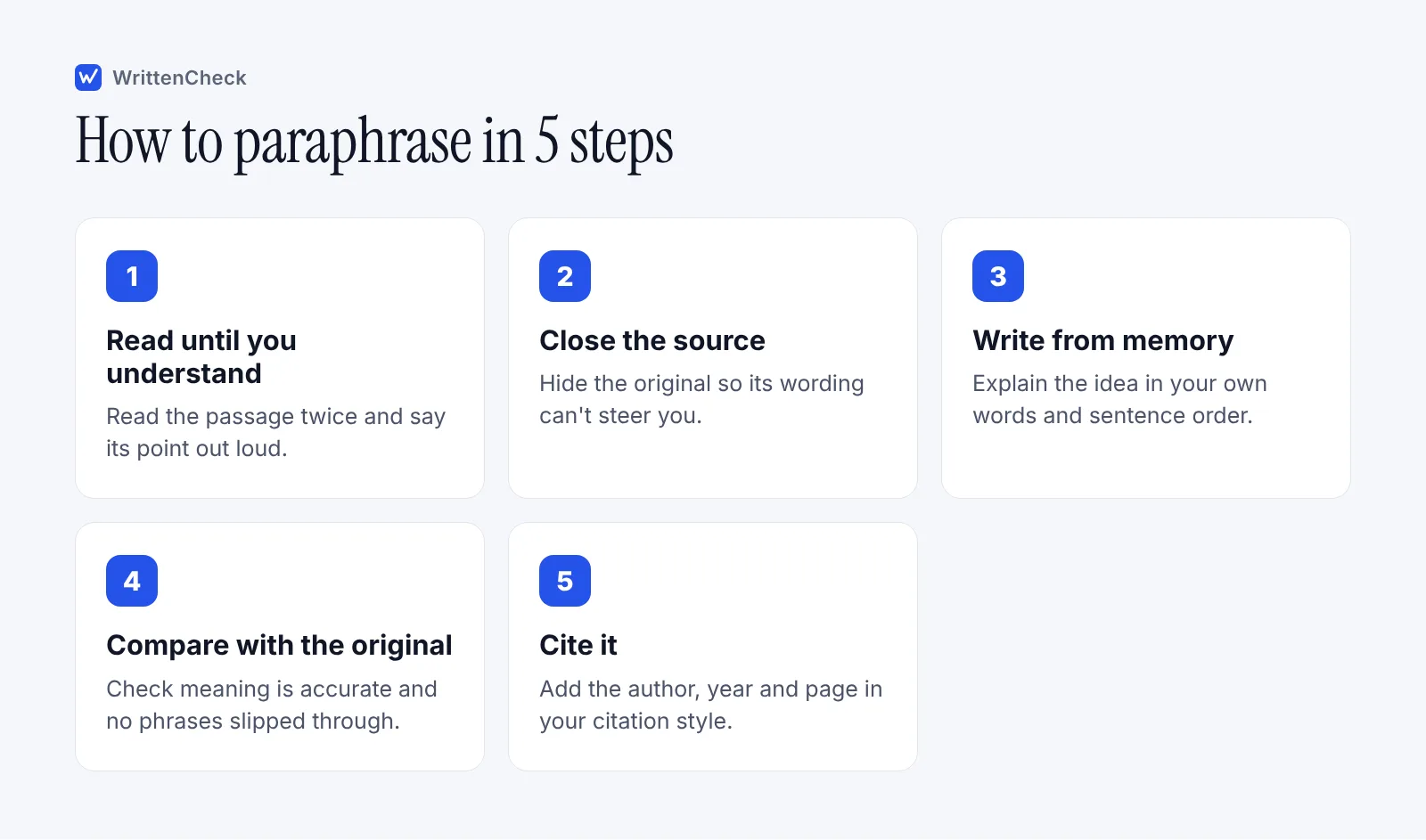
To paraphrase, understand the passage fully, set it aside, write the idea from memory in your own structure, check it against the original, and cite it. These five steps are based on Purdue OWL's six steps and the ORI guidelines.
Read until you understand. Read the passage at least twice. If you can't explain its point out loud, you're not ready to paraphrase it.
Close the source. Purdue OWL's advice is to set the original aside before writing. This one step does most of the work against patchwriting.
Write from memory. Explain the idea as if to a classmate. Start with the point that matters most for your argument, which naturally changes the structure.
Compare with the original. Check that the meaning is accurate and complete. Look for any run of three or more words that matches the source, and either rewrite it or put it in quotation marks.
Cite it. Add the author and year, plus a page number where your style asks for one. Purdue OWL suggests recording the page in your notes as you go.
How do you cite a paraphrase in APA and MLA?
Every paraphrase needs an in-text citation and a matching entry in your reference list. The format depends on your style guide.
APA (7th edition) uses author and year. A page number is encouraged but not required for paraphrases, especially when it would help a reader find the idea in a long text.
Narrative: Rivera (2022) argues that street trees lower cooling costs.
Parenthetical: Street trees lower cooling costs (Rivera, 2022, p. 14).
MLA (9th edition) uses author and page number, with no year and no comma. Purdue OWL's MLA guide shows paraphrases with page numbers too.
Narrative: Rivera argues that street trees lower cooling costs (14).
Parenthetical: Street trees lower cooling costs (Rivera 14).
The MLA Style Center says to give citations in full whenever leaving something out could make your source unclear. If a paraphrase runs across several sentences, make it obvious where it starts and ends. Naming the author at the start and citing at the end usually does it.
What are the most common paraphrasing mistakes?
Most paraphrasing problems come from staying too close to the source or forgetting the citation. Watch for these.
Writing with the source open. Your sentences start to mirror the original. Close it first.
Synonym swapping. Changing words one by one keeps the source's skeleton. That's patchwriting.
Dropping the citation. New words don't make an idea yours.
Changing the meaning. A paraphrase that says more, less or something different from the source misrepresents it. Recheck against the original.
Paraphrasing a whole page. The Utah Writing Center advises paraphrasing short passages only, and says even one page is too much. For longer material, summarize.
Working from one sentence. The Citation Project, which studied 174 first-year papers from 16 US colleges, found that 94% of citations came from just one or two sentences of a source. Reading the whole section gives you enough understanding to explain it in your own way.
Patchwriting is common. The same study found it in 52% of papers. It often shows up in drafts while a writer is still learning, so practice the steps above until they become habit.
Can you use AI tools to paraphrase?
Only if your course allows it, and you'll need to be open about it. A tool that rewrites text for you does the thinking you're meant to show, and if it swaps words while keeping the structure, it's patchwriting at speed. The idea still needs a citation to its original source either way.
If AI use is allowed, say how you used it and cite AI the way your style guide asks. Our guide on whether using AI is plagiarism covers how schools tend to see it. Paraphrasing well by hand is a skill worth building, since it's how you show you understood your reading.
Once your draft is done, you can paste it into our free AI detector to see a score for each sentence. It checks writing patterns only, so your citations still need a manual check against your reference list.
Frequently asked questions
What is paraphrasing in simple words?
Paraphrasing is saying what a source said in your own way. You keep the meaning, change both the words and the sentence structure, and give credit to the original author with a citation. It's different from copying, where the words stay the same, and from summarizing, where you shorten a long text to its main idea.
Do you need to cite a paraphrase?
Yes, always. A paraphrase uses someone else's idea, so it needs a citation even though the words are yours. The US Office of Research Integrity's guidelines say writers must identify the source when they paraphrase or summarize. In APA, include the author and year. In MLA, include the author and page number.
What is the difference between summarizing vs paraphrasing?
Summarizing condenses a whole article, chapter or section into its main points, so it's much shorter than the original. Paraphrasing restates a short passage at about the same level of detail. Both use your own words and both need citations. Use a summary for the big picture and a paraphrase for a specific point you want to use as evidence.
How many words can you keep from the original?
There's no official number. Keep subject terms that have no real alternative, like technical names. For anything distinctive, either rewrite it or put it in quotation marks. A practical check is to look for any run of three or more words that matches the source, then quote it or rephrase it.
Is changing every few words enough to paraphrase?
No. Swapping individual words while keeping the source's sentence order is called patchwriting, a term coined by Rebecca Moore Howard in 1993. Bowdoin College, for one, says it's punishable even with footnotes, because the structure and much of the wording still belong to the source. A real paraphrase changes how the idea is put together.
Should a paraphrase include a page number?
In MLA, yes, include the page when the source has page numbers. In APA 7th edition, a page number is encouraged but not required for paraphrases. Adding it helps readers find the idea in a long book or report. Recording the page in your notes as you read makes either style easy.
Sources
Paraphrasing, Purdue Online Writing Lab, Purdue University, accessed October 2026
Quoting, Paraphrasing, and Summarizing, Purdue Online Writing Lab, Purdue University, accessed October 2026
Paraphrasing and Summarizing, University Writing Center, University of Utah, accessed October 2026
Quotations, The Writing Center, University of North Carolina at Chapel Hill, accessed October 2026
28 Guidelines at a Glance on Avoiding Plagiarism, Miguel Roig, US Office of Research Integrity, accessed October 2026
Quotes vs Paraphrases (APA Citation Guide, 7th edition), Simmons University Library, updated August 2026
How do I make clear that a paraphrase is on the same page as a quotation I've given in the previous sentence?, MLA Style Center, Modern Language Association, February 2019
MLA In-Text Citations: The Basics, Purdue Online Writing Lab, accessed October 2026
The Common Types of Plagiarism, Bowdoin College, accessed October 2026
Words We're Watching: Patchwriting, Merriam-Webster, accessed October 2026
Writing from Sources, The Citation Project (Jamieson and Howard), study data 2010 to 2011


Comments